
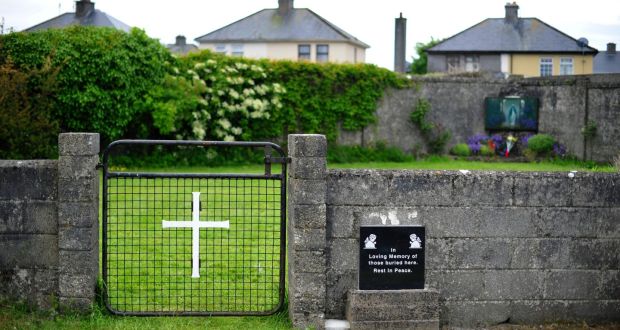
 There is something deeply disturbing, ghoulish even, in the media and political discussion of the Tuam mother and baby home.
No one, apart from a handful of
Catholic extremists, denies that conditions in the home were grim, and
that the women and children who lived and died there were gravely
wronged.
But the mawkish discussion of
Tuam, the transformation of it into fodder for tabloid outrage and
ostentatious emoting on Twitter, is an ugly spectacle.
It seems designed not to work out
what happened in the home, but to make it a symbol of evil that we
decent people might contrast ourselves against.
It’s virtue signalling – an attempt to advertise one’s own moral rectitude by poring over the depravity of bygone eras.
The most striking thing about the
handwringing over Tuam is its impatience with fact-gathering.
These Tuam
ghouls cannot wait for all the information – they have virtue to
display, and they’re damn well going to display it.
Consider how much they’ve
extrapolated from the short statement made by the Commission of
Investigation into Mother and Baby Homes.
On Friday, the commission
confirmed what many had suspected: that babies and young children were
buried in the grounds of the home.
It said “significant quantities of
human remains have been discovered” in a “long structure divided into
20 chambers”. It said the structure “appears to be related to the
treatment/containment of sewage and/or waste water”, but it has “not yet
determined if it was ever used for this purpose”.
Decorum
In short: we don’t yet know how
many of the 796 children who died at the home between 1925 and 1961 were
found in the structure; or what the structure was; or how the children
were buried – whether it was respectful or done in a more cavalier way.
And yet this hasn’t stopped tabloids from crying “Mass grave… discovered in sewage tank”, as the Irish Sun
did. It didn’t stop the writer, Donal O’Keeffe, from tweeting: “It was
all true. Every word. 796 babies dumped in a septic tank in Tuam.”
It was no barrier to Emer O’Toole outraging readers of the Guardian with the image of children “lying in that septic tank”.
Right now, as things stand, these
heated claims of 796 babies having been dumped in a sewage tank are
works of the imagination rather than proven facts.
They are intended to conjure up
images of evil nuns hurling tiny corpses in with the shit.
But there’s
nothing to show that this happened.
The number of bodies discovered
remains unknown, as do the circumstances of their burial.
Can we not
wait?
The rush to moralise about Tuam doesn’t only run ahead of facts – it seems also to run ahead of common decency.
Witness how the commission told
the media about the discovery of human remains before it told the
Coalition of Mother and Baby Home Survivors (CMABS), some of whose
members lost siblings in Tuam.
A spokesman for CMABS said it was
“shocking we [had] to learn of this news via the media”.
One can’t help feeling that the
commission’s urge to emote publicly, to display its “shock”, overrode
the traditional decorum of informing individuals of the potential
discovery of family members’ remains.
Nothing, not even basic civility,
can be allowed to stand in the way of virtue-signalling over Tuam.
Zealotry
The discussion of Tuam has been unhinged for some time.
In 2014, when researcher Catherine Corless first speculated, correctly, that children were buried at the home, a writer for the Derry Journal said: “This is our nation’s holocaust.”
Pat Flanagan at the Irish Mirror referred to it as “our own little holocaust”.
The use of the H-word is
especially disturbing.
The Holocaust was the conscious, murderous
destruction of a people.
Using it in relation to Tuam implies the nuns
killed children, casually, on a mass scale.
There’s no proof for any
such thing.
Such is the morally charged
climate around the Tuam home that anyone who keeps an open mind as to
what happened there risks being denounced as an apologist for horror.
But we must keep an open mind.
If we look calmly at what is
actually known, then it seems that while the home was an awful, tragic
place, it was not necessarily a site of insanity or evil.
That the “structure” had 20
chambers suggests it had been turned into a kind of catacomb.
That the
children buried there were “swaddled up”, as one eye-witness described
it, suggests they were not simply “dumped”.
That the discovery of the
structure in the 1970s was followed by a priestly blessing and then the
setting up of a grotto by local people suggests the town of Tuam, and
Old Ireland more broadly, was not a foul place but rather had many good people in it, concerned for the dead.
The evidence we have so far
suggests life in the home was exceptionally difficult and, of course,
utterly unjust: these women had committed no crime.
We also know the
infant mortality rate was terribly high, no doubt as a result of poverty
or institutional neglect, or both.
But a holocaust?
Babies flung in sewage?
There’s no proof.
Doesn’t proof matter?
As an atheist, I have no interest
in defending the Catholic church.
I want to defend science, rationalism,
and approach history in a measured way.
You see, this is the terrible
irony of the Tuam ghouls.
In running ahead of the facts and turning this
into a black-and-white morality play, in which they star as paragons of
decency against hellish nuns, they reveal that they share something in
common with the Old Ireland they claim to hate: a preference for moral
zealotry over reason.
Brendan O’Neill is editor of online current affairs magazine spiked