England’s new cardinal says those who are “stubbornly opposing” the
liturgical reforms of the Second Vatican Council are in danger of
adopting a position that is no longer Catholic.
Cardinal Arthur Roche, the Prefect of the Dicastery for Divine
Worship and Discipline of the Sacraments, became the third English
cardinal to be created by Pope Francis after he received his red hat
during a ceremony in St Peter’s Basilica on 27 August.
Roche was among 20 prelates admitted to the College of Cardinals,
with 16 of them under the age of 80 and eligible to vote in a future
conclave.
The former Bishop of Leeds has one of the most sensitive and
demanding jobs in the Church’s central government, requiring him to work
closely with the Pope and with the world’s bishops in overseeing
Catholic worship.
A trusted adviser to Francis, the Yorkshire-born church leader was
recently named by the Pope as a member of the Dicastery for Bishops, an
influential Vatican body which plays a critical role in helping the Pope
appoint bishops across the world. When Francis read out the names of
the latest batch of cardinals earlier in the year, Roche’s was the first
on the list.
But the 72-year-old cardinal has also been under attack himself
during a time when, as liturgy prefect, he has been closely involved in
re-establishing restrictions on
the celebrations of the old rite, the form of worship used by the
Church before the reforms mandated by the 1962-65 Vatican council. The
new restrictions have been met with a mixture of anger and defiance by
some traditionalist Catholics.
According to the new constitution of the Roman Curia,
Roche’s department is tasked with promoting the “sacred liturgy in
accordance with the renewal undertaken by the Second Vatican Council”.
It’s a point the cardinal was keen to emphasise ahead of his elevation.
“The council is the highest legislation that exists in the Church,” he told The Tablet and the National Catholic Reporter.
“If you disregard that, you are putting yourself sideways, to the edges
of the Church. You are becoming more Protestant than you are
Catholic.”
The reforms to Catholic worship decreed by Vatican II,
which emerged from a liturgical movement that dates back to the
nineteenth century, included a greater emphasis on the active
participation of ordinary believers in the liturgy and saw the
sacraments no longer only celebrated in Latin but in local languages.
“After two world wars which had been initiated in the heart of
Christian Europe, it was obvious that there needed to be an enormous
reform within the Church,” Roche said in reference to Vatican II, which
began 17 years after the end of World War II.
“That reform is taking place, but it’s a slow process because there
are those who are dragging their feet with regard to this and not only
dragging their feet but stubbornly opposing what the Church has actually
decreed. That’s a very serious matter. In the end, people have to ask
themselves: am I really a Catholic, or am I more of a Protestant?”
The pre-Vatican II liturgy requires a priest to say the prayers of the Mass in Latin, often inaudibly, while facing ad orientem (“facing east” and with his back to the people).
Although a significant minority are drawn to its contemplative,
“otherworldly” style, celebrations of the older liturgy have also become
a rallying point for dissent from the Francis pontificate and
opposition to Vatican II.
When the Pope issued his restrictions on the Old Rite, he told the bishops he
was seeking to protect the unity of the Church while ending the
suggestion there are two different churches with two different
liturgies. These restrictions were then followed up with guidelines on how to apply them by Roche’s office.
Nevertheless, supporters of the Old Rite continue to make their case
across various media platforms. Two days before the consistory to create
the new cardinals, the American actor Shia LaBeouf announced he had
been received into the Catholic Church and said that his conversion was
partly due to the older, Latin Mass.
He made his remarks in an interview with Bishop Robert Barron, the
leader of the Diocese of Winona-Rochester in the United States who
established the Catholic media ministry outfit, Word on Fire. LaBeouf,
36, who won a Bafta in 2008, said he experienced the Latin liturgy while
preparing to play St Padre Pio in a new film about the Italian saint.
He said the Latin Mass affects him deeply “because it feels like they’re
not selling me a car”.
Bishop Barron, who has more than three million followers on Facebook,
is visiting London next month when he will address an event in
Parliament, celebrate Mass at Westminster Cathedral and give a talk to a
gathering of more than 1,000 Catholic leaders. The visit, from 11-18
September, is being organised by Catholic Voices in collaboration with
Word on Fire.
In response to LaBeouf’s remarks, Cardinal Roche said it is a
priest’s job to talk to people about their experiences of the liturgy
and that he’d like to know “why he thinks that, what are his reasons for
saying that, and what is his experience”. He emphasised that the Mass
should be celebrated with “great dignity” and that this is not a trait
that only belongs to the older liturgy.
“The Latin Mass is still available in the 1962 Missal for those who
wish for that,” he said, adding that Mass celebrated in Latin in the
rite of Paul VI (post-Vatican II) should also be more readily
available.
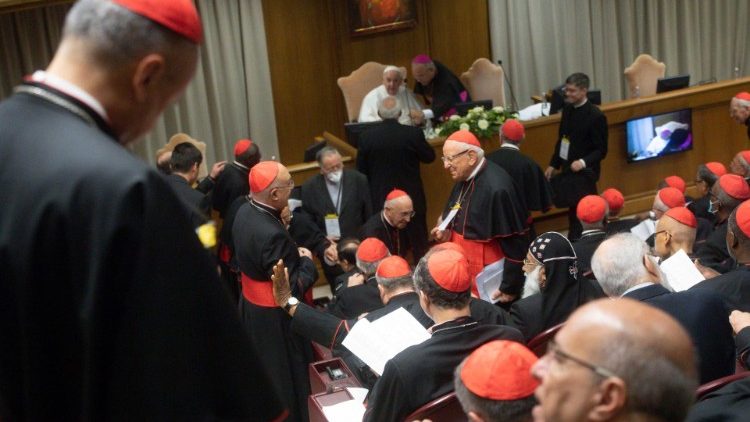
At the beginning of the consistory ceremony in St Peter’s Basilica,
Cardinal Roche addressed the Pope on behalf of the new cardinals. It is
customary for the cardinal who was named first by the Pope to carry out
this task.
“Our mission today is to help you carry this cross and not to
increase its weight. With great joy, we wish to walk at your side
knowing that to you have been entrusted the keys of the Kingdom,” Roche
said in front of a packed basilica with 180 cardinals and thousands of
pilgrims who had travelled to Rome for the consistory. “From you, Holy
Father, we learn to resist the temptation of any narrowness of mind and
heart which shrinks to the size of self instead of expanding "to the
measure of the fullness of Christ.”
Among those present in the basilica were several government
delegations sent to witness the occasion. The United Kingdom delegation
included Lord McFall, the Lord Speaker of the House of Lords and a
Catholic, and Lord Ahmad, a Foreign Office minister. Cardinal Vincent
Nichols of Westminster and several bishops from England and Wales were
also in Rome for the ceremony. After the ceremony, they greeted the new
English cardinal in the magnificent “Aula delle Benedizioni” (the Hall
of Blessings) inside the Vatican’s Apostolic Palace.
The ceremony marked the eighth consistory of the Francis pontificate
and once again showed the Pope’s desire to ensure the men who will take
part in a future papal election come from a broad cross-section of the
global Church. Over the years, he has significantly increased the number
of cardinals coming from Asia, Africa and Latin America.
On 27 August, four bishops from countries that had never had
cardinals before, including Mongolia, Paraguay, Singapore and East
Timor, were given red hats. Archbishop Anthony Poola of Hydeberad India
is the first Dalit (from the so-called “untouchable” caste) to become a
cardinal, and Dom Leonardo Steiner is the first to lead a diocese in the
Amazon rainforest. Also receiving a red hat was the world’s youngest
cardinal, Giorgio Marengo, a 48-year-old Italian missionary in Mongolia,
and the Bishop of San Diego, Robert McElroy, a bishop from the United
States who shares Francis’ pastoral priorities.
Making cardinals is the closest thing a Pope has to succession
planning, and Francis has now chosen 63 per cent of the 132 cardinal
electors. In his homily,
the Pope urged the cardinals to be attentive to the less public but
more pastoral elements of their ministry. He reminded them that Cardinal
Agostino Casaroli, the influential Cold War-era Vatican diplomat, made
weekly visits to juvenile inmates in a Rome prison and even joked about
an Italian priest who knew not only all his parishioners' names but also
the family dog.
“A man of apostolic zeal is impelled by the fire of the Spirit to be
concerned, courageously, with things great and small,” he said before
quoting the phrase: “To suffer no restriction from anything however
great, and yet to be contained in the tiniest of things, that is
divine.” This maxim was composed in 1640 as a way to describe the genius
of St Ignatius of Loyola, the founder of the Jesuits.
Cardinal Roche is now the highest-ranking English-born priest to
serve in the Roman Curia since Cardinal Rafael Merry del Val served as
the Holy See’s Secretary of State from 1903 to 1914. Roche said he felt
“very humbled” by his appointment as a cardinal and that it was an
“enormous responsibility” as it meant a “broader remit” for advising the
Pope.
He said it was a moment for Church leadership to be “more
transparent, more open” and ready to build communion. From 29 and 30
August, cardinals from across the world will gather in the Vatican to
discuss the Pope’s new constitution on the Roman Curia, which includes a
series of landmark reforms.
Cardinal Roche said the new constitution was about the “nature of the
relationship of the Pope with the bishops of the world and using his
curia to be a bridge between the two”. He said it meant “greater
collaboration at the episcopal conference level and individual bishop
level with the See of Peter” while emphasising the Church’s missionary
nature.