
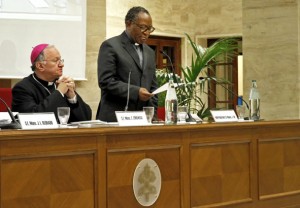
 At a November 7 press conference in Rome, the Pontifical Council for
Health Care outlined plans for a conference that will focus on the
treatment of rare and/or neglected diseases.
At a November 7 press conference in Rome, the Pontifical Council for
Health Care outlined plans for a conference that will focus on the
treatment of rare and/or neglected diseases.The World Health Organization defines a “rare” disease as one that affects, at most, one of every 2,000 people, said Msgr. Jean-Marie Munpendawatu, the secretary of the Pontifical Council.
There are thousands of such diseases, some life-threatening, and they affect about 400 million people, he said. There are also an estimated one billion people affected by “neglected” diseases, for which treatments are not readily available.
The challenge posed by these rare and neglected diseases is twofold.
First, they are frequently infectious diseases, which are most common in communities that lack proper nutrition, health care, and hygiene—in short, in impoverished societies.
Second, because they are uncommon, there is not a large market for drugs and treatments, and consequently no strong market pressure to produce such remedies.
The Vatican conference, to be held November 10-12, will bring together more than 320 people from over 50 different countries, to discuss says to reform the system of medical research, provide better care for those affected, and protect the environment.