All parishes in the Diocese of Kerry are being asked to
review their security arrangements amid concerns about break-ins and
burglaries in churches and other buildings.
Churches in
Killarney have been targeted in broad daylight over the last number of
months, including the rural Muckross Church near the Killarney National
Park with money being taken from the collection box.
Killarney
parish priest Fr Kieran O’Brien recently said rural churches are still
open each morning so people can drop in for a quiet prayer, but they are
vulnerable.
It is understood gardaí are investigating a number of incidents concerning church burglaries.
There are 53 parishes in the Diocese of Kerry — 44 in Co Kerry and nine in Co Cork.
Many parishes have two or three churches, a small number have one church, and one parish has four.
Parish
committees have been asked to review security procedures "with a view
to ensuring that reasonable precautions are in place to protect Parish
property", a spokeswoman for the diocese said.
Parishes
have been advised that valuable religious items and artifacts must be
stored away in unmarked and secure cabinets, safes, or storage rooms
when not in use.
Lighting and CCTV
They
have also been reminded that security is a requirement under the Parish
Policy of Insurance. Installation of outdoor perimeter lighting and
motion-activated lights are among the suggestions, alongside other
measures such as making sure that all doors and windows are locked when
the building is closed.
Other advice includes installing a security alarm system and the installation of CCTV systems.
The advice comes as the diocese has been left to deal with an exodus of priests due to retirements.
Bishop
of Kerry Ray Browne warned that more churches will be without weekend
Masses due to the number of priests set to hit retirement age in Kerry.
Already
15 of its 53 parishes are without priests. Currently, a "meitheal"
system operates with parishes grouped into pastoral areas and priests
operating on a rota basis to ensure churches have weekly Masses.
This
shift from a priest-dependent to people-centred Church will be
"radical".
The move is being billed as one of the most dramatic changes
the Irish Church has ever encountered, becoming "circular rather than a
top-down", in the words of one of the strategists responsible.
A fundraising effort is underway in Rathdowney after burst pipes flooded the parish church at Christmas.
Fr Martin Delaney, PP, has issued an appeal to the community to help
with fundraising to carry out repairs to the heating system at the Church of the Most Holy Trinity and its sister church in nearby Errill.
He has appealed to the community of the Rathdowney and Errill Parish after extensive problems were discovered after flooding at Christmas.
"As you may be aware, there was a major breakdown of the heating
system in Rathdowney Church on Christmas Eve last. The sanctuary area
was completely flooded on Christmas morning. The cause of the problem
was the corrosion of the underground pipe system between the boiler
house and the church itself.
"This is a problem which was probably a few years in the making and
as the insurance company concluded it was due to ‘wear and tear’ they
are not prepared to cover the cost. The full cost of the repair job is
in the region of €22,000. If we pay for this from our current account,
it will leave the account pretty much empty for all the other day-to-day
expenses," he said.
As a result, Fr Delaney appealed for help.
"Over the last few weeks, we have had a fundraising campaign to pay
for the heating repairs. There has been a very generous response from
our parishioners, but we still have not reached our target to pay for
the heating repairs.
"The church in Rathdowney is used by many people in our community
other than those who regularly attend Mass. Every year we welcome
thousands of people from our parish and beyond for funerals, weddings,
baptisms and many other occasions. We would really appreciate the
support of the wider community as we face this unexpected financial
challenge," he said.
Fr Delaney says there are envelopes for the heating system repair
fund in both Rathdowney and Errill churches.
They are also available
from the Parish Office in Rathdowney.
The
Church of England will aim to turn a £100m financial commitment into a
£1bn fund to address the legacy of slavery in order to reflect the scale
of “moral sin”.
The church should work in
partnership with other organisations to create the fund that will be
used to invest globally in black-led businesses and provide grants, says
a report from an independent group of advisers commissioned by the C of
E.
The
£100m initially earmarked by the Church Commissioners was insufficient
“relative either to the scale of the [commissioners’] endowment or to
the scale of the moral sin and crime”, it said.
The
Church Commissioners, the body that manages the C of E’s huge financial
assets, accepted the report in full. However, the commissioners are not
increasing the £100m investment but are aiming to attract co-investors
to increase the fund’s value.
Gareth
Mostyn, the chief executive of the Church Commissioners, said £100m was
the “appropriate financial commitment … at this stage” while ensuring
that they could honour existing commitment to parishes and other church
activities. The commissioners would “at some point in the future
consider whether to invest more”.
A £1bn fund would dwarf moves made by other UK institutions to address the legacy of slavery.
Justin
Welby, the archbishop of Canterbury, said the report was “the beginning
of a multi-generational response to the appalling evil of transatlantic
chattel enslavement”.
The Independent Oversight Group was set up after the C of E publicly acknowledged
its historical benefit from the international slave trade in January
2023. The origins of the C of E’s £10bn endowment fund were partly
traced to Queen Anne’s Bounty, a financial scheme established in 1704
based on transatlantic chattel slavery.
At the
time, Welby said the church must “take action to address our shameful
past” and the Church Commissioners announced a £100m fund over the
following nine years.
The
oversight group said the proposed fund was “very small compared to the
scale of racial disadvantage originating in African chattel enslavement”
and the timeline for delivery should be accelerated.
Instead,
it proposed a “fund for healing, repair and justice” with a target of
£1bn. The group said the fund should aim to attract capital from three
sources: the Church Commissioners; “other institutions once complicit in
African chattel enslavement”; and contributors who “outraged by
injustice, wish to make common cause against racial inequality”.
Among
those likely to be approached to join the initiative are pension funds,
sovereign wealth funds, ultra-high net worth individuals and
foundations.
The consequences of slavery had
“caused damage so vast it will require patient effort spanning
generations to address”, the report said.
The
fund will be black-led, and will invest in members of disadvantaged
black communities, it said. It “will aim to back the most brilliant
social entrepreneurs, educators, healthcare givers, asset managers and
historians. It will not pay cash compensation to individuals or provide
grants to government bodies.”
The report also
recommended that a “significant share” of the Church Commissioners’
extensive property portfolio “increases socioeconomic mobility across
racial lines by launching and expanding initiatives to provide
competitive and/or below-market leases to black businesses”.
It
called for a fresh apology from the C of E for “denying that black
Africans are made in the image of God and for seeking to destroy diverse
African traditional religious belief systems”.
The
Right Rev Dr Rosemarie Mallett, the bishop of Croydon and the group’s
chair, said: “No amount of money can fully atone for or fully redress
the centuries-long impact of African chattel enslavement, the effects of
which are still felt around the world today.”
The
impact of slavery persisted today, she said, and was “measurable and
apparent in everything from pregnancy and childbirth outcomes to life
chances at birth, physical and mental health, education, employment,
income, property, and the criminal justice system. We hope this
initiative is just the start and is a catalyst to encourage other
institutions to investigate their past and make a better future for
impacted communities.”
The historian and
broadcaster David Olusoga told the BBC: “I’m very pleased to see the
church recognising that it has a catalytic potential. This is an
organisation that is hugely respected around the world that can inspire
other organisations to make the same leap into their own history.”
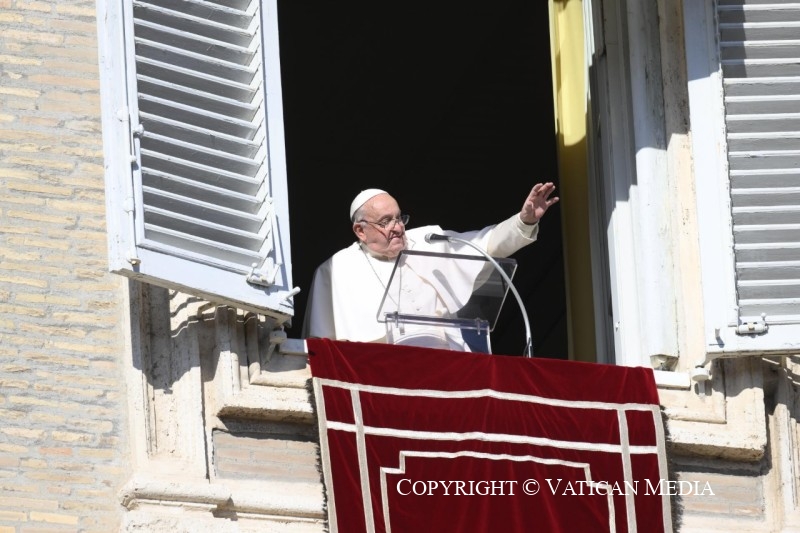
Every day Pope Francis carries a burden "in his heart", that of the "suffering of the populations in Palestine and Israel".
For their sake, after the recitation of the Angelus, the Holy Father today, the Third Sunday of Lent, spoke words to encourage the parties to negotiate an "immediate ceasefire”.
Sorrow is the leitmotif of his address, inner pain that reflects the aching caused by the lack of peace and the "thousands of dead, injured, displaced", as well as the "immense destruction".
More than 30,000 people have been killed in the Gaza Strip, according to the Hamas-run Health Ministry.
The ongoing hostilities are leading to “horrible consequences for children and the defenceless, who see their future compromised," Francis said a day after the Holy See released the Pope’s message to the world’s children in anticipation of the Church’s first-ever World Children’s Day, set for in Rome on 25-26 May.
Speaking to the crowd from the window of the Apostolic Palace, the pontiff asked: "Do you really think you can build a better world in this way?” and “Do you really think you can achieve peace?”
“Enough, please!” he said, “Let us all say: enough, please!” which sparked a long applause from a crowded and windswept St Peter's Square.
As he has done on other occasions, Francis urged the parties to work harder on negotiations "so that the hostages can be immediately freed,” adding, “Let them return to their loved ones who are anxiously waiting for them.”
Francis also reiterated the urgency for the civilian population to have "safe access" to "needed and urgent" humanitarian aid. The appeal follows the death last Thursday of 115 people near a humanitarian convoy in Gaza City.
"How many resources are being wasted on military spending, which due to the current situation sadly continues to increase,” the pontiff said.
With these words, Francis also mentioned the second International Day for Disarmament and Non-Proliferation Awareness, two days from now, expressing hope that the international community "will understand that disarmament is, first of all, a duty, [. . .] a moral duty.”
Indeed, “Let us put this in our heads. This requires courage on the part of all the members of the great family of nations."
Such courage can lead us to "move from the balance of fear to the balance of trust,” the pope explained. “There is so much pain," he noted, even in "tormented Ukraine," which should not be forgotten. Here, too, "many people die every day," he lamented.
At the end of his address, the Holy Father offered an "affectionate greeting" to the young Ukrainians invited by the Community of Sant'Egidio – whose flags were visible in St Peter’s Square – on the theme "Overcome evil with good. Prayer, the poor, peace."
"Dear young people, thank you for your commitment to those who suffer most from war," he said.
Prior to the Marian prayer, Pope Francis spoke about today's Gospel (Jn 2:13-25), in which an “angry” Jesus “does not accept that the temple-cum-marketplace replace the temple-cum-home, where the relationship with God is distant and commercial rather than close and trusting.”
In this episode, Jesus drives the merchants out of the temple, admonishing those he meets to “stop making my Father’s house a marketplace” (v. 6). Instead, the pontiff compares “home and market”, saying that they are two different ways "of placing oneself before the Lord.”
When the temple is seen as a market, all one needs to do is “buy a lamb, pay for it, and eat it." When, conversely, it is treated like a home, the "opposite" happens: “We go to meet the Lord, to be united with Him, and with our brothers and sisters.”
The main difference between the two ways is that "at the market, one looks out for one’s interests, while at home, one freely gives.” If one treats the house of God as a market, "a barrier is created between God and man and between brothers.”
With such thoughts in mind, the pope urged the faithful in this season of Lent to “Make in us and around us more home and less market.”
The first way to do this is by praying "to God”; that is, “praying a lot, as children who tirelessly knock trustingly at the door of the Father, not as greedy and distrustful merchants”.
The second is by "spreading brotherhood", which is much needed. "Think of the awkward, isolating, sometimes even hostile silence that one encounters in so many places.”
LOUTH
COUNTY COUNCIL has granted planning permission for a “state of the art”
hot dip galvanising plant on the outskirts of Drogheda that will lead
to the creation of 110 jobs.
The Council has granted planning permission to Co Meath firm,
Hibernia Steel (Manufacturing) Ltd despite a contemplative order of nuns
raising concerns that the proposed steel processing plant will
detrimentally affect the order’s essential “prayful atmosphere”.
The plant at Mell, Drogheda which involves large-scale dipping tanks, will process 36,000 tonnes of steel per annum.
The proposal faced local opposition with 60 submissions lodged with
Louth County Council and objectors now have the option of appealing the
decision to An Bord Pleanala.
The company lodged the application last May after the IDA confirmed
that it had agreed to sell, subject to contract, eight acres of land at
Mell, Drogheda to Hibernia.
The Council has granted planning after concluding that the proposed
development supports Drogheda’s role as Regional Growth Centre and will
deliver 110 jobs.
The planner in the case stated that he was satisfied the proposed
location is a suitable one to cater for the development with existing
road infrastructure in place, served by an excellent road providing
access to the M1.
In a submission, Prioress at the Dominican Contemplative Nuns, Sr M
Breda Carroll raised concerns over the plan on behalf of her order.
The Dominican Contemplative Nuns are based at the Monastery of St Catherine of Siena at The Twenties, Drogheda.
The monastery’s 8.5 acre site lies to the east of the planned steel
plant site and in the submission, Sr Breda told the Council “we are
concerned that this plant would seriously and detrimentally affect our
way of life and the present prayful atmosphere, which is essential to
us”.
Sr Breda told the planners “we live our whole life within the
confines of the monastery boundaries, a fact which heightens the
importance of this space for us”.
She added “maintaining a quiet, peaceful atmosphere in the monastery
and its surroundings is also of vital importance for many people who
avail of our retreat facilities and visit our chapel”.
Sr Breda told the Council that “we are concerned that the relative
proximity of this plant will result in noise and air pollution in our
area, especially since the prevailing winds tend to be from the west”.
The Prioress added: “We also wish to express the concern that it is
inappropriate to situate such a plant in close proximity to an area that
is set to become highly residential.”
Magdalena
Coromina tapped the hard ground with her walking stick and looked up at
a church that was meant to be underwater.
Six decades ago, when
engineers had built the reservoir in which she stood, they had flooded
the town of Sant Romà de Sau and drowned its buildings.
The rains that
slaked the region’s thirst had kept the ruins covered.
But
that world no longer exists. Struck by a drought that has dried the
reservoir to 1% of its capacity, the remains of the village have come
back into view. Crumbling stone structures now sit on cracked soil among
ashen plants. The church, whose spire used to poke above the surface
during dry spells, today stands high above the waterline.
“It
makes me so sad,” said Coromina, an 85-year-old from the nearby city of
Ripoll who came to see the ruins on an unusually warm February
afternoon. She remembered rain and snow during winters when she was a
girl. “Now? Nothing.”
Catalonia,
a rich region in the north-east of Spain, is in the grip of a drought
that is killing its crops, choking its economy and restricting the lives
of 6 million people who live under emergency measures. Scientists do
not know what role the climate crisis has played in shrinking the
region’s water supply, but they say the fight to keep taps running is
one that will sweep southern Europe as fossil fuel pollution heats it up
and dries parts of it out.
The western coasts
of the Mediterranean, in particular, will be hit by increased
evaporation, shorter rainy seasons and less mountain snow cover, said
Stefano Materia, a climate scientist at Barcelona Supercomputing Center.
In cities such as Valencia in Spain,
Marseille in France and Genoa in Italy – where industry and tourism are
already putting pressure on scarce water resources – “this will likely
increase the vulnerability”.
Catalonia
offers a glimpse of that future. At the start of February, after more
than 1,000 days of drought, the regional government extended
restrictions to cover Barcelona and other municipalities. Together with
Spain’s ecology ministry, it announced plans to invest nearly half a
billion euros in desalination plants to make salty water fit for the
tap. Officials also want to ship drinking water from wetter parts of the
country and double the aid money for emergency works on the leaky
network of pipes.
But as they wait for rain to
fall and infrastructure to improve, Catalans are divided on how to share
the water that remains. The dilemma has pitted locals, farmers and
tourists against each other as they fight over a resource that is
growing more scarce by the day.
“It’s difficult
to avoid these reactions, because when people suffer, they need to
react somehow,” said Meritxell Serret, Catalonia’s foreign minister and
former agriculture minister. “There is a lot that needs to be done – in
every sector – and we are aware that we cannot demand they do that from
one day to another.”
Farmers,
who use one-third of the water in the internal basin where most
Catalans live, face the greatest pressure to cut their consumption. The
Catalan government has ordered them to use 80% less water for irrigation
and 50% less water for livestock, while asking industry to cut water
use by 25%.
The “injustice” of the restrictions
and the effects of the drought has left farmers feeling powerless, said
Albert Grassot, the president of a local irrigation community. “It’s a
feeling of impotence, weakness and rage.”
Driving
through his rice farm near the medieval town of Pals, Grassot said the
drought weighed on his mind more than the coronavirus pandemic and the
energy crisis. If no rain falls in the next three months, he said, his
family will be unable to sow seeds for the first year since his
great-great-grandfather started farming the land.
The
effects will ripple beyond his own farm, he added. Rice paddies use
lots of water because the grain grows in flooded fields. But in Pals,
which is just 3km from the coast, the centuries-old practice helps stop
salt water from intruding inland and wreaking havoc on other crops and
ecosystems.
In
Barcelona, where public fountains are dry and beachside showers have
been shut off, the burden of drought is lighter than in the villages but
still hangs heavy over the city. Posters in subway stations warn in
stern letters that “water doesn’t fall from the sky”.
After
a previous drought struck Barcelona in 2008, the city invested in
recycling wastewater, desalinating seawater and persuading citizens to
save more drinking water. Its efforts have increased supply and brought
the city’s demand for water down to some of the lowest levels in Europe.
Alexander
Ross, a geographer at Portland State University who has co-written a
book on water politics in cities across the world, said Barcelona had
been leading the way in many regards but that its ambitions still fell
short of what was needed. “When even Barcelona is experiencing this kind
of crisis – given its policies – it shows the rest of the world that
it’s time to act,” he said.
Activists
complain the government has been unwilling to crack down on tourists,
who come for the hottest months of the year and on average use more than
twice as much water as locals. Barcelona welcomed 10 million
holidaymakers in 2022 – making it one of the most-visited cities in
Europe – and the sector makes up 12% of the Catalan economy.
But
hotels are starting to feel the heat. In the beachside party town of
Lloret de Mar, a group of owners have asked the Catalan government for
permission to buy a mobile desalination plant to avoid restrictions on
their swimming pools. If they cannot fill them ahead of summer, they
fear visitor numbers may plummet.
Over the next few days and weeks, the results of an in-depth investigation will be published here without fear or favour. What is this organisation? Who are its members? Why has it got a paedophile protector in its ranks? Why
is this paedophile protector registered as a State Solemniser by the
Registrar General despite the information being widely available? Who is responsible for attempting to have this information quashed? Why has this not been exposed before now? These
questions will be answered with the evidence to back it up over the
next while and all published posts will be re-published time and time
again if they are removed!! We will NOT be silenced this time!!
Senior Belgian bishops faced a hostile reception at a
national commission on abuse in the Church, where federal deputies
expressed disbelief at their apologies.
The meeting became so tense that the Bishop of Antwerp
Johan Bonny riposted he was tired of hearing so much criticism of the
Church when it had introduced far more reforms than public entities.
Bishop Bonny joined the Archbishop of Brussels Luc
Terlinden and other prelates to apologise once again for the abuse and
tried to explain how the Church responded to the scandal since it broke
in 2010.
“We heard that 12, 13 years ago,” responded one deputy
who was part of an earlier inquiry formed after the Bishop of Ghent
Roger Vangheluwe admitted to abusing two nephews.
When the Bishop of Limburg Patrick Hoogmartens said he
had learned much from meeting victims, another deputy asked: “Did you
really need a learning process to find sexual abuse terrible?”
A third said the bishops always found excuses such as “I
couldn't do anything about it, it wasn't my diocese, it was the Pope’s
[responsibility], etc.”
When the former Bishop of Ghent Luc Van Looy denied
discreetly moving predator priests, another deputy challenged him: “Then
what did you do with paedo-priest Luk Delft?”
After abusing in Belgium, Delft was sent to the Central African Republic, where he was accused of raping a minor.
Van Looy said that was a matter for Delft’s Salesian order, a distinction the deputies did not seem to understand.
“If this parliament wants to remain a credible partner
for us – and we hope it does – then it must also investigate where it
itself has fallen short in the follow-up to the previous committee,”
Bonny said.
He suggested the Church’s central information office for
abuse victims should provide a model for an office for all Belgium’s
abuse victims, where they could find advice and help. The Church was
ready to help finance this, he said.
Bonny later told Flemish television he wanted an office
in Antwerp where all abuse victims could come for help. He said he had
written to Pope Francis in September asking to step down from his
diocesan responsibilities in Antwerp to dedicate his time to dealing with abuse victims.
“I am ready to do anything, even if it means that I have
to put aside my task in Antwerp to work for the victims,” he said.
The Holy
Lance, also known as the Lance of Longinus, holds a significant place in
Christian tradition as the weapon believed to have pierced the side of
Jesus during his crucifixion.
Tradition holds that the Vatican’s St.
Peter’s Basilica has the jealous custody of a relic that is part of the
Holy Lance.
The Gospel of John provides the
sole biblical reference to this event, recounting that a Roman soldier
named Longinus, on the eve of the Sabbath, ensured Jesus’ death by
piercing him in the side with a lance.
This act, as described in John
19:34, has sparked centuries of reverence and fascination across Europe
and inside the Vatican.
A soldier of faith
The story of St. Longinus has
evolved into various local legends, contributing to the rich tapestry of
Christianity. The city of Lanciano in the Abruzzo region asserts itself
as his birthplace, claiming that his martyrdom occurred there.
Conversely, Mantua in Lombardy contends that Longinus preached in the
area, was martyred there, and brought relics of the Lord’s precious
blood and the sponge used during the Passion to the city’s Basilica of
St. Andrew.
The diverse narratives surrounding
St. Longinus highlight the widespread devotion and the impact of his
acts recorded in the Gospel of St. John and in legends that go beyond
the scriptural tradition.
Liturgical commemoration
The feast of St. Longinus was
historically celebrated on March 15. The Roman Martyrology, however,
mentions the saint on Oct. 16 without any mention of martyrdom.
The
entry states: “At Jerusalem, the commemoration of St. Longinus, who is
venerated as the soldier opening the side of the crucified Lord with a
lance.”
Inside the Vatican
The statue of St. Longinus,
sculpted by Gian Lorenzo Bernini and housed in St. Peter’s Basilica,
stands as a testament to his role in Christian history. The statue is
one of four statues standing in the pillars’ niches supporting
Michelangelo’s dome.
In the Vatican, a special ceremony
takes place in St. Peter’s Basilica during the first week of Lent. On
the eve of the second Sunday of Lent — this year on Feb. 24 — the canons
of St. Peter’s Basilica gather with the archpriest of the basilica,
presently Monsignor Mauro Gambetti, and with concelebrating priests and
the other ministers.
They process to the high altar, presently under
restoration, which marks the tomb of St. Peter. At the foot of the altar
they meet the faithful, who are waiting for the liturgy to begin.
The celebrant begins with the
opening prayer and incenses the procession cross, which bears the corpus
of Christ. The choir sings the Litany of the Saints until the
intonation of “St. Peter, pray for us” — sung three times in honor of
the “station,” which is kept on this day in Lent. (Each day during Lent,
the local Church of Rome pilgrimages to a different tomb of a martyr,
called the Roman Station Church pilgrim itinerary.)
After the third intonation to St.
Peter, the altar servers behind the crossbearer lead the procession.
They are followed by the concelebrating priests, the canons, and the
celebrant. The procession goes down the nave of the basilica. Those
present, the nuns and faithful alike, join in the procession, continuing
to sing the Litany of the Saints. The procession continues through the
basilica, culminating in the area of the altar of the chair for the holy
Mass.
Another procession
After the Mass, a special moment
unfolds as the ministers and servers process around the high altar as
the choir sings the “Stabat Mater.”
The following antiphon is also sung
in Latin: “Unus militum lancea latus eius aperuit et continuo exivit
sanguis et aqua,” the translation of which is: “One of the soldiers
opened his side with a spear, and immediately there flowed out blood and
water.”
Due to the work on the baldacchino
of St. Peter’s, the procession this year continues around the canopy of
the altar and pauses in front of the statue of St. Andrew. The clerics
take off their head coverings, miters and birettas, and face the chapel
above the statue of St. Veronica.
A prayer is said by the canon who is
about to expose the relic of the Holy Lance. He then goes to fetch the
relic accompanied by two additional canons.
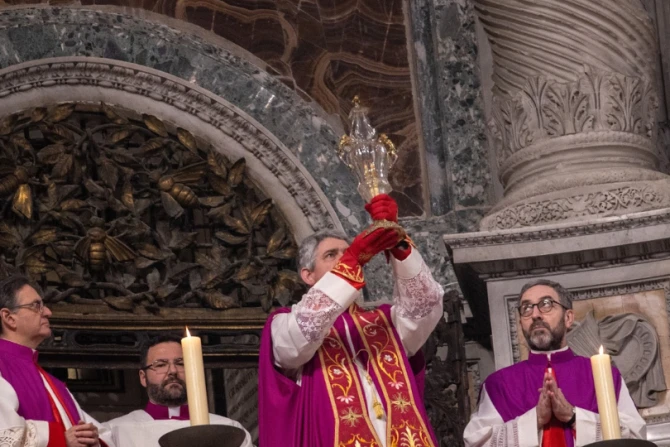
The bells begin to ring. Slowly,
three canons exit the chapel onto the loggia, and one with red gloves
carries the relic of the lance of St. Longinus.
The canon, accompanied
by the other two, proceeds to show the relic in all directions for the
veneration of those present while the thurifer incenses the relic from
down below.
The relic is shown from the center
of the loggia, then to its left and its right, and back to the center to
elevate the relic especially for one last glimpse.
The bells sound one more time as
the relic is processed back into its chapel — finally, the ministers of
the Mass process to the sacristy of the basilica. Thus, the station
liturgy is done.
A Lenten example
According to tradition, Longinus
not only witnessed the crucifixion but also was healed of a malady of
the eyes by the blood that flowed from Jesus’ side. He is also said to
be the centurion who said: “Truly, this man was the Son of God” (Mt
27:54).
In the intricate tapestry of Roman
tradition, the Holy Lance and the figure of St. Longinus stand as
symbols of devotion, sacrifice, and healing.
The biblical reference in
the Gospel of John, coupled with centuries of veneration, has woven a
narrative that forms the very fabric of the Lenten experience in the
local Church of the Diocese of Rome and the spirituality of St. Peter’s
Basilica.
The Holy Lance continues to
captivate hearts and minds, inviting believers to contemplate the
profound significance of Christ’s sacrifice on the cross and to say with
St. Longinus: “Truly, this man was the Son of God.”
The
Archdiocese of Toledo, Spain, has demanded that two priests apologize
for comments they made “that harm the communion of the Church and
scandalize the people of God.”
The priests had asked the viewers of their YouTube program to pray that Pope Francis “can go to heaven as soon as possible.”
In a statement posted on its
website, the archdiocese expressed its “profound rejection of any
manifestation of disaffection toward the person and ministry of the Holy
Father.”
The Archdiocese of Toledo also
stated that it was “not responsible at all for the statements made” by
the priests on the YouTube channel “La Sacristía de la Vendée” (“The Sacristy of the Vendée”), where the controversial comments were made.
The Vendée is a region on the country’s west coast that resisted the French Revolution of
1789–1799. Most of its priests refused to take the oath affirming the
Civil Constitution of the Clergy, which effectively subordinated the
French Catholic Church to the revolutionary government. A bloody civil
war ensued, which the Vendeans lost.
The statement of the Archdiocese of
Toledo, the primatial see of Spain, stressed that the priests’ remarks
“do not in any way [speak for] this particular Church. We reiterate and
reaffirm the calls for effective and affective communion with the
Successor of Peter that both the archbishop and his auxiliary bishop
have made on various occasions.”
The statement noted that “other
corrective measures are not excluded with respect to those who are
called to be ministers of Christ at the service of the unity and
evangelical life in the Church, avoiding any conduct that is contrary to
their state.”
“We appreciate the work and
dedication that has always distinguished the diocesan presbytery to
promote communion and affection for the Successor of Peter with the holy
people of God on their journey in Toledo,” the statement concluded.
What is ‘La Sacristía de la Vendée’?
“La Sacristía de la Vendée” is a
YouTube channel that once a week broadcasts, among other content, a
“counterrevolutionary gathering of priests” in which several priests
from different dioceses participate.
The priests who usually take part
are Father Gabriel Calvo Zarraute, Father Francisco José Delgado, and
Father Rodrigo Menéndez Piñar, all from the Archdiocese of Toledo in
Spain; Father Juan Manuel Góngora from the Diocese of Almería, Spain;
Father Roylan Recio from the Diocese of Colorado Springs, Colorado; and
Father Francisco Torres from the Diocese of Plasencia, Spain.
The words that provoked the public
reaction of the Archdiocese of Toledo were spoken at the beginning of
the Feb. 22 broadcast of the program, coinciding with the feast of the
Chair of St. Peter.
In that presentation, Delgado
referenced the feast of the Chair of St. Peter, stating that this was a
day “to pray for the Petrine office of the Successor of Peter.” Góngora,
in his initial greeting, encouraged on the occasion of that feast that
viewers be “united in truth and fidelity to the Holy Father and praying
for him, for his person and intentions.”
In his presentation, Calvo added:
“I also pray a lot for the pope, so that he can go to heaven as soon as
possible,” to which Delgado added: “It’s one of the things you can pray
for anyone.”
Next, Father Charles Murr, an
American priest invited to the video gathering, was introduced and said
that he joined with “Father Gabriel Calvo’s prayers for the Holy
Father,” to which Calvo replied: “There are many of us with that
intention.” It was then that Delgado added: “Well, perhaps we’ll be
praying harder.”
Before each episode, the broadcast
explicitly states that “the participants in this program submit in
everything to the judgment of the ecclesiastical authority” and express
“their total adherence to the teachings of the Catholic Church.”
There is also a disclaimer: “The
opinions expressed in this program are the exclusive responsibility of
those who make them and do not necessarily represent the [position] of
‘La Sacristía de la Vendée.’”
Priests apologize for ‘comment in bad taste’
On Feb. 28, “La Sacristía de la Vendée”posted
a statement on X in which its members said that “we’re sorry for the
unfortunate comment said in jest about ‘praying for the pope to go to
heaven as soon as possible.’ It was a comment in bad taste and although
it does not express the wish for the pope to die, as some media have
maliciously spread about, we understand that it can be understood that
way.”
In their statement they expressed
their “adherence to Pope Francis, in the same terms in which it was
clearly expressed in the program of last Feb. 15. We reject attacks
against the pope and the unity of the Church and those who deny the
legitimacy of the pope’s ministry.”
At the same time, the statement’s
signatories pointedly refused to apologize “to those who pharisaically
take advantage of our mistake to attack our entire message.”
In conclusion, the priests
regretted “the problems caused to our respective dioceses due to the
coordinated protests that came in due to our actions. It would not be a
bad thing for those who appreciate our work to express, if they see fit,
their support. Long live Christ the King!”
In a statement issued on Friday 1 March, the Patriarchs and Heads of
Churches in Jerusalem have joined the international community in
condemning the "wanton attack against innocent civilians" that took
place the previous day in Gaza City during the distribution of
humanitarian aid.
On Thursday 29 February, a doctor from al-Chifa hospital and
witnesses said that Israeli soldiers fired on a crowd of civilians
desperately seeking food aid being distributed from aid trucks in Gaza
City in the north of the Palestinian enclave.
The latest death toll
stands at 112 with 760 injured, according to the Hamas health ministry.
The United States, a staunch ally of Israel, demanded "answers" from
Benjamin Netanyahu's government following Thursday's slaughter calling
for a "thorough investigation."
A lasting ceasefire
The representatives of the Churches in Jerusalem "call for the
warring parties to reach an immediate and lengthy ceasefire that allows
for the speedy disbursement of relief supplies throughout the Gaza
strip, and for the enactment of a negotiated release of those held as
captives and prisoners."
They also denounced the denial of
responsibility for this violent act by Israeli army spokespersons and
attempts to blame the victims.
In sending their thoughts to all the "innocents suffering from the
war," the statement offered "special prayers of support to the Christian
communities in Gaza under our pastoral care."
These include the 800
Christians who have taken refuge for the past five months in the
Orthodox Church of Saint Porphyrios and the Catholic Church of the Holy
Family in Gaza City.
"We likewise extend these same expressions of
solidarity to the intrepid staff and volunteers of the Anglican-run Ahli
Hospital, and to the patients they serve," the statement adds.
Prayers for peace
In conclusion, the Church leaders expressed their ultimate hope for
an end to the violence, the release of captives, and care for the
victims can "open a horizon for serious diplomatic discussions that
finally lead to a just and lasting peace here in the land where our Lord
Jesus Christ first took up his cross on our behalf."
They pray that God
"may grant us all his grace as we seek the fulfilment of this hopeful
Easter vision."
A new document reported to be from an unidentified Catholic cardinal
says the next pope must work to heal a “Church more fractured than at
any time in her recent history.”
The document called “The Vatican Tomorrow” appearing in the Daily Compass,
a conservative Catholic website, under the name Demos II, a reference
to the 2022 letter by “Demos” – later revealed to be the Australian
Cardinal George Pell, who died last year – which criticized aspects of
the pontificate of Pope Francis.
Although Demos II praised Francis’s compassion toward the weak,
outreach to the poor and marginalized, concern for the dignity of
creation, and efforts to accompany the suffering and alienated in their
burdens, it accused the pontiff of having an autocratic and “at times
seemingly vindictive” style of governance.
It accused Francis of carelessness in matters of law; an intolerance
for disagreement; and a pattern of ambiguity in matters of faith and
morals.
“Confusion breeds division and conflict. It undermines confidence in
the Word of God. It weakens evangelical witness. And the result today is
a Church more fractured than at any time in her recent history,” Demos
II writes.
The unnamed cardinal offers seven “practical observations” for the next pontiff.
First, he says real authority is damaged by authoritarian means in
its exercise, emphasizing the pope “is not an autocrat.” He cannot
change Church doctrine, and he must not invent or alter the Church’s
discipline arbitrarily. “A new Pope must restore the hermeneutic of
continuity in Catholic life and reassert Vatican II’s understanding of
the papacy’s proper role,” Demos II writes.
Second, he says just as the Church is not an autocracy, “neither is
she a democracy,” adding the popes “have no authority” to refashion
Church’s teachings “to fit more comfortably with the world.”
Third, Demos II says ambiguity is neither evangelical nor welcoming.
“Rather, it breeds doubt and feeds schismatic impulses,” he says.
Fourth, the cardinal emphasizes the Catholic Church is also a
community of law, and accuses Francis of having “excessive reliance on
the motu proprio as a tool for governance and a general carelessness and distaste for canonical detail.”
Fifth, he says the Church can never be reduced to “a system of
flexible ethics or sociological analysis and remodeling to fit the
instincts and appetites (and sexual confusions) of an age,” and adds
that one of the key flaws” of Francis’s rule is “its retreat from a
convincing ‘theology of the body’” – the theological philosophy
developed by Pope St. John Paul II.
Sixth, Demos II said the global travel of a pope should be reduced,
claiming the Church in Italy and throughout Europe is in crisis, and the
next pontiff needs to offer his “presence, direct attention, and
personal engagement.”
Seventh and finally, the document says Francis has “failed to bring
cardinals together in regular consistories designed to foster genuine
collegiality and trust among brothers,” and in the future, if the
college is to serve its purposes, “the cardinals who inhabit it need
more than a red zucchetto and a ring.”
“Today’s College of Cardinals should be proactive about getting to
know each other to better understand their particular views regarding
the Church, their local church situations, and their personalities –
which impact their consideration of the next pope,” Demos II says.
“The Vatican Tomorrow” is the latest document trying to influence the
election of the next pope. Francis turned 87 in December and has
suffered minor health problems in the past year.
Interestingly, the text doesn’t touch on the Latin Mass, a major
issue supported by the most conservative members of the clergy. It also
doesn’t discuss the papal response to clerical abuse, which has
dominated the press stories on the Vatican for the past few years.
It is predicted the next conclave could pit conservative cardinals –
more inclined to the style of Francis’s predecessors Pope St. John Paul
II and Pope Benedict XVI – could try to reverse the more liberal style
of Francis, who has appointed the vast majority of the current cardinals
eligible to vote for his successor.
Both the more conservative and more liberal cardinals have quietly
been speaking to each among themselves about what they want from the
next pope.
In his document, Demos II says he has not disclosed his real name
because “candor is not welcome, and its consequences can be unpleasant”
under the present pontificate, “despite synodality’s decentralizing
claims, among other things.”
However, traditionally cardinals are not supposed to discuss who they
want as a successor of the present pope until after he has died – a
practice more honored in the breach, especially in a pontiff’s later
years.
It seems that the Order of Marian Apostles (OMA) has got itself a new member but one has to wonder what they are letting through the door after taking a read of this little article....
Self-appointed 'priest' Hal Somerville, is selling cancer cures at €100 a
time. The Sligo-based self proclaimed healer is claiming he can treat
terminally ill cancer patients and give them an 'extra five' years of
pain-free life.
According to the Mail on Sunday,
Somerville holds 'clinics' throughout Ireland and the UK and at his
impressive home and headquarters, The Granery, Kilmactranny, Dromore,
County Sligo.
He had come to the attention of local media last
year and it would appear that the publicity-shy 'healer' is now
promoting his 'powers' through the internet.
He claims membership of the Order of Marian Apostles (OMA) an 'order' not recognised by the Catholic Church.
A trawl by SLIGO TODAY, discovered that Somerville's Sligo address is the contact address and headquarters for the OMA.
He
claims that his 'power to heal and relieve pain' is 'a gift from our
Lord Jesus Christ'. The Derry-born claims on the internet that he has a
95pc success rate.
His website states that 'Hal administers the gift of
healing by placing his right hand on the most painful or afflicted area
of his patient's body whilst praying that he may accept their pain'.
The
'donation' or 'contribution' requested and expected from each 'patient
is €100 which he says is to cover his expenses and claims to have only
€5,000 left to live on after his expenses of €17,000 are paid.
Dubious
online testimonials by anonymous and uncontactable 'patients' thank him
profusely for curing them of cancer, depression, stomach ulcers,
anxiety, gangrene and a host of other ailments. He does admit that he
has no scientific evidence to support his 'cures', and that none of them
can be verified by doctors or scientists.
Reputable cancer
doctors and consultants have, in the past, warned of such hopes being
offered by 'healers' and condemned them as heartless opportunists
praying on the weak and desperate patients seeking to extend their
lives.
Pope Francis’ prayer intention for the month of March is for the martyrs of our day and witnesses to Christ.
“This month, I want to tell you a
story that is a reflection of the Church today. It is the story of a
little-known witness of faith,” Pope Francis stated in a video released
Feb. 27.
“Visiting a refugee camp in Lesbos,
a man told me, ‘Father, I am Muslim. My wife was Christian. Terrorists
came to our place, looked at us and asked what our religion was. They
approached my wife with a crucifix and told her to throw it on the
ground. She didn’t do it, and they slit her throat in front of me.’
That’s what happened.”
The Holy Father added, “I know he
held no grudges. He was focused on his wife’s example of love, a love
for Christ that led her to accept, and to be faithful to the point of
death.”
He reminded the faithful that “there will always be martyrs among us” and that it is a “sign that we’re on the right path.”
“A person who knows told me there are more martyrs today than at the beginning of Christianity,” he explained.
“The courage of the martyrs, the witness of the martyrs, is a blessing for everyone.”
Pope Francis concluded with a
prayer: “Let us pray that those who risk their lives for the Gospel in
various parts of the world might imbue the Church with their courage and
missionary drive. And to be open to the grace of martyrdom.”
Pope Francis’ prayer video is promoted by the Pope’s Worldwide Prayer Network, which raises awareness of monthly papal prayer intentions.