Wednesday, November 01, 2023

Vatican, Iranian foreign ministers discuss Israel-Hamas war amid risk of wider conflict

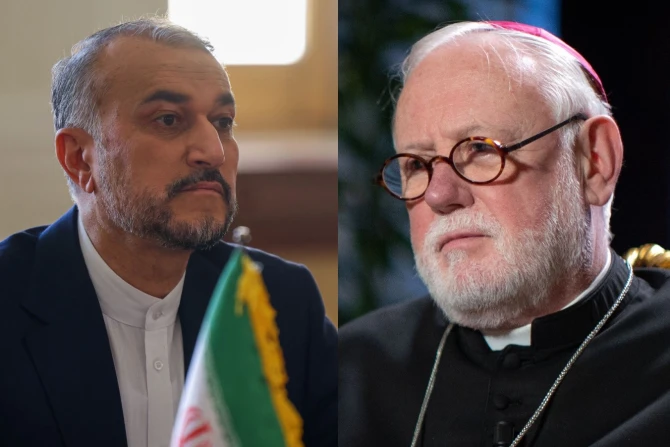
Hossein Amir-Abdollahian Archbishop Paul Gallagher

Vatican foreign minister Archbishop Paul Gallagher spoke by phone with his counterpart in Iran on Monday morning regarding the ongoing Israel-Hamas war, according to the Holy See.

The Vatican said the talk on Oct. 30, which comes amid fears that Iran may expand the conflict in the region, was requested by Iran’s minister of foreign affairs, Hossein Amir-Abdollahian.

“In the conversation, Archbishop Gallagher expressed the Holy See’s serious concern for what is happening in Israel and Palestine, reiterating the absolute need to avoid spreading the conflict and to come to a two-state solution for a stable and lasting peace in the Middle East,” Holy See Press Office Director Matteo Bruni said in a press release. 

Earlier this month, Amir-Abdollahian warned of a further escalation in the Middle East if Israel does not halt its strikes on Gaza.

If “measures aimed at immediately stopping the Israeli attacks” fail, “it is highly probable that many other fronts will be opened,” the Iranian foreign minister told Al Jazeera on Oct. 15. “This option is not ruled out, and this is becoming increasingly more probable.”

Iran’s president, Ebrahim Raisi, said on Sunday that Israel’s offensive in Gaza had “crossed the red lines” and “may force everyone to take action,” CNN reported.

“Washington asks us to not do anything, but they keep giving widespread support to Israel,” Raisi warned in a post on social media. 

U.S. National Security Adviser Jake Sullivan told CBS on Sunday that officials are seeing “an elevated risk of this conflict spreading to other parts of the region.”

Iran’s hostility toward Israel goes back more than 40 years, with a proxy conflict having been waged between the two Middle Eastern countries for decades.

The war between Israel and Hamas has reached unprecedented death tolls in the history of Israeli-Palestinian violence.

The Oct. 7 attack by the Sunni Islamist political and military organization Hamas killed 1,400 people, mainly civilians, according to Israeli authorities.

According to the Hamas-controlled Gaza Health Ministry, Israel’s counter campaign after the attack has led to a death toll of more than 8,000 Palestinians, mostly women and minors.

The Holy See supports a two-state solution for Israel and Palestine.

On Oct. 27, Pope Francis held a Eucharistic adoration prayer vigil for peace amid the ongoing Israel-Hamas war in the Holy Land.

Invoking the Virgin Mary as the Queen of Peace and Mother of Mercy, the pope implored her to “intercede for our world in danger and turmoil” and to “convert those who fuel and foment conflicts.”
Assault at San Francisco Catholic church leads to police pursuit, reported pipe bomb

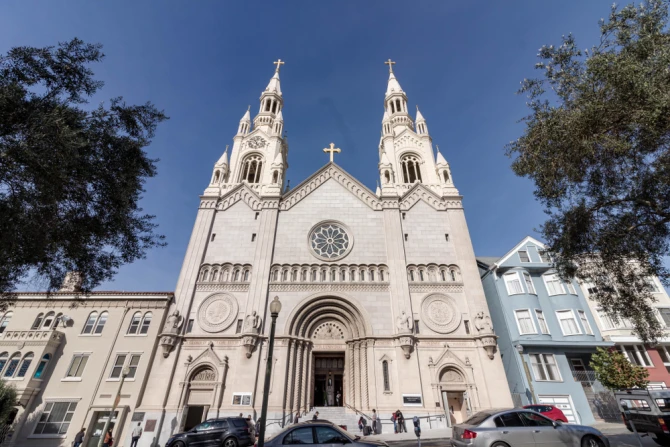
Sts. Peter and Paul Church in North Beach, California

An assault at a San Francisco Catholic church on Sunday led to a police pursuit that reportedly included the possible use of a pipe bomb.

The San Francisco Police Officers Association (SFPOA), a local police union, said on X on Sunday evening that there had been an “assault at Sts. Peter and Paul Church in North Beach.”

“Responding officers encountered a suspect with an improvised device,” the SFPOA said. “A pursuit occurred.” The suspect was subsequently “apprehended by [the San Francisco Police Department] in another county.”

Archdiocesan spokesman Peter Marlow told CNA on Monday that the incident began after an individual received Communion but did not consume the host.

“It was a person that went up to receive Communion at the 5 p.m Mass and then didn’t consume the consecrated host,” Marlow said. “He left without consuming.”

“There was a visiting person [also in attendance] who stood up and confronted the person and told him, ‘You can’t leave the church without consuming the host,’” Marlow said. “And the guy went off and punched him and ran out of the church.” 

“The gentleman who got punched, I was told, was not in serious condition,” Marlow added. “He just took a punch and was treated by the paramedics.”

It was unclear at press time what happened to the Host.

City Supervisor Aaron Peskin told the San Francisco Standard that police said the man “set off a pipe bomb” during the pursuit incident before subsequently igniting a “Molotov cocktail.” There were no serious injuries, Peskin told the outlet.

The SFPOA included in its X post a photograph of an “improvised device” said to have ignited on a city sidewalk or street.

A spokesperson for the San Francisco Police Department could not be reached for comment before publication Monday.

Sts. Peter and Paul Church says on its website that it is run by the Salesians of Don Bosco of the Western United States.

The present church structure on Filbert Street was constructed in 1924 after the 1906 earthquake destroyed the original structure, according to the parish’s website.

‘This is dangerous stuff’: UK university offers course on ‘occult science’

Welcome > The Centre for Magic and Esotericism

Next fall, a university in the United Kingdom will be offering a graduate degree in occultism and magic, a program of study that will reportedly be the nation’s first master’s degree of its kind. 

Students who enroll in the University of Exeter’s M.A. in “magic and occult science” program will study topics including “magic in Greece and Rome, occult texts in Judaism, Christianity, and Islam, the history of witchcraft, magic in literature and folklore, deception and illusion, and the history of science and medicine,” among other topics, according to the program description.

Research will be conducted on sources for “rites and rituals, meanings of belief, Westcountry witchcraft and folklore, along with ancient and Arabic sources,” the description says.

At the “core” of the coursework are the themes of “decolonization, the exploration of alternative epistemologies, feminism, and anti-racism,” it says.

The university did not immediately respond to a request for comment on the course, including how much criticism it has received over the controversial offerings, nor did Emily Selove, the director of the program.

Monsignor Stephen Rossetti, a priest and exorcist in the Archdiocese of Washington, told CNA on Monday via phone: “I can understand studying these sorts of things, but the question is, do people realize the reality is that this is dangerous stuff?”

“The problem with these courses is that people say, ‘Well, we’re studying this. There’s nothing wrong with it.’ And then the course encourages people to get into it,” the priest said.

“If you talk to some people who have been in the occult and gotten out, they’ll tell you how horrible their experience was,” he said. “You can study hell if you want, which is fine, but you don’t want to go there. And it’s the same thing with magic.”

Graduates of the program can go on to lead spiritual retreats, work in museums, or stay in academia, Selove told the New York Times this month.

Selove, who spoke at a conference for occultists in October, told the Times that there have already been hundreds of students interested in the degree. “A number” of applicants for the degree have been from China, another of the school’s professors told NPR.

“If we are looking for truly new and creative solutions to the problems that we as a society face, then we need to be honest and courageous about the fact that some of our tried and true methodologies do have a limit,” Selove told the Times.

“Let’s cautiously and responsibly try some new or some old ideas that we’ve thrown out,” she added.

Rossetti, meanwhile, said that his concern is that enrollees in the course will begin engaging in occult practices after learning about them out of curiosity, adding that “actions have consequences.”

“So I think it’s a dangerous thing when you just sort of dabble in these things with no awareness of what you’re really getting into,” he said.

He added that he suspects the school has included “these alternative spiritualities in the name of diversity.” 

“But diversity does not mean promoting evil … and witchcraft is by its nature very evil,” he said.

“And frankly, the way one protects oneself from the evil one is by living a holy and a good Christian, Catholic life,” the priest said. 

“And I’m sure one of the screening factors for entering the course is not whether you’re living a holy life. So if you got a bunch of people who are not living a holy life, and they’re starting to dabble and look into the occult and evil, it will have a special ability to hurt you,” he said.

Latin patriarch of Jerusalem reconsecrates Holy Land to Our Lady, Queen of Palestine

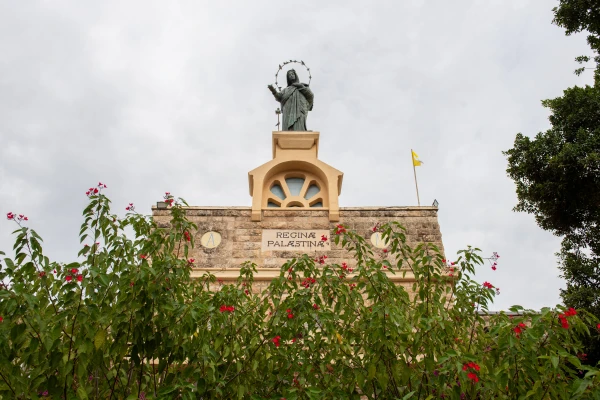
On Sunday, Oct. 29, 2023, the Catholic Church in the Holy Land celebrated the feast day of Our Lady, Queen of Palestine and the Holy Land at the shrine dedicated to Her at Deir Rafat. Above the shrine stands a large bronze statue of Our Lady with her right hand extended over Palestine, her homeland, as a sign of protection. Credit: Marinella Bandini

For the first time since the outbreak of the war between Israel and Hamas on Oct. 7, the Catholic Church of the Holy Land gathered around its patriarch on the feast day of Our Lady, Queen of Palestine and the Holy Land and reconsecrated the local Church and the entire land to her.

On Sunday, Oct. 29, Cardinal Pierbattista Pizzaballa, the Latin patriarch of Jerusalem, presided over a Mass at the shrine dedicated to the Blessed Mother in Deir Rafat in the presence of a few hundred faithful.

The attendance was relatively small compared with the thousands of faithful who usually join the celebration from all the communities scattered throughout Israel and the Palestinian territories. However, the circumstances right now prevented a large gathering.

The Mass also took place inside the church instead of the courtyard where large crowds usually gather. The mood among those present was one of celebration, but not without somber undertones: Too many brothers and sisters are missing, and many are experiencing trauma on both sides of the war front.

The shrine of Deir Rafat is located halfway between Tel Aviv and Jerusalem in one of the most characteristic regions of ancient Palestine on the border of biblical Philistine, the scene of Samson’s famous exploits. A few kilometers away is Beit Shemesh, where the Ark of the Covenant was returned by the Philistines to the Jewish people (1 Sm 6:1-15). The shrine was built beginning in 1925 and was inaugurated on March 21, 1928, by the then-patriarch of Jerusalem, Monsignor Luigi Barlassina (1920–1947). Above the shrine stands a large bronze statue of Our Lady with her right hand extended over Palestine, her homeland, as a sign of protection.

It was Barlassina who, on the day of the solemn entry into the Basilica of the Holy Sepulcher on July 15, 1920, consecrated the Diocese of the Latin Patriarchate of Jerusalem to Mary at a time marked by strong tensions. The Second World War had just ended, and Palestine was being contested by the Ottoman Empire and the Triple Entente powers (the United Kingdom, France, and Russia).

Eventually, it came under the governance of the United Kingdom (the period between 1920 and 1948 and is known as the “British Mandate”). On that occasion, for the first time, Barlassina invoked Our Lady as “Queen of Palestine.” The Sacred Congregation of Rites approved the title in 1933. The name refers to the entire Holy Land, which was called “Palestine” under the British Mandate.

The feast in honor of Our Lady, Queen of Palestine and patroness of the Latin Patriarchate of Jerusalem, was first celebrated on Aug. 15, 1928. Since 1971, following the liturgical reform of the Second Vatican Council, the feast was moved to Oct. 25, and since then, it has been celebrated on the last Sunday of the month.

“Today, we consecrate once again our Church, our diocese, our land to Our Lady, Queen of Palestine,” Pizzaballa said in his homily. “We have done this several times in moments of need for our community, and this is one of the most difficult in our recent history. It is an act of entrustment and therefore of trust. In this moment when everything seems to be overwhelming us, we need to entrust and deliver to God and the Virgin Mary all that we hold in our hearts.”

At the end of the Mass, the Act of Consecration of the Holy Land to the Immaculate Heart of Mary was read.

The patriarch emphasized the significance of the day’s readings, especially the passage from the Magnificat, which, he said, “overturns our perspective: The powerful are humbled, and the humble are lifted up. We think the world belongs to the powerful, but in the Magnificat, we hear the voice of the humble. The Gospel tells us that the meek shall inherit the earth, not those who destroy. What awaits us is a challenge. I’m not referring to physical destruction but rebuilding trust. That’s why we need meek people; through them, we can rebuild and offer the next generations a land full of beauty.”

Just after the Mass, the traditional procession around the shrine with the statue of Our Lady took place.

Among the celebrants was also the Latin parish priest of Gaza, Father Gabriel Romanelli. When the war broke out, he was in Bethlehem; now he is in Jerusalem. However, he still cannot reunite with his people.

“Why did the Lord want and allow me to be away since the beginning of this war?” he said to CNA. “Perhaps because from the outside, I can respond differently to many people... but for me, it is a great pain. The greatest pain is not being close to those who are suffering.”

Communication comes and goes, but Romanelli manages to stay in almost daily contact with his vicar, Father Yusuf, and other parishioners. Tears fill his eyes as he describes the situation.

Currently, about 700 people — almost all of Gaza’s Christians — have found refuge in the premises of the Latin parish and the adjacent school, “but everything around is destroyed,” he said.

More than 8,000 people are reported to have died in the Gaza Strip since the beginning of the conflict, and about 20,000 have been injured. After the recent bombings, “many people are under the rubble,” Romanelli said. “For hundreds, it’s not even possible to recognize the bodies.”

Every day, Christians celebrate Mass and pray together, and to share food and essential supplies, although these are starting to run out.

“The danger is real, but they trust that Our Lady and Jesus will protect them from all harm,” Romanelli said. “They pray for peace, peace for everyone, and for the bombings to stop. It can be done, it can be done!”

‘You are not alone’: Pope Francis meets women who escaped the Mafia

Pope Francis

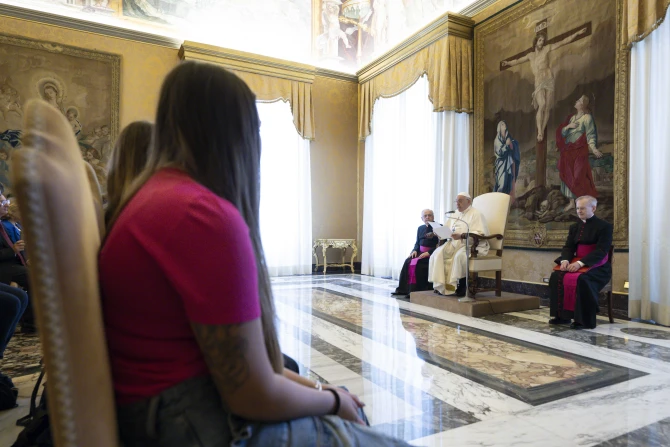
Pope Francis on Monday encouraged a group of women who escaped criminal organizations in Italy to keep fighting despite fear and to know they are not alone.

“You, dear women, were born and raised in contexts corrupted by Mafia crime, and you have decided to come out of it. I bless this choice of yours, and I encourage you to move forward,” he said during an audience in the Vatican’s Apostolic Palace on the morning of Oct. 30.

“I imagine that there are moments of fear, of bewilderment; this is normal. In these moments think of the Lord Jesus who walks by your side,” he said. “You are not alone; keep fighting.”

The women were accompanied by Father Luigi Ciotti. The 78-year-old Italian priest is the founder of two associations: Gruppo Abele helps those with drug and other addictions and Libera combats the abuses of criminal organizations in Italy and around the world.

In the audience, Pope Francis recalled that some of Jesus’ disciples were women.

“Those women — as well as the rest of the men — were not perfect people, they were not ‘angelic’: They were women tried by life, sometimes ‘infected’ by evil,” he said.

Francis said Jesus had compassion for those women and healed them from their sin. They were freed, he continued, “not by magic” but by walking with the Lord and sharing in his cross and resurrection.

“This gives us freedom!” he underlined.

Pope Francis recommended that the women keep a pocket-sized copy of the Gospels with them wherever they go and read a little bit every day.

“Every day read a passage from it, quietly, and imagine that you are with him, with the Lord, in the midst of the disciples,” he said, adding that he would ensure Ciotti provided a copy of the Gospels for each of them.

Jesus, the pope said, “walks with us every day on the road of life. His cross gives meaning to our crosses and his resurrection is a source of hope.”

“I accompany you with prayer for you and for your loved ones, especially for your children,” he concluded. “May the Lord bless you and may Our Lady protect you.”

Franciscan friars ‘Way of the Cross’ resumes on the Via Dolorosa in Jerusalem

Between second and third station, at the corner of the Via Dolorosa, people from different communities in Jerusalem gathered for prayer. On Friday, Oct. 27, after two weeks, the Franciscan friars of the Custody of the Holy Land returned to pray the Way of the Cross on the Via Dolorosa in Jerusalem. Credit: Marinella Bandini

As the Israel-Hamas conflict enters its third week, the Catholic Church in Jerusalem continues to raise its prayers to God for peace. 

On Friday, Oct. 27, in the context of the day of prayer, fasting, and penance for peace called for by Pope Francis, the Franciscan friars returned to celebrate the Way of the Cross on the Via Dolorosa after it had been held in a church for two weeks for security reasons. 

The procession was the only sign of life in a Jerusalem emptied of tourists and pilgrims and patrolled by security forces.

The event brought together people in the local Church to speak with one voice — one of peace, despite the diverse sensitivities within the local Christian community.

Cardinal Pierbattista Pizzaballa, the Latin patriarch of Jerusalem, was present. A few days ago, he wrote a letter to his diocese urging every Christian to have “the courage of love and peace” despite “the evil ravaging the world.”

“We want to be victorious over the world,” the Patriarch wrote, “taking upon ourselves that same cross, which is also ours, made of pain and love, of truth and fear, of injustice and gift, of cries and forgiveness.” 

Against the constant backdrop of the roar of warplanes and the sweltering heat of the day, the Christians of Jerusalem walked together on the Via Dolorosa, physically tracing the path of peace.

On Friday evening, the Franciscans gathered for a moment of prayer in the Church of St. Savior in Jerusalem in front of the image “Ecce Homo” by Arcabas, placed before the altar. Participants read Bible passages, sang hymns, and prayed the words that Pope John Paul II wrote for the World Day of Peace in 2002 a few months after the 9/11 attacks. The famous passage of that message stood out: “No peace without justice, no justice without forgiveness.” 

One of the most evocative moments was when each person present placed grains of incense into a brazier so that the scent of prayer would rise to the sky instead of the smoke from the rockets and bombs that continue to batter the Holy Land.

After the proclamation of the beatitudes, the custos of the Holy Land, Father Francesco Patton, spoke briefly.

“Forgiveness is what qualifies us as Christians. John Paul II reminds us that it is necessary to speak of forgiveness even in contexts dominated by feelings of revenge and hatred. Let us ask the Lord to open our hearts to forgiveness, reconciliation, and peace and that, through our prayers, this seed may also be sown in the hearts of those living in this land, those who have the power to make decisions that affect the lives of others, and in the hearts of the entire world.”

Before the final blessing, a candle was lit from the paschal candle, and the light was passed from person to person as a symbol of the light of Christ and the fire of the Spirit that illuminates our path, which each person pledges to carry and spread in their daily lives.

Christmas 2023 at the Vatican: Nativity to recall St. Francis’ first-ever manger scene

Pope Francis Nativity scene

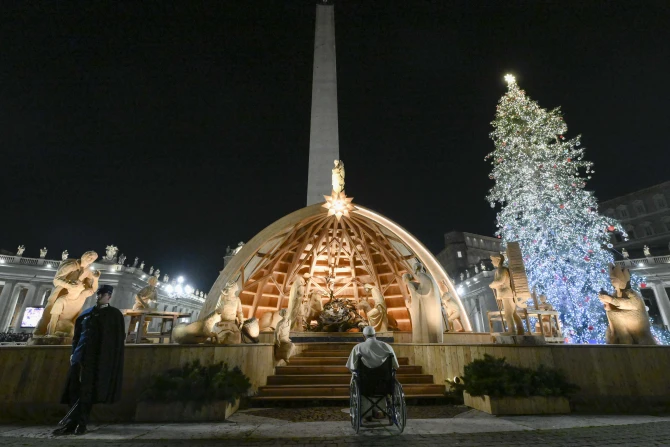
The Christmas 2023 Nativity scene at the Vatican will evoke the first-ever live manger, which was created by St. Francis of Assisi in Italy in the 1200s, the Vatican said Monday.

The Vatican’s Nativity scene, which is different every year, will be unveiled at a ceremony in St. Peter’s Square on Dec. 9. 

The Christmas tree will also be lit for the first time this season at the same event.

The Christmas tree and Nativity scenes will remain in place through the Christmas season, until Jan. 7, 2024, the feast of the Baptism of the Lord.

St. Francis’ meditations on the life of Christ while visiting the Holy Land led him to create a representation of the birth of Jesus on Christmas in Greccio, Italy, in 1223. It is believed to be the origin of the Nativity scene.

The Vatican’s Nativity scenes in St. Peter’s Square and the Paul VI Hall will “revive the atmosphere of Christmas 1223 ... when St. Francis, returning from a journey to the Holy Land, asked to reenact the birth of Jesus in a village that reminded him of Bethlehem,” a press release said.

Christmas 2023 marks 800 years since St. Francis of Assisi staged the first manger scene in the hill town of Greccio, about 50 miles north of Rome.

In addition to the traditional Nativity figures of Mary, Joseph, the child Jesus, and the ox and donkey, the life-size painted terracotta statues will depict St. Francis and some of the principal characters who helped him create the first live creche.

The structure behind the figures will be of the rock still present at the Catholic shrine in Greccio and the fresco painted above it. The surrounding countryside and the four Franciscan shrines of that area will also be depicted.

The Nativity scene inside the Paul VI Hall, where Pope Francis holds his Wednesday audiences with the public during the winter months, will be made from thousands of glass Venetian tiles.

The 82-foot-tall white spruce to be used for the Vatican Christmas tree comes from the Italian Alps close to the border with France.

Instead of traditional ornaments, the tree will be decorated with thousands of edelweiss, a white mountain flower that grows in the Alps and other areas of high altitude.

Christian Leaders in Nigeria Appeal for an End to Frequent Kidnappings, Insecurity

Members of the Christian Association of Nigeria (CAN) in Nigeria’s Taraba State have called for an end to cases of kidnappings and insecurity in the State.

In a  Wednesday, October 25 statement that CAN Taraba Chapter Chairperson, Rev. Isaiah Magaji Jirapye, signed, members of the Christian entity that includes representatives of the Catholic Bishops' Conference of Nigeria (CBCN) say they are “saddened with the nefarious activities of kidnappers which are targeted on Christian clergymen and their families.”

“It would be recalled that recently kidnappers stormed the residence of a clergyman with ECWA church in Mile six, Jalingo and many other clerics,” CAN members in Tabara State say.

They add, “The abductors made it clear that the clergy was their target. Again, another clergy with the CRC-N was abducted in his station at Tudun Haske, a village in Donga local government area of Taraba State alongside his family members and others.”

“CAN condemns this nefarious act and calls on the government to make security to the life and properties of Christian clerics a top priority as now they are the soft target of the kidnappers,” the Christian leaders say.

They continue, “CAN is worried that local Communities and villages are no longer safe as they are attacked frequently by these bad elements without caution and regard to humanity.”

“This must not be allowed to continue to happen, the government should prioritize the security of the local communities across the state,” Christian leaders in Tabara State say.

CAN members in Tabara State further say, “Security presence should be felt in the local communities. The people should support security agencies with intelligence that will uncover the hideout of the criminals in their midst.”

They note that “the need for prayers for the mercy of God upon the land cannot be overemphasized.”

Christian leaders in Tabara State call on “believers to raise family altars and cry to God for a permanent solution to banditry and kidnapping in our vicinity.”

Newly Elevated South Sudanese Cardinal Calls for Togetherness, with “God ahead of us”

Here's what the Church's newest cardinals think about the Synod on  Synodality

The newly elevated South Sudanese Cardinal returned to his Metropolitan See from Rome with a call to togetherness, emphasizing the need to invoke and rely upon God’s graces for lasting peace in the world’s newest country.

Addressing journalists at Juba International Airport (JIA) on Monday, October 30 after arriving from Rome, Stephen Ameyu Martin Cardinal Mulla said, “Let’s work together for peace; not (only) a peace for the silence of guns, but (also) a peace of Christ that puts each one of us together.”

The Local Ordinary of the Catholic Archdiocese of Juba, who was among the three Africans created Cardinals during the September 30 Consistory acknowledged with appreciation the “warm reception” he had just been accorded upon his return to South Sudan’s only Metropolitan See, and added, “As we come together to remember this day … let’s put God ahead of us.”

“God has given us this nation so that we can be people of history,” Cardinal Mulla said. While the past has been characterized with “bloodshed”, he observed, “God is opening for us a new page,” he added.

He went on to underscore the need for the people of God to “work together in order to build up a relationship that can extend to all, not only to the few.”

The South Sudanese Cardinal advocated for practice of love and forgiveness “from the bottom of my heart”, and explained, “It is only forgiveness that makes us mature. It is only forgiveness that makes our Church strong.”

“We cannot build unity without love; we can build it together. Let’s love one another,” he emphasized, adding, “It is the love and faith in Jesus Christ that unites us.”

The Cardinal who was among the 364 voting delegates in the October 4-29 XVI Ordinary General Assembly of the Synod of Bishops called for collaboration between the government of South Sudan and the Church. 

“The Church and the government can work together in order to complement one another,” Cardinal Mulla said during the October 30 press conference at JIA, and thanked the South Sudanese authorities for being part of the delegation that was at the airport to receive him.

He continued in reference to his call for Church-State collaboration, “There are fields that we can participate in together; in education and in making peace and all other fields. We can work together in order to build this country; one person alone is unable to do the job.”

The newly elevated Cardinal whose transfer from Torit Diocese to Juba Archdiocese in December 2019 was met with resistance from a section of the Clergy and Laity recalled the cultural diversity of South Sudan, and underscored the need for unity in diversity to realize development. 

“We are 64 tribes. God has put us to this nation and we must build it together,” he said.

The Archbishop of Juba challenged the youth in the world’s youngest nation to strive to “make a difference” in the growth of the Church and society.

“We can bring peace to this country,” he said, and added, “Throw (away) the guns that kill your brothers and sisters, and live the love of God that unites all of us.”

Cardinal Mulla is the first-ever Cardinal in South Sudan, the world’s newest country that gained independence from Sudan on 9 July 2011. He is the second South Sudanese Cardinal, after the 82-year-old Gabriel Cardinal Zubeir Wako, who was elevated to the rank in October 2003 while serving as Archbishop of Sudan’s Khartoum Archdiocese.

Other Cardinals from Africa that Pope Francis created during the September 30 Consistory included Protase Cardinal Rugambwa, the Coadjutor Archbishop of Tabora in Tanzania, and Stephen Cardinal Brislin, the Local Ordinary of South Africa’s Cape Town Archdiocese.

Speaking after the Consistory, Cardinal Mulla said that his elevation to Cardinal was a “recognition of the Catholic Church and the faith of the people of South Sudan in the universal Catholic Church.”

“Being a Cardinal is an eye opener and a proof to the world that South Sudan believes in God and deserves recognition in the top leadership of the Church,” he said, and added, “This office of the Cardinal is not only for one person; it is for all of us in South Sudan.”

Cardinal Mulla reiterated the same message during the October 30 press conference at JIA.

“This chair of the Cardinal is not for Stephen Ameyu; it is for all of us South Sudanese. It is a sign that our Church has matured; it is no longer a young Church because we have celebrated 100 years of faith, and that faith the Holy Father has seen it,” the Catholic Church leader who started his Episcopal Ministry in March 2019 as Bishop of Torit Diocese said.

On his part, South Sudan’s Vice President for Economic Cluster, who represented President Salva Kiir Mayardit at the JIA reception of the new Cardinal said, “We are very happy; as South Sudanese, we will walk with our heads high because it is the first time for South Sudan to have a Cardinal since we became a country.”

“As the government, we will stand with the Cardinal 100% and other Churches,” James Wani Igga said, and added, “Thank you so much our civilians for the warm reception of our Cardinal Stephen Ameyu.”

Plans Underway for Funeral of Murdered Nigerian Monk as Search for Body Hits a Snag

Monks at the Benedictine Monastery, Eruku in Nigeria’s Catholic Diocese of Ilorin are planning for the funeral ceremony of their confrere, Br. Godwin Eze, after those who set out to search for the murdered monk’s body encountered obstacles.

Fr. Joseph Ekesiobi, a former Novice Director at the Nigerian Benedictine monastery, told ACI Africa that the team that ventured into the forest where Br. Godwin was held captive before he was brutally shot and his body thrown in a river decided to retreat fearing for their lives.

The search team was composed of a vigilante group, some members of the Monastery, and the Nigerian police. Also joining the search crew was a group of hunters who were brought on board for their familiarity with the forest. 

Br. Godwin’s father who also joined the search advised the team to retreat when they found themselves deep inside the Fulani territory, Fr. Ekesiobi told ACI Africa on Sunday, October 29.

“Our community met with the police on Wednesday (October 25) last week to organize the search for Godwin’s body. All arrangements were made and on Thursday (October 26), they embarked on the search,” Fr. Ekesiobi, the monastery’s spokesperson said.

He added, “The joint task-force went deep into the forest following the river where the body of Godwin had been thrown. They got to a point where they were very exhausted. They also started seeing some of the Fulani herdsmen who are notorious for attacking people. Godwin’s father told them to retreat.”

Meanwhile, Br. Godwin’s father has asked that the funeral of his deceased son be arranged as soon as possible. 

“He wouldn’t want the torture to be prolonged,” Fr. Ekesiobi says, adding that a funeral committee at the Monastery has been constituted and is meeting to reach a decision, which will be communicated to the Diocesan Administrator to set a date for Br. Godwin’s funeral service.

Noting that the Monastery has not lost hope of recovering Br. Godwin’s body, the Priest says, “Hunters on the search party agreed to continue with the search and to inform our community of any developments. We are hoping and praying that the body will be found.”

Br. Godwin was kidnapped at around 1 a.m. on October 17 alongside Br. Anthony Eze and Br. Peter Olarewaju as they slept in the Novitiate block of their community.

While Br. Anthony and Br. Peter were set free on October 21, Br. Godwin, aged only 31, was shot and his body thrown into a river on October 18, a day after his kidnapping.

Eulogizing the murdered monk, Fr. Ekesiobi said, “Br. Godwin lived a contemplative life. I remember him as a very easygoing young man. He was very jovial and very prayerful.”

Christian Entity “welcomes” UN Experts' Letter on May 2022 Lynching of Nigerian Student

How Court Freed, Acquitted Suspected Killers Of College Student, Deborah  Samuel After Police Prosecutors Absconded From Trial | Sahara Reporters

The Christian Solidarity Worldwide (CSW) has welcomed the Letter of Allegation, which five United Nations (UN) Special Procedure mandate holders sent to the government of Nigeria regarding the public lynching of Deborah Emmanuel.

In an October 27 report, CSW lauds the UN experts’ statement on the May 2022 murder of Deborah, and the subsequent detention of Rhoda Jatau.

Deborah was an Economics student at Shehu Shagari College of Education in Sokoto. She was stoned to death and burned by male students at the school; they accused her of blaspheming against Prophet Muhammad.

Meanwhile, Rhoda is a Christian mother who shared a video denouncing Ms. Emmanuel's murder, was charged with blasphemy, inciting a mob, and exciting contempt of religious creed at a High Court in Nigeria’s Bauchi State in December 2022.

The CSW report provides the background of the UN experts’ statement that is dated August 4. It states, “The Letter of Allegation, also known as a communication, was sent to the Nigerian authorities in August, but was published on 26 October, after the government failed to respond within the required 60-day deadline.”

The CSW report further cites the UN experts’ letter, in which the express "utter concern at the lynching and burning alive of Ms. Emmanuel; the apparent negligence of the police prosecution and the lack of accountability for the perpetrators of her murder." 

“We are also concerned at the arrest and detention of Ms. Jatau, accused of ‘blasphemy’, who has been imprisoned for over a year for what appears to be her mere peaceful exercise of her right to freedom of expression and freedom of religion or belief,” the UN experts say in their letter that the CSW report references.

In the October 27 report, CSW UN officer, Claire Denman, says the Christian human rights entity "welcomes the Letter of Allegation from the five Special Procedures, including their findings of police negligence and lack of accountability, among other violations and abuses." 

"We commend their robust questioning of the government of Nigeria on the circumstances surrounding Deborah Emmanuel’s brutal death and the unjust detention of Mrs Jatau for peacefully exercising her fundamental rights," Ms. Denman says.

She adds, “We continue to extend our deepest condolences to Ms Emmanuel’s family, and to urge both state and federal authorities to prioritize the arrest and prosecution of Ms Emmanuel’s murderers."

Ms. Denman goes on to call on Nigerian authorities to release Mrs. Jatau "unconditionally, and to end the impunity currently enjoyed by those who weaponize religion to justify the taking of innocent lives."

The CSW official further urges President Bola Ahmed Tinubu-led government to repeal blasphemy laws in Africa’s most populous nation. 

"It is incompatible with the country’s constitutional and international obligations, and is a driver of religious extremism and violence, which in turn critically undermines social cohesion," the CSW UN officer is quoted as saying in the October 27 report.

African Delegates to Share Experience, Lessons from Synod on Synodality in Planned Webinar


African delegates who participated in the October 4-29 XVI Ordinary General Assembly of the Synod of Bishops in Rome are expected to share their experience and lessons from the meeting in a webinar scheduled for November 15.

The virtual event has been initiated by the African Synodality Initiative (ASI), a partnership between the Jesuits Conference of Africa and Madagascar (JCAM), the Symposium of the Episcopal Conferences of Africa and Madagascar (SECAM), and the Association of Member Episcopal Conferences in Eastern Africa (AMECEA).

In a note shared with ACI Africa on Monday, October 30, ASI indicates that during the webinar, “speakers and panelists will reflect on the experience and lessons from the 16th Ordinary General Assembly of the Synod of Bishops.”

The Secretary General of SECAM, Fr. Rafael Simbine Junior, is to deliver the opening remarks at the virtual event that is being organized under the theme, “Walking the Synodal Path: Reflections on the Synod on Synodality – Voices from Africa.”

Archbishop Andrew Fuanya Nkea of Bamenda Archdiocese in Cameroon, who doubles as a member of the Ordinary Council of the Synod that was appointed by Pope Francis is to give the keynote address. 

Advertisement

Other panelists include, Sr. Marie Solange Randrianirina, the Regional Provincial of the Pious Society of the Daughters of St. Paul (FSP) in Madagascar; the Secretary General of AMECEA, Fr. Anthony Makunde; and Ms. Sheila Pires, the communications officer of the Southern African Catholic Bishops’ Conference (SACBC), who served as Secretary at the Synod Information Commission.

Fr. Andrew Kaufa, the Coordinator of the Social Communications department of AMECEA, also a consultor to the Dicastery for Communication at the Vatican, is to the moderate the November 15 webinar session.