Monday, August 07, 2023

New cardinal in Hong Kong says red hat will help ‘build bridges’ with China

Pope names Jesuit educator bishop of Hong Kong | Crux

Cardinal-designate Stephen Chow, who’s slated to get his red hat from Pope Francis in late September, has voiced confidence that the honor will aid in “building bridges” between the global Church and mainland China.

“The bridging role should be a significant contribution to the Church as a whole. I think the appointment as cardinal will strengthen the role of the Catholic Church in Hong Kong as a bridging church, to promote exchanges and interactions between mainland China and the universal Church,” Chow told Crux in a written interview from Hong Kong.

A Jesuit like Pope Francis, Chow was named bishop of Hong Kong in 2021 and was appointed a cardinal by the pope last month. He will get his red hat during a Sept. 30 consistory and will remain in Rome to participate in the Oct. 4-29 Synod of Bishops on Synodality.

His appointment comes at a time when the Vatican has stepped up its courtship of China, including a request from Vatican Secretary of State that an official liaison office be established in Beijing following the pope’s recent decision to formalize the unauthorized transfer of a Chinese bishop to the diocese of Shanghai.

The Vatican and Chinese authorities signed a controversial provisional agreement on the appointment of bishops in 2018 which has twice been renewed, but which has been repeatedly violated by Chinese authorities in recent months.

Chow himself this year made an April 17-21 visit to Beijing after receiving an invitation from Beijing Bishop Joseph Li Shan, marking the first time a Hong Kong bishop had traveled to Beijing since 1985, when Hong Kong was still a British colony.

In an interview with La Civilta Cattolica after his visit, Chow said he believed his visit to Beijing helped solidify relations between the Vatican and mainland China on a pastoral level, and he described his vision for the Church in Hong Kong’s role as a “bridge church,” aiding in dialogue between east and west.

Chow told Crux that he sees his appointment as a cardinal as “a positive sign that the Holy Father and the Holy See are close to the diocese and people of Hong Kong.”

“Our diocese will remain committed to our different pastoral works, and continue our local mission in education and social services to the different sectors of our social community,” he said.

Chow said he heard about his appointment on July 9 from a friend in Rome, after the pope had announced the consistory and his new cardinal-appointees.

“I was in disbelief at that moment and thought the message was missent. At the same time, I regard the appointment as a new mission from the pope, though I shall continue with my current mission as the bishop of Hong Kong,” he said.

Asked about Parolin’s proposal for a liaison office in Beijing and how he as a cardinal might support such an initiative, Chow said the office is “between the two governments,” and is thus not a pastoral concern for the Diocese of Hong Kong.

However, he reiterated his belief that his role as cardinal could also help strengthen Hong Kong’s role “as a bridging Church” in this sense, and that it could “promote exchanges and interactions between mainland China and the universal Church.”

Chow is a pontifical delegate to Pope Francis’s upcoming Synod of Bishops in October, which holds the theme, “For a Synodal Church: Communion, Participation, Mission,” and is focused on how to transform Church life and structures to make it a more welcoming place for all of its members.

When it comes to the application of the synod process in Hong Kong, Chow said the aim of the synod “is not to provide a temporary or one-time experience of synodality.”

Rather, he said, the aim is to “pray, listen, dialogue, discern and offer advice on making pastoral decisions in the long-term, which correspond as closely as possible to God’s will.”

“In this way, we continue to fulfill our mission to evangelize in the world. The same dynamics should apply to the church in Hong Kong,” he said.

When it comes to his own pastoral priorities, Chow said his main desire is to promote “the pastoral work of the local church, especially the formation for clergy, laity, and young people in particular, for a synodal and inclusive Church.”

“We will continue with our efforts to bring hope to our young people whose lives have been interrupted,” he said.

Chow said efforts toward reconciliation are also high on his list of priorities, saying he prays “that more hope will be nurtured for the young to create a better future with them.”

Retired Albany bishop enters civil marriage after Vatican refuses to laicize him

Wedding Bells Ring for Former Bishop Howard Hubbard

Former Albany bishop Howard Hubbard announced Tuesday that he has attempted marriage with a woman, after the Holy See rejected his request last year to be laicized.

The attempted marriage — contracted according to the laws of New York state — could lead the Vatican to declare the bishop dismissed from the clerical state.

Bishop Hubbard, 84, announced the Vatican decision — and his subsequent attempt to marry — in an open letter to the Albany Times Union newspaper. The bishop explained in that letter that  he had “fallen in love with a wonderful woman who has helped and cared for me and who believes in me.”

Hubbard served as bishop of New York’s capital diocese until 2014. Since his retirement, he has faced allegations of sexually abusing minors, and has admitted to knowingly reassigning abuser priests and failing to report instances of abuse to law enforcement.

In November 2022, Hubbard announced he had petitioned Pope Francis to be dispensed from the rights and obligations of the clerical state, claiming that his former diocese had placed restrictions on his ministry as a priest – a claim the Albany diocese rejected as untrue. 

Citing sources in the Albany diocese, The Pillar reported last November that the bishop had expressed plans to marry, if the pope approved his petition for laicization.

Under canon law, clerics of any rank may petition the pope for a dispensation from the rights and obligations of the clerical state. 

Although they remain sacramentally ordained when dispensations are granted, they cannot licitly exercise any ministry except in certain carefully defined circumstances usually involving immediate danger of death, and they no longer enjoy the rights of clerics, including financial support from their former dioceses or religious institutes.

While deacons, priests, and bishops can be stripped of the clerical state following a canonical trial, a dispensation from the clerical state can also be granted after a petition to the pope. Such a laicization is canonically considered a “favor” and is not a punishment, and can be denied.

A laicized deacon, priest, or bishop must receive a dispensation from the clerical obligation of celibacy in order to marry validly — without that, he is canonically unable to contract a valid marriage. 

According to Hubbard’s Aug. 1 letter to the Times Union, “In March, [he] received notice from the Vatican that my request had been denied. [He] was encouraged to wait patiently and prayerfully and to continue to abstain from public ministry until seven civil lawsuits against me alleging sexual misconduct had been adjudicated.” 

Instead of “waiting patiently,” however, Hubbard said he had undergone a civil marriage ceremony last month, and asked that the press and public “respect our privacy as a couple.”

Hubbard’s successor as Bishop of Albany, Edward Scharfenberger, told the Times Union that Hubbard’s announcement was “unexpected,” and “ like many of you, I am just now beginning to process it.” 

Bishop Scharfenberger did, however, make clear that whatever the civil effects of Hubbard’s attempt at marriage, the union is not a valid marriage, and that although he is prohibited from public ministry, Hubbard remains sacramentally a bishop, and canonically a cleric. 

While the wedding is presumably civilly recognized, the Church holds that it does not validly establish marriage.

According to canon law, Hubbard’s attempt at marriage is invalid for several reasons, the first of which is that he is bound by the legal impediment of orders — canon law prevents individuals from marrying if they are already married, have professed religious vows, or are clerics.

Additionally, Catholics who wish to marry are obliged to exchange matrimonial consent according to specific norms, called canonical form. These require Catholics to marry with a priest or deacon receiving the consent of the parties before at least two witnesses, and that the ordinary place for the celebration of marriage be a church.

Catholics can receive dispensations from canonical form, but these permissions must be granted by their local diocesan bishop — in this case Bishop Scharfenberger, who has made it clear no such dispensation was sought or granted.

As it happens, Hubbard’s attempt at marriage could lead to the laicization he previously sought.

Clerics who attempt to marry commit a specific canonical crime, with the Code of Canon Law providing that “a cleric who attempts marriage, even if only civilly, incurs a latae sententiae suspension” from ministry and “if, after warning, he has not reformed or continues to give scandal, he must be progressively punished by deprivations, or even by dismissal from the clerical state.”

As a former diocesan bishop, Hubbard will have been well aware of these legal provisions — as well as the canonical penalty for his actions. Indeed, incurring the legal penalties may have been a motivating factor in the bishop’s decision to attempt civil marriage.

In many cases in American dioceses, priests who have left ministry and sought laicization have opted to attempt civil marriage in the expectation that the Vatican would move faster to laicize them as a punishment, in order to address public scandal, than as a favor. 

Royal Commission finds Church failed to act on horrific sexual abuse in New Zealand institutions

Royal Commission into Institutional Responses to Child Sexual Abuse
WARNING: This article discusses sexual abuse 
and suicide which may be distressing.

Two days after his arrival at Marylands School, a young boy was taken to the church and forced to perform sexual acts on two religious brothers entrusted to care for him.

They pulled out a Bible and told the boy: “This is what God means by love”.

A week later he was taken back to the church and raped on the marble altar.

This is one of countless cases of horrific historical abuse against young boys at the Christchurch school, which has been referred to by survivors during the Royal Commission of Inquiry as “hell on earth”.

In an interim report released today, the inquiry’s 48 findings :

  • Marylands School did not provide adequate education and safeguards for the children sent there
  • The students were abused, neglected and deprived of their human rights
  • The religious brothers who abused the children sought to actively evade accountability
  • The Catholic Church, the Order and the State have not yet been found accountable for the magnitude of the tragedy that unfolded at Marylands School and Hebron Trust for failing to address the abuse

‘Abhorrent’ abuse should never have happened, says bishop

Archbishop Paul Martin SM said the scale of abuse set out in the report is abhorrent and should never have happened.

“Today’s case-study report highlights the horrific abuse and suffering that took place, and the failure of individuals to ensure safety and manage redress adequately,” he said. “Confronting these realities is a significant and necessary step as we all continue to transform the way we manage redress and ensure the safety of everyone in a Church environment.

“The abuse described should never have happened. Nor should any abuse happen. I want to restate categorically that the bishops of the Catholic Church in Aotearoa New Zealand have zero tolerance for abuse. No form of abuse, misconduct or inappropriate behaviour is acceptable in the Church community.

“The Church must continue to confront the difficult truths of the past, including the inexcusable abuse and suffering described in the case study report.”

As part of its investigation of the Catholic Church, the commission undertook a case study, including a public hearing, into abuse in the care of the Order of St John of God.

Members of the religious order cared for children and young people in Christchurch from the early 1950s onwards.

Marylands School and the Hebron Trust were established in Christchurch in 1955 and 1984 by the Order of St John of God.

Until the late 1980s successive governments placed disabled children and young people in the facilities to be trained. Marylands was designed to support and educate boys, as young as 6, who had disabilities or learning and behavioural problems.

Five brothers were sent from Australia to staff the school, most were untrained as teachers without specialist skills to educate disabled children.

Within the first year of the school’s operation, all five brothers had been accused of abusing the children.

The brothers routinely raped, sexually assaulted and beat the boys. The children were forced to perform sexual acts on the brothers, sometimes more than one at a time, as well as other boys.

The report titled ‘Stolen Lives, Marked Souls’ states that of the 37 brothers who ministered in the Christchurch community when the Order operated Marylands, 21 had allegations of abuse made against them.

Two of the brothers were convicted of committing indecencies against children. One remains in an Australian prison where he is likely to die while the other has already died. Other trials did not take place due to illness of the brothers or survivors.

One Marylands survivor Darryl Smith recalled being raped when he was seven years old by one of the brothers. They told him no one would believe him if he spoke up.

Smith has since gone on to self-publish several accounts of the abuse he suffered and is a historical child sex abuse advocate.

Abused boys ‘easier prey’

One survivor was made to have sex with a younger boy. A brother then told the boy that he was “like him”, an abuser, and he would get in trouble if he disclosed the abuse.

Sometimes the abuse would happen behind closed doors, other times in plain sight of everyone as a punishment.

Abuse was so normalised, the boys started sexually abusing each other.

A boy known to have been abused by one brother became “easier prey” for another brother.

One boy who had an intellectual disability was sent to Marylands when he was 10 years old. He spent three days in school and then was put in the kitchen, made to wash dishes for the next four years.

He recalled being separated from the other boys, unable to play with or eat meals with them.

He was sexually assaulted in the swimming pool by himself by one of the brothers.

On one occasion he was made to gas puppies to death with a brother. He was then instructed to take the dead puppies to the dump.

Another Marylands survivor spoke about being gathered into a room with a group of other boys and forced to perform oral sex on one of the brothers. When he tried to pull away he was hit with a baseball bat so hard his nose bled.

He described the brothers getting angry while they were abusing him as he often wouldn’t hold still but he soon “adapted” to the abuse.

He was taken to the hospital morgue on one occasion and forced to see a dead body as a scare tactic.

The boy told multiple teachers, social workers and even police when he was caught running away but no one believed him.

His teenage years were horrible, and it wasn’t until he went to prison that he learned to read and write and by the time he was 25 he was a patched member of a gang.

“It is sad to say that the only sense of belonging and support I ever felt was being part of a gang.”

Another survivor recalled a boy being forced to strip naked outside in front of others and was sexually assaulted as punishment.

‘Racially targeted’ abuse

Some brothers held negative racist attitudes toward Māori students, often calling them “n*****s”.

One Māori boy was forced to dress in a grass skirt and perform a Māori song and dance for the brothers. After the performance, the boy was forced to participate in group sex with the brothers.

Another Māori student said boys would often fight him because of his ethnicity.

A ‘reign of terror’

After the Order left Marylands in 1984 the Bishop of Christchurch invited brothers to establish a youth ministry to support at-risk people, often “street kids”, many of whom were Māori.

Despite the allegations of his abuse at Marylands, Brother Bernard McGrath, one of the Order’s most prolific serial rapists, was appointed the sole brother of the ministry, named Hebron Trust.

From there his “reign of terror” only escalated.

Boys as young as 8 went to Hebron, although it was mostly aimed at teenagers who were homeless, referred by social service agencies or by the criminal and youth justice system.

About three-quarters of survivors turned to drugs or alcohol as a way of coping with the abuse they endured. Many had contemplated or attempted suicide, others had died this way.

One survivor began getting in trouble with the police in his early teens but instead of being dealt with by the court, he was sent to Brother McGrath’s house to do community work such as gardening and chores.

He said McGrath routinely sexually assaulted him in his office. On one occasion when he raped the boy, the brother he “was in with the police” and no one would believe the boy if he spoke up about the abuse.

‘McGrath ruined my life’

One survivor said McGrath ruined his life.

He was subjected to routine rapes by McGrath at Hebron Trust from the age of 15 to 19.

He said McGrath would put a scarf in his mouth and tape it shut with duct tape so he wouldn’t make any noise when he raped him. The boy was also handcuffed and blindfolded, stating McGrath would become aggressive and choke him.

“I often thought I was going to die,” he told the inquiry.

The boy said McGrath would often put things in his drink that made him dizzy. He also gave the boy alcohol while he was supposed to be counselling him through drug and alcohol use.

The survivor, now an adult said he got involved with gangs and has been in and out of prison since the 1990s. He mostly lives on the streets or with gangs and has attempted suicide several times.

McGrath had a trusted reputation in the community, with survivors often describing him as friendly and supportive upon meeting him. This made it difficult for victims to disclose the abuse as they were often told McGrath would “never do that kind of stuff”.

The report states McGrath often supplied drugs to the boys before sexually assaulting them and sometimes made boys engage in sexual acts with their family members or watch while he sexually assaulted their family members.

One boy was six when he was sent to Marylands. On his first day, someone had defecated in the gym and one of the brothers accused him of doing it.

The brother then rubbed his face in the faeces in front of everyone as punishment.

He recalled McGrath raping and beating him often. He said he was beaten so severely once that his knees cracked and even as an adult he still has the scars.

When he was 10 he was caught holding a packet of cigarettes belonging to another boy. As punishment, he was made to smoke the whole packet in front of everyone.

“He made me inhale the smoke on each puff. This started my addiction to cigarettes.”

In his adult life, the man had been in and out of prison and suffered from post-traumatic stress disorder and chronic anxiety.

“I want to be heard. I want justice to be served for all of us who were hurt by these monsters.”

‘Death’ at school

Some boys witnessed violence that they believe may have led to the deaths of other boys.

According to Marylands attendance register, six boys aged between nine and 14 died while at the school or shortly after leaving it.

Survivors described instances that ended in “suspicious circumstances” such as receiving a severe beating and never returning to the school.

One survivor described a brother rushing at one boy who had trouble understanding things. He said the brother pushed the boy over and he smacked his head on the concrete and began bleeding heavily. He was then taken to the medical room, never to be seen again.

“The way he was just hit I knew he wouldn’t make it. He was helpless.”

Another survivor spoke of a brother who pushed a boy into the pool and he sank to the bottom. Soon after a funeral was held for the boy.

Police said they have not found “any records of death of children while at Marylands” and do not “hold any information about the circumstances of these deaths”.

Abuse in the orphanage

Children at the St Joseph’s Orphanage were aged between birth and 11 years and described nuns taking them from their beds and delivering them to priests or brothers as punishment. There, they would be sexually assaulted.

One survivor recalled being taken to a chapel with a group of other boys. He said he was injected with a sedative and forced to carry out sexual acts on other boys, nuns, brothers and priests.

Some of the boys were also taken to Marylands as punishment.

‘Violent, emotionally uncontrollable boys leaving Marylands

The devastating impacts on the survivors once they left Marylands saw about three quatres turn to alcohol and drugs as a way of coping. Others struggled with their mental health and attempted suicide.

One caregiver at the school told the inquiry a telling sign of the abuse was seeing the boys’ mood change as some became “violent and emotionally uncontrollable’.

The report stated Marylands was a “terrifying and unpredictable place” with little evidence of any schooling.

The young boys had no means of escape and would often talk about ending their lives.

“The Inquiry acknowledges the trauma likely to have been experienced by many at Marylands whose experiences are not and will probably never be known”.

The report describes what happened at the hands of the brothers of the St John of God at Marylands School and Hebron Trust as the “worst possible” type of abuse and neglect.

It stated that this is not a report about “bad apples” but reflects that those responsible who “shamefully” enabled the abuse to continue must take accountability for their failings in caring for and protecting the children.

Bishop laments Netanyahu government’s weak response to growing anti-Christian violence

Fr. Rafic Nahra

Church leaders in Israel continue to raise awareness about increased violence against the local Christian community — one of several serious issues convulsing Israeli society in recent months.

Tensions in Israel have been increasing on several fronts since January, including violent eruptions in the Israeli-Palestinian conflict and protests around a controversial bill, which was passed on 24 July, limiting the power and reach of the country’s Supreme Court.

According to national statistics, 185,000 Christians live in Israel. Almost half, about 80,000, were living in Nazareth. 

However, many young couples have left, seeking the relative safety of towns that are not predominantly Christian, said Bishop Rafic Nahra, auxiliary bishop of the Latin Patriarchate of Jerusalem and patriarchal vicar for Israel.

While there “surely is not an organized activity or policy of the government against Christians,” the reaction from government and law enforcement officials to the increased violence is “very, very weak.”

“There is no real protection that is given,” he added.

This violence against Christians increased noticeably since January, less than one month after Israel’s new coalition government began at the end of December.

“Something is going wrong,” the bishop said. “For sure, the extremists who hesitated before [the new government came into office] to do such acts … feel more secure.”

220 churches have been destroyed in Manipur since May

India sees 'record level of violence against Christians' - UCA News

Charred walls, collapsed tin roofs and smashed windows in a burned Kuki community church illustrate how deadly ethnic violence has led to brutal sectarian attacks in India's troubled Manipur state.

At least 120 people have been killed since May in armed clashes between the predominantly Hindu Meitei majority and the mainly Christian Kuki in the northeastern state.

The ruins of the Kuki church in Imphal are just one among the more than 220 churches and 17 Hindu temples destroyed in the months of vigilante violence, according to a report by India Today news magazine.

Across the street from the burned church, Baptist priest Zuan Kamang Damai led a service on Sunday with a congregation just a third of its usual size of about 800 after many of his Kuki parishioners fled.

"After this violence erupted, they moved to different places to save their lives," he said.

"They want to come back, they want to resettle, they want to live with my family," Damai said. "This is what they responded to me, and I comfort them. God is there."

Damai is himself a Naga, another major tribal group in the area who have largely been spared in the cycle of revenge attacks.

But many of his regular worshippers are staying away, fearful of the possibility of violence.

"We have to respect each religion -- regardless of Christians, regardless of Hindu, Muslim, whatever," the 55-year-old said.

While there was "conflict here and there", he said, "we have to avoid attacking the temples".

Land, rights and power 

The cause of conflict is a complex mix of land, rights and power.

The Kuki oppose Meitei demands for reserved public job quotas and college admissions as a form of affirmative action, fearing that they might also be allowed to acquire land in areas currently reserved for tribal groups.

India's Interior Minister Amit Shah has promised a "thorough, in-depth and impartial investigation" into the violence and has said the government "stands shoulder-to-shoulder with the people of Manipur".

But the Human Rights Watch group says that state authorities, led by Shah's Hindu-nationalist Bharatiya Janata Party, have rolled out "politically motivated, divisive policies that promote Hindu majoritarianism".

Many say religious divisions are adding to the trouble.

While the majority Meitei people are largely Hindu, a small number are Christian and some say they too have been attacked.

B, a Meitei Christian who did not wish to be identified beyond an initial, described how he watched in horror as his church was burnt to the ground by a mob.

"The large-scale attack on churches across communities makes it evident that it has a religious angle to it," he said.

But others point out that while churches used by the Kuki community have been attacked, those of the Naga people have not.

Eva, a Christian with roots in both the Meitei and Naga communities who also asked for her real name not to be used, said the conflict is not just about land rights or government jobs.

"Meitei churches were vandalized and burnt," she said. "If it is just a Kuki and Meitei issue, then why were the Meitei churches attacked? The evidence is very clear cut."

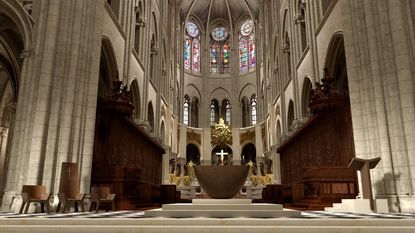
‘Sinuous minimalism’ marks altar, other furnishings for the restoration of Notre-Dame de Paris

Notre-Dame de Paris interiors

For the reopening of Notre-Dame de Paris, set for late 2024, French designer Guillaume Bardet created a series of liturgical objects and furniture. 

The Gothic cathedral was partly destroyed by a fire in April 2019, which resulted in the collapsing of its roof. 

The renovation has involved carefully restoring the remains, while reproducing its Gothic architectural details as well as recreating the spire that was added in the 19th century by architect Eugene Viollet-le-Duc. 

Bardet, part of Paris' Galerie Kreo's roster and whose work is defined by a sinuous minimalism, was chosen by the Archbishop of Paris during a long and rigorous process.

The designer has been tasked with creating an altar, lectern, cathedra with seats, tabernacle, and baptistery, which he developed in bronze and favouring simple forms that exude a graceful approach that is guided by timelessness. 

The T-shaped lectern, for example, is meant to symbolize freedom, and was the first piece he designed for this space. 

Similarly, the baptistery draws from the object's ritual circularity and is imagined with flow of people in mind. His intention with these objects, reads a note introducing the project, was 'to embrace organic shapes that evoke a profound sense of permanence and spiritual devotion.'

While the designs appear rigorous and solemn, the design gesture favoured by Bardet resulted in a series of gentle objects that discreetly inhabit the space. 'They should resonate with conviction for Catholics and captivate the attention of non-Christians,' he comments. 

'Each element carries its own distinct identity, symbolism, and purpose, yet together they form a cohesive ensemble that engages in a meaningful dialogue. These pieces should exist within and beyond the realm of liturgy: not demanding attention, but also not hiding away. They should have a subtle yet undeniable presence.

'The pieces should embody the essence of the past, embrace the present, and welcome the future.'

Indian officials detain Catholic teens who want to be nuns

Christians are being attacked in India – and this is why | Magazine  Features | Premier Christianity

Parents of three tribal Catholic girls have demanded their release from the custody of child welfare authorities in a central Indian state after they were forcibly taken away on suspicion of conversion to Christianity.

“We want our children to be immediately released,” Prakash Baria, father of one of the girls told UCA News on July 26.

The teenage girls were reportedly detained in central Indian Madhya Pradesh by a team of the state's Commission for Protection of Child Rights on July 21.

They were detained during an inspection of a Catholic school hostel in the predominantly tribal district of Jhabua, where they were staying, Church sources said.

The girls, two of them studying in grade 11 and one in grade 12, reportedly said they wanted to become Catholic nuns, which was interpreted as a religious conversion activity by the inspection team, Baria said. 

The girls are now held in the custody of the District Child Welfare Committee (CWC) ignoring their pleas, alleged their parents, who are from Jamburi village in Banswara district of neighboring Rajasthan state.

Baria along with the other parents had arrived in Jhabua and questioned the authorities’ decision without even informing them.

“We are tribal people who have followed the Catholic faith since our forefathers’ time. Why are our children kept in the custody” of the officials, Baria asked.

Samsun Makwana, another parent, asked: “Is it a crime to become a nun?”

“Even if our daughters have said that they want to become nuns, what is the problem,” he said.

Makwana said his daughter had studied up to class 10 in the village school and was sent to the Catholic school for further studies and she was accommodated in the Church-run hostel.

The parents told UCA News on July 26 that they plan legal action against the child welfare authorities if their daughters are not released.

Ashok Arora, chairman of the CWC, told UCA News that they were handed custody of the girls by the state’s child rights panel team.

He accused the hostel of violating norms and asked: “Is a school hostel a place to keep candidates who want to be nuns or give them training?”

Arora said the girls will be legally handed over to the CWC from Banswara district in Rajasthan.

“This is sheer harassment,” said Sister Pramila Toppo, hostel in charge and superior of the Convent of Missionary Sisters of Ajmer.

She told UCA News that it was “unfortunate that innocent girls are being treated like criminals for no fault of theirs."

"It seemed a deliberate attempt to tarnish the image of our education institutions,” she added.

Madhya Pradesh, which is ruled by the pro-Hindu Bharatiya Janata Party, amended and sharpened its anti-conversion law in 2021.

The amended law prohibits unlawful conversion from one religion to another by use of misrepresentation, force, undue influence, coercion, any other fraudulent means, and allurement. Violators face a prison term of up to 10 years.

Christian leaders say the law is often used to target Christians in remote, tribal-dominated areas of the state.

“The frequency of the attacks on Christians has drastically increased" since the law was amended, said Daniel John, a Catholic leader based in the state capital Bhopal.

Both the federal and state child rights panels have been harassing Church-run schools, hostels and orphanages, through surprise inspections, and false cases against priests, nuns, staff members, and even bishops, John said.

 Christians make up 0.29 percent of more than 72 million people in Madhya Pradesh, a majority of them Hindus.