Wednesday, November 01, 2023

Synod on Synodality 2023: The Key Discussions and Decisions

Now that the October 4-29 Synod on Synodality meeting in Rome has drawn to a close, all eyes are on the final report emanating from the month-long ecclesiastical gathering.

The acronym LGBT is notably absent; the question of female diaconate received the lowest vote; and even the somewhat broad paragraph on controversial topics equating sexual identity and euthanasia lacks substantial consensus. 

Although all the methods (paragraphs) of the summary document from the first stage of the 2023 Synod were approved with a two-thirds majority, it's evident that the points lacking consensus stand out.

Jean-Claude Cardinal Hollerich, the General Rapporteur of the Synod, highlighted in a press conference on October 28 that "some issues were expected to encounter more opposition. The surprising part is that many voted in favor, indicating the resistance wasn't as significant as anticipated." 

The Cardinal's words reveal a robust and unyielding debate, hinting at a desire for change, especially when the narrative throughout the Synod revolved around "seeking communion."

Those words also explain the fears of Joseph Cardinal Zen, Bishop emeritus of Hong Kong, who, after having signed the last letter of the dubia sent to Pope Francis, also sent a letter to synod fathers, highlighting the risk of pressure for a change in doctrine and above all denouncing the General Secretariat of the Synod as "very effective in the art of manipulation."

Cardinal Zen's letter and the publication of the dubia of the five Cardinals fell on fertile ground. From the final document, ultimately called to balance all positions, it emerges that the concerns raised are the concerns of many Bishops. Many voted "yes" with the thought of being able to fix things in the final document, wanting to avoid debate. Those who voted "no" did so with the awareness of facing a tough cultural battle in the coming months.

The news, however, is that there will be no new continental stages, as previously thought. The road map that is emerging does not provide for further meetings of continents and documents, and this perhaps helps the General Secretariat of the Synod, which risks finding new documents with new dubia given the next leg of the Synod, which promises to be heated.

Spot the Differences

The 1,251 proposed amendments to the 40-page text essentially meant a call for a complete rewrite from the Synod Fathers. From the first to the final draft, many terms were revised. The reference to LGBTQ vanished, initially replaced by "sexual identity," and eventually by "gender identity" as a compromise.

Also scrapped was the suggestion for accountability of pontifical representatives by local Bishops, which could have significantly altered roles, placing the Pope under bishops' oversight. Instead, the text mentions renewing the procedures for Bishop selection with greater engagement and listening—a practice already in place, albeit with varying emphasis depending on the Apostolic Nuncios and their operations.

The suggestion for a Synod Council to assist the Pope in Church governance also disappeared, supplanted by a proposal to reform the Council of Cardinals synodally. Likely, someone observed the redundancy in adding structures atop existing ones.

Ecumenism and Mission

The stress on ecumenical dialogue remains unchanged, though not without differing opinions. The idea of a new way to exercise the Petrine ministry, previously touched upon by St. John Paul II, continues to hold a place in the discourse.

Archbishop Gintaras Grušas' homily on October 18, commemorating St. Luke, was well-received during the Synod.

Archbishop Grušas, head of the Council of European Bishops' Conferences, stressed: "While discussing necessary processes, structures, and institutions for a missionary Synodal Church, we must ensure they aid the mission of spreading the Good News to those in need of salvation. Synodality, including its structures and gatherings, must serve the Church's evangelization mission, and not become an end unto itself."

This sentiment about not making synodality an end in itself was a recurring thread in discussions both outside and inside the Synod hall. How do we harmonize Bishops’ authority with synodality? How do we find a balance between listening and teaching, mercy and doctrine?
The First Synod on Synodality Assembly is Over. What Comes Next?

The first part of the Synod on Synodality’s two-part assembly concluded Sunday leaving many unanswered questions about the next steps in the process.

The synod synthesis document published over the weekend calls for bishops’ conferences to “play an important role” in encouraging theological and pastoral reflection “on the most relevant and urgent issues and proposals” outlined in the document.

It says that the bishops’ conferences and hierarchical structures of the Eastern Catholic Churches are to “act as a link” between their local Catholic Churches and the general secretariat of the synod in this “development of the reflection” in the coming months.

Yet much remains unclear about what concretely will take place in the year leading up to the second and final synod assembly in October 2024.

According to the Instrumentum Laboris, the working document for the first synod assembly that took place Oct. 4–29 at the Vatican: “The main objective of the first session will be to outline paths of in-depth study to be carried out in a synodal style, indicating the relevant actors to be involved and ways to ensure a fruitful process in service to the discernment to be completed in the second session in October 2024.”

While the synthesis report published at the end of the assembly calls for further study on multiple issues, as well as the establishment of commissions of theologians and canonists, nowhere in the document is it specified how these new “commissions” would be composed, who would choose the members, or how or when they would meet.

Commissions for further study

In particular, the report calls for the establishment of a “special intercontinental commission of theologians and canonists” to examine the definition and conceptual understanding of the “idea and practice of synodality” and its canonical implications. 

The proposals also include the formation of “a joint commission of Eastern and Latin theologians, historians, and canonists to study the issues that require further study and make proposals for pursuing the path.”

In addition to these commissions, the document also defines the 75 different items listed as “matters of consideration” in the synthesis report as “points on which we have recognized that it is necessary to continue theological, pastoral, and canonical deepening.”

Among these “matters of consideration,” which could not find a consensus in the first synod assembly, are women’s access to diaconal ministry, priestly celibacy, “Eucharistic hospitality” for interfaith couples, ways to make the sacrament of confirmation “more fruitful,” and assigning the handling of abuse cases to another body instead of the bishops.

New synod participants?

The 365 synod delegates who participated in this year’s assembly have been told that they are invited back to Rome for the 2024 assembly, but the synthesis document also calls for the inclusion of more new participants in 2024.

The majority of synod delegates voted in favor of a proposal “to involve Christians of other denominations in the synodical Catholic processes at all levels and to invite more fraternal delegates to the next session of the assembly in 2024” with 25 delegates objecting to the proposal in Saturday’s vote.

The document also calls for “ways to be developed” to achieve “a more active involvement of deacons, priests, and bishops in the synod process during the coming year.”

“A synodal Church cannot do without their voices, experiences, and contributions. We need to understand the reasons for the resistance to synodality by some of them,” it adds.

A call to ‘bear witness’ to the synod

Rather than focusing on concrete steps, synod organizers in the last days of the assembly encouraged synod participants to “bear witness” to their experience at the synod assembly after leaving Rome.

“After a month of work, now the Lord is calling us to return to our Churches to pass on to all of you the fruits of our work and to continue the journey together,” the synthesis document says.

“Our personal accounts will enrich this synthesis with the tone of lived experience, which no page can restore. We will thus be able to bear witness to how rich the moments of silence and listening, of sharing and prayer have been,” it adds.

Father Timothy Radcliffe, the spiritual adviser for the synod assembly, told delegates in the last week of the assembly that “the most fertile time” of the Synod on Synodality will be the months of “active waiting” leading up to the final 2024 synod assembly.

Radcliffe also warned delegates not to speak negatively or sow conflict when they return home from Rome, quoting St. Paul’s letter to the Ephesians: “‘Let no corrupting talk come out of your mouths’” (Eph 4:29). 

More synod documents to come

Synod organizers have said that the synthesis report voted on at the end of this month’s assembly will not serve as the working document for the 2024 synod assembly. Instead, a second Instrumentum Laboris will be written and released next year to guide the second assembly’s discussions. 

It is expected that the synod assembly in October 2024 will produce and vote on a final document to advise the pope on the topic of the synod’s official theme, “For a Synodal Church: Communion, Participation, and Mission.”

Cardinal Jean-Claude Hollerich, the synod’s relator general, explained in prepared remarks for a press conference on Oct. 28 that the current synod synthesis report had already been delivered to Pope Francis and will now be “entrusted to the bishops’ conferences so that they may promote its return to the people of God living in the local Churches.”

“The process starts, really starts, at the end of the [whole] synod,” Hollerich told journalists. “So even next year, I hope there will be a document that is a real document, where also some theological questions of synodality get considered and so on.”

Pope Francis at Synod Closing Mass: To Reform the Church, Adore God and Love Others


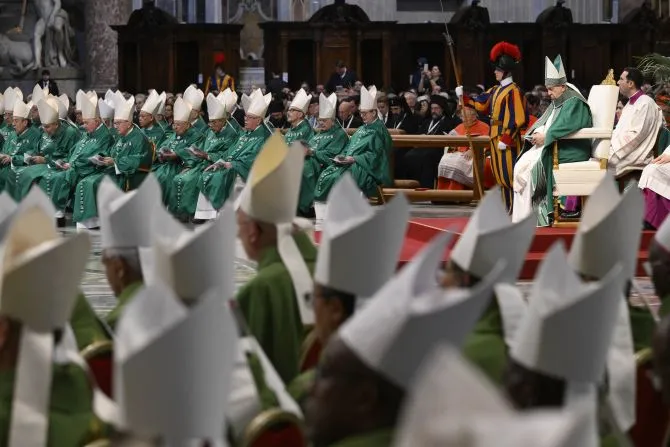
At the Synod on Synodality’s closing Mass, Pope Francis said that God’s love cannot be confined “to our own agenda” and that those who truly want to reform the Catholic Church should follow Jesus’ greatest commandment: to adore God and love others with his love.

“We may have plenty of good ideas on how to reform the Church, but let us remember: to adore God and to love our brothers and sisters with his love, that is the great and perennial reform,” Pope Francis said in St. Peter’s Basilica on Oct. 29.

“We are always at risk of thinking that we can ‘control God,’ that we can confine his love to our own agenda. Instead, the way he acts is always unpredictable, it goes beyond, and consequently, this action of God demands amazement and adoration,” he added.

The pope underlined that worship of Jesus in the tabernacle “in every diocese, in every parish, in every community” is necessary in the “struggle against all types of idolatry” in today’s world.

“Let us be vigilant, lest we find that we are putting ourselves at the center rather than him. And let us return to worship. May worship be central for those of us who are pastors: Let us devote time every day to intimacy with Jesus the Good Shepherd in the tabernacle. Adoration,” he said.

“Only in this way will we turn to Jesus and not to ourselves. For only through silent adoration will the word of God live in our words; only in his presence will we be purified, transformed, and renewed by the fire of his Spirit. Brothers and sisters, let us adore the Lord Jesus!”

The pope’s homily marked the closing of the monthlong 2023 Synod on Synodality assembly, where 365 delegates discussed and voted on more than 80 proposals for how to become a more “synodal Church.”

“Brothers and sisters, the general assembly of the synod has now concluded,” he said. “In this ‘conversation of the Spirit,’ we have experienced the loving presence of the Lord and discovered the beauty of fraternity.”

“Today we do not see the full fruit of this process, but with farsightedness, we look to the horizon opening up before us. The Lord will guide us and help us to be a more synodal and more missionary Church, a Church that adores God and serves the women and men of our time, going forth to bring to everyone the consoling joy of the Gospel,” Francis added.

In his homily, Pope Francis said he believed that at the conclusion of this stage in the synod “it is important to look at the ‘principle and foundation’ from which everything begins ever anew: loving God with our whole life and loving our neighbors as ourselves.”

“Not our strategies, our human calculations, the ways of the world, but love of God and neighbor: that is the heart of everything,” he said.

Pope Francis emphasized that adoration and worship are “essential in the life of the Church.”

“To adore God means to acknowledge in faith that he alone is Lord and that our individual lives, the Church’s pilgrim way, and the ultimate outcome of history all depend on the tenderness of his love. He gives meaning to our lives,” he said.

“Those who worship God reject idols because whereas God liberates, idols enslave,” he added.

“We must constantly struggle against all types of idolatry; not only the worldly kinds, which often stem from vainglory, such as lust for success, self-centeredness, greed for money — the devil enters through our pockets let us not forget — the enticements of careerism; but also those forms of idolatry disguised as spirituality: my own spirituality, my religious ideas, my pastoral skills.”

Pope Francis said that being “a worshipping Church and a Church of service” entails “washing the feet of wounded humanity, accompanying those who are frail, weak, and cast aside, going out lovingly to encounter the poor.”

Quoting St. John Chrysostom, he said: “The merciful man is as a harbor to those who are in need; and the harbor receives all who are escaping shipwreck, and frees them from danger, whether they be evil or good; whatsoever kind of men they be that are in peril, it receives them into its shelter. You also, when you see a man suffering shipwreck on land through poverty, do not sit in judgment on him, nor require explanations, but relieve his distress.”

About 5,000 people attended the closing Mass for the Synod on Synodality’s 2023 assembly, according to the Vatican. The Mass concluded with the congregation singing the Marian hymn “Salve Regina.”

Pope Francis thanked all of the cardinals, bishops, priests, religious, and laypeople from around the world who traveled to Rome to participate in the synod. Next year, the delegates will return to the Vatican in October 2024 to take part in the second assembly to advise the pope on the theme: “For a Synodal Church: Communion, Participation, Mission.”

“In expressing my gratitude, I would also like to offer a prayer for all of us: May we grow in our worship of God and in our service to our neighbor. Worship and service. May the Lord accompany us. Let us go forward with joy,” Pope Francis said.

Pope at Angelus: By Loving Others, "we reflect the Father’s love like mirrors"

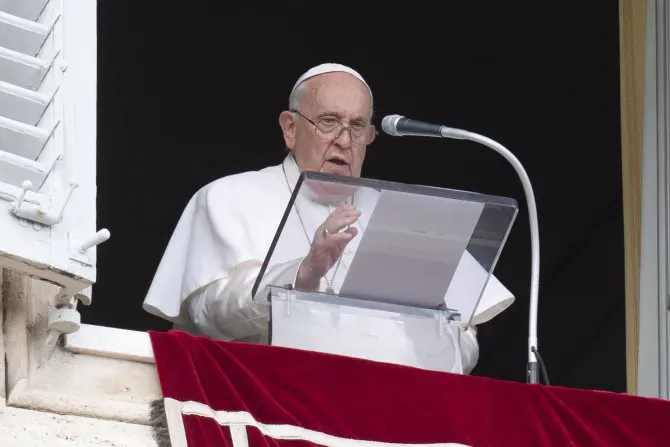
During his Sunday Angelus message, Pope Francis expressed that the love of God and the love of neighbor are inextricably bound together.

“Love of God and neighbor are inseparable from each other,” the pope said Oct. 29 in front of nearly 20,000 faithful, according to an official estimate of the Vatican Gendarmerie.

Reflecting on today’s Gospel (Mt 22:34-40), the Holy Father stressed that in it we find the “greatest of the commandments”: “‘You shall love the Lord your God with all your heart and with all your soul and with all your mind … and … your neighbor as yourself.’”

This commandment is constructed upon two central pillars. Love, the pope explained, stems first and foremost from God.

“The fact that love for the Lord comes first reminds us that God always precedes us, he anticipates us with his infinite tenderness, with his closeness, with his mercy, for he is always near, tender, and merciful,” the pope said.

The capacity to love God is the starting point and underscores all of our other relations and actions, he said.

“Everything originates in him. You cannot truly love others if you do not have this root, which is love of God, love for Jesus,” the pope explained.

The Holy Father also said this love for God is the source for charity and a font of mercy. He also said we should feel in God’s arms the way children feel in their parents’ arms.

“There [in God’s arms], we absorb the Lord’s affection; there, we encounter the love that impels us to give ourselves generously,” the pope said.

The second component of this commandment of love is fraternal love.

“It means that by loving our brothers and sisters, we reflect the Father’s love like mirrors. To reflect God’s love, this is the point — to love him whom we do not see through the brother[s]/sisters whom we do see,” Pope Francis said.

At the end of the Angelus the Holy Father took a moment to thank those who observed the international day of prayer and fasting on Friday, Oct. 27, for peace in the Israel-Hamas war.

“I thank all those who — in so many places and in various ways — united themselves to the day of fasting, prayer, and penance that we lived last Friday, imploring peace for the world,” he said. “Let us not stop.”

The pope called for continued prayers for Ukraine and placed a special emphasis on the humanitarian crisis that has been unfolding in Gaza over the past three weeks.

“Particularly, in Gaza, may space be opened to guarantee humanitarian aid, and may the hostages be released right away. Let no one abandon the possibility that the weapons might be silenced — let there be a cease-fire,” the pope said.

The pope then quoted Father Ibrahim Faltas, an Egyptian Franciscan priest who in 2022 was elected custodian of the Holy Land, whom the pope heard on a recent television program. “‘Let the arms cease! Let the arms cease!’” the pope implored.

“War is always a defeat, always!” the pope said in his often-repeated refrain.

The pope concluded his appeal with a special prayer intention for those affected by Hurricane Otis in Acapulco, Mexico.

“I am praying for the victims, for their families, and for those who have suffered serious harm. May the Virgin of Guadalupe sustain her children in this hardship.”

Hurricane Otis made landfall in the southwestern region of Guerrero on Wednesday evening as a category 5 hurricane. Currently, efforts are underway to deliver immediate emergency relief to the area. The government deployed some 17,000 soldiers and police to combat widespread looting in the city of Apulcuao, the BBC reported.

Synod: Church in Africa Called to “theological, pastoral discernment” on Polygamy Issue

The delegates at the first session of the XVI Ordinary General Assembly of the Synod of Bishops are encouraging the leadership of the people of God in Africa to discern pastoral care towards persons in polygamous unions.

In the Synod on Synodality’s “synthesis report” that the Vatican released in Italian on Saturday, October 28 night, a document written by “experts” invited to participate in the Synod and overseen by a commission of 13 Synod delegates, some 20 topics are discussed, each of the topics having “convergences,” “matters for consideration,” and “proposals”.

Under the topic, “For a Church that listens and accompanies”, the highly anticipated text, which was reportedly approved paragraph by paragraph on October 28 by a vote of 344 Synod delegates, addresses members of the Symposium of Episcopal Conference of Africa and Madagascar (SECAM).

The continental symposium of Catholic Bishops, the Synod delegates say, “is encouraged to promote theological and pastoral discernment on the issue of polygamy and the accompaniment of people in polygamous unions coming to faith.”

In this topic, under “matters for consideration”, the Synod delegates encourage the people of God across the globe to enhance Small Christian Communities (SCCs), a new way of being Church that the leadership of the Church in Africa has included in its evangelization structures.

“Widespread in many parts of the world, grassroots or small Christian communities foster listening practices of and among the baptized,” the Synod delegates say in their 42-page document, adding, “We are called to enhance their potential, including exploring how they can be adapted to urban contexts.”

In Eastern Africa, the Catholic Church has fostered SCCs for five decades.

In August, the Association of Member Episcopal Conferences in Eastern Africa (AMECEA) launched the Golden Jubilee Year of SCCs to assess the status of this new way of being church in the region.

“By December 2023, it will be 50 years since the Small Christian Communities were adopted by the AMECEA Region as a pastoral priority,” Bishop Rogatus Kimaryo of Tanzania’s Same Diocese and Chairman for AMECEA Pastoral Department said in his key address during the launch that was held in Malawi’s Dedza Diocese.

Bishop Kimaryo added that the Pastoral Departments of Bishops’ Conferences in the AMECEA region will be spearheading the yearlong Golden Jubilee celebrations, “not as an event, but a process comprising of several strategic activities involving all AMECEA member Conferences.” 

In the synthesis report that aims to be “a tool at the service of ongoing discernment”, the Synod delegates also address the reality of SCCs under the topic, “Participating bodies” from the perspective of “matters for consideration”.

Hinting to this new way of being church in Africa, the Synod delegates say, “Synodality grows in the involvement of each member in processes of discernment and decision-making for the mission of the Church: in this sense we are edified and encouraged by many small Christian communities in emerging Churches, which live a daily fraternal "body to body" around the Word and the Eucharist.”

Still under the topic of “a Church that listens and accompanies”, the Synod delegates pose the question of what needs to “change so that those who feel excluded can experience a more welcoming Church” and go on to affirm, “Listening and accompaniment are not just individual initiatives, but a form of ecclesial action. This is why they must find a place within the ordinary pastoral planning and operational structuring of Christian communities at different levels, also valuing spiritual accompaniment.”

“The Church is not starting from scratch, but already has numerous institutions and structures that carry out this valuable task,” the Synod delegates further say, and acknowledging the service of Caritas, propose pastoral care to migrants and refugees.

They say, “Think, for example, of the capillary work of listening to and accompanying the poor, marginalized, migrants and refugees carried out by Caritas and many other realities linked to consecrated life or lay associations. It is necessary to work to strengthen their link with community life, preventing them from being perceived as activities delegated to a few.”

Under the topic, “The poor, protagonists of the Church's journey”, the Synod delegates had consensus about the fact that there are different kinds of poverty.

They say, “Among the many faces of the poor are those of all those who lack the necessities to lead a dignified life. Then there are those of migrants and refugees; indigenous, original and Afro-descendant peoples; those who suffer violence and abuse, particularly women; people with addictions; minorities who are systematically denied a voice; abandoned elderly; victims of racism, exploitation and trafficking, particularly minors; exploited workers; economically excluded and others living in the peripheries.”

“The most  vulnerable of the vulnerable, on whose behalf constant advocacy is needed, are babies in the  womb and their mothers,” the Synod delegates say, and add, “The Assembly is aware of the cry of the ‘new poor,’ produced by the  wars and terrorism that mar many countries on different continents, and condemns the  corrupt political and economic systems that cause them.”

The plight of migrants and refugees is also addressed in the topic, “A Church from every tribe, tongue, people and nation’”. Here, the Synod delegates call on Church to take decisive strategies, “particularly in pastoral formation programs”, to address the challenges of racism and xenophobia.

“In a world in which the number of migrants and refugees is increasing while the willingness to  accept them is decreasing, and in which the foreigner is viewed with increasing suspicion, it is  appropriate for the Church to engage decisively in education in the culture of dialogue and  encounter, combating racism and xenophobia, particularly in pastoral formation programs,” they say.

The Synod delegates add, “It is equally necessary to engage in projects for the integration of migrants.”

Over 80 proposals were approved in the Synod vote, including establishing a new “baptismal ministry of listening and accompaniment,” initiating discernment processes regarding the decentralization of the Church, and strengthening the Council of Cardinals into a “synodal council at the service of the Petrine ministry.”

The summary report does not have definitive conclusions on blessing of same-sex unions, the ordination of women, and optional Priestly celibacy, among other hot-button topics, which have drawn the lion’s share of media attention in this first session of the XVI Ordinary General Assembly of the Synod of Bishops.

Still, the hot-button issues, which the Synod delegates call “controversial”, were addressed. For instance, among the proposals during the October 4-29 meeting at the Vatican, was the request for continued theological study of the possibility of women deacons. The Synod delegates requested that the results of such a study be shared at the next session of the Synod on Synodality, which Pope Francis extended to October 2024.

In the October 28 Synthesis report, the Synod delegates recognize their differing views regarding the possibility of a female diaconate.

The Prefect of the Vatican Dicastery for Communications, Dr. Paolo Ruffini has been quoted as saying that over 1,000 amendments were submitted by Synod delegates to the original draft of the report after it was presented to the assembly on October 25.

It has also been reported that in the exercise that saw every paragraph approved in the voting process, the paragraph describing “uncertainties surrounding the theology of the diaconal ministry” and calling for more reflection on women’s access to the diaconate received the most negative votes.

The Synod delegates, who, for the first time included the Laity with the power to vote on the final document, agreed that persons who feel excluded because of their sexuality or gender identity stand in need of accompaniment and that the Church needs to defend their dignity.

Vatican Releases Synod on Synodality Report Proposing Larger Role for Laity in Church

The Vatican released the Synod on Synodality’s “synthesis report” on Saturday night outlining key proposals discussed during the nearly monthlong assembly’s confidential conversations.

The highly anticipated text was approved paragraph by paragraph on Oct. 28 by a vote of 344 Synod delegates, which for the first time included women and other non-bishops as voting members.

The document, the synthesis of the assembly’s work from Oct. 4-29, proposes a “Synodal Church” that implements synodality throughout Church governance, theology, mission, and discernment of doctrine and pastoral issues.

The 42-page text, released by the Vatican in Italian, covers 20 topics from “the Dignity of Women” to “the Bishop of Rome in the College of Bishops.” For each topic, “convergences,” “matters for consideration,” and “proposals” are outlined.

More than 80 proposals were approved in the Synod vote, including establishing a new “baptismal ministry of listening and accompaniment,” initiating discernment processes regarding the decentralization of the Church, and strengthening the Council of Cardinals into a “synodal council at the service of the Petrine ministry.” 

Other proposals include giving lectors a preaching ministry “in appropriate contexts,” implementing structures and processes to increase the accountability of bishops in matters of economic administration, supporting “digital missionaries,” and promoting “initiatives that enable shared discernment of controversial, doctrinal, pastoral, and ethical issues in the light of the Word of God, Church teaching, theological reflection, and valuing synodal experience.”

The document also encourages churches to experiment with “conversation in the spirit”— the listening-and-reflection method the Synod’s delegates have used in their deliberations this month — and forms of discernment in the life of the Church. It calls for the implementation of “the exercise of synodality at regional, national, and continental levels.”

Absent from the summary report are definitive conclusions on same-sex blessings, women’s ordination, and a handful of other hot-button topics that have drawn the lion’s share of media attention during this year’s assembly.

Throughout the document, areas of disagreement among the Synod participants are listed as “matters of consideration.” Among them are women’s access to diaconal ministry, priestly celibacy, “Eucharistic hospitality” for interfaith couples, and assigning the handling of abuse cases to another body instead of the bishops.

Written by “experts” invited to attend the Synod and overseen by a commission of 13 Synod delegates, the text says it aims to be “a tool at the service of ongoing discernment.” It is divided into three main sections on the elements of a synodal Church, participation in mission, and processes that enable dialogue with the world.

Vatican spokesman Paolo Ruffini said that more than 1,000 amendments were submitted by Synod delegates to the original draft of the report after it was presented to the assembly on Wednesday.

Voting on the text took place on Saturday night with each paragraph requiring the approval of two-thirds of the members present for inclusion in the final report. 

Every paragraph was approved in the voting process. A paragraph describing “uncertainties surrounding the theology of the diaconal ministry” and calling for more reflection on women’s access to the diaconate received the most negative votes.

“Rather than saying that the Church has a mission, we affirm that the Church is mission,” the document says.

“The exercise of co-responsibility is essential for synodality and is necessary at all levels of the Church,” it adds.

The text is the culmination of days of discussion by 365 Synod delegates during the 16th Ordinary General Assembly of the Synod of Bishops after years of consultation at local, national, and regional levels since the global Synod process was launched in 2021. It lays the foundation for the second Synod on Synodality assembly that will take place in October 2024.

The 2023 Synod assembly will come to its formal conclusion on Oct. 29 when Pope Francis offers the closing Mass in St. Peter’s Basilica.