Friday, September 02, 2022

Catholic Charities gets water to needy communities in Mississippi

 Catholic Charities of the Diocese of Houma-Thibodaux - Home | Facebook

Chamon Williams remembers the catastrophic damage caused by Hurricane Ida in 2021, and how Catholic Charities of Jackson, Mississippi helped the Diocese of Houma-Thibodaux then. Now, she is returning the favor as a water crisis hits Mississippi’s capital city.

“Sometimes we have to support each other before we can get resources from other agencies,” Williams, the executive director of Catholic Charities of Houma-Thibodaux, Louisiana, told Crux.

“I can definitely say that after Hurricane Ida the Jackson Diocese and Catholic Charities of Jackson were very instrumental in getting household supplies, hygiene items, and different food to the Houma-Thibodaux diocese,” Williams said. “So, we’re just sharing the blessing that they shared with us.”

About 215 miles north of Houma, Catholic Charities of Jackson is also doing all it can to respond to the water crisis. The organization bought pallets of water that were available to the community, while simultaneously helping house those displaced by recent flooding.

Wanda Thomas, executive director of Catholic Charities of Jackson, told Crux that the challenge is that even as the water has dried up and people can return to their homes, they’re returning to homes without the water that they need.

“The stores are working really hard in the State of Mississippi to get water in so the water supply will be there,” Thomas said. “Of course, it has to be purchased, so anyone who’s able to send water to the state of Mississippi or send donations to assist with purchasing that water will be greatly appreciated.”

Jackson is a city of about 150,000 residents. The water crisis began earlier this week after the Pearl River flooding caused by excessive rainfall led the city’s main water treatment facility to fail. Gov. Tate Reeves earlier this week declared a state of emergency and activated the Mississippi National Guard.

On Aug. 31, an emergency rental pump was installed at The O.B. Curtis Water Plant. And Reeves’ federal disaster declaration was approved, paving the way for an array of federal programs to assist. Further, Reeves announced on Sept. 1 that the state has seven water distribution sites set up, each of which is open from 9 a.m.-6:30 p.m. offering bottled water.

“Getting these water distribution sites set up and running quickly was a top priority,” Reeves said. “Local, state, and federal officials are working together in tandem to ensure that everyone in Jackson has the supplies they need to weather this crisis. As the state works to repair Jackson’s water system, we’ll ensure these sites are well stocked and able to meet the needs of the people.”

On Aug. 31, Bishop Joseph Kopacz of Jackson thanked government officials for their efforts, but also highlighted the need to address what has become a longstanding water problem in Jackson. Compounding the present crisis, the city already had a boiler-water notice that has been in effect for more than a month because of water quality concerns.

“We are pleased that President Biden, Governor Tate Reeves and Jackson Mayor Chokwe Lumumba are trying to work together to address the water situation in Jackson,” Kopacz said in a statement. “We pray for a long-term solution to this problem, and a swift response to get water flowing back into all Jackson homes and businesses.”

A spring report from the Mississippi Urban Research Center examined the Jackson water crisis from past and present perspectives, and highlighted the age of Jackson’s water system, the city’s declining population and high poverty rates, and a lack of federal and state assistance as some of the reasons for the city’s persistent water problems. Current Mayor Chokwe Lumumba stated that it would take approximately $2 billion to fully repair and fix a dated Jackson water system.

Recommendations in the report to address the issues include increasing efforts for collecting water bills and creating a new agency for enhanced inter-local government collaboration, increasing African-American church representation in municipality emergency preparedness plans, increasing federal and state investment in Jackson’s water infrastructure, and pursuing innovative methods of generating revenue for the city in light of a shrinking population and tax base.

Until the ball gets rolling on any possible fixes Jackson residents will have to live with the uncertainty of whether something like this will happen again. Thomas said she’s never experienced anything like the present water crisis, noting that this week residents have expressed to her concerns about what this means for the future.

“Water is essential. It is one of the basic needs of life for us to be healthy and survive, so when you think about that and think about not having it, it is very terrifying for them and I’m sure we will have a lot more of those conversations with those who arrive at our office today and tomorrow as they come by to pick up the water that’s being offered,” Thomas said.

Vatican Swiss Guards up efforts to draw new recruits

  Pope tells new Swiss Guards they represent a church that welcomes -  Catholic News Service

The world’s smallest army, which in recent years has faced difficulty filling all its slots for new recruits, has created a new media relations position in a bid to yield better publicity and attract fresh members.

In a Sept. 1 communique, the Pontifical Swiss Guard announced it is expanding its presence in Switzerland “by creating a press office and a contact point for authorities.”

The man tapped for the job is Stefan Wyer, originally from Visp and who previously worked as an independent business consultant for communication and politics.

Wyer will report directly to the Commander of the Swiss Guard, Christoph Graf, who was appointed to the post by Pope Francis in 2015, and he will also work closely with the head of the Swiss Guard Information and Recruitment Office, Bernhard Messmer.

After Pope Francis’s decision in 2018 to increase the number of Swiss Guards from 110 to 135, “the need to hire new recruits has increased,” the communique said, saying the process of recruitment “must be supported by a more active public relations work.”

According to the communique, the Guards’ new public relations’ push will include the creation of a direct point of contact with Swiss Media, and better publication of the activities and entities attached to the Guard.

Over the past few years, the Swiss Guard has attempted to change the perception that those who enlist are merely another tourist attraction at the Vatican, standing with their distinctive halberds in hand while foreigners snap selfies beside their colorful uniforms and feathered hats.

Instead, the Guard has sought to emphasize the military and weapons’ training members are required to have, and the fact that they accompany the pope everywhere he goes, including on foreign trips.

New recruits are sworn in each year on May 6, marking the date in 1527 when 147 Swiss Guards lost their lives defending Pope Clement VII during the sack of Rome. Only 42 guards survived the massacre, and the swearing-in date was selected specifically as a reminder of what they must be willing to sacrifice when pledging their oath to protect and serve the pope.

The Guard – whose members pledge to “faithfully, loyally, and honorably” serve and protect the pope and, if necessary, give their lives for him – keep watch over the pope at his residence in the Vatican’s Domus Sanctae Marthae guesthouse, and they also provide security at public events and for visits of heads of state and other dignitaries to the Vatican.

Conditions for joining the Guard

In order to be accepted in the Swiss Guard, recruits must meet a list of specific criteria.

They must be male, a Swiss citizen, a practicing Catholic, single, and between the ages of 19-30. Young men who enter must commit for at least 26 months and they must also be athletic, in good health, and stand at least 5 feet 8 inches tall with an “unblemished reputation.”

New recruits are required to pass a series of health exams in order to be accepted, including a psychophysical test evaluating their ability to handle stress. They must also have completed the Swiss Army Recruit School, giving them familiarity with both the military and how to form camaraderie in close quarters.

Training for new guards lasts two months and is divided into two parts.

Since 2016, new members have undergone intensive training with the police in the Ticino canton of Switzerland, after having completed their medical exams in Rome.

The training courses in Ticino include studying certain aspects of psychology and law, as well as tactical military training and lessons in other areas such as fighting fires, CPR, shooting, self-defense with “restrictive and containment techniques,” as well as sports and measures for personal safety.

In the second part of their training, Swiss Guard recruits return to the Vatican to learn more practical skills, including Italian language lessons and getting to know the layout of Vatican City itself, and the people they will encounter on a daily basis.

Their knowledge of the Vatican’s Apostolic Palace and the people employed in each of the Vatican’s offices are tested on a weekly basis.

New recruits also undergo further military training exercises and conduct drills for marching, alone and as a team, and on use of the halberd they carry while on duty.

The guards are expected to practice “continuous learning” throughout their time in the tiny army, and undergo several checks and tests throughout their time in the Vatican, including formal language exams, and an annual athletic test.

New barracks

In recent years, there has been chatter within the Swiss Guard about the possibility of allowing women to join its ranks.

The main reason women are not allowed, at least since the beginning of the new millennium, is not gender, but housing, as the current barracks are small and cramped shared spaces, with just 12 single rooms for the entire 135-man army, making the addition of women into such tight quarters problematic.

Last year the Vatican unveiled plans to renovate the barracks, with a projected completion date of 2026, to mark the 520th anniversary of the founding of the Swiss Guard.

The plans include a much-needed expansion that is aimed not only at improving the life of the current guards, but which will also allow the possibility of allowing women to enlist in the future.

The new barracks are scheduled to be formally inaugurated May 6, 2027 and include floor plans for 123 single rooms spread out over four floors.

Currently, the building is 150 years old and requires near-constant repair, making the need for updates and modernization urgent, and with the decision to increase the number of guards to 135, there has been increased pressure for more space.

A Switzerland-based architectural firm has designed the new barracks, in keeping with current building and safety codes, as well as environmental efficiency standards. The total cost is estimated around $60 million.

Whether any of these efforts and the new media push will be successful in drawing new recruits is yet to be seen, but in the meantime, the Guard appears to be doing everything it can to pique interest for what is arguably one of the most unique military experiences in the world.

Pope Francis' tenure isn't over. In fact, themes of his pontificate are now starting to gel (Op-Ed)

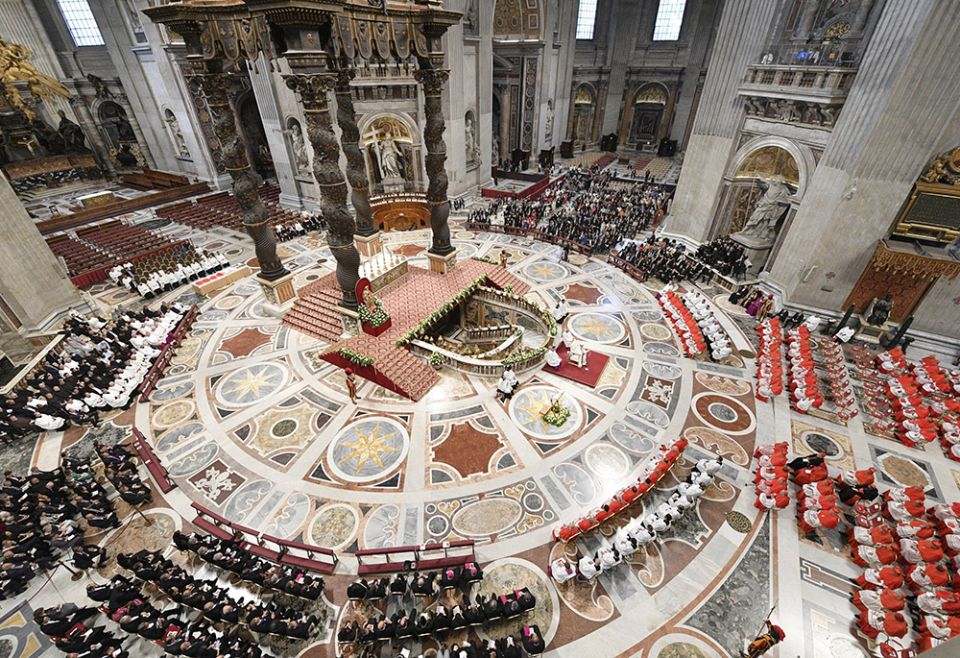
 Pope Francis leads a consistory for the creation of 20 new cardinals in St. Peter's Basilica Aug. 27 at the Vatican. (CNS/Vatican Media)

While in Rome this week, I spoke with a number of visiting cardinals and curial officials. All agreed that speculation that Pope Francis' tenure is coming to its end is misplaced. 

But there was a sense that the papacy has entered a new phase in which the Holy Father and the Roman Curia are looking to consolidate the reforms.

The consolidation is focused on the central, ecclesial themes of the pontificate: discernment, encounter, accompaniment, emphasizing the mercy and tenderness of God, the revival of pastoral theology, synodality, how to care for creation, and how to engage, rather than confront, secularization. These themes are taking root, and even those cardinals and bishops who were once skeptical are embracing the pope's ideas. 

One cardinal who in 2015 gave what a synod father said was "a finger-wagging speech" to the pope, telling him he couldn't do what he thought he could do regarding Communion for the divorced and remarried, this time gave a speech commending the pope and endorsing his reforms of the Roman Curia.

The consolidation of themes is not like the consolidation of gains a general might undertake on the battlefield, halting an advance so that the rest of the army can come up, reestablishing supply routes and taking measures to squash any counterattack. No, this consolidation is more like the flavors of a stew melding together in the course of a long, slow simmer, each flavor still distinct but improved by encountering the other flavors.

In conversations with people in different roles, the most consistently expressed opinion was that synodality was changing the way the church is, not just the way it functions, including what it means to be a pastor and an evangelizer. A bishop is a teacher of the flock, for example, but synodality reminds him in concrete ways that the Spirit of God is already at work in the lives of his flock. 

A bishop does not drop out of the sky with all the answers and if he thinks he can, his ministry will be limited, even crippled, and pedantic. The diocese may become an extension of his vision, and the people may be obedient, but the diocese will not be alive to the promptings of the Holy Spirit. The Master chose 12 apostles, not one, so the church has never been a univocal thing.

Similarly, cultivating discernment in the life of the church takes more work than simply memorizing the catechism. A rote faith may be real, but it will not be well suited to evangelization. It will only be capable of apologetics. There is a place for apologetics, to be sure, but unless pastoral leaders distinguish apologetics from evangelization, we will continue to drive away five young people for every one we attract. 

Reducing the faith to a set of propositions is very Kantian. For a sliver of the ambient population, such a reduction works, but for millions of other people, it is the tenderness of God, not the theses about God, that attract and stir the heart. Here it is Francis, not his critics, who is most faithful to the ressourcement, or return to the Patristic sources and Scripture that characterized Vatican II.

There is a place for apologetics, to be sure, but unless pastoral leaders distinguish apologetics from evangelization, we will continue to drive away five young people for every one we attract.

The Spirit of God is at work not only in the lives of the faithful, but beyond the walls of the church as well. This is one of the Holy Father's most provocative and important themes, one he touched on in his address to the bishops, clergy and religious of Quebec. There, building on quotes from Pope Paul VI, he said:

Saint Paul VI distinguished secularization from secularism, a concept of life that totally separates a link with the Creator, so that God becomes "superfluous and an encumbrance", and generates subtle and diverse "new forms of atheism": "consumer society, the pursuit of pleasure set up as the supreme value, a desire for power and domination, and discrimination of every kind" (ibid). As Church, and above all as shepherds of God's People, as consecrated men and women, seminarians and pastoral workers, it is up to us to make these distinctions, to make this discernment. If we yield to the negative view and judge matters superficially, we risk sending the wrong message, as though the criticism of secularization masks on our part the nostalgia for a sacralized world, a bygone society in which the Church and her ministers had greater power and social relevance.

Instead of wringing our hands about the secularization of the ambient culture, a process that has been ongoing for centuries, Pope Francis invites us to accompany those outside the church, mindful that the Spirit is at work in their lives too, that our Catholic doctrine of the Incarnation demands we stipulate that God is at work in their lives.

That speech in Quebec is one to read again and again if you want to understand Pope Francis and how his Christocentric vision is so rooted in the teachings of Vatican II.

What most surprised me about this visit to Rome was the cross-pollination among the themes of this pontificate. Officials who have been hard at work implementing the integral ecological vision of Laudato Si' talk about the importance of synodality to their work. Curial officials who are coordinating the synodal process talk about the importance of Laudato Si' and its commitment to the idea that everything is related.

It is ironic in a sad way that so many U.S. Catholics, and so many Catholic institutions of higher learning in the U.S., fail to see these connections or engage this cross-pollination. Ideologues always abhor synthesis and resist cross-pollination. Academics need to specialize to get published, focusing on ever narrower points of interest.

But a secular, non-Catholic school, the University of Louisville, launched in May a "New Vision of Health" downtown campus as part of its Christina Lee Brown Envirome Institute, and the organizers of that endeavor seem to have grasped what Pope Francis and the Curia grasp: Everything is related and if we do not break out of our silos, our culture and society will never meet the challenges we face. Science, justice, encounter, charity, faith all have a role to play in coping with the mess we moderns have made.

The picture of what a synodal church will look like, which was somewhat unknown and even vague when the Holy Father began placing emphasis on synods at the start of his papacy, is being filled in. This week, he added an element that has been missing since 2015, getting all the cardinals together so that they can get to know each other because they one day have to enter into the conclave that will choose Francis' successor.

Critics of this papacy, however, shouldn't count on that conclave happening anytime soon. The pope seems to have made peace with his physical infirmities and doesn't appear to be going anywhere. What is more, the reforms he has begun are likely to be pursued by the next pope and the pope after that.

Francis' synodal commitment is not only changing the papacy and the Curia, although it is doing that. It is changing the church. The windows opened at Vatican II are letting in fresh breezes. There is excitement again in the ancient center of the Catholic faith as new ecclesial approaches spread the good word to a new generation of Christians and non-Christians: The cloth at the temple has been rent from top to bottom and the tomb of the crucified is empty.

Pope to WCC: Christian mission is to bring reconciliation to world

 Pope to visit Geneva for World Council of Churches anniversary - Vatican  News

“Our mission as Christians is to bring the fulfilment of this reconciliation to the world, with the Church being the instrument and visible sign of the unity to which God calls all people,” says Pope Francis in his Message to the 11th Assembly of the World Christian of Churches.

The Pope’s message was read by Cardinal Kurt Koch, the Prefect for the Dicastery for Promoting Christian Unity, who is leading the Catholic delegation to the meeting.

The Holy Father notes in his message that the Catholic Church has been sending observers to the Assemblies since 1901, and says the presence of the delegation at this Assembly is a sign of the “strong relationship” between the Church and the WCC.

A timely invitation

In his message, Pope Francis focuses on the theme of the Assembly — “Christ’s love moves the world to reconciliation and unity” — which he calls “a timely invitation” for Christians to work for even greater unity among themselves, and to foster reconciliation around the world.

He emphasizes that the “search for reconciliation and unity has, above all, a vertical dimension,” recalling that it is ultimately directed to God, who has reconciled humanity to Himself through Christ.”

At the same time, he warns of the “perennial temptation to accommodate the evangelical message to worldly ways of thinking,” and reminds Christians that they can bear convincing witness to reconciliation only if they are faithful to the Lord.

Ecumenism and mission belong together

This also requires a commitment among Christians to work for unity among themselves: “Reconciliation among Christian is the fundamental prerequisite for the credible mission of the Church,” he says, adding, “Ecumenism and mission belong together and are interrelated.”

Pope Francis concludes his message with the hope that the “reconciled diversity” of the Assembly of the WCC might strengthen and deepen communion among all, so that Christian unity may be an ever more radiant sign of hope and comfort for humanity."

And he prays that the Assembly might “bring the world closer to reconciliation and unity, with the power and light of the Holy Spirit.”

Churches to continue support service for abuse victims

 About the safe spaces project – Safe Spaces England and wales

The Catholic Church in England and Wales has announced that it will continue the Safe Spaces service, provided jointly with the Church of England, to support victims of church-based abuse. This follows a successful two-year trial of the scheme.

The service, run through its pilot period by the charity Victim Support, offers a confidential helpline and personal support to those who have suffered abuse through their relationship with the Church. 

It is staffed by a team of trained support advocates, who have undergone specialist training in supporting survivors of sexual violence, and specific training on church abuse cases.

More than 300 victims have used the service since it began in September 2020.

An independent assessment found the pilot a success, and the Churches will now begin a tendering process to find a long-term provider to take over from Victim Support in January. 

The charity said it would be “working closely with the Churches to ensure a smooth transition and extending our support for victims currently in our service in the meantime”.

Victim Support confirmed to The Tablet that it had not expected to run the service beyond the pilot.

The lead on safeguarding for the Catholic bishops’ conference is the Bishop of the Forces, Paul Mason, who is also on the board of the Catholic Safeguarding Standards Agency. He said it was “vital that victims and survivors of church-related abuse get the support they need, when they need it, from an independent specialist source”.

Although Safe Spaces is funded by the Churches, it is run independently.

Bishop Mason continued: “Whether you have used the Safe Spaces service previously, are currently receiving support, or may in the future, we will do everything we can to make sure there is always this free, confidential service available to you.”

The Anglican Bishop of Southampton, Debbie Sellin, is a trustee of Safe Spaces. She said that the two years of the pilot scheme demonstrated how it “provides a vital support service to those who have experienced church-related abuse and I am encouraged that we are now moving to establish it on a longer term footing”.

She confirmed that existing users will remain in contact with the current team from Victim Support, while those contacting Safe Spaces from 23 September would be supported by a team from the Splitz Support Service, which will cover the scheme until January.

Safe Spaces was welcomed by campaigners when it was launched in 2020, but both Catholic and Anglican Church authorities were criticised for their slow progress in starting the initiative, which had taken six years.

Pope Francis expresses closeness to Argentine Vice President

 Falklands shock: How Pope Francis 'helped Cristina Kirchner back into  power' | World | News | Express.co.uk

Pope Francis has sent a message of closeness to the Vice President of Argentina, Cristina Fernández de Kirchner, following reports of an attack on her on Thursday.

“Having received the disturbing news of the attack that Your Excellency suffered yesterday afternoon, I wish to express my solidarity and closeness in this delicate moment,” the Pope said in a telegram on Friday.

The Pope prayed that “social harmony and respect for democratic values may prevail in dear Argentina, against all types of violence and aggression.”

Assassination attempt

The Argentine Vice President narrowly survived an assassination attempt late Thursday, after a gunman’s weapon failed to fire as he aimed at her.

Footage circulating online shows Fernández de Kirchner surrounded by a mob of supporters as a hand appears from the crowd holding a gun pointed at her face at close range. The weapon did not discharge and Fernández can be seen flinching and ducking.

Police said the gunman, identified as a 35-year-old Brazilian, has been taken into custody, according to the BBC.

Authorities are still attempting to establish a motive for the attack on the Vice President.

Parish granted reprieve in Derry diocesan clerical changes

 Diocese of Derry - Building our Faith Community

A CATHOLIC parish in Derry city has been given a reprieve following fears it was to be amalgamated with a larger neighbouring parish because of the fall in numbers and vocations to the priesthood.

Parishioners at Culmore had feared their parish was to be amalgamated with neighbouring Steelstown following the retirement of Fr Colum Clerkin. 

It was also announced earlier this year that the parish was to lose its church when a lease arrangement with the Sisters of Mercy religious order came to an end. 

The move could make the parish the first in Ireland to operate without a church.

However, after meeting parishioners, Bishop of Derry, Donal McKeown confirmed in his annual clerical changes for the diocese that the parish would continue to exist under the administration of Steelstown parish priest, Fr John McDevitt. 

It is understood negotiations are continuing to establish a place of worship in Culmore parish.

Thursday, September 01, 2022

Vatican’s silence on China is disconcerting (Op-Ed)

 Are diplomatic relations between the Vatican and Beijing on the horizon? |  Catholic News Agency

Last Saturday, as a new consistory began in Rome, Pope Francis created 20 new Cardinals.  Six came from Asia — Singapore, Mongolia, Timor-Leste (East Timor), South Korea, and two from India.

New cardinals came from five continents, ensuring that the universality of the Church is really, truly, global. And three new religious members were appointed, from the Congregation of Jesus and Mary (Eudists), the Consolata Missions Institute and the Legionaries of Christ.

Among religious orders represented in the College of Cardinals, the largest are the Salesians, who now number ten.

This is all very good news and I applaud the Holy Father for these appointments. I began my human rights work in Timor-Leste, during Indonesia’s brutal and bloody occupation, and worked there throughout and beyond its transition to independence.

I have had the privilege of meeting the current Bishop of Dili, Virgilio do Carma da Silva, and am so pleased he has been made his country’s first cardinal. It is a signal of solidarity and respect for that beautiful, benighted and often forgotten half-island that fought for freedom and human dignity for a quarter of a century with immense sacrifice and has risen from the ashes over the past two decades in an inspiring way.

As someone who has lived, traveled in and loves Asia, I am delighted that Singapore and Mongolia now have cardinals. And as someone who was inspired and received into the Church by Myanmar’s Cardinal Charles Bo, a Salesian, I am delighted to see the presence of Salesians, including the new East Timorese Cardinal.

My spirituality has had many influences, particularly drawing from Jesuit, Dominican and Benedictine traditions, but several of the heroes of my faith happen to be Salesians.

And yet in the consistory, out of 226 cardinals, there is one cardinal — and one Salesian — conspicuous by his absence, and that is Hong Kong’s 90-year-old Bishop Emeritus, Cardinal Joseph Zen. On May 11 this year, he was arrested by the Hong Kong police for the crime of being a trustee of a charity providing legal aid to protesters facing prosecution. Next month, he will go on trial.

When Cardinal Zen was arrested, the police took his passport. In itself that is not uncommon for those arrested in Hong Kong. But one has to wonder whether the Vatican did not regard that as rather convenient. Did the Vatican invite Cardinal Zen to the consistory? Did the Holy See make any efforts to appeal to the Hong Kong and Chinese authorities to return Cardinal Zen’s passport and allow him to travel to Rome? Were any diplomatic efforts of any kind made by Rome to at least signal that His Eminence would be welcome if he could travel? These are questions the whole world should be asking — not of Beijing, but of the Vatican.

If the answer to these questions is "no" and "none," then my heart breaks for the future of the Church. Especially when it comes at a time when, just two weeks ago, China held its own rival gathering of clergy, when 345 bishops, priests and religious met for the 10th National Congress of Catholicism in Wuhan, in the presence of senior Chinese Communist Party officials, to elect the new leaders of the Catholic Patriotic Association (CPA) and the Bishops Conference of the Catholic Church in China.

Strikingly, among a conference of supposedly Catholic bishops and clergy, among this gathering there was much talk about Xi Jinping Thought, advancing the goals of the Chinese Communist Party, patriotism (which in this context means loyalty to the Party more than the country), and little if any mention of God, our Lord Jesus Christ, Our Lady, the Holy Bible or Catholicism. The focus was on the regime’s campaign of “Sinicization” of the Church — which, rather than the “inculturation” familiar to Catholic theology, essentially means the wholesale coercion, indoctrination and takeover of the Church by the regime in Beijing.

What worries me is that Xi Jinping’s campaign of “Sinicization” does not stop with the state-approved Church in China. It has penetrated the highest echelons of the Vatican itself.

Why else would a pope who admirably speaks out on many issues of injustice around the world, including the genocide of the predominantly Muslim Rohingyas in Myanmar, be so persistently and consistently silent about one of the worst mass atrocities of contemporary times, the genocide of the predominantly Muslim Uyghurs?

Why else would a pontiff who speaks out for persecuted Christians in the Middle East and elsewhere, and rightly so, be so silent about the persecution of Christians in China?

Why else would a pope who has regularly defended the Yazidis fail to call out the crime against humanity of forced organ harvesting perpetrated against Falun Gong practitioners?

Why else would a pope who has often led inter-faith dialogue refuse to meet the Dalai Lama?

Why else would this pope ignore the dismantling of freedoms in Hong Kong and the threats to Taiwan’s very existence?

Why would a pope who wants to convey compassion and mercy refuse to meet one of his most senior and elderly cardinals, as he did when Cardinal Zen traveled to Rome in vain in 2020, despite knowing it was likely to be Zen’s last visit?

And why has the Vatican’s response to Cardinal Zen’s arrest and forthcoming trial been so tepid, merely noting the news “with concern?”

Cardinal Zen, despite his arrest, should have been invited by the pope to the consistory, and the Vatican should have appealed to the Chinese and Hong Kong authorities to release Zen’s passport so he could travel. Failure to do either is a stain on the moral authority of the Holy See.

Over the past few days, I have been in Rome. I did not go for the consistory, but I happened to be there at the same time. For the first time in the nine years since I became a Catholic, I felt very profoundly mixed feelings — and a very heavy heart.

On all my previous visits I felt only the joy of being in the Eternal City. On several previous occasions I have had the privilege of joining private, and public, audiences with the Holy Father.

In 2015, just two years after he received me into the Catholic Church in St Mary’s Cathedral, Yangon, I had the honor of being in St Peter’s in Rome to see my friend Cardinal Bo receive the red biretta, as Myanmar’s first ever Cardinal.

This time it felt different. I love Rome, I love the Church and I love the Holy Father. Indeed, I was received into the Church in Myanmar only 10 days after Pope Francis was elected. I have grown up as a Catholic under Pope Francis, and his message of mercy, grace, peace and love is much-needed in our world today. I am also saddened to see his health deteriorate, and the pain he is clearly in when he walks.

But there was a pain in my heart and soul too — a spiritual pain, afflicting the conscience.

I was attending a conference, and with that conference, I could have once again attended a private audience with the Holy Father, as I have been privileged to have done on several previous occasions. Ordinarily, I would have loved to and would have made it a priority to do so, especially after the past two years of absence due to the Covid-19 pandemic. With the world facing so many enormous challenges at this time, I would have been eager to see the Holy Father in person once again, for a moment of encouragement and instruction. But this time, I had to wrestle with my conscience. I love Pope Francis. On most issues his message is beautiful. But I have a very deep, profound problem with the position the Vatican has taken under his papacy on China. And so I thought it better not to go.

I could not in all consciousness make platitudes to a pontiff whom I love and yet whose silence on the genocide of the Uyghurs grieves me. I could not in good conscience shake hands and make small talk with a pope who refused to meet one of my heroes, Cardinal Zen, and won’t speak out for him. I could not with integrity smile and not ask him why he never speaks out for persecuted Christians in China. And I could not, without hypocrisy, present myself to him at a time when he is poised to renew a deal with a regime that stands accused of crimes against humanity for forced organ harvesting, a regime that threatens democratic Taiwan, and a regime that has destroyed Hong Kong’s freedoms and torn up its international treaty promises.

Yet at the same time, the audience was not in any way an appropriate place to make my conscience known. I could not have raised any of these issues, without souring the occasion, embarrassing my hosts, or making for an awkward, perhaps angry, photograph with the Holy Father, none of which I would want to do. So on this occasion, it was best to stay away.

But on the Vatican’s deal with China, I cannot and will not be silent. It is truly an appalling betrayal of the faithful in China and of all that drew me into the Church in the first place.

I joined the Church because I read the Catechism from start to finish. I cannot find where in the Catechism it calls us to sell out our values and stay silent about the truth.

I joined the Church because I read the Compendium of the Social Doctrine of the Church from start to finish, and many papal encyclicals. I cannot find where the Catholic Social Teaching tells us to be silent in the face of genocide, crimes against humanity, religious persecution, unjust imprisonment, forced organ harvesting, forced abortion, human trafficking, torture and other injustices.

I joined the Church because I was inspired by its many examples — throughout history — of courage in defense of freedom, justice, human dignity and truth, epitomized by Cardinal Zen. I cannot fathom the Vatican’s apparent rejection of him.

I will never leave the Church I joined nine years ago because I believe at its heart it contains a truth that outshines the world’s lies. I just wish its leaders would rediscover that truth and stop kowtowing to Beijing’s lies. In the Eternal City, let’s see a revival of eternal courage to defend an eternal truth that beats anything Xi Jinping and his sordid regime has to offer. Let us have the courage of our convictions, stand up, stand tall and hold that eternal flame boldly and brightly in the face of bullies.