Thursday, September 01, 2022

Nuns' statement on new Chilean Constitution stirs Church

 Category:Discalced Carmelite nuns - Wikimedia Commons

A group of Discalced Carmelite sisters issued a statement with their reflections on the new constitution being put to a plebiscite, provoking reactions within the church, including other nuns.

"If we reject the proposal of a new constitution," the Carmelites' statement said, "we are rejecting the possibility of taking a big step forward in the future of our country."

Chileans vote Sept. 4 on a new constitution, which would replace a document dating back to the military dictatorship of President Augusto Pinochet, who seized power in a 1973 coup.

The new constitution has been described as progressive by supporters and derided as "woke" by critics. A lengthy document with 388 articles, it declares Chile a "pluri-national" state, in which Indigenous peoples are recognized. It also enshrines environmental protections, guaranteed education access and gender equality.

Chile's Catholic bishops urged people to participate in the referendum and supported the process, but have not said how to vote. The vote comes as the bishops' deal with the fallout of clerical sexual abuse scandals, which have cratered their credibility in Chilean society.

The Carmelites, based in San José de Maipo, showed support for many of the progressive articles. Their statement said of the recognition of Indigenous peoples "is a gesture that dignifies Chile and profoundly rejoices Mary, Our Lady of Guadalupe."

Their statement pointed to an article reading, "Every person has the right to freedom of thought, conscience, religion" and another saying, "the state recognizes spirituality as an essential element of being human."

The sisters continued, "This new constitution is ecological, respects and legislates on nature, as Pope Francis asks us in the encyclical 'Laudato Si'', in which he calls us to respect and love the 'common home,' the earth and common natural assets."

Other Carmelites did not share the sisters' reflections, however.

The statement "causes us great pain," the Association of Discalced Carmelites said in a statement Aug. 23. "It does not represent the opinion of the Carmelites in Chile. It only represents the voice of a monastery, the only one that is not associated with the 13 monasteries of the Discalced Carmelite of Chile."

The association added, "As women and citizens, each Carmelite nun, in the exercise of our freedoms and in conscience, will decide the best for Chile," and emphasized, "We defend life from conception until natural death."

Auxiliary Bishop Carlos Godoy Labraña of Santiago sent a letter to the Carmelites, asking them to "clarify that your statement respects the life of the unborn."

In a June statement, the Chilean bishops' conference called for discernment on the constitution and for people to "put the common good of the country first."

The bishops offered a "positive assessment" on the constitution's sections on social rights, the environment and Indigenous peoples.

But they said, "We make a negative assessment of the norms that allow the interruption of pregnancy, those that leave open the possibility of euthanasia, those that disfigure the understanding of the family, those that restrict the freedom of parents regarding the education of their children, and those that that pose some limitations on the right to education and religious freedom."

The bishops especially expressed unease with the constitution's sections on religious freedom.

"The problem is that the project ... supports the right to abortion, assumes a questionable orientation of sexual education where parents participate in a very insufficient way, and promotes a radical theory of gender, all aspects incompatible with the Christian faith," the bishops said.

"By being subject to what is established in the proposed Constitution, religious freedom is put at risk."

The new constitution was drafted by an elected assembly of 154 men and women, who were convened after protests over social conditions and the stark inequality stemming from the neoliberal policies of the Pinochet regime -- even though Chile has become the wealthiest country in Latin America on a per capita basis.

A poll published Aug. 19 by Cadem -- on the final day polling for the plebiscite was permitted -- showed 46% opposing the new constitution, 37% supporting it and 17% uncertain or not responding. If the new constitution is rejected, the current one remains valid.

Backers of priest’s cause vow to fight recommendation to suspend it

  Children's Rosary: Prayer to Father Vincent Capodanno

A battlefield commander’s radio message pierced the frenzied bustle at the headquarters for the 3rd Battalion of the 5th Marine Regiment.

Top brass expected lots of casualties during “Operation Swift” — an assault aimed at sweeping enemy troops from a strategic rice-producing valley in Vietnam.

The cost was 127 U.S. service members killed in action, but no one expected one of them would be the 38-year-old Naval Reserve lieutenant from Staten Island.

The commander didn’t say the man’s name, but everyone quickly guessed it was the chaplain, Father Vincent Capodanno, affectionately known as the “Grunt Padre.”

“He said, ‘One KIA Naval officer,'” recalled George Phillips, then a corporal from Brooklyn, who was wounded in the same battle. “They made him repeat the message to make sure they heard it correctly.”

This grim news, Phillips said, quickly spread — “The padre is dead.”

Phillips, a lifelong Catholic, attended St. Thérèse of Lisieux Parish in Brooklyn and in Vietnam, he developed an easy acquaintance with Father Capodanno.

He recalled seeing the priest on the morning of Sept. 4, 1967, at the staging area for Operation Swift. The priest joked with Marines, shared cigarettes and handed out St. Christopher medals.

Later, Phillips caught glimpses of him during the battle, pulling the wounded to safety and giving last rites.

Phillips was evacuated with shrapnel wounds to his legs. The next day he learned that shrapnel tore fingers from Father Capodanno’s right hand. Still, the priest continued until 26 machine gun bullets killed him.

“Grunts” of the 5th Regiment, part of the 1st Marine Division, mourned their popular chaplain. His heroism nearly 55 years ago brought him the nation’s highest military award, the Medal of Honor — and spawned efforts to have him canonized.

But members of the Father Capodanno Guild were recently startled by a recommendation from theological consultants for a “suspension” of the chaplain’s cause for sainthood.

The consultants’ recommendation is under consideration by the Dicastery for the Causes of Saints at the Vatican, which ultimately decides whether a case moves forward. One concern suggested that venerating someone from the military may not be appropriate for the modern church.

Phillips served 24 years in the Marines and retired as a captain. Now living in Sarasota, Florida, he’s a founding member of the guild and a former chairman of its board of directors. His successor as chair is Vice Adm. (Retired) Stephen Stanley of Waterford, Virginia. Both men were disappointed by the concerns related to the military.

“In my mind, it’s almost specious,” Stanley told The Tablet, newspaper of the Diocese of Brooklyn. “The process of canonization is not a process about what the person did in this world. It’s about whether or not the soul is in heaven and in communion with God.”

The Archdiocese of the Military Services is the “petitioner” of the priest’s sainthood cause.

Archbishop Timothy P. Broglio of the military archdiocese was unavailable for comment, but issued a statement saying the suggested suspension does not mean that the cause is denied. The recommendations, he explained, are only “consultative.”

“The body only makes a recommendation” to the sainthood dicastery, he said.

Msgr. Robert Sarno, a Brooklyn native who is now retired after 38 years as an official with the dicastery, confirmed the cause of sainthood for Father Capodanno is very much alive. He said the theological consultants have three options for their recommendations or votes: affirmative, negative or “suspensive.”

“This clearly was not a negative vote,” Sarno said. “If it were a negative vote, then that would be very serious, and then there could be an appeal. But if it’s a suspended vote, there is no such thing as an appeal. The cause is still going along. It’s just that the consultors feel that there are some issues to be considered more deeply.”

The consultants’ concerns are: Father Capodanno’s “positio” — a formal brief arguing for canonization — focuses on the last year of his life, which does not provide a full picture of the “virtuous life” standard.

They also note that as a Maryknoll missionary, the priest expressed dissatisfaction with his assignment to Hong Kong, an indication of disobedience and the order did not pursue his sainthood cause.

Other concerns were that the priest’s fastidious appearance could be a sign of sinful pride; and venerating someone from the military may not be appropriate for the church while wars persist in the world.

Sarno said all but one of the concerns could be handled easily by the postulator, who advocates for the cause before the dicastery.

He said one stickler is in the positio, where the argument for Father Capodanno reportedly showed little record of spiritual growth in the year leading to his death.

Sarno stressed that in 2017, Pope Francis established a third path to sainthood called the “offering of life.” Father Capodanno’s cause is the first to be considered under this criteria, the priest said.

“So, in a certain sense, this is new territory,” he said. “The consultants are feeling their way.”

The new path is for people who died prematurely by offering their lives for the love of God and neighbor — just as Father Capodanno did in the moments leading to his death.

Such cases might fall outside the strict definitions of the two traditional paths to sainthood of “martyr” or the category of “confessor,” under which the Vatican scrutinizes and verifies one’s faith life displaying “heroic virtue.”

The newest category also requires proof of a “virtuous life” and a single year does not tell the whole story.

“I think that objection is valid,” Msgr. Sarno said. “They have to prove a virtuous life. And you can’t do that in the last year, so that needs to be filled in.” He said one way that could be remedied would be to “prepare a supplementary positio and concentrate on proving Father Capodanno lived a virtuous life.”

“It’s not a big deal, but it’s a serious deal,” Sarno said. “The other three or four questions can be answered very simply.”

“Remember,” Stanley said, “we’re dealing with Rome, and Rome wasn’t built in a day.”

“I understand we will have the opportunity to rebut the recommendation,” Mary Preece, vice postulator of the cause, told Catholic News Service from her home in Virginia. “More information about Father Capodanno’s virtuous life have come to my attention.”

“We will be able to restate our rationale,” Preece added. “It’s disappointing, … but I’m not at the point of despair. We will persevere.”

Just when that rebuttal will come is “a very good question,” Preece told CNS. “Our postulator is a canon lawyer in Rome. Rome is closed in August, We are hoping that Dr. (Nicola) Gori will be available with his opinions in the very near future.”

Gori, she said, is also postulator for the sainthood cause of Blessed Carlo Acutis, the Italian teen who had set out to build a database of all known eucharistic miracles before he died in 2006.

Despite the uncertainty now surrounding Father Capodanno’s cause, an annual memorial Mass for the priest is still scheduled to be celebrated Sept. 6 in Washington, with Broglio as celebrant. Another annual memorial Mass for the priest will take place Sept. 4 at the Father Capodanno Chapel at Fort Wadsworth in Staten Island.

Spain’s bishops criticize bill to allow abortions without parental consent

 Spanish Episcopal Conference - Wikipedia

The Spanish bishops’ conference criticized a government-backed draft law that would allow girls 16 or older to obtain abortions without parental knowledge or consent and would impose fines and disqualifications for objecting medical staff.

“Abortion is never a right,” Archbishop Luis Argüello García, the bishops’ secretary-general and spokesman, said in a tweet. “This new abortion law suppresses the prior information and reflection that are essential for making such a serious decision. It is all symptomatic of a way of governing.”

The Spanish government submitted the draft “Organic Law on Sexual and Reproductive Health” Aug. 30 to Spain’s Cortes, or lower house. The bill would scrap a mandatory three-day reflection period for women and the requirement to obtain “information supporting motherhood” and would facilitate access to contraception and sex education. It also would erase abortions from medical records after five years.

Defending the measure Aug. 30, Spanish Equality Minister Irene Montero said it would be “a fundamental measure of democracy” by protecting “rights for half the population.”

The 34-year-old minister predicted the law would be approved by December, along with a government-backed law on LGBT rights, which would allow people over 16 to change their gender in the civil register via a simple court declaration.

Regarding abortion, Argüello said Spain could ill afford to “impose a will to power” over “fragile and vulnerable” life.

“In a situation of demographic winter, when advances in science make it possible to say unequivocally that a new life has begun, it’s frankly appalling to propose abortion as a right and try to resolve the ensuing conflicts by annihilating the weakest,” the bishops’ conference secretary-general said in a separate Aug. 30 interview with the Valladolid archdiocesan radio.

Abortion was legalized in Spain in 1985 and made freely available up to 14 weeks in 2010, with terminations allowed up to 22 weeks in cases of “serious risk” to a mother’s “life or health.”

The latest abortion dispute appeared to contradict an Aug. 27 pledge by Félix Bolaños, the minister coordinating government-parliament ties, of a “cordial relationship with the Catholic Church, based on collaboration and dialogue.”

Heading Spain’s official delegation to the elevation of a new Spanish cardinal, Archbishop Fernando Vérgez Alzaga, at a Rome consistory, Bolaños told journalists church and government were “making an effort to get closer and find a balance,” and he predicted agreements were now close on a range of issues “after discreet work and negotiation.”

Catholic campaigners said they would pray outside abortion clinics during a Sept. 10-11 “Days for Life” festival, in defiance of an April law criminalizing the hindering of access “through annoying, offensive, intimidating or coercive acts that undermine a woman’s freedom.”

Ukrainian bishop fears nuclear plant ‘disaster,’ says people preparing for ‘harsh winter’

 Ukrainian bishop fears nuclear plant 'disaster,' says people preparing for  'harsh winter' | Crux

Even if Western Europe may be looking toward autumn with a sigh of relief after a summer of constant heatwaves, Ukrainian towns are preparing for a harsh winter.

“It will be the hardest one since World War II,” said Jan Sobiło, auxiliary bishop of the Diocese of Kharkiv-Zaporizhzhia.

John Paul II used to call the region “the far lands,” Sobiło recalled, since what historically has been the wild steppes is also now an area with very few trees.

“I already ordered wood from western Ukraine; it will be a very hard winter with many shortages of gas, electricity and water supplies,” the bishop told Crux.

“People are installing heating units for wood and coal; they don’t have a choice, winter is not a wonderland here and certainly it won’t be this year,” he said.

Zaporizhzhia is in the news due to the Russian invasion of Ukraine. The city is the location of a nuclear power plant that is currently occupied by the Russians.

Both the Russian forces and Ukrainian army accuse the other side of shelling the plant, which is the largest nuclear facility in Europe.

“That would be a disaster on many levels, including humanitarian, since we have so many IDPs [internally displaced people] from Mariupol and Melitopol here,” Sobiło said.

The bishop is a trusted religious leader for the local community, which is why he has been present at meetings with the authorities concerning the threat to the nuclear plant.

“We pray, of course, that it doesn’t happen, but we are also ready for potential evacuation, and for spending days in our basements to wait until the radioactivity goes down a bit and people are allowed to move,” he said.

It is not a common image to see a bishop in a bulletproof vest, but this is the reality of Sobiło’s current ministry. He is often visiting soldiers in hospitals and comforting people who lost their loved ones.

“Sometimes I’m a ‘taxi priest’ if someone needs a lift to the train station because they decide to leave,” he told Crux.

The bishop said during a war, a priest becomes as close as a family member to his people.

“Sometimes we are like a brother, sometimes like a father, and sometimes like a son to someone. Our ministry is now very individual, so any time there is a particular need to help spiritually or materially, we go wherever we’re needed,” he said.

Sobiło is on the ground, seeing people’s poverty, despair, and fear. It can be hard for outsiders to understand, including popes.

The bishop said he couldn’t understand the words of Pope Francis in last week’s general audience, when he said he thinks “of so much cruelty, so many innocents who are paying for the madness, the madness of all sides, because war is madness.”

The pope then mentioned as an “innocent victim” the public commentator Daria Dugina, daughter of Russian propagandist, Alexander Dugin. Dugina herself was a constant media presence, pushing for harsher measures in the war. She was killed by a car bomb in Moscow on Aug. 20. The Russians blamed the Ukrainians, although many analysts put the blame on the Russian security forces.

“People here were surprised and disappointed with the general audience statement,” Sobiło told Crux.

“My first thought was of two girls from Donetsk region: Their father told me that in 2014 when really this war started and Russians attacked, his girls were hiding in the basement. And when the shelling ended they came out to get some fresh air, and then the last rocket hit and killed one of them and the other one lost both her legs. I thought of those Ukrainian girls when I heard the Holy Father,” the bishop said.

“I couldn’t stop thinking of it at night and in the storm of thoughts I got this – ‘who informs the Holy Father?’ He is such a good, honest man. He is the man of a good heart and cares deeply about the people of Ukraine, I know it. So maybe one of his advisors told him about ‘poor Dugina’ and that’s how it started,” he continued.

“If the Western world is so influenced by the Russian rhetoric, why wouldn’t they manage to get to the Vatican? That’s not a surprise for me,” he told Crux.

The Vatican, faced with backlash from Ukrainian people and officials, released a statement this week saying, “the Holy Father’s words on this dramatic issue should be read as a voice raised in defense of human life and the values attached to it, not as political stances.” In the message, the Vatican also acknowledged the war was “initiated by Russian Federation.”

Sobiło said when people ask him, “What’s going on in the Vatican,” he says: “Don’t worry, the Holy Father is with us. He suffers with you and he will see it firsthand when he comes to Ukraine.”

The bishop said a papal visit is much needed for the suffering nation, and it is rumored Francis will visit before his Sept. 13-15 visit to Kazakhstan.

In his conversation with Crux, Sobiło said that one of the hardest stances during war is the radical Christian rule of “loving your enemy.”

“Many Ukrainians in my diocese say it’s very hard. For Christian soldiers it’s also dramatic to face the fact they may have to kill. But they look at it the Christian way – I am not killing because I hate Russians. I may need to do that because I love my country, I love my family, and I need to defend peace,” he said, adding, “and that it’s an act of mercy to stop evil from spreading.”

The bishop said one soldier asked him for his blessing, and told him: “Please tell my family I am sorry for all the evil of war I had to take part in.”

“At war, there is no people without faith,” Sobiło said.

Although he was born in Poland – becoming auxiliary bishop in 2010 – the bishop said he has no plans on leaving Ukraine for the safety of his homeland. Like all the Catholic bishops in the country, he is staying with his people.

“I’m not going anywhere,” he told Crux.

“If our people stay, we stay. When they’re forced to go, we’ll go. If God wants us here, God will provide.”

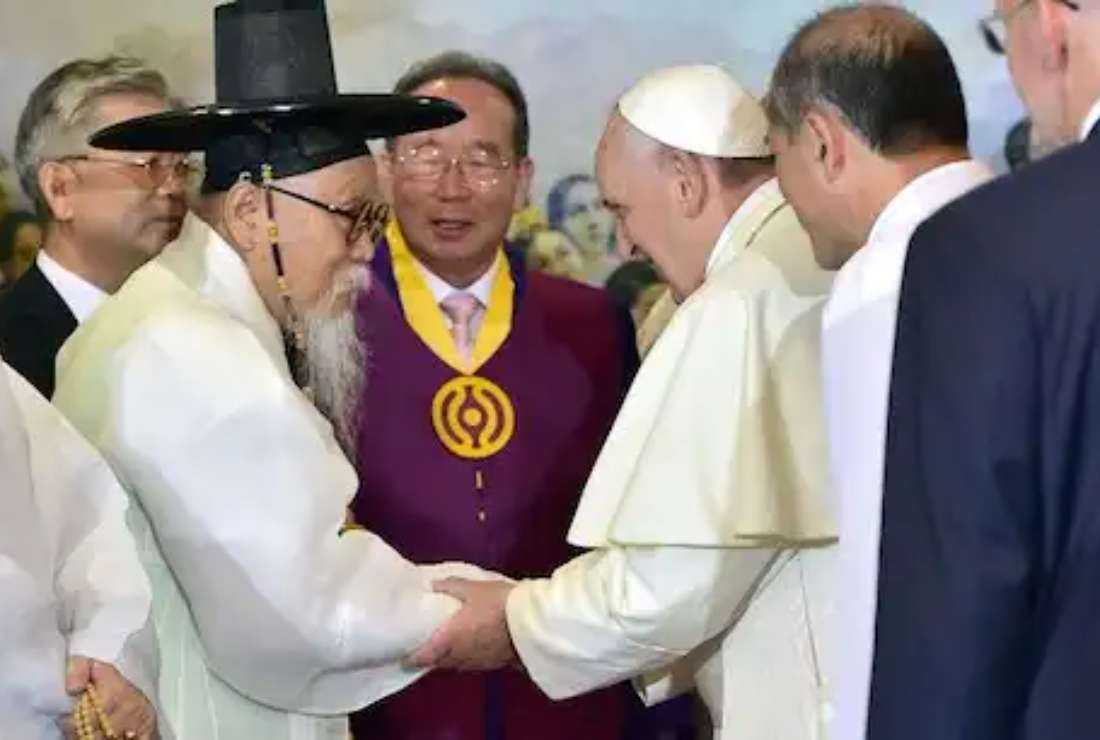
Korean religious leaders to meet Pope Francis

Pope Francis greets Han Yang-Won, chairman of the Association for Korean Native Religion, and other religious leaders at Myeongdong Cathedral in Seoul in 2014

A group of South Korean religious leaders will meet Pope Francis in the Vatican City later this month as part of a pilgrimage to develop a better understanding and dialogue between religions.

The seven-member delegation will hold a meeting with Pope Francis on Sept. 19, the Korean Council of Religious Leaders, announced in a statement on Aug. 31, Korean news agency Dong-A Ilbo reported.

The council is a consultative body of seven religious groups in Korea -- Buddhism, Won Buddhism, Catholicism, Protestantism, Cheondoism, Confucianism, and the Association of Korea National Religions.

The council’s current chair is Venerable Wonhaeng of the Joyge Order, a major group representing Korean Buddhism.

The Sept. 13-21 "pilgrimage" will visit Jerusalem in Israel, the Vatican" and other places, Venerable Wonhaeng said in the statement.

The pilgrimage is being hosted by Catholic members of the council, he said.

This will be the third meeting of Korean religious leaders with the pope in the Vatican. Earlier, the council members met with Pope Benedict XVI in 2010 and Pope Francis in 2017.

It was proposed by Archbishop Hyginus Kim Hee-Joong of Gwangju during an inter-faith pilgrimage to Honam in Gwangju in April this year.

Archbishop Kim is the chairman of the Korean Catholic bishops’ Committee on Church Unification and Inter-religious Communication.

During his 2014 visit to South Korea, Pope Francis met a delegation of 12 religious leaders.

About 50 percent of South Koreans are non-religious, 28 percent are Christians, 15 percent are Buddhists and the rest adhere to other faiths including Confucianism and Shamanism, according to government data as of 2020.  

Catholic Church has an estimated 5.6 million members spread across three archdioceses, 14 dioceses, and a military ordinariate.

Meet the Burkes: Suspended teacher Enoch Burke hails from a controversial family of evangelical Christians

On Tuesday, a secondary school secured a temporary High Court injunction preventing teacher Enoch Burke from attending the school or teaching any classes while he remains suspended from his position.

Enoch opposes addressing a student, who wishes to transition their gender, with the pronoun “they” and has come into conflict with the school principal.

Enoch Burke has not been sanctioned, and no finding has been made against him by the school.

The Burke family are evangelical Christians from Co Mayo known for their strident beliefs.

They have also become known for launching various long-running protests and campaigns against issues like marriage equality and the abortion referendum.

Family members have also been involved and, on occasion, involved themselves in several high-profile legal cases.

Matriarch Martina Burke, a qualified teacher of repute, has home-schooled all her 10 children. Several of the children have run into controversy in their professional lives, namely Ammi, Jemima and Enoch.

The remainder of the children, Keren, Elijah, Simeon, Kezia, Josiah, Isaac and Esther, have all, according to evidence in a legal case, enjoyed great academic success.

ADVERTISEMENT

While Martina is known as “the driving force”, their father Sean, an electrician, is described by locals in Castlebar as “quiet” and “unassuming”.

Members of the Burke family and their posters have become a familiar sight in Market Square in Castlebar, particularly during the first two years of the pandemic. 

They have protested about a range of issues; most recently Mayo University Hospital (MUH) has been their focus. Previously they protested against the Castlebar Gay Pride parade and canvassed heavily against gay marriage.

During the abortion referendum, they took up a regular post outside then Taoiseach Enda Kenny’s constituency office.

Such was the vitriol of their protests against MUH that one staff member told the Irish Independent she was “terrified” of them. “I used to get a sick feeling in my stomach when I saw them,” she said.

A source who has had dealings with several siblings in a court case described their behaviour as “outrageous” and “ridiculous”. “Nothing would entice me to have any dealings with them ever again,” he said.

The founder of Burke Christian School in Castlebar, Martina Burke, is a fiercely determined woman who according to one local representative in Castlebar “fights like a dog” for her beliefs cemented in the Bible.

When contacted by the Irish Independent, the same representative said he recalled contact with him previously about the Burkes. “If you are going to call me every time they get into scrapes, we are going to get to know each other very well,” he mused.

In 2020, Martina Burke claimed during a court case her son Isaac took against NUIG to have educated “hundreds” of children over the past three decades. The Irish Independent has been unable to track down anyone who attended Burke Christian School full time, but many Mayo students have attended for grinds.

Last year in the High Court, Elijah Burke successfully challenged Education Minister Norma Foley’s refusal to grant him calculated grades as his mother, who taught him, would be awarding his grades.

The court heard eight of Elijah’s siblings had averaged 520 points in the Leaving Cert, and all obtained first-class honours degrees. 

Mrs Burke’s behaviour made headlines last April Fool’s Day when her solicitor daughter Ammi Burke’s unfair dismissal case was thrown out by the Workplace Relations Commission amid chaotic scenes. Martina Burke repeatedly interrupted and “berated” the adjudicator.

Following at least five warnings and suspensions, the appeal was thrown out due to Mrs Burke’s obstructive behaviour.

During the hearing, Ammi Burke had demanded that senior counsel for the defence withdraw his remark that the Burke family was like a “travelling circus”, calling it “highly defamatory”.

“I object... How dare you call me and my mother a ‘travelling circus?” she said. “My family is held in very high regard in the local community in Castlebar, Co Mayo.

"My mother is a qualified teacher and has taught for over 30 years. It is the height of insult and a defamatory comment.”

Over the years, Martina Burke has placed advertisements in local newspapers in Mayo. Initially she sold religious books, but in recent years she has taken out full-page advertorials for her school.

In August 2018, Mrs Burke criticised the introduction of LGBT+ training for school principals. She described it as an “amoral, permissive framework” that would “stigmatise modesty and inhibitions”.

Other members of the Burke family have risen to prominence in recent years.
Journalism graduate Jemima Burke came to public awareness when her intemperate questioning of chief medical officer Dr Tony Holohan at a Nphet press conference went viral.

Jemima gained access to the press conference by purporting to be a journalist with The Western News, a Galway-based newspaper that ceased publication in 1926.

Jemima, her brother Josiah and Martina Burke had to be removed forcibly by gardaí from a child inquest after causing huge distress to the bereaved family while making unfounded claims about the girl’s hospital care.

In November 2021, four of the Burke siblings lost a legal case against NUI Galway over a decision to bar them for life from membership of college societies.

Isaac, Kezia, Ammi and Enoch Burke, all members of the Christian Union Society (CUS) in 2014, alleged discrimination based on their religion. However, the college maintained the ban had nothing to do with religion.

The court heard the Burkes distributed flyers against gay marriage which implicitly connected gay marriage to paedophilia and incest. Some fellow students had complained about the leaflets and flyers.

Judge Raymond Groarke found many procedural flaws in the University Societies Co-ordinating Group’s handling of the case. However, he found “serious aggravating circumstances”, including the failure of the Burkes to co-operate with the investigation, their efforts to hinder it and their failure to give a truthful account of matters. He also found that accounts had been fabricated and CUS funds had been misused.

Esther Burke followed her mother into teaching and worked in a secondary school in Mayo for many years. She is highly regarded for her warmth and excellent teaching skills.

Pope’s September prayer intention: For abolition of the death penalty

 Pope Francis: How do you pray when someone asks you to pray for him?

“Each day, there is a growing ‘NO’ to the death penalty around the world,” says Pope Francis in the video released on Wednesday announcing his prayer intention for September. “For the Church, this is a sign of hope.”

In The Pope Video, produced by the Pope's Worldwide Prayer Network, the Holy Father maintains that the death penalty is not necessary “from a legal point of view.”

He argues that “society can effectively repress crime without definitively depriving offenders of the possibility of redeeming themselves.”

He adds that there must be “a window of hope” in every legal sentence. Capital punishment, he says, “offers no justice to victims, but rather encourages revenge. And it prevents any possibility of undoing a possible miscarriage of justice.”

Always possible to repent

Pope Francis goes on to say that the death penalty is “morally inadmissible” because it destroys life, and insists that “up to the very last moment, a person can convert and change.”

The Pope argues further that “in the light of the Gospel, the death penalty is unacceptable, because the commandment ‘Thou shalt not kill’ refers to both the innocent and the guilty.”

Pope Francis concludes his message with an appeal for all people of goodwill to mobilize for the abolition of the death penalty throughout the world.”

“Let us pray that the death penalty, which attacks the dignity of the human person, may be legally abolished in every country.”