Thursday, December 02, 2010

Dublin archbishop says Church's deepest crisis is loss of faith

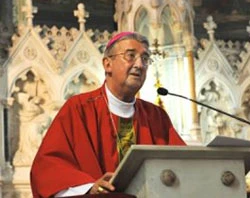
Archbishop Diarmuid Martin of Dublin, Ireland delivered a hopeful but brutally honest homily about the state of the Irish Church on Nov. 20, addressing serious failings that he said indicated a deeper crisis of faith.

The archbishop did not shrink from speaking frankly about the scandals that have rocked the Irish Church in the wake of two 2009 reports. 

The Murphy Report and the Ryan Report detailed sexual and other physical abuse in the Irish Church, along with church authorities' efforts to hide the incidents. Both reports prompted a papal investigation that began Nov. 12.

Speaking to members of the Legion of Mary at a Mass marking the 30th anniversary of its founder Frank Duff's death, Archbishop Martin acknowledged that many church leaders had failed profoundly in their pastoral duties. 

More than this, he said, they had demonstrated “arrogance and power seeking,” acting in a way that alienated many believers and contradicted the message of the gospel.

These failures and abuses, he said, caused the Church to lose both its remaining social power and much of its credibility. The blows came at a time when many Irish Catholics were already drifting away from the Church to “live as if God did not exist,” the archbishop continued.

He also highlighted the “crisis of vocations to the priesthood,” noting that he recently presided at a Mass in memory of 20 priests who had died within the past 12 months. 

“A further dozen or so priests retired from active ministry during the same period,” he said. 

“And yet, in the past year I ordained just one new priest for the diocese (of Dublin).”

While in no way minimizing either the abuse scandals or the priest shortage, Archbishop Martin offered  that there was a deeper crisis within the Irish Church, one that concerned “the very nature of faith in Jesus Christ,” and the question of Jesus' identity and mission.

He proposed that the Irish Church would only be able to address its more obvious problems, by returning to what he called “the fundamental question:” “Who is Jesus Christ?”

“We do not create our own identity for Jesus Christ,” the archbishop emphasized. Nor, he said, could the Christian message of sacrificial love be reduced to the notion of “being nice to each other.” 

He stated that only a rediscovery of Jesus' real call to discipleship would enable the Irish Church to find its footing– not by returning to a past state of affairs, but by returning to the unchanging truths of faith.

“In today's society, where the message of Jesus is less and less accessible,” he said, “the Church must become a place where formation in the Word of God resounds in a way that it has not done in the Irish Church for generations.” 

The Church, he stressed, was not a “vague moralizing agent in society,” but a supernatural institution, with a mandate that God's grace alone could achieve.

Outside interventions and structural reform, while potentially beneficial and at times necessary, could never substitute for this type of spiritual renewal, which the archbishop acknowledged would be painful.

“There are many indications that the Church in Ireland has lost its way,” he said. 

“Many people of various ages, no longer really know Jesus Christ.” 

He suggested that this living faith, for many people, may have given way to cultural expectations and outward obedience.

“Can we be happy to celebrate first communion services which put people into debt for thousands of Euro,” he asked, “while neither the children nor their parents have been led to a true understanding of the Eucharist and … the Church? Can we be satisfied when confirmation is looked on by many as a graduation out of Church life?”

“In not addressing such issues, we are not just deceiving ourselves, but we are damaging the integrity of the mystery of Jesus.”

Archbishop Martin offered no easy answers or quick fixes in the searching address. 

He acknowledged the persistence of deep and authentic faith among many Irish Catholics, as he observed that “many people with little education have a deeper insight into the message of Jesus Christ than learned theologians or bishops.”

Above all, he praised the example of Frank Duff, a layman who began the Legion of Mary during the troubled year of 1921, during which the Irish people faced looming civil war and crushing poverty.

“Frank Duff was a man who, in the face of a major social challenge, did something … He gathered likeminded men and women around him into a movement of spiritual renewal, prayer and Christian service.” 

Such movements, the archbishop indicated, would have a critical role to play in calling Irish Catholics –both the clergy and the laity– back to the essence of their faith.

SIC: CNA/IE

++++++++++++++++++++++++++++++++++++++++++++++++++ 

Disclaimer 

No responsibility or liability shall attach itself to Clerical Whispers, its contributors or its Team, or the blogspot itself, for any or all of the articles placed here. The publishing of an article here does not, nor should it be interpreted as, an agreement or acceptance, of the article contents as being factual in theology, dogma or otherwise. Accessing this blogspot and perusing its articles is considered as an acceptance of the above. 

Seán Keohane, Editor, Clerical Whispers

Reaction divided over claims by Church of anti-Catholic hostility

The Catholic Church’s media director has had a sharply divided reaction to his claims that sectarianism remains a hugely prevalent factor in Scotland. 

Peter Kearney stood solidly behind his offensive against anti-Catholic abuse yesterday after a no-holds-barred critique in which he said hostility to Catholics in Scotland was “deep, wide and vicious”. 

In response to his comments, reported in The Herald yesterday, Mr Kearney received e-mails both in support and against his outspoken attack in which he declared: “The bigotry, the bile, the sectarian undercurrents and innuendos must end.” 

Mr Kearney said: “Reminding Scotland that religious intolerance exists here is a risky business, which is probably why so few people do it.” 

In a series of e-mails, seen by The Herald, one critic said: “I and a lot of other Scots of every and no denomination feel that these matters are doing nothing to help and everything to incite the bigotry between Catholic and Protestant in Scotland.” 

Another said Catholics should “get their own house in order” before making such accusations. 

The writer added: “In my own experience, Catholics in the west of Scotland are more than capable of giving as good as they get.” 

One complained about the Catholic Church in the west of Scotland talking about a desire “to assimilate and integrate” while continuing to insist that Catholic children have their own schools. 

The e-mail added: “If there is one policy within this country that does more damage to community relations and reeks of insularity and intolerance I have yet to come across it.” 

However, supporters congratulated Mr Kearney, saying he should be thanked for taking a stand against anti-Catholic bigotry. 

One e-mail read: “You said what had to be said and you said it very well.” 

Another said: “As a Catholic father of two kids, I would like to say thanks for speaking out on behalf of us in the pews.” Mr Kearney spoke out after the sacking of SFA referees’ chief Hugh Dallas over allegations that he sent an offensive e-mail about the Pope during his recent visit to Scotland. 

He said: “Let no-one be in any doubt, with this shameful episode, Catholics have drawn a line in the sand.” 

Yesterday, Mr Kearney was unrepentant about fanning the flames of controversy. 

He said: “Today many organisations have an ‘acceptable use’ policy which applies to staff communication by e-mail, it often allows them to brandish their zero tolerance credentials. 

“In most cases, dismissal is the penalty for breaching these strictures. If anyone considers such policies harsh they would do well to take up the matter with employers who use them.” 

Mr Kearney said statistics showed Catholics were six times more likely to suffer a sectarian attack than any other group. 

He added: “If referring to this reality is inflammatory, then how exactly should we describe the underlying problem which gives rise to it? We should not make the mistake of assuming that highlighting anti-Catholic prejudice is a criticism of other Christians, it is not. 

“Inter-denominational relations in Scotland are, thankfully, excellent. In reality, those who perpetrate acts of bigotry, by their actions, undermine and contradict Christian teaching.” 

SIC: HS/UK

++++++++++++++++++++++++++++++++++++++++++++++++++

Disclaimer

No responsibility or liability shall attach itself to Clerical Whispers, its contributors or its Team, or the blogspot itself, for any or all of the articles placed here. The publishing of an article here does not, nor should it be interpreted as, an agreement or acceptance, of the article contents as being factual in theology, dogma or otherwise. Accessing this blogspot and perusing its articles is considered as an acceptance of the above.

Seán Keohane, Editor, Clerical Whispers

Bishops baulk at priests’ pay demands

Bishops in a central Indian state say they have practical difficulties in meeting their priests’ demand for standardized transfer and remuneration.

Standardized packages posed problems as resources vary from diocese to diocese, said Archbishop Leo Cornelio of Bhopal, chairperson of the Council of Bishops of Madhya Pradesh.

But the prelate told ucanews.com he would address the issue. “We take care of every just demand of our priests,” he said, adding that priests and bishops are “equal partners in the mission of spreading the world of God.”

“It is the duty of the diocese to take care of its priests and no bishop will shy away from discharging their duties for the interests of the Church,” said Archbishop Cornelio, who heads the Church in the state.

He said he would soon meet the priests’ representatives to try to resolve misunderstandings and restore confidence.

A week earlier, the regional conference of the diocesan priests reiterated their demands which they said were legitimate. They expressed shock and disappointment that the bishops had ignored them.

The priests first met Aug. 5-6 to seek a uniform policy on transfer of priests, their maintenance allowance and other benefits.

Bishop Chacko Thottumarickal of Indore, secretary of the bishops’ council, also said the priests’ demands are “impractical.”

It is not proper to compare dioceses as each has different needs and capabilities. Similarly, the priest’s needs also vary from diocese to diocese, he told ucanews.com on Nov. 25.

Bishop Thottumarickal says a priest’s service cannot be treated as a job with standardized remuneration and fixed tenure. “Priesthood is a committed service for the people,” he said.

Funds the diocese gives for priests’ upkeep cannot be treated as remuneration or an allowance.

“The priest-bishop relation is not like relationship between an employer and employee. It is a father-child relationship. The father knows the children’s needs and always tries to fulfill them,” he added.

SIC: CTH/ASIA

++++++++++++++++++++++++++++++++++++++++++++++++++ 

Disclaimer 

No responsibility or liability shall attach itself to Clerical Whispers, its contributors or its Team, or the blogspot itself, for any or all of the articles placed here. The publishing of an article here does not, nor should it be interpreted as, an agreement or acceptance, of the article contents as being factual in theology, dogma or otherwise. Accessing this blogspot and perusing its articles is considered as an acceptance of the above. 

Seán Keohane, Editor, Clerical Whispers

Aussie parish unveils Our Lady of the Boat People

A new Stations of the Cross and Our Lady of the Boat People installation at St Joseph’s Conference Centre at Bringelly in NSW is a token of gratitude from the Vietnamese Catholic community.

It marks 35 years of resettlement of the Vietnamese refugees here, said Father Toan Nguyen, senior chaplain of the Vietnamese Catholic Pastoral Centre at Revesby, The Catholic Weekly reports.

The installation was blessed by Bishop Julian Porteous on October 17, hours before the canonisation of Mary MacKillop.

“The Stations of the Cross are built here as a token of gratitude to Australia by the generosity of all members of the Vietnamese Catholic Community for all pilgrims not only in Sydney but also Australia and all over the world who would like to make a spiritual journey with our Lord, from Jerusalem to Golgotha,” Fr Toan said at the blessing.

“The fall of Saigon was in 1975 so it is 35 years of resettlement, and we feel that we should do something to show our gratitude to the Australian people, especially the Australian Church.

The Vietnamese Catholic community raised about $1 million to fund the project, which includes Stations of the Cross, a statue of Our Lady, and a small timber boat to represent refugees. All were hand-made in Vietnam.

SIC: CTH/ASIA

++++++++++++++++++++++++++++++++++++++++++++++++++ 

Disclaimer 

No responsibility or liability shall attach itself to Clerical Whispers, its contributors or its Team, or the blogspot itself, for any or all of the articles placed here. The publishing of an article here does not, nor should it be interpreted as, an agreement or acceptance, of the article contents as being factual in theology, dogma or otherwise. Accessing this blogspot and perusing its articles is considered as an acceptance of the above. 

Seán Keohane, Editor, Clerical Whispers

Turkish government now recognises us officially, says Bartholomew I

The Orthodox Ecumenical Patriarchate celebrated its foremost feast day today, the day of Saint Andrew, the Apostle of Constantinople, but it also marked the successful end of a legal battle with the Turkish state over the Buyukada orphanage. 

The Ecumenical Patriarch Bartholomew I, after meeting with a delegation from the Holy See led by newly appointed Card Kurt Koch, the new president of the Council for Christian Unity, expressed his emotions in an interview with AsiaNews.

“Today is a great day for our Great Mother Church. The orphanage on Princes Island (Buyukada) has been given back to us. What we inherited from our ancestors has also been returned to us. We could not tolerate the injustice done to us. We first turned to Turkey’s courts. Since we lost all of our cases, we turned to the European Court of Human Rights in Strasbourg, which gave us justice,” the Patriarch said.

The implications of the return to the Patriarchate of the ‘Tapu’ (title deed) are of great significance.

“The Turkish government did not appeal against the court’s ruling, starting instead the procedures to return us the orphanage,” Bartholomew said. “I want to stress the tapu by Turkish authorities is issued in the name of our Patriarchate, as Rum Patrikanesi. This means not only the return of the orphanage but also the official recognition of our Patriarchate as a legal person. This is a positive step.”

“Our struggle must teach us never to put down our spiritual tools and always trust Divine Providence, which knows when and how to overcome human obstacles and weaknesses,” the Ecumenical Patriarch said.

Ioannis Ktistakis, one of the lawyers that represented the Fener (the Patriarchate) in the case, spoke to AsiaNews about the case after the Ecumenical Patriarch received the tapu.

“We fought to re-establish civil rights in Turkey. Our struggle was first about rights, and only secondarily about a title deed. It was about re-establishing rights in this country as in any other country since the rights of a centuries-old institution like the Ecumenical Patriarchate had been violated.”
 
SIC: AN/INT'L

++++++++++++++++++++++++++++++++++++++++++++++++++ 

Disclaimer 

No responsibility or liability shall attach itself to Clerical Whispers, its contributors or its Team, or the blogspot itself, for any or all of the articles placed here. The publishing of an article here does not, nor should it be interpreted as, an agreement or acceptance, of the article contents as being factual in theology, dogma or otherwise. Accessing this blogspot and perusing its articles is considered as an acceptance of the above. 

Seán Keohane, Editor, Clerical Whispers

Prison policy 'disaster' with drugs and overcrowding rampant, say chaplains

CURRENT PRISON policy in Ireland is a “disaster”, the State’s prison chaplains have said.

Making the State’s prisons safer and drug free was in everyone’s interest, the chaplains concluded in their annual report for 2010, published yesterday. 

“The only obstacle is political will,” they said.

Conditions in many prisons were “an insult to the dignity of any human being and an affront to the basic tenets of decency”. 

Prisoners were subject to overcrowding, drugs and violence.

They noted that Mountjoy was built for 489 prisoners but in July this year it held 759 prisoners, which meant that “129 prisoners did not even have a bed to sleep in; indeed some did not even have a mattress to sleep on”.

Wheatfield was designed for 320 but on July 30th last it held 508 prisoners. 

“A 75-year-old man was sleeping on a mattress,” the report noted.

Cork jail was built for 146 but on July 30th last it held 334 prisoners. 

Dóchas (the women’s prison) was built for 85 but held 180 prisoners. Limerick jail, built for 185 prisoners, held 322.

Meanwhile in 2009, 27,227 random drug tests on prisoners disclosed that 33 per cent were positive for heroin, cocaine or cannabis. 

“In some jails, more than 50 per cent of those tested were positive for heroin.”

The chaplains concluded that a culture had developed in prisons which successfully perpetuates pro-drug attitudes.

They found there were over 800 assaults by prisoners on other prisoners each year, and some of the attacks were fatal.

Last December, 20 per cent of the prison population, 972 were on protection for their own safety, the report added. It singled out St Patrick’s Institution for particular mention, as it accommodates very young people. 

The detention there of under-18s was in direct contravention of the United Nations Convention on the Rights of the Child, and the chaplains said the Ombudsman for Children is explicitly prohibited from investigating complaints or allegations by the young people there.

About one in four young people in St Patrick’s was on protection, with most confined to a cell for 23 hours a day. Such conditions for the young were completely unacceptable and can only cause psychological and emotional damage, the report said.

It found the sacrifice of human dignity and compassion in Ireland’s jails to advance political agendas was tragic and unworthy of the Department of Justice and the Irish Prison Service.

The Irish Prison Chaplains’ Report 2010 is also highly critical of the media.

“Apart from the sensationalising of certain cases, there is now a growing tendency to fabricate stories. Vulnerable prisoners are often targeted as subjects for stories that have no foundation in reality. We have serious concerns in relation to the sources of some of this coverage.”

In particular it said “the appalling and irresponsible mismanagement of Larry Murphy’s release in August this year created a media circus that was both shameful and dangerous”.

Most of those in jail were imprisoned for short periods of time and for less serious offences. 

In 2009, of the 10,865 sentenced to jail “1,153 (10 per cent) were convicted of offences with violence, while 5,750 (53 per cent) were sentenced to three months or less”.

The politicisation of our criminal justice system needs to be addressed, they said. 

Public opinion, as reported by certain sections of the media, calls for longer and harsher sentencing without in any way addressing the real issue of crime and its prevention. 

Politicians respond and the vicious circle continues, the report claimed.

The chaplains were disappointed the Minister for Justice declined to meet them after the publication of their last report.

They also noted that a decision to build a prison in Thornton Hall, north Dublin, “resulted in millions of public funding being spent on a site that now stands idle”.

This “stands in stark contrast to the mattress-strewn floors of our prisons”, they said.

In their own words: prison chaplains speak out 
  • “We cannot ignore the reality we witness every day of a system that is in crisis
  • “Our role as chaplains calls us to be a voice for those deprived of their freedom and to bring matters of concern to the Minister
  • “In 2008, 8,000 people were committed to prison. Eighty per cent were sentenced to less than one year
  • “The cost of imprisonment needs to form part of Government policy on crime. The public need to know
  • “At present , prisoners get 25 per cent remission for good behaviour. In the United Kingdom, 50 per cent remission is the norm
SIC: IT/IE

++++++++++++++++++++++++++++++++++++++++++++++++++

Disclaimer

No responsibility or liability shall attach itself to Clerical Whispers, its contributors or its Team, or the blogspot itself, for any or all of the articles placed here. The publishing of an article here does not, nor should it be interpreted as, an agreement or acceptance, of the article contents as being factual in theology, dogma or otherwise. Accessing this blogspot and perusing its articles is considered as an acceptance of the above.

Seán Keohane, Editor, Clerical Whispers

Wednesday, December 01, 2010

Advent Meditations - 1st Week

First Week of Advent
"Jesus said to his disciples: 'Be constantly on the watch! Stay awake!...You do not know when the Master of the house is coming.'" Mark. 13:33

O Jesus, your voice sounds through the house of my world: Be on your guard! Stay awake!
Yet I hardly hear you. Busy with so much, I go about the things I do like a servant trapped in household routine, hardly giving a thought to what my life is about. My spirit within has grown tired and you, my God, seem far away. How can I hear your voice today?
Speak to my heart during this season of grace, as you spoke to your prophets and saints. Remind me again of the journey you call me to make and the work you would have me do. I am your servant, O Lord. Speak to me in this holy season and turn my eyes to watch for your coming.
 
O Emmanuel, Jesus Christ,
desire of every nation, Savior of all peoples,
come and dwell among us.

December 1st - World AIDS Day

A Franciscan Prayer to Mark World Aids Day


Lord, make me an instrument of peace:
 
What concrete steps can we take to promote peace and reconciliation in situations of conflict, violence and sexual exploitation to help reduce the incidence of HIV/AIDS and promote a culture of peace and reconciliation? 

Where there is hatred, let me sow love:
 
How can Franciscans and religious leaders create welcoming communities of faith for persons living with HIV/AIDS and those affected by AIDS and eliminate all instances of discrimination and social stigma? 

Where there is injury, pardon:
 
Do we hold those who are living with HIV/AIDS as evil, immoral persons? How can we set them free and allow them to discover the face of God in their current situations? 

Where there is division, unity:
 
Do our fears and prejudices lead us to commit acts of violence against our sisters and brothers living with HIV/AIDS? 

Where there is darkness (untruth), light (truth):
 
Can we preach and speak about HIV/AIDS openly, exploring its origins, its impact, and the fears we have about it? Can we begin to speak the truth in the light, in our parish communities, our religious houses, and everywhere?
 
Where there is doubt, true faith:
 
Can we reach out to one another, particularly our brothers and sisters living with HIV/AIDS, in a way that restores faith in God? Can we draw upon the power of resurrection to remove all fears, fears of contagion that lead us to reject or withdraw our love and support from persons living with HIV/AIDS? 

Where there is despair, hope:
 
How are we fostering communities of hospitality, receptivity, and healing where our brothers and sisters can find 'home', a place of welcoming and love. 

Where there is sadness, new joy:
 
Do we recognize the power and grace in our brothers and sisters living with HIV/AIDS? Do we allow ourselves to be 'evangelized' and transformed by the witness of our sisters and brothers living with HIV/AIDS?

Honduran cardinal says papal remarks on condoms offer teachable moment

The public debate on church teaching on condoms triggered by Pope Benedict XVI's comments in a new book is an ideal opportunity for parish priests to clarify it for the faithful from the pulpit, said the president of Caritas Internationalis.

Cardinal Oscar Rodriguez Maradiaga of Tegucigalpa, Honduras, told The Record, Catholic newspaper of the Archdiocese of Perth, that many Catholics do not know what the church teaches in this regard.

"This could be a good opportunity for us in the parishes to clarify and to teach," said the cardinal, who has completed separate doctorates in philosophy, theology and moral theology and holds a diploma in clinical psychology and psychotherapy.

The book, "Light of the World: The Pope, the Church and the Signs of the Times," was based on interviews Pope Benedict granted German journalist Peter Seewald. The book was released Nov. 23.

In the book, Pope Benedict said: "There may be a basis in the case of some individuals, as perhaps when a male prostitute uses a condom, where this can be a first step in the direction of a moralization, a first assumption of responsibility, on the way toward discovering an awareness that not everything is allowed and that one cannot do whatever one wants."

Cardinal Rodriguez laughed off claims made in secular media globally that the pope had changed the church's teaching on the use of condoms.

"It has been the doctrine of the church all the time that when there are emergency cases the principle of double effect (applies). The pope was only quoting the extreme cases, so I believe it is coherent (with existing Catholic teaching)," Cardinal Rodriguez told The Record Nov. 26 during a four-day trip to Australia.

The church teaches that the principle of double effect may be employed when one is considering an action that is morally good, yet the action involves one or more unintended bad consequences. Because these consequences are side effects and not directly willed, the choice that brings them about is morally acceptable.

"We, as disciples of Christ, have a lot to learn; we cannot pretend that in special matters all the baptized know everything, as we are always learning and trying to implement what the mother church is teaching us," the cardinal said.

 SIC: CNS/INT'L

Bishops urge Congress to condemn persecution of Iraqi Christians

The United States Conferences of Catholic Bishops urged Congress on Nov. 29 to pass a resolution condemning religious violence in Iraq, and insisting on better protection for Christians and other minority faiths.

Two representatives of the conference, Archbishop Jose H. Gomez of Los Angeles and Bishop Howard J. Hubbard of Albany in New York, wrote to the sponsors of House Resolution 1725, in their respective positions as the national chairmen for migration and social justice. They commended the seven sponsors of House Resolution 1725, and called for the act's immediate passage. 

Rep. Chris Smith (R – N.J.), a Catholic and an outspoken advocate for international religious freedom, introduced the resolution along with six co-sponsors from both the Republican and Democratic parties. 

The proposal follows a wave of attacks targeting Iraqi Christians this fall, the worst of which left over 50 worshipers dead at Baghdad's Cathedral of Our Lady of Salvation on Oct. 31.

Several Iraqi Christians now living in the U.S.--including a board member of the international charity Iraqi Christians In Need, and a former seminary professor of two priests killed at Our Lady of Salvation– have told CNA that the government is not doing enough to stop an epidemic of violence that has forced more than half of the country's Christians to flee.

Although Rep. Smith voted in favor of the American invasion of Iraq –which Pope John Paul II warned would destabilize the region and lead to sectarian violence– he has also demonstrated a willingness to speak out against cases of abuse or negligence by the ruling Iraqi government. 

Last year, he co-sponsored a resolution condemning Iraqi security forces' attacks on a group of Iranian refugees.

Archbishop Gomez and Bishop Hubbard praised Rep. Smith's introduction of HR 1725, as a means to “focus attention on the situation of the vulnerable religious communities in Iraq.” 

They particularly appreciated its call for a “comprehensive plan” to prevent religious persecution, and to increase the representation of Christians and other minority groups in Iraq's government.

The bishops described the attack at Our Lady of Salvation, along with other assaults intended to drive Iraqi Christians from their homes and businesses, as “horrific reminders of the appalling lack of security that has condemned many in Iraq to live in fear.

” The resolution expresses concern for Iraqi refugees, urging that barriers to their resettlement or return be lifted.

“We sincerely hope that H. Res. 1725 will be adopted quickly by the House of Representatives as we believe it will help improve security for all Iraqis, especially Christians and other vulnerable minorities,” the bishops wrote, noting that the resolution's proposals would help the troubled country achieve peace and address its refugee crisis.

SIC: CNA/INT'L

Do teachers have religious freedom?

A teacher discriminated against because she is not a Catholic won maximum damages at the Equality Tribunal recently. 

The case raises important issues about the continuing influence of the Catholic church in teacher training

IN A recent case before the Equality Tribunal, a Catholic school was found to have discriminated against a teacher on the grounds of religion. 

The school withdrew the offer of a permanent post after it discovered that the teacher was a member of the Church of Ireland. 

Michelle McKeever was asked about her religion after she failed to furnish a Catholic religious certificate to the board of management at a Co Cavan school.

The cases raises fresh questions about the compulsory requirement of the religion certificate, the teaching of this certificate in mainstream teacher colleges and the continued existence of legislation which allows schools to discriminate on the basis of religious ethos.

The certificate in religious studies is a compulsory requirement of the Irish Catholic Bishops’ Conference for teachers working in Catholic-managed primary schools. These comprise more than 90 per cent of schools in the Irish system.

The vast majority of students take the optional certificate in religious studies,the president of St Patrick’s College, Drumcondra, Dr Pauric Travers says. The college welcomes students for the certificate both of “deep religious faith and none”, he explains.

“Our position as a teacher education provider funded by the State is that we meet the needs of an evolving society in an open way, being inclusive and respectful of diversity.”

The college made a change to its religious education offerings at the beginning of the academic year in response to public debate, Travers says.

The change was not to the optional Catholic religion certificate but to the religious education course. Religious education is part of the national primary school curriculum and forms a compulsory part of the education degree.

However this year the college is offering a course in ethics to students as an alternative. “That is us responding to a perceived need,” he says.

Daniel O’Connell, head of religious studies in Mary Immaculate College, Limerick, says that most students choose to take the certificate but he explains that some students feel pressure to take it for future employment prospects.

He does not see an issue with the certificate being part of a State-funded degree course.

Ireland is at an “in-between stage” of having an over-representation of Catholic primary schools and there is an expectation that teachers know something of the tradition, values and ethos, he says.

This could change “if provision went down hugely” and it would be an issue over the next 20 years, he says.

The optional certificate in religious studies is academic and not a “confessional indoctrination,” he says.

Archbishop of Dublin Diarmuid Martin alluded to such change in patronage last month at the graduation ceremony of teachers in St Patrick’s College when he said that education would be different in the future as “new patronage systems will replace the almost monopoly of religious schools”.

Asked about the continued need for the certificate, the Irish Catholic Bishops Conference spokesman says that under the primary school curriculum the school is responsible for providing religious education that matches its ethos. 

“Accordingly a primary teacher must be qualified to teach religious education according to the ethos of the school,” the statement outlined.

The Irish National Teacher’s Organisation (INTO) has “no difficulty” with teachers being asked for the certificate, as long as it is open and transparent, says equality officer Deirdre O’Connor.

While the certificate is formally required, anecdotally, many schools do not look for it, she says.

The Church of Ireland College of Education has a compulsory religious education element in its curriculum to prepare teachers for “reformed faith” primary schools.

There is no religious certificate required but there is “probably some preference” in seeing someone that has a familiarity with the Church of Ireland religious syllabus says Anne Lodge, principal of the Church of Ireland College of Education. 

However there is not a blanket refusal to employ people who do not have this. 

“We’ve moved on from there,” she says.

Lodge is “surprised” by the McKeever case as she is aware of many teachers of various faiths working in different denominational schools.

“There are no issues around this and it doesn’t seem to be a reason for blocking employment in the normal course of events.” she says.

While McKeever won her case as she was directly discriminated against because of her membership of the Church of Ireland, an exception still applies allowing schools to discriminate if it believes its religious ethos is under threat. 

Significantly this section, 37.1, of the Employment Equality Act, was not used as a defence in the McKeever case.

Many gay and lesbian (LGBT) teachers feel this could be used against them if they are open about their sexuality. 

The Equality Authority has pointed out that this tension is set to be magnified by the introduction of the civil partnership bill next year.

Many gay teachers in religious schools feel it is “being held over them”, says Cathal O’Riada, chairperson of the INTO LGBT teacher’s group.

“It’s not being invoked but it’s still there and it’s a threat all of the time,” O’Riada says. 

“These teachers are nervous that their orientation will affect their promotion prospects,” and they tend to hide their sexuality at interviews, he adds.

There is much anecdotal evidence from religious schools that people are told to “keep quiet” about their sexuality, he says. “That’s kind of crazy in this day and age.”

A call for a change of the religious ethos exemption was made by the Equality Authority at its 20th anniversary conference in October. 

At the conference, spokesman Brian Merriman described as an “area of potential friction” the enactment of the civil partnership legislation and the existence of the exemption.

“Employees of religious-based institutions, on finally being granted legal recognition for their family life may have conflict in applying for leave traditionally associated with partnership or marriage or family leave,” he says.

People may be “outed” by lawful declarations of beneficiaries in insurance schemes or pensions “despite a legal status for such relationships”.

“It may be timely to review this exemption,” Mr Merriman says. 

In response to a query on the application of the exemption in the case of gay teachers, a spokesman for the Catholic Bishops says: “The law allows for a school to be mindful of its ethos in the employment of its staff. It is part of the responsibility of the board of management of the school to maintain the ethos of the school. Employees should not undermine the ethos of the school.”

The religious exemption – and religious cert 

THE EXEMPTION to the Employment Equality Act 1998 allows a school to discriminate against an employee or prospective employee to maintain its religious ethos.

Former Minister for Justice John O’Donoghue applied to the European Union for an exemption to the European Equality Directive in 2000.

At the time he said the exemption would preserve the right of denominational schools to uphold their religious ethos when recruiting staff.

Concerns were voiced at the time that it would enshrine in legislation the decision in the late Eileen Flynn case in 1985 in which the dismissal of a teacher from a Catholic school because of her relationship with a married man was upheld by the High Court.

The text of exemption 37.1 reads: 

A religious, educational or medical institution which is under the direction or control of a body established for religious purposes or whose objectives include the provision of services in an environment which promotes certain religious values shall not be taken to discriminate against a person if:

(a) it gives more favourable treatment, on the religion ground, to an employee or a prospective employee over that person where it is reasonable to do so in order to maintain the religious ethos of the institution, or

(b) it takes action which is reasonably necessary to prevent an employee or a prospective employee from undermining the religious ethos of the institution.

What is the Catholic certificate? 

The certificate in religious studies is a requirement of the Irish Catholic Bishops Conference for teachers in Catholic managed primary schools.

The certificate is taught as an optional part of the Bachelor of Education degree at four of the teacher training colleges which have Catholic links. It can also be taken separately by teachers who took degrees abroad or in colleges where it is not offered.

It is usually taught over three years and covers subjects such as Christian foundations, the creed and trinity, theology, religious diversity, liturgy and spirituality. The certificate is also required for teachers in Catholic-managed primary schools in the UK. 

Separately, religious studies is a compulsory part of Bachelor of Education degrees. 

In Catholic teacher-training colleges this focuses on the Alive-O Catholic primary school curriculum.

The background to the case 

MICHELLE McKEEVER was awarded more than €12,000 by the Equality Tribunal after it found that a Co Cavan school had discriminated against her on the grounds of religion when she applied for a permanent post.

Ms McKeever, who is a member of the Church of Ireland, applied for a job in Knocktemple national school, Virginia, in May 2007.

Subsequently, she was contacted by the principal and the chairperson and offered a permanent post. 

However the offer was withdrawn after she was questioned in a telephone call about holding the Catholic religion certificate.

McKeever had said she was willing and able to teach the Catholic Alive-O religious curriculum. 

The equality officer in the case concluded that a school board meeting in July 2007 was advised by the chairperson that the complainant did not have the religious certificate.

The officer concluded that not only was the complainant’s religion discussed, but it influenced the board of management in withdrawing the offer that had been made. 

This amounted to discrimination on the grounds of religion.

McKeever has since secured a permanent post in another school.

SIC: IT/IE

Laois presbytery and worshippers' cars robbed during Mass

Worshippers attending Mass were given another reminder to be careful of their belongings this week, after opportunistic thieves went on a spree in a County Laois village and robbed parishioners’ cars and the priest’s house while Mass was in progress.

Cars parked outside St Brigid’s Church in Ballinakill were burgled while the owners were inside for the Saturday evening vigil Mass and the parochial house was ransacked.  

A handbag and other personal items were reported to have been taken from one car but fortunately nothing is known to be missing from the priest’s house.

Parish priest Fr Sean Conlon, whose house was entered, warned parishioners that they should not leave valuables in their cars in the car park.  

He said that the warning did not just apply to people going to Mass.

"Do not leave anything on view - even in petrol stations, you have people leaving their keys in cars,” he remarked.  “You could be number three in the queue to pay but by then the car could be halfway to Dublin," he said.

Gardaí investigating the incidents in Ballinakill are also following up other instances of thefts from cars in Co Laois recently from motorists who failed to heed warnings about the danger of leaving valuables in their cars.  

These include complaints that thieves broke into two cars outside a school in Abbeyleix in the middle of the day and that a car was also broken into in Portlaoise one night.

A car left at a forest park while its owner went for a walk was also targeted and personal items were stolen.

SIC: CIN/IE

Church refuses to compensate abuse victim

The Roman Catholic Archdiocese of Quebec has no intention of compensating a Quebec City woman who took them to court for being raped by a priest in the 1980s.

Last week, Shirley Christensen, 37, gave the archdiocese an ultimatum – either offer her compensation for her abuse or see her in court.

But in a letter to Christensen on Friday, auxiliary bishop Gerald Lacroix refused her request for a settlement.

Christensen applied to sue the Quebec Archdiocese in 2007. 

She was seeking $250,000 in damages for sexual abuse she suffered at the hands of Paul-Henri Lachance between 1979 and 1981.

Lachance, now 79, pleaded guilty in 2009 and was handed an 18-month sentence.

Quebec Superior Court and the Quebec Court of Appeals dismissed the lawsuit because of an article in the Quebec Civil Code that places a three-year statute of limitations on civil lawsuits.

The case finally ended up in Canada’s top court, which tabled a judgement in October.

The Supreme Court didn’t strike down the statute of limitations on Quebec lawsuits but it told the lower courts to hear the case and consider whether the time limit on this lawsuit should have started in 2006.

In her court filings, Christensen claims to have suffered trauma in 2006 that triggered the memories of the sex abuse.

In a statement, Christensen said she still hopes to meet with Lacroix to explore the possibility of a settlement agreement.

SIC: SUNT/INT'L

Dutch bishop tackles sex abuse scandal

In his advent message, the bishop of Roermond, Frans Wiertz, has tackled the recent revelations about child sex abuse and the surrounding cover-up by Roman Catholic clerics in the Netherlands. 

Roermond is a city in Limburg in the south of the Netherlands, traditionally a predominantly Catholic region. 

“We as a church have been hurt by the abuse committed against children and young people. It’s unbelievable that servants of the Church failed in their duty to stand up for the defenceless,” he writes. 

He carries on to say that everything must be done to ensure that victims obtain justice, be given attention and support, and that all such criminal acts be prevented from taking place.

Bishop Wiertz’ advent message will be read to Catholic congregations in the Roermond area over the coming weeks.

SIC: RN/INT'L