Thursday, July 04, 2024

UK cultural grandees urge Vatican to keep TLM in new ‘Agatha Christie’ letter


Prominent U.K. figures in the arts, business, journalism, and politics have appealed to the Vatican not to impose new restrictions on the Extraordinary Form of the Roman Rite, also known as the Traditional Latin Mass.

In a letter to the Times of London, published July 3, more than 40 signatories, Catholic and non-Catholic  — including “Downton Abbey” creator Julian Fellowes, human rights activist Bianca Jagger, and opera singer Kiri Te Kanawa — lamented “worrying reports from Rome that the Latin Mass is to be banished from nearly every Catholic church.”

“We implore the Holy See to reconsider any further restriction of access to this magnificent spiritual and cultural heritage,” said the letter, also signed by composer Andrew Lloyd Webber, historian Tom Holland, and Princess Michael of Kent, a member of Britain’s royal family.

The letter explicitly echoed an appeal by artists and writers published by the Times of London in July 1971. The signatories of the earlier letter, including mystery writer Agatha Christie, novelist Graham Greene, and violinist Yehudi Menuhin, expressed alarm at reports of “a plan to obliterate” the pre-Vatican Council II Mass.

That appeal reached Pope Paul VI, who is said to have exclaimed “Ah, Agatha Christie!” as he read the list of signatories. The pope signed a document allowing the bishops of England and Wales to grant permission for Traditional Latin Masses to be offered on special occasions, known today as the “Agatha Christie indult.”

The new letter cited the 1971 appeal’s argument that the Traditional Latin Mass belonged to “universal culture,” because it had “inspired a host of priceless achievements in the arts — not only mystical works, but works by poets, philosophers, musicians, architects, painters and sculptors in all countries and epochs.”

The July 3 letter described rumors of a further Vatican crackdown on the Traditional Latin Mass — first aired in June by the website Rorate Caeli — as “painful and confusing,” particularly for “the growing number of young Catholics whose faith has been nurtured by it.”

Rorate Caeli reported that “an attempt is being made to implement, as soon as possible, a Vatican document with a stringent, radical, and final solution banning the Traditional Latin Mass.” The Pillar has not been able to confirm the existence of such a document.

However, several curial officials told The Pillar that they understood such a draft existed and that, if promulgated by Pope Francis, it would further restrict the celebration of the old form of the liturgy beyond the provision of the 2021 motu proprio Traditionis custodes.

At the time of Traditionis custodes’ promulgation, Francis said he was “saddened that the instrumental use of Missale Romanum of 1962 is often characterized by a rejection not only of the liturgical reform, but of the Vatican Council II itself, claiming, with unfounded and unsustainable assertions, that it betrayed the Tradition and the ‘true Church.’”

One Vatican official told The Pillar that some proponents of new measures to restrict celebration of the TLM were not aiming for complete and total suppression, which they termed “practically unworkable,” but rather a kind of “quarantine.”

“The thinking, and some will put it in these terms, is to ‘force them [traditionalist Catholics] onto reservations,’ with everything that goes with that kind of imagery.”

“Taking them out of diocesan life, driving them into little pockets around things like the ICKSP, the [Priestly Fraternity of St. Peter] and even the SSPX [which is in irregular communion with the Church] would take them out of local bishops’ hands,” the official said.

“For the ones pursuing ‘maximum TC’, it would be a welcome relief,” he said. “And for those bishops who have been pushing back [by seeking to make space for traditionally minded communities] it would take the whole issue out of their hands.”

Signatories of the new letter argued for the traditional liturgy to be preserved for its cultural and historical significance, calling it “a ‘cathedral’ of text and gesture, developing as those venerable buildings did over many centuries.”

“Not everyone appreciates its value and that is fine; but to destroy it seems an unnecessary and insensitive act in a world where history can all too easily slip away forgotten,” the letter said. 

“The old rite’s ability to encourage silence and contemplation is a treasure not easily replicated, and, when gone, impossible to reconstruct.” 

The letter described itself as “entirely ecumenical and non-political,” like the 1971 appeal, and noted that its signatories also included “Catholics and non-Catholics, believers and non-believers.”

In a companion op-ed to the letter, also published in The Times, signatory James MacMillan described restrictions on the Extraordinary Form introduced in 2021 as “a shattering blow to Generation Z Catholics who have found their spiritual home in the old liturgy.”

The Scottish Catholic composer wrote: “The fact that there are Vatican functionaries indulging in this petty, philistine authoritarianism against their own co-religionists is shocking for a non-Catholic audience.” 

“Fortunately, creative artists and other public figures are once more coming forward in defence of religious freedom via a letter to The Times.”

Other signatories to the letter included the cellists Steven Isserlis and Julian Lloyd Webber, the conductor Jane Glover, the sopranos Sophie Bevan and Felicity Lott, and the pianists Imogen Cooper, Stephen Hough, András Schiff, and Mitsuko Uchida.

The letter was also signed by members of the House of Lords, the upper house of Britain’s Parliament, including the human rights campaigner David Alton and composer Michael Berkeley.

The interior designer Nina Campbell and fashion designer Paul Smith were also among the signatories, as were the actor Susan Hampshire, and the authors Antonia Fraser and A.N. Wilson.

The letter was also signed by Fraser Nelson, editor of the U.K.’s Spectator magazine, and Charles Moore, a former editor of The Telegraph newspaper.

Boyle convent to close down after 23 years

The six-bedroom Boyle property, which overlooks Lough Key and Lough Arrow, is now on sale.

A convent in Boyle is closing down after over two decades and the three remaining nuns are moving out.

The Sisters of Mercy have run the Galilee Spirituality Centre since 2001, but Sisters Mae McManus, Olive Flanagan and Margaret O'Brien are moving to Roscommon town and Athlone in September.

The six-bedroom Boyle property, which overlooks Lough Key and Lough Arrow, is now on sale.

Local TD Frank Feighan has been paying tribute to the three sisters who are set to leave in a few months' time.

"It was a wonderful service and they were great friends and much loved and respected," said the Boyle man.

"The Galilee Community was a sacred space of prayer and reflection and many people called in and it was great to see the three nuns in town over the years.

"I just want to thank them for the great service they provided to the people of Boyle, Roscommon and indeed across the island of Ireland. I wish them well."

Chicago archdiocese silent on donations from convicted politician

The Archdiocese of Chicago is facing pressure to return tens of thousands in donations from a city politician convicted of corruption, and facing prison time.

But while donations remain unreturned, several Church officials, including Milwaukee’s Archbishop Jerome Listecki, wrote letters to a judge earlier this year, asking that former Chicago alderman Edward Burke be given a light prison sentence, and touting his exemplary status as a Catholic.

While the convicted former alderman steered more than $100,000 in campaign funds to Catholic projects, his wife Anne Burke was the initial leader of the USCCB’s National Review Board, serving as interim chair of the national child protection board from 2002 until 2004.

Edward Burke, 80, was sentenced June 24 to two years in prison, after he was convicted on 13 counts of racketeering, bribery, and extortion — in charges that the longtime alderman lined up public funds for companies which paid off his law firm, shook down public contractors to do business with his firm, accepted a bribe for a federal program contract, and threatened the Chicago Field Museum with opposing a fee increase measure when it failed to help him place a son’s friend in an internship.

Prosecutors, calling Burke “greedy,” and insisting that he had not shown “a single ounce of remorse,” initially asked federal judge Virginia Kendall to sentence the politician to 10 years in federal prison. 

Kendall instead sentenced Burke to two years of incarceration, citing the number of letters she had received praising Burke’s involvement in the local community.

One letter came from Archbishop Listecki, who wrote that Burke was “a man dedicated to the common good” with a commitment to “charitable generosity.”

Listecki, who served as a Chicago auxiliary bishop from 2001 until 2004, wrote that he had got to know Burke “when I was a priest and auxiliary bishop of the Archdiocese of Chicago.”

“He and his family were always involved with various charities and supportive of the many civic events,” the archbishop wrote in a March 25 letter.

“I was always impressed by his families [sic] involvement in the Church both locally and nationally,” Listecki added, in a letter he called a “plea for leniency.”

Another letter came from Fr. Clete Kiley, a Chicago priest who was, as a USCCB staffer in the early 2000s, charged with coordinating the U.S. bishops’ conference response to emerging sexual abuse scandals.

Kiley said the former alderman, who had once been a seminarian at Chicago’s Quigley Prep high school seminary, had helped the Church to confront the problem of clerical sexual abuse.

Kiley told the judge that when Anne Burke, the former alderman’s wife, was in 2002 made interim chair of the first National Review Board for the Protection of Children and Young People, which monitors compliance with conference policies and particular laws on abuse protection, the former alderman “was right there in his support” of his wife’s efforts, demonstrating “moral rightness and courage.” 

With Edward Burke as an alderman and Anne Burke a judge — who would eventually become chief justice of the Illinois Supreme Court — both Burkes “lent their moral credibility to confronting [the] moral nightmare” of clerical sexual abuse, the priest said.  

Burke did not submit a plea for leniency from Chicago’s Cardinal Blase Cupich, who has had a friendship with Burke and his wife since his 2016 arrival in the Archdiocese of Chicago — and who has credited the Burkes with introducing him to influential politicians and civic leaders in Chicago.

But in total, more than a dozen letters came from Chicago area clerics. 

One came from Fr. Michael Pfleger, the well-known “senior pastor” of St. Sabina’s parish in south Chicago.

Pfleger said that Burke “has never asked for anything,” is “deeply committed to his faith,” and is “honest, helpful, and knowledgeable.” 

When Burke was indicted for corruption charges in 2019, the Archdiocese of Chicago told local reporters that it had not decided whether to return contributions made to Catholic organizations by Burke’s campaign organization — and that it would “await the outcome of the case” before deciding whether to return any donations, including a $10,000 donation made by Burke’s campaign to an archdiocesan capital campaign, called “To Teach Who Christ Is.”

According to campaign finance records, Burke’s campaigns and campaign organizations have donated more than $100,000 in total donations to Catholic parishes, schools, and other groups in the archdiocese, including $50,000 since the politician’s indictment, WBEZ reported.

Some donations were made to schools and parishes administered by the archdiocese, while others went to institutions supported by religious orders.

But with now Burke now convicted and sentenced to prison time, the archdiocese has not responded to questions from The Pillar regarding whether any of those funds will be returned — especially given concerns that campaign funds functioned as pay-to-play accounts for businesses hoping for city contracts, or otherwise were supplied by Burke’s criminal activity.

But Robert Warren, a retired IRS investigator and professor of accounting at Radford University, said that with the state of those donations unclear, archdiocesan clerics should have refrained from intervening in Burke’s sentencing.

“I believe that these letters are imprudent for several reasons,” Warren told The Pillar. 

“First, Mr. Burke fought his public corruption case for years and thus did not demonstrate actual contrition until he was indicted, arraigned, tried and convicted. Second, the Church received more than $100,000 of possibly ill-gotten gain from Mr. Burke's campaign fund, so Church leaders cannot say that their ministries did not benefit from the fraud. Third, the Church has demonstrated little transparency in giving an account to the lay faithful over how much money was donated by Mr. Burke, how these funds were used, and whether they intend to return the money to help Mr. Burke fulfill restitution and fines imposed by the court.”

Warren pointed out that bishops and other clerics are often asked to write letters on behalf of convicted criminals, explaining that “the effect of these letters on the ultimate sentence probably varies from judge to judge.”

The investigator pointed out several cases in which bishops and other priests intervened to plead for light sentences for financial criminals, including several cases in which priests were facing prison, for crimes committed against the Church.

Warren cautioned against the practice, noting that dioceses should be aware of when they have conflicts-of-interest, including those caused by donations received from possible criminal activity.

He also argued that clerics should be concerned with seeing just sentences in all financial cases.

“The judge should deliver a sentence that both deters the particular defendant from committing the crime again, and also serve as a deterrent for all those in a similar position for committing a similar crime,” Warren said.

Burke, a Chicago alderman for more than five decades, is the 10th Chicago alderperson sentenced to prison since 2006.

Bishop of Lourdes: Rupnik mosaics must go – but not immediately

The mosaics by the controversial Jesuit artist Marko Rupnik in the French pilgrimage site of Lourdes will not be removed from the basilica for the time being. 

Although he is convinced that they will have to be removed one day, the Bishop of Lourdes, Jean-Marc Micas, told the French newspaper “La Croix” (Tuesday evening online). 

Until then, the first step will be to no longer emphasise them, as was previously done, for example, by illuminating them during the evening Marian procession.

Micas pointed out that it was possible to remove the mosaics without destroying them. They had not been glued directly to the walls of the basilica, but had been installed in such a way that they could be removed.

His decision was preceded by the appointment of a working group in April 2023 to discuss the continued existence of the artworks on the façade of the Rosary Basilica. Micas emphasised at the time that the group was to help him with the decision he had to make as bishop.

The renowned Slovenian artist Rupnik had fallen into disrepute due to various allegations of sexual harassment and spiritual abuse. 

The Jesuit order and the Vatican have imposed punitive measures on him. 

As a result, Rupnik’s religious work is also under discussion. 

In Lourdes, Rupnik was commissioned to create mosaics on the theme of the rosary for the façade of the basilica to mark the 150th anniversary of the Marian apparitions there in 2008.

“Lourdes must be a place of consolation for those affected”

Micas emphasised that it was agreed that Lourdes must continue to be a place of consolation and healing for those affected by abuse. 

However, the working group was divided on the removal of the mosaics. Those in favour had emphasised that artistic or economic considerations should not be more important than the care of those affected by abuse. 

The opponents had pointed out that the trauma of the victims could not be healed by destroying the memories of the abuse and that the work had to be separated from the person of the artist.

For him personally, the decisive factor was that the mosaics could be an obstacle for those affected to visit Lourdes. 

The omnipresence of the works is problematic; they are impossible to overlook. Lourdes is a place of mercy where those wounded by life and the Church must come first, said Micas. 

Addressing those affected, he emphasised that their lives and their personalities were “infinitely more valuable” than the most beautiful work of art.

Those affected call for further steps

A group of affected women, represented by Italian lawyer Laura Sgro, welcomed the decision, but also called for further steps to be taken. 

Even if the mosaics are no longer illuminated in the evening, they are still visible during the day and fuel the disconcertment of the faithful and the feeling of pain of the victims, they said in a statement on Wednesday. 

Those affected are prepared to meet with Bishop Micas to discuss an appropriate course of action.

A priest was tortured by communist methods in Poland

The outrage is huge.

The charge against him is money laundering and that he allegedly used 66 million euros from a financial fund illegally.

The Justice Fund was originally created for victim assistance and educational activities, and Father Olszewski was involved in both activities. 

But the matter also has a political thread, as it all coincides with the administration of the PiS government. 

According to the charges, the alleged money laundering took place during the time of the previous conservative justice minister, Zbigniew Ziobro.

Since Father Olszewski's arrest, more and more disturbing details about the conditions of his detention have come to light. The Polish press published a letter written by Olszewski to his close relatives. 

In the letter, the priest reported that he was subjected to torture and inhumane treatment, for the first 60 hours he was kept in handcuffs, was not allowed to eat, was given only half a bottle of tap water, and was forced to urinate in a bottle.

In addition, the light was turned on every hour at night and he was kept under special custody, which meant constant camera surveillance.

The conditions of detention, which Olszewski reported on , caused serious indignation both among the public and human rights organizations. His lawyer, Krzysztof Wąsowski, announced that they are turning to international organizations and the Polish Human Rights Commissioner for help. The UN Convention against Torture clearly prohibits such a procedure.

Prime Minister Donald Tusk reacted to the case on Monday, calling the allegations of torture absurd.

At the same time, he stated that the case will be investigated down to the smallest detail, and if there were indeed violations of the law, there will be consequences. 

In a statement, the Polish Ministry of Justice emphasized that the detention took place in accordance with the current legislation, and neither Olszewski nor his lawyer filed an official complaint regarding the conditions of detention.

In connection with the incident, the representatives of the Suwerennej Polska party in the Polish parliament announced that they would appeal to the UN Committee against Torture. 

In addition, the ombudsman, Marcin Wiącek, indicated that the circumstances of the detention will be investigated and any possible irregularities will be revealed.

Father Olszewski's pretrial detention was recently extended by three months, despite his lawyer's claims of procedural errors and judicial bias. The case continues to cause serious controversy in Poland and has received widespread international attention as the defenders of rights and the public both demand the independence of the judiciary and fair proceedings.

Aggressiveness is not far from the new administration. 

Do we remember when PiS representatives were arrested in the Polish presidential palace? 

But let's not forget that after Tusk came to power in Poland, he took over the headquarters of the Polish public media with such force that even one PiS representative was injured.

Soon, LGBTQ propaganda was also broadcast in the public media.

Lourdes to no longer light up mosaics by accused priest

Victims of an artist priest accused of sexual assault welcomed Wednesday a decision by the Catholic pilgrimage site of Lourdes to no longer illuminate his mosaics.

Slovenian priest Marko Rupnik, 69, is being investigated for psychological and sexual violence on at least 20 women over a period of nearly 30 years.

Five of the women last month asked the dioceses where Rupnik's works are displayed to take them down -- a request that the French diocese of Tarbes-Lourdes said it would honour in part.

The diocese said Rupnik's mosaics within the Sanctuary of Our Lady of Lourdes -- one of the world's biggest Catholic pilgrimage sites -- would no longer be lit up during a procession each evening.

The Italian lawyer for the women, Laura Sgro, called the decision "a first step that we welcome".

But she said the mosaics will still be visible during the day and "will continue to fuel the uneasiness of the faithful and the victims' pain."

Bishop Jean-Marc Micas said he personally wanted to remove the mosaics, while cautioning that this did not have "widespread support".

More than 200 of Rupnik's mosaics adorn churches around the world, from Madrid to Washington and at pilgrimage sites including Fatima in Portugal and the Vatican itself.

Many of the women who accuse Rupnik of abuse are nuns from a convent in Ljubljana he co-founded in the early 1990s. Other accusations involve Rupnik's time at a Rome art institute he subsequently founded.

The Church briefly excommunicated Rupnik in 2020 after he absolved someone of having sexual relations with him, but reinstated him after he formally repented.

Then in June 2023, Rupnik was expelled from the Jesuit order -- of which Pope Francis is a member.

In October, Francis waived the statute of limitations on the offences, opening the way for potential disciplinary proceedings.

In Lourdes, a think-tank including bishops, art experts, victims and psychologists had been assembled to decide whether or not the mosaics be removed.

Victims feel ‘free’ following death of Terenure priest accused of abuse

An alleged orchestrator of abuse at Dublin’s Terenure College, who was accused of ‘funnelling’ children to convicted paedophile John McClean, has died, leaving his victims feeling ‘free’.

Fr Adrian Weakliam was buried in recent weeks in north Dublin following a low-key funeral Mass which was attended by several of his victims.

The former provincial of the Carmelite Order in Ireland was not given a typical cleric’s funeral, which would often be attended by bishops and high-ranking members of the clergy.

The funeral Mass was delivered by Fr Michael Troy, the current provincial of the order in Ireland, in the Carmelite church at Whitefriars Street in Dublin.

His death notice – which did not include a photograph – stated that he died on Sunday, June 9, ‘peacefully, surrounded by family and in the care of the nursing staff and community at Gort Muire’ in Dublin 16 and that he ‘will be missed by his Carmelite Confreres’.

There was no option to leave condolences or any messages to his surviving family on the death notice.

Fr Weakliam is the latest physical abuser in Terenure College to be exposed after his death.

The Irish Daily Mail has since unmasked Fr Aidan O’Donovan and Dennis Whitty as alleged abusers at the secondary school during the 1970s and 1980s.

While Fr Weakliam was never accused of sexually assaulting any of the children at the private school, he was physically abusive, often leaving children unable to walk or with long-lasting injuries.

While he was never arrested or charged with any offence, Fr Weakliam was investigated by gardaí after the jailing of serial paedophile teacher John McClean in 2019.

 McClean, 79, the former rugby coach at Terenure College, was convicted of sexually abusing 45 pupils over a period of more than 20 years.

The charges against McClean related to indecent assault and sexual assault committed between 1971 and 1993 when he was a teacher at Terenure College, and all the complainants were pupils at the school.

However, Fr Weakliam’s claims that he had late-term dementia precluded officers from progressing their investigations.

The Mail has spoken with several of Fr Weakliam’s victims who have said they now feel they can get on with their lives.

One man, who went to Fr Weakliam’s funeral, said he feels he is ‘free’ and that ‘a weight has been lifted from my shoulders’

‘I had to watch them bring in his coffin… Then I walked out the door. That was enough for me. He’s gone and now I can go asleep. I still have dreams he’s at the foot of my bed, ready to give me a hiding… But now I know he’s gone and can’t hurt me any more.’

The Irish Daily Mail has also seen a statement given to gardaí by one of the victims of abuse at the hands of Fr Weakliam.

The statement, given to us by the victim with our permission to reproduce it, described what would happen to him when summoned to Fr Weakliam’s office.

The victim explained how they were told to ‘do what they were asked’ by the paedophile priests and lay teachers. When the boys did not allow themselves be abused, they were sent to Fr Weakliam’s office and assaulted, six victims told the Mail.

The excerpt from the victim statement to gardaí reads: ‘Previous statements have outlined a small bit of what transpired between McClean and myself, all of this is true and more. Note: He and Fr Madden were the primary rugby coaches in the school, they both dropped me from their first teams when I was unwilling to “play ball off the field”.

‘I finally had enough, had grown enough, to stand up to it all as in the documented case of being abused in class by Fr Madden. Having witnessed my classmates being sleazily groped by Madden I resolved it wasn’t going to happen to me. I had had enough! I walked away from Madden when he went to feel me; I walked away, sat down ignoring his demands.

‘He leaned and drooled over me reeking of whiskey, cigarettes, bad breath and BO then suddenly squeezed my genitals so hard I nearly passed out. When I called him a ‘f**kin ba***rd’ and elbowed his hands from my crotch he bounced my head repeatedly off the desk.

‘Days later I was called into Fr Weakliam’s office. I had no idea why, until he said: “I heard you are not obeying Fr Madden and Mr McClean and not doing what you are told.” With that, Weakliam locked the door, beat me to a pulp, focusing on my liver, kidneys and internal organs keenly avoiding any visible signs… It took me days to recover from it.

‘With the help of a good therapist I am facing forward… I declare I am no longer a prisoner of my past… I have the chance to walk into a shiny new present free from Guilt, Shame and Regret. Wounded but proud.'

Cavan priest responds to abuse survivor's questions

Smyth's grave set to remain at abbey ...

Work to demolish Kilnacrott Abbey has started with no plans to remove paedophile priest Fr Brendan Smyth's grave.

The priest who is part of a group who are developing a Catholic education and retreat centre on the site of the Kilnacrott Abbey has responded to comments made by one of Fr Brendan Smyth's survivors. 

Smyth was one of the country's first convicted paedophiles who, in the 1990s was found guilty of 43 counts of child sexual abuse in the North and pleaded guilty to 74 counts in the Republic.

He hid out from police in the North in Kilnacrott Abbey for a time and his botched extradition from the Republic collapsed the Albert Reynolds coalition government and almost brought down the fledgling Northern Ireland peace process. He was buried at dawn in Kilnacrott, near Ballyjamesduff after he died of a heart attack just months into a 12-year prison sentence.

Work to demolish the 100-year-old Abbey began at the end of last month as Catholic organisation Direction For Our Times begins the development of their new centre. Some had raised the issue of whether the prolific paedophile's grave would be moved from the site or whether it would remain as a stain on the site into the future.

Earlier this week, survivor Loretto Martin told the Joe Finnegan Show exhuming her abuser's remains would only trigger survivors but she asked some questions of Direction For Our Times including would the new centre be a place for dealing with every day family issues, providing therapy and support? 

Fr Darragh Connolly was offered the right to reply and explained the reason for keeping Smyth's grave at the abbey and answered Loretto's concerns: "It is a stain, not just on the site but it's a stain on the church and we dare, dare not forget what happened," Fr Connolly told Northern Sound, "We offer courses on faith development in the area of human development so that our response is that we will assist in teaching boundaries so that young people and people of any age will be able to respond when somebody is encroaching on their boundaries, when somebody is behaving in a way towards them which is inappropriate and potentially even dangerous."

Diocesan Changes 2024 - Cork & Ross

Announcing the changes which are effective on July 27th, Bishop Fintan said that he is grateful to the priests who are undertaking new appointments this year and to those who retire from a fulltime appointment. 

"I continue to be grateful for their willingness to minister in new ways with colleagues and with people in Families of Parishes," he said.. 

Priests taking up appointments in Families of Parishes in July 2024

Family of Parishes of Carrigaline, Crosshaven, The Harbour Parishes (Monkstown and Passage West) and Tracton Abbey

Fr David O’Connell Co-PP resident in Monkstown.


Family of Parishes of Aughadown, Castlehaven & Myross, Kilmacabea, Rath & The Islands and Skibbereen

Fr Kevin O’Regan Co-PP and Moderator resident in Skibbereen.


Family of Parishes of Ardfield & Rathbarry, Barryroe, Clonakilty, Kilmeen & Castleventry, Rosscarbery & Lisavaird and Timoleague. 

Canon Martin O’Driscoll Co-PP resident in Rosscarbery.

Fr Fergus Ryan OP CC resident in Barryroe.


Family of Parishes of Ballincollig, Ballinora, Ovens & Farran.

Fr John McCarthy Co-PP resident in Ovens.


Family of Parishes of Bandon, Enniskeane & Desertserges, Innishannon / Knockavilla, Kilbrittain, Kilmurry, Murragh & Templemartin

Fr Pontianus Jafla CC resident in Kilbrittain.


Family of Parishes of Bantry, Caheragh, Goleen, Muintir Bháire, Schull

Fr. Myles McSweeney Co-PP and Moderator to be resident in Bantry.

Fr Chris O’Donovan Co-PP resident in Schull.


Family of Parishes of Blackpool, The Glen & Ballyvolane, Ss Peter and Paul’s, St Finbarr’s South, St Patrick’s, Sunday’s Well and The Cathedral

Fr Kieron O’Driscoll Co-PP resident in St Finbarr’s South.


Family of Parishes of St Joseph’s Mayfield and Upper Mayfield.  Pastoral Care of Holy Family Church, Military Hill

Fr Liam Ó hIcí AP resident in St. Joseph’s Parish, Mayfield.


Family of Parishes of Clogheen & Kerry Pike, Farranree, Gurranabraher, Knocknaheeny & Hollyhill

Fr Declan Mansfield to assist in this Family of Parishes while also fulfilling the role of part-time chaplain in Marymount University Hospice.


Retirements

The following priests retire from full-time appointments though their priestly ministry will continue.  I am deeply grateful for their service and commitment over many years in different appointments through their dedicated priestly ministry, which continues in consultation with moderators and teams of priests in each Family of Parishes.

  • Fr Ted Collins AP in the Family of Parishes of Ardfield & Rathbarry, Barryroe, Clonakilty, Kilmeen & Castleventry, Rosscarbery and Timoleague.

  • Fr Jeremiah Cremin Co-PP in the Family of Parishes of Bandon, Enniskeane & Desertserges, Innishannon/Knockavilla, Kilbrittain, Kilmurry, Murragh & Templemartin.

  • Canon James O’Donovan AP in the Family of Parishes of Ballyphehane, The Lough and Togher.

  • Fr Bertie O’Mahony AP in the Family of Parishes of Bandon, Enniskeane & Desertserges, Innishannon/Knockavilla, Kilbrittain, Kilmurry, Murragh & Templemartin.

Bishop Fintan also extended his gratitude and that of the diocese to Fr. John Heinhold SPS Co-PP and Moderator in the Family of Parishes of Aughadown, Castlehaven, Kilmacabea, Rath & The Islands and Skibbereen who is returning to St. Patrick’s Missionary Society.

Cardinal Fernández's first year as head of Vatican doctrinal office

Vatican Blasts Gender-Affirming Surgery ...

One year ago, the arrival of Cardinal Víctor Manuel Fernández as the head of the Vatican doctrinal office was accompanied by a request from the Pope. 

In it, he asked the Dicastery for the Doctrine of the Faith to use a more pastoral spirit.

What this spirit consisted of became clear soon after: the Dicastery became much more public. It published answers to questions posed from bishops from around the world—from whether a transgender can be a Godparent to whether single mothers can receive communion. The Dicastery's new approach has generated some appreciation and some apprehension.

But the most controversial moment took place in December of 2023 when the Dicastery published the document Fiducia supplicans, which allowed for the pastoral blessing of couples in same-sex relationships and irregular situations—reversing what Pope Francis had said two years prior, which was a clear “no” to the blessing of same-sex couples.

CARD. VÍCTOR M. FERNÁNDEZ
Prefect, Dicastery for the Doctrine of the Faith

 
It is a minor topic, but it was not explicitly dealt with in the magisterium, which has spoken very little about blessings. Even so, even if it is not a very important topic, it matters a lot to the Pope, it is in the pastoral heart of Francis.

The document has been one of the most controversial moves of Francis' pontificate. But despite backlash, he has remained firm in his decision.

POPE FRANCIS   

The first is that these blessings, outside of any liturgical context and form, do not demand moral perfection in order to be received. The second is that when spontaneously approached by a couple to ask for such a blessing, the union is not being blessed but simply the people who together made the request.

Cardinal Fernández's first year has not been free of backlash and it did not only come to the surface after Fiducia supplicans. Shortly after his appointment, a book he published more than three decades ago, titled “Heal me with your mouth. The Art of Kissing” created scandal. And in January 2024, yet another old publication of the Cardinal was revealed—in this one, he wrote about the spirituality of orgasms. It was published in the late 1990s and Fernández says he would not write it today.

Over the past few months, the Vatican doctrinal office, led by Cardinal Fernández, has published two other documents. The first, Dignitas Infinita, reaffirms the Church's position on issues such as abortion and euthanasia and rejects gender ideology.

The most recent document of the Dicastery for the Doctrine of the Faith addresses alleged Marian apparitions or supernatural phenomena. Cardinal Fernández says that his department will not pronounce on whether apparitions are true or not. The only one who can point out whether the apparitions are real is the Pope.

Pope Francis Erects New Diocese in South Sudan, Appoints First Bishop

Pope Francis has erected the Catholic Diocese of Bentiu in South Sudan and appointed Bishop Christian Carlassare, who is currently serving as the Local Ordinary of the country’s Rumbek Diocese as its pioneer Bishop.

The erection of the new Catholic Diocese in Africa’s youngest nation was made public by the Holy See Press office on Wednesday, July 3.

The Holy Father erected the Diocese of Bentiu with territory dismembered from the Diocese of Malakal, making it a suffragan of the Metropolitan Archdiocese of Juba.

The newly erected South Sudanese Diocese measures 37836 square kilometers. It has a population of 1,131.886 of which 621,643 are Catholic faithful, representing 54.92 percent of the total population of the territory of the Diocese, according to the Holy See report.

Bishop Carlassare, the pioneer Bishop of the new Diocese, who has been at the helm of Rumbek Diocese since his Episcopal Ordination in March 2022 was born in the Diocese of Vicenza in Italy in October 1977. He was ordained a Priest of the Comboni Missionaries of the Heart of Jesus in September 2004.

In 2005, he was sent on a mission to South Sudan where he held various positions including, Deputy Parish Priest, Parish Priest, Vocations Promoter, and Director of the orientation course for the Comboni Missionaries.

He also served as a member of the Secretariat of Vocational Animation and Basic Training, Councilor Provincial of the Comboni Missionaries, and Vice-Provincial of the Province of the Comboni Missionaries in South Sudan.

The Native of Italy served as Vicar General of the Diocese of Malakal before being elected as the Bishop of Rumbek in March 2021follwoed by his consecration in March 2022.

After his installation, Bishop Carlassare will oversee the new Diocese that starts with seven Parishes, seven  Diocesan Priests, four Religious Priests, 10 Major Seminarians, and two Male religious institutes, according to the July 3 Holy See report.

Separatist sideshow must not derail Catholic Church reform (Opinion)

The SSPX, the Papacy, and the situation ...

Three weeks ago in this space, I wrote about the organised attempt by extreme traditionalists in the Catholic Church to undermine the reforms that Pope Francis is now anxious to introduce – change that was supposed to be implemented 60 years ago after the Second Vatican Council. 

I mentioned that there are multiple examples of this push-back against Francis by very traditional, very conservative church figures, among them cardinals George Pell, Gerhard Muller and Robert Sarah and archbishops Georg Ganswein and Carlo Vigano.

I suggested too that Francis was nervous that the push-back from traditionalists mentioned above (and others) might lead to a breakdown (or schism) in the Church.

I also mentioned that in 2018 when Francis was returning to Rome after his visit to Ireland, Archbishop Carlo Vigano, the retired papal nuncio in America, issued a statement accusing Francis of knowing that the former Cardinal archbishop of Washington was guilty of sexual abuse but that he had done nothing about it. 

It was a chilling accusation, clearly meant to undermine Francis and his meetings with abuse victims in Ireland. Later, Vigano’s scandalous accusations were shown to be untrue and led to the shedding of his reputation.

While Francis has always encouraged debate during the last six years or so eyebrows were often raised at his extraordinary patience and tolerance in the face of what were very personal, unfair, untrue and sometimes scurrilous attacks on him.

But now the word is that Francis, nervous that those opposing his reforms with such vehemence would tilt the church in the direction of schism, is beginning to use his authority as pope to rein in this small but vicious ultra-conservative separatist side-show that threatens to fragment the unity of the Catholic Church.

Some months ago he removed Bishop Joseph Strickland of Tyler in Texas for rejecting his programme of reform, accusing him of undermining the faith. And on June 11 last, Francis ordered Archbishop Carlo Vigano to attend a trial in Rome on June 20 at which he would be accused of schism by the Vatican’s doctrinal office and warned him that if he failed to respond by June 28, he would be tried in his absence.

In a direct response to the accusation, Vigano stated that he wouldn’t be attending the Vatican on either date and effectively accepted that he was guilty as charged by stating that he was honoured to be accused of saying that Francis wasn’t the real pope. Worse still, his statement continued, the Second Vatican Council was ‘a moral and liturgical cancer of which the Bergoglian synodal church is a necessary metastasis'. A rough translation of those words is: ‘The Second Vatican Council is a cancer in the Church and the pontificate of Pope Francis is a secondary cancer.'

Even Vigano’s most committed supporters must recoil from such personal abuse but for some time (after Francis demoted him from his position as nuncio in the US) Vigano has form, constantly overturning the consensus of rational opinion in the Catholic Church and beyond.

Here are some examples of some of Vigano’s thinking: he has rejected the Second Vatican Council; he has praised Donald Trump who has used that praise to canvass the votes of American Catholics; he has opposed the use of the Covid-19 vaccines; he has supported and helped spread the present complement of conspiracy theories; he has praised President Putin of Russia; he has refused to recognise Francis as the pope, insisting on childishly calling him Bergoglio – and he’s continually making anti-Francis statements and campaigning against Francis notably in the American Church where he’s being widely promoted at present, notably for the last six years.

And to cap it all, he justifies not turning up to his trial in Rome on the grounds that he owes no obedience or loyalty to Francis because Francis represents a different church – the one founded at the Second Vatican Council! – but he (Vigano) remains a ‘real’ Catholic of the ‘real’ Catholic Church (that preceded Vatican Two). Thus, he argues, Pope Francis has no jurisdiction over him.

The nonsense of this posturing is clear when, to follow Vigano’s logic, it would mean that Popes John Paul II and Benedict XVI weren’t ‘real’ Catholics either. And what is clearer still is that if, during the pontificates of John Paul and Benedict, Vigano had proposed that either of them wasn’t really the pope because they accepted the legitimacy of Vatican Two, Vigano might have arrived at where he is now in much less than the six years it took Francis to exert his authority.

However, the worry remains that the demented edges of Catholicism would give some credence to the bizarre and grotesque world that Vigano and his acolytes inhabit – and that the added nightmare of a schism would (in some permanent form) emerge from it. But, in the wider Church, I think there’s relief that Francis has at last decided to deal with Vigano, and to close out in so far as it is possible, the danger that well-meaning and fearful people may be taken in by him, given the kind of media coverage that he enjoys.

So what’s to happen to Vigano? If he’s found guilty of schism, in canon law that’s punishable by excommunication and clearly it would be impossible to disprove his guilt at this stage – given that Vigano has stated he is proud of it and given too that the more he’s found guilty, the happier his more extreme supporters will be. Like Trump’s.

Migrants meet with Pope: He is like a father for all of us

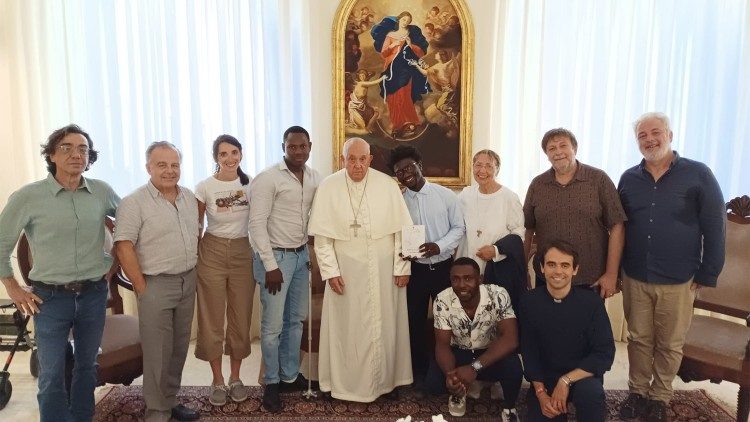
Pope Francis meets with migrants at Casa Santa Marta

Pope Francis’ meeting with migrants on Tuesday afternoon was not the first such encounter. Each, however, follows a similar pattern, and each time “a great moment of grace” is repeated.

A group of migrants visited Casa Santa Marta to get to know a man they see as a “father” and a “shepherd to all,” in the words of Fr Mattia Ferrari, who accompanied the group.

Authors share their stories

The central figures in Tuesday’s meeting were two young people, Ibrahim Lo, who came from Senegal, and Ebrima Kuyateh, originally from Gambia, who both journeyed through Libya to come to Europe.

Ibrahim is the author of Pane e acqua. Dal Senegal all’Italia passando per Libia (“Bread and Water. From Senegal to Italy via Libya”) and La mia voce. Dalle rive dell’Africa alle strade dell’Europa “My Voice. From the Shores of Africa to the Streets of Europe”); while Ebrima has shared her story in a book with the eloquent title, Io i miei piedi nudi (“I My Bare Feet”) with a preface by, among others, Erio Castellucci, the Archbishop of Modena-Nonantola and bishop of Carpi, as well as an afterword by Stefano Croci, director of Migrantes.

Among the rest of the group meeting with Pope Francis were Fr Mattia Ferrari; Stefano Croci, director of Migrantes Carpi; Giulia Bassoli, a volunteer from the same section; and Luca Casarini, founder and mission leader of Mediterranea Saving Humans and a special guest of the Synod of Bishops; and Sister Adriana Dominici, a consecrated sister of Spin Time Labs in Rome.

Stories of hell and hope

Father Mattia explained that Pope Francis wanted to listen to their stories and to thank “everyone for what they do and what they live,” and he encouraged them “to keep going.”

One of those stories came from Pato, who had already met with Pope Francis in November 2023. The death from thirst of Pato’s wife Fati and daughter Marie as they crossed the desert last year struck consciences around the world.

Similar stories of hellish experiences, though, were mixed with stories of hope that migrants wanted to share with the Holy Father. Their experiences, including the welcome received by these young people, Fr Mattia said, demonstrate that, whether at sea or on land, “when we rescue or welcome the poor, the migrants, it is they who are saving us.” And it shows that “in the love, in the fraternity that one lives with the poor, with migrants, one actually experiences salvation.”

Open the church's doors to evangelization, pope tells new archbishops Vatican

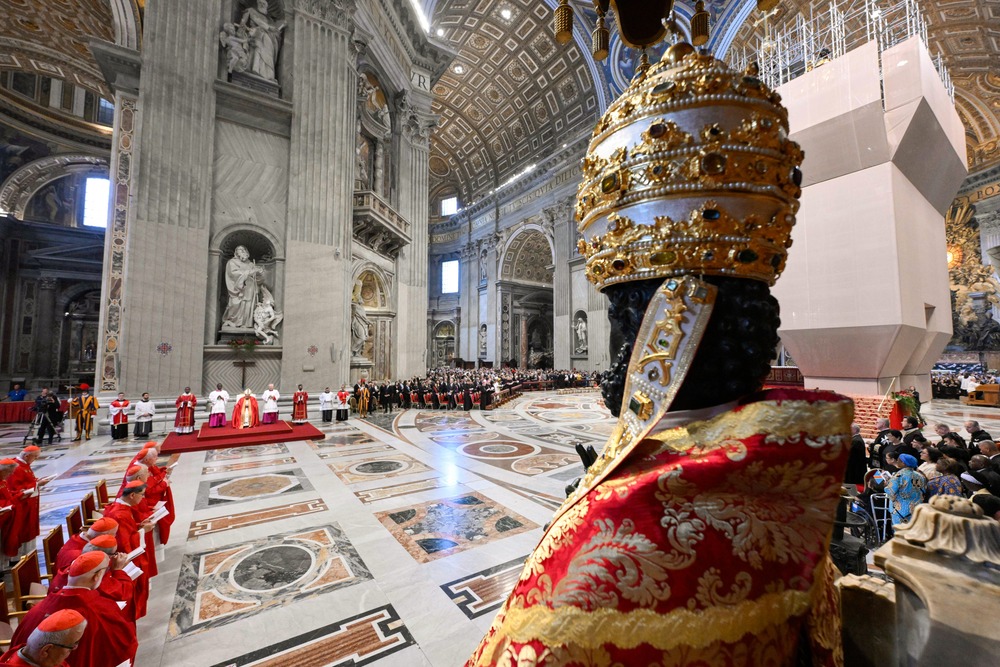
Bronze statue of St. Peter, adorned with Papal regalia, pictured from behind, Pallium Mass fills frame

While Jesus entrusted St. Peter with the keys to the kingdom more than two millennia ago, and his modern-day successor conferred apostolic authority to newly appointed archbishops June 29, it is ultimately God who holds the power to open the church's doors and lead the Christian community forward in its mission of evangelization, Pope Francis said.

Reflecting on the Apostle Peter's liberation from prison after an angel opened his cell, the pope said God "is the one who sets us free and opens the way before us" in his homily during Mass for the feast of Sts. Peter and Paul June 29.

He noted that the Christians Peter sought out after his liberation did not believe he was knocking at their door, mistaking him for an angel.

"This point is significant: the doors of the prison were opened by the Lord’s strength, but Peter then found it hard to enter the house of the Christian community," he said. "How many times have communities not learned this wisdom of the need to open the doors!"

Before 33 newly appointed archbishops gathered in St. Peter's Basilica to receive their palliums — woolen bands worn by archbishops to symbolize their pastoral authority and unity with the pope — Francis underscored the model of St. Paul as one who "discovers the grace of weakness."

"When we are weak, he tells us, it is then that we are strong, because we no longer rely on ourselves, but on Christ," the pope said.

Yet he explained that relying on Christ "does not lead to a consoling, inward-looking religiosity like that found in a few movements in the church today," noting instead that St. Paul's encounter with God ignited within him "a burning zeal for evangelization."

Both Sts. Peter and Paul "witnessed first-hand the work of God, who opened the doors of their interior prisons but also the actual prisons into which they were thrown because of the Gospel," he said, as well as the "doors of evangelization, so they could have the joy of encountering their brothers and sisters in the fledgling communities and bring the hope of the Gospel to all."

After the entrance procession, deacons brought out the palliums from the tomb of St. Peter for Francis to bless them. The palliums, made from the wool of lambs blessed by the pope on the feast of St. Agnes — who is often depicted with a lamb to symbolize purity — emphasize the role of the archbishop as a pastor who guides and protects his flock.

Francis remained seated during the Mass — Cardinal Giovanni Battista Re, dean of the College of Cardinals, was the main celebrant at the altar — but stood during the sign of peace to greet Orthodox Metropolitan Emmanuel Adamakis of Chalcedon, who attended the Mass as part of a delegation from the Ecumenical Orthodox Patriarchate of Constantinople.

The pope invited the metropolitan to sit next to him when he distributed the palliums to the archbishops, who each shook his hand after greeting the pope.

Among the 33 archbishops were Archbishop Christopher J. Coyne of Hartford, Connecticut, and Archbishop Thomas R. Zinkula of Dubuque, Iowa. Both U.S. archbishops brought members of their families with them to Rome to witness them receive their palliums from the pope.

After the Mass, Zinkula told Catholic News Service that receiving the pallium is a "huge symbol" of the archbishops' unity with the universal church and the pope, which he said is especially important in light of a growing sense of division in the United States at large and the U.S. church.

A member of the North American synod team, Zinkula said that discussions on tensions arose in many synod listening sessions throughout the country, and that the responsibility for overcoming such feelings of division falls to the church's pastors.

"If we're going to be effective in evangelizing in our increasingly secular culture, we've got to be together as a church, and that bishop is at the heart of that," he said, stressing the need for people to seek refuge in the sacraments and particularly the Eucharist "to heal us and help us grow in our faith and love."

The archbishop said the church needs to address its own sense of division, but that it should also play a role in "helping to dissipate that larger tension in society."

Coyne also acknowledged increased societal division which "finds its way into the church," but said that the chair of St. Peter remains as a "symbol of unity" for Catholics, "regardless of who sits in it."

As a result, the church's pastors are called to be "unifiers," the archbishop told CNS. "People are feeling isolated, that's why we want to bring them to communion, people are feeling angry and feel they have meaningless lives, that's why we want to have them know the full meaning of life, which is in Jesus Christ."

"Everything we do as Christians, especially as Catholics, should never be anything that leads to division, anger," but rather action that "brings us together as brothers and sisters," he said.

Pope who once advised learning from tattoos bans them in the Vatican

Francis Bans Vatican Employees from ...

Back in 2018, Pope Francis famously insisted the Church should not be “afraid” of the tattoos many young people sport, saying that priests actually can learn from them because they often communicate something important about the personality of the wearer.

“It’s important not to be scared. With young people, one should never be scared. Never,” he said at the time.

It turns out, however, that the pontiff’s seemingly benign view of tattoos doesn’t extend to his own workforce in the Vatican. New rules for employees of St. Peter’s Basilica issued June 29 specify that personnel may not have visible tattoos or piercings, and theoretically could be suspended if they do.

The new provisions were part of a twin set of new statutes released on Saturday, which the feast day of Sts. Peter and Paul, one governing the Fabbrica di San Pietro, meaning the administration of the basilica, and the other its “chapter,” referring to a body of retired priests who assist in liturgical and sacramental life.

Among other things, the new rules require basilica employees to “commit to adhering to principles of exemplary religious and moral conduct,” including not cohabitating outside of marriage. Employees must not have a criminal record, and must be both baptized and confirmed in the Catholic Church. They must also produce a letter from a parish priest testifying to their good standing.

The rules apply to all employees of the basilica, who include artistic experts and architects in addition to the so-called Sampietrini, meaning laborers who carry out routine maintenance and operations.

In addition, personnel are also barred from “taking part in activities, or attending rallies, which are inappropriate for a Vatican employee.” Most observers have taken that provision, at least in part, to refer to events such as the Gay Pride rally which was staged in Rome on June 15.

On another front, the new rules also address the chronic leaks which have beset the Vatican in recent years, and which have resulted in two separate scandals known as “Vatileaks.”

Personnel are required at the time of hiring to make a profession of faith or a loyalty oath, including the promise to maintain what’s known as the “secret of the office,” generally meaning confidentiality, before one of the superiors of the basilica.

Employees are also banned from giving interviews to media outlets without authorization, and from divulging any information covered by the “pontifical secret.” They may not invite outsiders into their workplace, and may not remove “original documents and photocopies or electronic copies and other archival materials.”

In what amounts to a fairly clear break with previous Vatican practice, the rules also discourage nepotism, barring the hiring of close blood relatives of current employees without the express consent of the cardinal in charge of the basilica.

The other set of new norms governs the basilica chapter, an institution which has existed in one form or another since the second half of the 11th century. Originally, the role of the chapter was to oversee sacramental life in the basilica and to administer its property, including artwork, other goods, and even real estate donated to the papacy.

Today financial oversight has largely been turned over the administration of the basilica, while the chapter has come to focus more on liturgical and sacramental matters. It’s composed of a vicar and 34 members, mostly retired clergy, who traditionally have been granted a stipend and living quarters in addition to fees for specific services.

Among other things, the new provisions specify that the canons will become merely “honorary” once they reach the age of 80 and will no longer receive stipends, though they will be allowed to retain their title and to participate in liturgical and pastoral activity in the basilica. They also will retain the right to be buried in the chapel of the chapter.

The same rules apply to canons who have not taken part in meetings and liturgical events in the basilica for more than a year.