Wednesday, February 01, 2017

Sex abuse inquiry to hold final hearing into Australian Catholic Church

Image result for Royal Commission into Institutional Response to Child Sexual AbuseThe Royal Commission into Institutional Response to Child Sexual Abuse will examine the current policies and procedures of Catholic Church authorities in Australia in its final public hearing into the church.

The public hearing will be held on Monday inside the royal commission’s hearing rooms at the Governor Macquarie Tower in Sydney.

The hearing will probe existing child protection and child-safe standards within the Catholic Church, including responding to allegations of child sexual abuse.

It will also examine factors that may have contributed to the occurrence of child sexual abuse at Catholic Church institutions across Australia.

The hearing is also expected delve into the response of Catholic Church authorities in Australia to relevant case study reports and other royal commission reports.

It will also examine data relating to the extent of claims of child sexual abuse in the Catholic Church of Australia. 

The purpose of this hearing is not to inquire into individual sets of facts or particular events as has occurred in previous royal commission case studies.

The commission, which is due to deliver its final report in December 2017, stopped accepting survivors' applications to tell their stories to commissioners in private hearings on September 30.

The hearing comes after disgraced paedophile Catholic priest Gerald Ridsdale fronted this month charged with more than 36 new allegations of historic child sexual abuse.

The inquiry revealed last year, it has spoken to 5111 survivors in private sessions, with 1544 waiting for future sessions. Last year alone, it held about 37 private sessions a week with survivors.

The Courier understands a number of Ridsdale’s alleged victims have come forward and made reports to Victoria Police Taskforce Sano in the wake of the Royal Commission into Institutional Responses to Child Sexual Abuse. 

Australia’s police commissioners are also set to make a historic apology to all victims of child-sex abuse in institutional care who not believed when they reported child sex crimes at the hands of clergy, or who were returned to abusers. 

Victoria Police chief commissioner Graham Ashton said earlier this year, commissioners will wait until after the royal commission's final report is released in December. 

In December 2015, the inquiry heard a widespread conspiracy to conceal child sex abuse by a disgraced priest was orchestrated by leaders of the Catholic Church and Victoria police. 

The hearing will be streamed live to the public via webcast on the royal commission’s websitewww.childabuseroyalcommission.gov.au.

SCOTLAND : Catholic church launches major priesthood recruitment drive

http://priestsforscotland.org.uk/wp-content/uploads/2016/08/Logopfs6.pngSCOTLAND'S Catholic church has launched its biggest recruitment drive for the priesthood in generations amid ongoing concerns over a rapidly ageing clergy. 

As the number of priests in parts of Scotland is predicted to drop by 100 in the next two decades, young men in parishes across the country will be encouraged into the vocation as the church seeks to attract its next generation to the pulpit. 

Figures from around a decade ago showed the number of Scots entering the priesthood had dropped to one or two a year, with Blairs College, the main entrance for teenagers seeking to join closing in the late 1980s. 

But while the number of priests in Scotland appears to be hurtling towards one of its lowest points since the restoration of the Catholic hierarchy, when the curbs of the Reformation were lifted almost 150 years ago, the church said there was evidence of "green shots of recovery" with a sustained rise in those now in training. 

With the number now training in the Scots College in Rome standing at 20, the Church is now seeking to capitalise on what it believes is a growing interest in religious life amongst a generation of males in their 20s. 

All 500 Catholic parishes throughout Scotland will receive copies of a new magazine this weekend focusing on young men currently studying at the Scots College in Rome, with the church believing personal testimonies are one of the most effective tools for selling the religious life. 

John Keenan, president of the church’s national vocations agency and Bishop of Paisley, said: “As I go round our parishes, schools and youth events I see, every day, young or single men who’d make ideal priests and I’m sure God is calling many of them to be priests for Scotland. 
  "But they won’t come forward unless they hear God’s call. Today God calls them through modern media so I want everyone to take a copy of Priests for Scotland and put it in the hands of a man you think might be being called. You just might have found Scotland a new priest and God won’t forget it.”

The drive comes amid some grim figures for the church, with the number of priests dropping in the Galloway Diocese from 55 to 23 in the quarter century from 1990, and the St Andrews and Edinburgh Archdiocese predicting it will have only 30 priests in 2035, down from around 130 now. 

Hit by the same secularisation effecting all Christian churches in the UK, parishes also rely upon overseas priests, primarily from Africa and Eastern Europe and who see Scotland as "missionary terrain", with one priest recently training parishioners to carry out funerals. 

But the church insists the new push is about making it self-sufficient, with parishes reliant during its era of packed congregations upon a massive influx of Irish priests. 

With bishops currently going through major upheaval by reorganising their dioceses and reducing the number of churches and parishes it also insists the projected clergy numbers are not so bleak when seen as a ratio per parishioner. 

One source said: "This is the important number. We have around one priest to 250. In Latin American this can be one to 10,000. In Africa one to as many as 40,000. The number of those in training has been gradually rising and its now a definitive trend. We now want to build on that." 

Father John Morrison, assistant director of the Priests for Scotland campaign drive, said: “We wanted to let people know that there are still men who are being drawn to the priesthood. We wanted to communicate some of the joy and happiness they have felt in responding positively to that call.”

LAOS - Two new priests for Laos in 2017

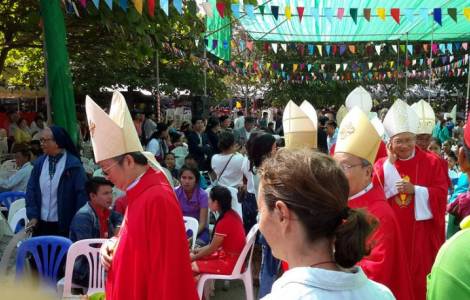
The small Catholic community in Laos (less than 1% out of seven million inhabitants) is preparing to celebrate two new priestly ordinations in 2017.

One of the deacons who is preparing for his priestly ordination - programmed in the current year, belongs to the Apostolic Vicariate of Pakse, the other belongs to Luang Prabang. 

Louis-Marie Ling, Apostolic Vicar of Pakse, tells Fides is "hopeful", after the solemn public celebration of the beatification of the martyrs: "It was a feast with more than seven thousand faithful, a historical event, a miracle for us".

The pastoral activities, Ling says to Fides, proceed calmly, "we sometimes have some small problems with some diligent provincial officials, but as priests and religious we visit families, we celebrate the sacraments, we do catechism without problems". 


With the new deacon, whose ordination is scheduled for next March, "I will have five active and two retired priests in Pakse", he says. They are entrusted parishes and over 13 thousand faithful of the Vicariate. "It is not my job nor my merit, everything is God's work. We follow the inspiration of the Holy Spirit", confides the Bishop to Fides.

Even Tito Banchong, apostolic administrator in Luang Prabang, in the north of the country, celebrated the ordination of three priests in September 2016 and is preparing for the gift of another vocation. 


"In my area, where for 12 years, from 2000 onwards, I was completely alone, we are blessed with the thriving of vocations to priesthood: a sign that the Lord is near. He is the God-with-us. And he was also with us in the time of suffering", says the Bishop, who between 1976 and 1986 spent five years in prison, when the pressure of the communist Pathet Lao regime on religious freedom was stronger.

On 30 January in his homily during Mass in the Casa Santa Marta, before the Bishops of Laos, Pope Francis said that "the greatest strength of the Church today is in the little Churches, tiny, with few people, persecuted, with their bishops in prison. This is our glory today, and our strength today".


At the end of the ad limina visit, Bishop Tito Banchong remarked: "We are very happy. This visit gave us the certainty of unity with the Pope. The Pope knows us, loves us, has opened his heart. He is really a father for us who listens to us. He told us to move forward in our mission: it is for us a precious encouragement".

BANGLADESH : Tight controls on insults to the religious sentiment at Dhaka’s book fair

http://www.asianews.it/files/img/BANGLADESH_-_0201_-_Fiera_del_libro.jpgBangladesh Prime Minister Sheikh Hasina today opened this year’s Amar Ekushey Book Fair in Dhaka.
 
Police will provide security to the month-long event, including plainclothes agents, said Dhaka Metropolitan Police (DMP) Commissioner Asaduzzaman Mia said.

Their task will be to ensure that books on display do not contain insults to the religious feelings of the population.

One of the most important events in the country, the fair is held every year at the Bangla Academy near the Suhrawardy Udyan National Memorial.

It is dedicated to the martyrs who died on 21 February 1952 in a demonstration calling for the establishment of Bengali (Bangla) as one of the state languages in the former East Pakistan. For this reason, it is considered the "month of the language".

The decision to vet books is due to rise of radical Islam, which led to last year’s Dhaka massacre, the bloodiest in the country's recent history, and to attacks by extremists against minority leaders, bloggers and free-thinkers.

The fair includes 663 stands given in concession to 409 publishing houses presenting thousands of new editions.

DMP Commissioner Mia said authors and publishers have a responsibility to review their books to see if they contained insulting comments. 

The Bangla Academy, the fair’s organising authority, will eventually scrutinise them as well.

Commenting on the danger that controls could be a barrier to publication, Mia noted that "We believe in freedom of thought, but if someone hurts someone else’s religious feelings and incites sectarian violence, it is no longer freedom of thought."

Last year the authorities shut down one stall because it was selling a book containing insults to Islam.

"We are aware of controls,” said one Muslim publisher. “According to past experience, before printing, we reread the books word for word.”

“Bangladesh is a conservative Islamic country,” he added, “and we must obey the laws of the land and respect the religion of others."

CHINA : Protestant church destroyed in Henan

http://www.asianews.it/files/img/Dali_Church_1-27-17_combined.jpgA Protestant church was destroyed last Friday morning, 27 January, in Henan province.
 
A bulldozer tore down half of the four-storey building pulverising many facilities whilst Christians were remained locked in an office space inside.

Intruders hired by the authorities forcibly entered the Dali Christian Church, a government-recognised Three-Self (Protestant) congregation, carrying clubs.

They locked a church elder, named Ding, the church's temporary director, and several other Christians in the reception office, confiscated their cell phones, and threw away their SIM cards.

No one was allowed to enter the church, and the authorities forbade pictures.

The intruders then smashed and looted church property, and a front loader tore down about half of the building, destroying many facilities.

This event has sparked fears that the church and cross demolitions, which were part of a "beautification" campaign led by the authorities in Zhejiang province and targeted many Three-Self churches, will soon erupt into a nationwide endemic of abuse against government churches.

Mgr Allwyn D'Silva is Mumbai’s new auxiliary bishop

The Archdiocese of Mumbai (Maharashtra) has a new auxiliary bishop, Mgr Allwyn D'Silva, 68, head of the Mumbai chapter of the Prison Ministry India (PMI).
 
For years he has been involved in social affairs, human rights and environmental protection; hence his episcopal motto, he told AsiaNews, is’ Care of Creation’.

He believes that his ordination is a recognition by the Catholic Church of the "importance of environmental issues and justice. It is also a recognition for the work he has done in favour of the marginalised and on the environment in Asia.”

Born on 20 April 1948, he was ordained priest on 19 April 1975, and elevated to the status of auxiliary bishop last Saturday (28 January).

Mgr D'Silva believes that his appointment is "a great challenge, especially since Pope Francis has set very high standards for us bishops when he said that we must be shepherds with the smell of sheep."

The bishop is the current secretary of the Climate Change desk at the Federation of Asian Bishops' Conferences (FABC), and will remain in office until the end of 2017. For more than 20 years, he has dealt with social justice, in particular with respect to prison inmates.

Mgr D'Silva explained that the PMI Mumbai was established in 2001, noting that the city has nine penitentiaries and the prison population has unique traits. 

Convicts crowd facilities outside Mumbai, whereas 90 of inmates in the city are still under trial.

This is a colonial legacy whereby defendants are held in detention before trail. Although still innocent until proven guilty, they are deprived of their liberty.

The MPI Mumbai is staffed by volunteers who deal with legal aid and prisoner rehabilitation. 

They receive regular visits from other PMI members who organise health care treatment and dental visits.

Inmates take part in cultural events, games and shows, and receive various kinds of professional training: from tailoring to painting, from teaching embroidery techniques to arts and flower arrangements.

Volunteers provide courses in computer science, cooking and foreign languages. Inmates are involved in singing competitions, music, dance and writing. Some of them have written articles that are then published in the Examiner, a weekly published by the archdiocese.

As for their spiritual care, a Mass is celebrated each Sunday in every prison. 

Except for the Dadar facility, prison authorities allow Christmas and Easter celebrations such as Christmas carols, the Stations of the Cross during Holy Week, and exchange gifts between inmates and staff during holidays.

Litany of St. Brigid


Brigid of the hearth and the hare
Brigid of the spark and the flame
Brigid of the cloak and the veil
Brigid of the herb and the stars
Brigid of the byre and the kine
Brigid of the ill and the old
Brigid of the young and the wild
Brigid of the poor and the voiceless
Brigid of the oak and the staff
Brigid of the long nights watching
Brigid of the Sun's slow dawning
Brigid of the Moon's spring rising
Brigid of the first bloom’s flowering
Brigid of the well’s gentle healing
Brigid of the Earth’s old wisdom
Brigid of the Nun’s deep chanting
Brigid of the High King of Heaven
Brigid of the rush woven cross
Brigid of the shaven head
Brigid of the lost sword
Brigid of the royal house
Brigid Abbess of the duel house of prayer
Brigid Eldress of the sanctuary’s light
Brigid Wise Woman of the healing touch
Brigid saint of Ireland
Pray for us

Boy Scouts accepts gender identity as new standard for admission

Image result for boy scouts of america gay flagCiting legal and community changes, the Boy Scouts of America have said self-declared gender identity now determines youth eligibility for its scouting programs. 

The move could add new difficulties for Catholic sponsors of scout troops trying to adapt to the organization’s relatively new policy on homosexuality.
 
“Starting today, we will accept and register youth in the Cub and Boy Scout programs based on the gender identity indicated on the application,” the Boy Scouts of America said Jan. 30.
The statement said its local councils will “help find units that can provide for the best interest of the child.”

The statement said Cub Scouting and Boy Scouting are “specifically designed to meet the needs of boys.” In previous years, the organizations have used individuals’ birth certificates to determine whether they are eligible for single-sex programs. 

“However, that approach is no longer sufficient as communities and state laws are interpreting gender identity differently, and these laws vary widely from state to state,” the statement said.

The new policy comes after a transgender child in New Jersey was asked to leave the Cub Scouts late last year. The child's pack was hosted by Immaculate Conception parish in Secaucus. The child had told CNN that “it's not fair because my friends get to do it, but I can't.”

CNA contacted the National Catholic Committee on Scouting for comment but did not receive a response by deadline.

The Boy Scouts of America had announced in July 2015 that it would adopt a non-discrimination policy allowing homosexuals to be scout leaders and volunteers. 

The decision promised that churches with objections to homosexual behavior could set their own standards for affiliated organizations.

Bishop David Kagan of Bismarck, himself a former boy scout, in summer 2015 reluctantly told his North Dakota diocese to disaffiliate from the Boy Scouts of America due to the legal risks and the moral confusion its leadership policy could cause for Catholics.

He said the policy could risk lawsuits for church-sponsored troops that attempt to hold their leaders and volunteers to Catholic moral standards.

Bishop Kagan lamented the goals of those who sought the policy change to “redefine what is acceptable and unacceptable in society.” 

At the same time, the bishop suggested that the Boy Scouts of America would not be able to defend the previous policy in court given trends in the American legal system.

However, Bishop Robert Guglielmone of Charleston, a leading member of the National Catholic Committee on Scouting, had recommended “cautious optimism” towards that policy change, voicing hope that Catholic churches could still use Boy Scouts of America programs in a way consistent with Church teaching.

He said Catholic-chartered scouting units are “the only way we can have a direct influence” on Catholic youth involved in scouting.

At the same time, the bishop acknowledged there is no way Catholics can control the material in Boy Scout programs, merit badge material, and its Boys’ Life magazine.

Bishop Kagan recommended alternatives to the Boy Scouts, enumerating the Federation of North American Explorers, the Columbian Squires, and Trail Life USA. He also recommended alternatives to the Girl Scouts, listing American Heritage Girls, Little Flowers’ Girls Clubs, and the Federation of North American Explorers.

There are about 2.3 million members of Boy Scouts of America groups between the ages of 7 and 21. 

President Donald Trump’s nominee for Secretary of State, Rex W. Tillerson, is a past national president of the Boy Scouts of America and served on its executive board in 2013 when it voted to lift the ban on homosexual scouts, The New York Times reports.

The Resurrection is more than a wish – it's a reality, Pope Francis says

Pope Francis greets pilgrims during his Feb. 3, 2016 general audience in St Peter's Square. Credit: Daniel Ibañez/CNA.On Wednesday Pope Francis said the Christian belief in the Resurrection of Christ and in our own resurrection at the end of time is more than just wishful thinking, but rather implies confidence in something certain.
 
“This is the Christian hope. Christian hope is the expectation of something that has already been accomplished and that certainly will be realized for each of us,” the Pope said Feb. 1.

Speaking to pilgrims in the Vatican’s Paul VI hall, he said that we need “to return to the root and foundation of our faith, so as to become aware of what God has done for us in Christ Jesus and what our death means.” 

Continuing his catechesis on the theme of hope, Francis’ lesson for the audience centered on the Letter of St. Paul to the Thessalonians. The community of Thessalonica had only been around for a few years when Paul wrote, which was shortly after Christ’s Resurrection, he said.

At this time, the community did not have difficulty believing in Jesus’ resurrection from the dead, but rather, the difficulty they faced was believing that on the last day, all of the dead would be raised.

“We all have a little fear of the uncertainty of death,” the Pope said. “Each time we face our death, or that of a loved one, we feel that our faith is tested. All our doubts emerge, all our weaknesses and we ask ourselves: ‘But really there is life after death ...? I can still see and embrace the people I loved...?’”

However, despite the fears and concerns of the community, St. Paul invites the people to hold firm to “the hope of salvation,” especially “in trials and in the most difficult moments of our lives.”

Christian hope is not like the everyday hopes we have, like when we hope or wish for good weather, even though we know that the weather may actually be bad, he said.

Rather, Christian hope means “to be sure that I’m on the way to something that is, not that I want to be.” We should strive to live in this kind of hopeful expectation, he said, using the image of a pregnant woman who waits in expectation to see her child. 

Although this isn’t always easy, we are able to learn to live with this kind of expectation, he said, but added that to do this requires a “humble heart, a poor heart.” Someone who is full of himself and of his possessions, on the other hand, cannot place his trust in anyone but himself.

Pope Francis said that something that touches his heart and fills him with hope, is the line from St. Paul that says: “And we shall always be with the Lord.”

“One nice thing: everything passes but, after death, we shall be forever with the Lord. It is the total certainty of hope,” he said.

“Do you believe this?” he asked, inviting those present to repeat with him: “And we shall always be with the Lord.”

He noted how St. Paul writes that Jesus “died for us ‘so that whether we wake or sleep, we should live together with him.’” These words, he said, “are always a source of great consolation and peace.”

COLOMBIA - Consecrated life: "light for the world, promoter of peace and reconciliation"

Inspired by the theme "Let us be reconciled to God" (2 Cor 5:20) indicated by the Colombian Episcopate, which places reconciliation as a priority commitment of the whole Church of Colombia for the year 2017, even consecrated life intends to live the next World Day on February 2, highlighting the task of consecrated people to be, once reconciled, promoters of peace and reconciliation.

The World Day of Consecrated Life, which is celebrated on the feast of the Presentation of the Lord in the Temple, February 2, "is an opportunity to recognize the gift of consecrated life and to say that their dedication and their loving service to the Church is light for the world, and promotes peace and reconciliation", stressed His Exc. Mgr. José Alejandro Castaño Arbeláez, Bishop of Cartago, President of the Episcopal Commission for consecrated life, in the note sent to Fides.

"Consecrated people in Colombia have been present since the first evangelization - the Bishop continues - in different areas, by proclaiming the Gospel in the field of education, health, work with the poorest; with great missionary spirit they have brought the Gospel to diverse populations, with their poor, chaste and obedient life". 


In this feast we are called to recognize the gift of consecrated life as "an expression of God’s love and tenderness", urges Mgr. Castaño Arbeláez, who calls consecrated people to be "joyful promoters of peace and reconciliation".

February - Purification of the Blessed Virgin Mary


Almighty and beneficent God! who didst impose upon our mother Eve, in punishment for her sin, that she should give birth to her children in pain:

I offer to Thee all the pains which I have thus suffered in atonement for my sins, and thank Thee, that I have safely brought a child into the world, whom I now offer to Thee, according to the example of the Mother of Thine only-begotten Son, for Thy holy service, whom I shall zealously endeavor to educate for Thy honor.


Give me but this grace through the intercession and merits of this most blessed Mother.


Bless me and my child, and grant, that we may here live in accordance with Thy divine will, and receive eternal salvation.


Through Christ, our Lord.


Amen.