Friday, September 01, 2023

Finnish lawmaker on trial for ‘hate speech’ for defending traditional marriage

Here We Go: Finnish Lutheran Bishop and Christian Politician Both Face  Trial for Rebuking Homosexuality -

Finnish lawmaker Päivi Räsänen is on trial this week for “hate speech” and “ethnic agitation” after publicly sharing in 2019 her biblical, religious views on marriage as between one man and one woman. 

Räsänen, 63, is being tried for violating Finland’s hate speech laws by using Bible verses to express her support for traditional marriage. 

Her trial began on Aug. 31 and Sept. 1. 

In the 2019 tweet that landed Räsänen in her current legal troubles, she criticized her denomination for embracing LGBTQ+ ideology, asking how these views could be reconciled with Scripture. In the tweet, she referenced Romans 1:24-27, which clearly states that homosexual activity is against God’s will. 

Along with Räsänen, a Finnish Lutheran bishop named Juhana Pohjola is also being tried for hate speech for publishing a pamphlet written by Räsänen that advocated for the biblical understanding of sexuality and marriage. 

Though they were unanimously acquitted by a Finnish District Court in 2022, prosecutors appealed their acquittal to the Helsinki Court of Appeal. 

Now, the two are facing tens of thousands of Euros in fines and possibly two years in prison if they are found guilty. 

Additionally, the court could also rule to censor Räsänen’s publications.

Räsänen and Pohjola are being represented by the Alliance Defending Freedom International (ADF). 

Paul Coleman, executive director of ADF International, said in a press release last week that “the relentless prosecution” of Räsänen has not only consumed four years of her life but “also intimidates others into silence.” 

“In a democratic society, everyone should be free to share their beliefs without fear of state prosecution,” Coleman said. “Criminalizing speech through so-called ‘hate-speech’ laws shuts down important public debates and endangers democracy.”

Räsänen, who is a mother of five and grandmother of 10 as well as a member of Finland’s Parliament, told EWTN’s Tracy Sabol in a Monday interview that despite facing renewed persecution, she trusts “that this whole process is in God’s hands” and that she is confident that she will once again be acquitted of the hate speech charges. 

U.S. lawmakers defend Räsänen

Fifteen U.S. lawmakers, led by Republican Rep. Chip Roy of Texas, signed onto an Aug. 8 letter in support of Räsänen and all Christians’ right to free speech. 

The strongly worded letter was addressed to Rashad Hussain and Douglas Hickey, Biden’s U.S. ambassador at large for international religious freedom and the U.S. ambassador to Finland, respectively. 

“The prosecutor,” the letter said, “is dead set on weaponizing the power of Finland’s legal system to silence not just a member of Parliament and Lutheran bishop but millions of Finnish Christians who dare to exercise their natural rights to freedom of expression and freedom of religion in the public square.” 

The lawmakers further said that Räsänen’s case holds greater significance for all Christians throughout the Western world. 

“History will remember this case for either stopping the madness or as the beginning of the end as the West declares open war on Christianity,” the lawmakers wrote, adding that “the selective targeting of these high-profile individuals is designed to systematically chill others’ speech under the threat of legal harassment and social stigmatism.” 

In a Tuesday tweet, Roy said that “no American, no Finn, and no human should face legal harassment for simply living out their religious beliefs.”

All 15 lawmakers who signed the letter are Republican members of the House of Representatives.

‘Christian teachings on trial’ 

According to a Tuesday ADF statement to the media, “Christian teachings [are] on trial” in Finland. 

ADF said that “core Christian teachings” were attacked during the district trial in early 2022 and that “finding Räsänen guilty would be a grave violation of human rights, significantly damaging free speech in Finland.” 

Tony Perkins, president of one of the U.S.’s leading religious advocacy groups, Family Research Council, also said in a Tuesday tweet that “it is not just Päivi and Bishop Pohjola on trial” but that “the Bible and the ability to live by the word is on trial.” 

In her Monday “EWTN News Nightly” interview, Räsänen said her trial directly challenges the rights of Christians to freely express deeply held religious beliefs and that “if something like that could happen in Finland it can happen in any country.”

Vatican reassures Ukrainian Catholics that pope did not intend to praise Russian imperialism

Young Catholics participating in the 10th edition of the All-Russian Meeting of Catholic Youth in St. Petersburg, Russia, watch a livestream of Pope Francis at the Basilica of St. Catherine of Alexandria on Aug. 25, 2023. Credit: Basilica of St. Catherine of Alexandria

After the leader of the Ukrainian Greek Catholic Church expressed “great pain and concern” at Pope Francis’ recent video message to young Russian Catholics, the Vatican said that the pope did not intend to exalt Russian imperialism.

Vatican spokesman Matteo Bruni said Tuesday that “the pope intended to encourage young people to preserve and promote what is positive in Russia’s great cultural and spiritual heritage, and certainly not to glorify imperialistic logic and government personalities.”

The statement came in response to concern from Major Archbishop Sviatoslav Shevchuk of the Ukrainian Greek Catholic Church over Pope Francis’ words referring to “the great Russia of Peter I, Catherine II, that great and enlightened Russian empire of much culture and much humanity.”

Pope Francis made the comment while speaking off the cuff during a live video conference with Russian youth on Aug. 25. 

Before the final blessing, Pope Francis said: “Do not forget your heritage. You are heirs of a great Russia. The great Russia of saints, of kings. The great Russia of Peter II [a likely reference to Peter I], Catherine II, that great and enlightened Russian Empire of much culture and much humanity. Never deny this heritage, you are the heirs of the great Mother Russia, carry on with it, and thank you, thank you ... for your way of being and for being Russian.”

The remarks were made in Italian after the pope’s question-and-answer session with the youth, before the blessing, and were not included in the available livestream nor in the official transcript of Pope Francis’ speech released on Aug. 26 by the Holy See Press Office.

The pope’s words were published on the Moscow Archdiocese’s platform cathmos.ru at the conclusion of the youth event on Aug. 27. 

Pope Francis referenced Russian czars who expanded the Russian empire in centuries past and whom President Vladimir Putin previously invoked in justifying the full-scale invasion of Ukraine. 

The Ukrainian major archbishop responded with alarm. “We hope that these words of the Holy Father were spoken spontaneously, without any attempt at historical evaluations, let alone support of Russia’s imperialist ambitions,” Shevchuk said. 

“There is a danger that these words could be taken as supporting the very nationalism and imperialism that has caused the war in Ukraine today — a war that brings death and destruction to our people every day,” he added.

The apostolic nunciature in Ukraine later released a statement “firmly rejecting” the interpretation that “Pope Francis might have encouraged young Russian Catholics to draw inspiration from historical Russian figures known for imperialistic and expansionist ideas and actions that negatively impacted neighboring populations, including the Ukrainian people.”

The Vatican embassy added that the words of the Roman pontiff are to be understood in the context of Pope Francis being “a staunch opponent and critic of any form of imperialism or colonialism across all peoples and situations.” 

The Archdiocese of Moscow told CNA that it stands with the clarification provided by the Holy See Press Office.

In Pope Francis’ video conference with the young Russian Catholics, the pope urged them to be peacemakers and “bridge builders.”

“I wish you, young Russians, the vocation to be artisans of peace in the midst of so many conflicts, in the midst of so many polarizations on all sides, which plague our world,” he continued.

“I invite you to be sowers, to sow seeds of reconciliation,” he said, “little seeds that in this winter of war will not sprout for the moment in the frozen ground, but which in a future spring will blossom.”

Opus Dei does not want to be an exception in the Church, prelate says

Situación actual y futura del Opus Dei tras el motu proprio y los nuevos  estatutos

Monsignor Fernando Ocáriz, the prelate of Opus Dei, said the institution he has led since January 2017 “does not want to be an exception” in the Catholic Church.

The prelate gave his comments June 27 to El País Semanal in a weekend supplement to the Spanish newspaper, which was published Aug. 26 in a report titled “Opus Dei at the crossroads.”

When asked if Pope Francis, with the reforms he has ordered for Opus Dei, has decided to dissolve the “specificity” of the institution, the prelate said he amiably disagrees and that “the specificity of Opus Dei rests on its charism or spirit rather than on its legal trappings. At its core is the universal call to holiness through work and the ordinary realities of life.”

“For the rest, Opus Dei does not want to be an exception,” he noted.

The fact that until now “The Work” has been “the only personal prelature that could have been perceived as something ‘exceptional,’ but of course it’s not that: On the contrary, I think it would be very good if there were other personal prelatures that contributed to the evangelization of numerous areas especially in need of Christian inspiration,” Ocáriz remarked.

Opus Dei means “the work of God” in Latin, which is why its members refer to the institution as “The Work.” Its emphasis or charism is sanctification through daily work. It is made up of priests, celibate laymen who are called numeraries and associates, and supernumeraries who are married members.

Founded by St. Josemaría Escrivá on Oct. 2, 1928, and erected as a personal prelature on Nov. 28, 1982, by St. John Paul II, since March 2022 Opus Dei has been at the center of a series of reforms determined by Pope Francis.

The most recent, issued Aug. 8, equates personal prelatures with public clerical associations that have the power to incardinate clerics.

A little over a year ago, on July 22, 2022, with the motu proprio Ad Charisma Tuendum (“to protect the charism”), the Holy Father transferred the competencies in matters of personal prelatures from the Dicastery for Bishops to the Dicastery for the Clergy and determined that the prelate, currently Ocáriz, will not be a bishop although he maintains the honorary title of monsignor.

Blessed Álvaro del Portillo and Javier Echevarría, the first two successors of St. Josemaría at the head of Opus Dei, were appointed bishops by St. John Paul II.

The perception outside of Opus Dei

The prelate also pointed out to El País Semanal that “most of the people who know us appreciate us. Especially when they know about the work that is done: social, educational ... when they come into contact with people individually, because these are the realities. Even when they think otherwise.”

Then there are other environments, he continued, “in which there may be more criticism, due to prejudice: due to a conception that one has of the history of the Church and of its role in the world that can lead to a nonpositive assessment.” 

It is understandable, then, “that there are aspects that do not fit the way of thinking of some people. But that’s pluralism. The only important thing is to respect each other: We can always collaborate,” he added.

Position in face of criticism

Regarding the criticism that Opus Dei receives, Ocáriz commented that “mistakes and personal inconsistencies are part of life. Criticisms help to improve when they are well-founded and come from knowledge of reality.”

“I would like the variety of Opus Dei people to be better perceived from the social and cultural point of view. Sometimes the focus is on a person of public importance and not on a hundred others who have difficulties making ends meet.”

In the opinion of the 78-year-old Spanish prelate, “in some cases a stereotyped reading has been made of Opus Dei, based on clichés, which don’t help understanding a broader and more plural reality.”

“I would also like to see greater understanding that Opus Dei people are free and responsible. Their merits or mistakes in their professional performance or in civil life, for example, must be attributed to him or her, as it happens with any other Catholic,” he noted.

The prelate of Opus Dei stressed that “the opinions or decisions of a politician on the left or the right are his and his alone, not attributable to the Church or to an institution; these are realities that move on different planes. Historically, this mechanism of attributing personal performance to belonging to a spiritual path has fostered misunderstandings that continue to this day.”

Opus Dei is currently present in almost 70 countries and is made up of more than 93,000 lay members, of whom 57% are women and 43% men, in addition to 2,095 priests.

Fighting between progressives and conservatives in the Church?

Regarding the “fight” between conservatives and progressives in the Catholic Church, Ocáriz recalled that “the pope was asked a similar question, and he pointed out that it was a worldly interpretation, alien to the religious dimension. I think that too often there is a tendency towards a reading of reality in terms of power and polarization, with groups that oppose each other and don’t understand each other.”

However, the prelate explained that “in the Church the logic that must prevail is that of service and collaboration. We all row in the same boat, open to being helped to improve.”

And about the “old conflict” that the Spanish newspaper mentioned between Jesuits and members of Opus Dei, the prelate noted that “personally I can tell you that I am a former student of the school of the Society of Jesus in Madrid, and I am very grateful for the formation and the example I received from the Jesuits.”

A prayer request from the prelate

The reform ordered by the pope, which includes the modification of the statutes of The Work, led to holding a world congress in Rome in April in which 126 women and 148 men participated, of whom 90 were priests.

“The motu proprio of Aug. 8 must also be taken into account when adapting and updating the statutes of the Work … For this reason, I now renew the request for prayers that I already addressed to you a few months ago, so that this work comes to fruition,” Ocáriz wrote in a letter to the members of Opus Dei two days after the publication of the papal document this month.

Pope Francis’ prayer intention for September 2023

Pope Francis' General Audience Catechesis on Prayer - Full Text - Cardiff  Cathedral

Pope Francis’ prayer intention for the month of September is for people living on the margins. 

“A homeless person who dies on the street will never appear among the top stories of search engines or newscasts,” the pope said in a video released Aug. 29.

The Holy Father questioned: “How could we have reached this level of indifference?”

He goes on to ask how we as a society have allowed the “throwaway culture” to “dominate our lives, our cities, our way of life?”

“Our necks are going to get stiff from looking the other way so we don’t have to see this situation,” he said.

The pope urged the faithful to “stop making invisible those who are on the margins of society, whether it’s due to poverty, addictions, mental illness, or disability” and instead “focus on accepting them, on welcoming all people who need it.”

He concluded with a prayer: “Let us pray for those people on the margins of society in subhuman living conditions, that they may not be neglected by institutions and never be cast out.”

Pope Francis’ prayer video is promoted by the Pope’s Worldwide Prayer Network, which raises awareness of monthly papal prayer intentions.

Former U.S. Cardinal Ruled Incompetent to Face Criminal Trial for Sexual Assault

Judge rules former Cardinal Theodore McCarrick is not competent to stand  trial in sex abuse case, dismisses charges | CNN

Former cardinal Theodore McCarrick is not competent to stand trial on criminal sexual abuse charges in Massachusetts, a state district judge ruled Wednesday in criminal court. 

The dismissal of the charges follows separate examinations of McCarrick’s mental health by health professionals hired by both his and the state’s legal teams, both of which concurred on his incompetence.

McCarrick, 93, was charged in state court with three counts of indecent assault and battery on a person over the age of 14 relating to allegations that he sexually abused a teenager who was a family friend at a wedding ceremony in the 1970s at Wellesley College in Wellesley, Massachusetts. 

That teenager was identified by NorthJersey.com in February as James Grein, a now-64-year-old former New Jersey resident.

Norfolk assistant district attorneys Lisa Beatty, Alix Beamon, and Meagan Monahan asked Dedham District Court Judge Paul McCallum to dismiss the case against McCarrick citing his incompetence to stand trial, a court filing for Aug. 30 said.

McCarrick was not in the courtroom but was present through video conference, the New York Times reported. He did not say anything during the proceedings.

The Times reported that the state’s psychologist who examined McCarrick testified in court Wednesday that McCarrick has cognitive issues and “deficits of his memory and ability to retain information.”

Neither of McCarrick’s lawyers issued comment following the ruling.

David Traub, a spokesperson for the Norfolk District Attorney’s Office, said in a statement that “after defense came forward with a report finding him incompetent several months ago, the Commonwealth hired an independent expert to fly to Missouri and conduct an independent evaluation.”

“That evaluation also found a lack of competency to assist in his defense, as required to go forward. The judge heard that information today and ruled McCarrick incompetent,” he said.

The charges in Dedham were the first criminal charges that McCarrick has ever faced following several accusations of sexual abuse of minors and seminarians, which led to his removal from the clerical state in 2019. 

However, criminal sexual assault charges filed against McCarrick in Wisconsin in April are still pending, as are a number of civil lawsuits.

The watchdog group BishopAccountability.org, which keeps an online database of sexual abuse by clergy on its website, issued a statement Wednesday sharply critical of the case’s outcome.

“Today is a reminder of the Catholic hierarchy’s cynical strategy of cover-up,” the group’s co-director Anne Barrett Doyle said in the statement.

“McCarrick’s predations were an open secret. Many of his fellow cardinals and bishops knew, and they did nothing. They didn’t report him to law enforcement, they didn’t go public with the information, and they didn’t reach out to those he assaulted,” she said.

“McCarrick might have been prosecuted years ago if even one of his brother bishops had called the police,” Doyle added. “Instead, yet again, a predator has evaded accountability. While the institution may been spared the embarrassment of an ex-cardinal on trial, the disgrace of its complicity with McCarrick remains.”

In a statement filed with the court dated Aug. 30, Grein accused McCarrick’s legal team of “coaching” the former prelate for the psychiatrist’s interviews.

“His defense attorneys seem to have run out of continuances to delay the proceedings further, so they moved on to the competency issues,” he said.

“Only they and Mr. McCarrick know the extent of the coaching to prepare him for his two interviews. If McCarrick is found incompetent, they will have won and justice will have lost,” he wrote.

Grein also said that the dismissal of the case and McCarrick’s subsequent freedom could result in “retaliation from his followers.”

He said that when he went public with allegations against McCarrick in 2018, “McCarrick sent followers to my house to remind me that he is the ‘most powerful man in the U.S., if not the world.’”

Grein’s allegations in 2018 were recorded in an interview with the New York Times, which referred to him only by his first name. He told the newspaper that McCarrick had serially sexually abused him beginning when he was 11.

“The first time he said this to me was in 2012 at the funeral of my mother,” Grein recounted in his Aug. 30 court statement. “His sinister eyes and voice warned me of retaliation if I went public.”

Referring to a neurological exam of McCarrick conducted by psychiatrist David Schretlen, who was hired by the defense, Grein said: “I have trouble reconciling the concept that someone who is intelligent and articulate is also not competent to stand trial and answer for his actions.”

Grein said that McCarrick was “part of my immediate family since 1945,” therefore he was able to witness the former prelate’s rise “to the top of the Church.”

“He was charismatic, intelligent, and witty. His mind could work fast and he could control his audience rather quickly. He was brilliant and, methinks, still is,” he said.

“These proceedings were to have provided a modest level of payback,” he said.

“I brought the charges in this matter in the hope of finding justice in this court,” he added. “Instead, McCarrick walks a free man and I am left with nothing. Nothing except the continuing fear of the twice-threatened retaliation.”

‘I pray a lot’

When McCarrick was examined by Schretlen Dec. 5, 2022, the physician’s report concluded that McCarrick has a “severe cognitive disorder” and “everyday functional disability” that classifies as dementia and is most likely due to Alzeimer’s disease.

In June, psychologist Kerry Nelligan examined McCarrick at his residence in Missouri, the Vianney Renewal Center, on behalf of the state, which was included in court documents. She found that McCarrick “is suffering from an organic process of cognitive decline” that will not improve.

In it, conversations between McCarrick and Nelligan are included, with recordings of McCarrick’s answers being contradictory and oftentimes forgetful.

When asked the last time he celebrated Mass, he said: “When you retire, you don’t retire from Mass. I offer Mass every day.”

The report then said that Nelligan asked if McCarrick still offered Mass. “No. Now I’m not able to because at a certain point in time when you reach a certain age…” he responded, trailing off. “I offer Mass from time to time.”

McCarrick acknowledged that he was not an active member of the clergy and that he had lost his standing in the Church.

In Nelligan’s findings, she cited Schretlen’s report, in which McCarrick said that he has had “a small number of strokes” that resulted in “a bit of aphasia,” a condition affecting the way one communicates and understanding written word and speech, according to the Mayo Clinic.

According to McCarrick’s medical records, he suffers from a variety of conditions including hypertension, hyperlipidemia, chronic kidney disease, heart failure, atherosclerotic heart disease of the native coronary artery, atrial fibrillation — treated by a pacemaker — and “a history” of transient ischemic attacks, otherwise known as mini-strokes.

He also had his left knee replaced three to four years ago.

When he was asked how he spends his free time, McCarrick said: “I pray a lot. I read a lot of church stuff. I play bingo. I won around Easter time… five dollars.”

In the interviews with McCarrick, Nelligan wrote that he “demonstrated significant deficits in all aspects of his memory.”

“In summary, based on the data available to me at this time, it is my opinion that Dr. McCarrick does not present with the skills and abilities typically associated with competence to stand trial,” Nelligan wrote.

Pope Francis to Release Second Laudato Si’ on Feast of St. Francis of Assisi, October 4

Best Laudato Si' summary - Laudato Si' Movement

Pope Francis said Wednesday he will release a follow-up environmental document to the 2015 encyclical Laudato Si’ on Oct. 4, the feast of St. Francis of Assisi.

Speaking at the end of his general audience Aug. 30, the pope said he plans “to publish an exhortation, a second Laudato Sì’,” at the end of a Vatican-supported ecumenical initiative that will run Sept. 1–Oct. 4.

The Season of Creation will begin, Pope Francis said, on Sept. 1, which is the World Day of Prayer for the Care of Creation. This year’s theme is “Let Justice and Peace Flow.”

“Let us join our Christian brothers and sisters in the commitment to care for creation as a sacred gift from the Creator,” Francis urged at his public audience.

“It is necessary to stand with the victims of environmental and climate injustice, striving to end the senseless war on our common home, which is a terrible world war,” he added. “I urge all of you to work and pray for it to abound with life once again.”

Pope Francis announced last week that he is writing a second part to his 2015 environmental encyclical Laudato Si’.

The pope said with this new writing he is updating Laudato Si’ to cover current issues.

The Holy See Press Office director, Matteo Bruni, confirmed to CNA on Aug. 21 that “the pope is working on a letter updating Laudato Si’ with regard to the recent environmental crises.”

Laudato Si’ is the second of three encyclicals published in Pope Francis’ pontificate thus far. It was released in June 2015.

The theme of the encyclical, which means “Praise be to you,” is human ecology, a phrase first used by Pope Benedict XVI. The document addresses issues such as climate change, care for the environment, and the defense of human life and dignity. 

Pope Francis said Aug. 30 that the second part to Laudato Si’ would be the kind of papal document known as an “exhortation.”

Francis has so far published five apostolic exhortations during his pontificate, including Evangelii Gaudium and Amoris Laetitia.

The feast of St. Francis of Assisi was also the date in 2020 that Pope Francis chose to release his most recent encyclical, Fratelli Tutti, about fraternity and social friendship.

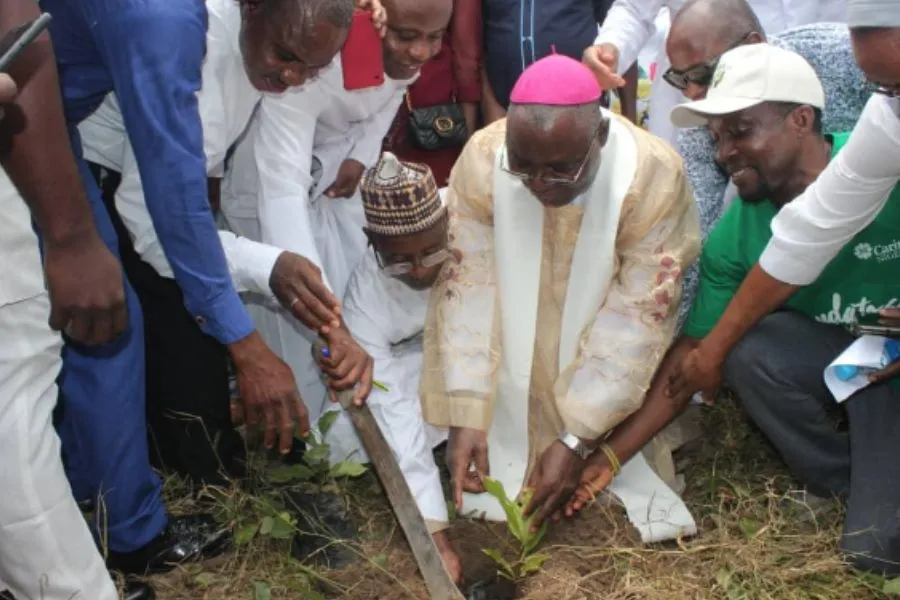
Tree Planting in Nigerian Archdiocese to Foster “ecological conversion”: Archbishop

The Catholic Archdiocese of Abuja in Nigeria has launched a campaign to plant thousands of trees aimed at fostering “ecological conversion”, the Local Ordinary has said.

In his speech during the launch of the Abuja Archdiocesan Tree Planting Campaign at Maryland Passo Gwagwalada Abuja on August 25, Archbishop Ignatius Ayau Kaigama said that the initiative was part of the implementation of Pope Francis’ May 2015 Encyclical on Care for Our Common Home, Laudato Si’. 

“Abuja Archdiocese will be planning 20,000 trees yearly for the next five years as a way of protecting the environment in line with the Commitment of the Catholic Bishops Conference of Nigeria (CBCN) to implement the Holy Father Pope Francis Encyclical, Laudato Si’, Care for our Common Home,” Archbishop Kaigama said. 

He added, “What we are doing here today is to promote ecological conversion and Pope Francis’s Encyclical Letter, Laudato Si’, calling on the world to treat the environment more fairly as we carry out our activities as human beings; if you go round our environment, you will see a lot of plastic waste and other forms of environmental pollution that has affected our environment.”

The Nigerian Catholic Archbishop commended members of CBCN for initiating the 5 million tree planting project in Nigeria “to ensure the prevention of Climate Change, global warming and reforestation of the country.”

Also speaking during the August 25 event, the Chairman of Justice Development and Peace Commission (JDPC) of Abuja Archdiocese, Josephat Abaagu, expressed optimism that tree planting can be of immense help in environmental protection. 

“Protecting the Earth is crucial because it sustains all life, providing resources and a stable environment. Pope Francis emphasizes tree planting as a way to protect the Earth due to trees' role in combating climate change,” Mr. Abaagu said.

He explained that trees can “absorb carbon dioxide, provide oxygen, prevent soil erosion, and support biodiversity. This aligns with the Pope's call for responsible stewardship of the planet to ensure a sustainable future for generations to come.”

Meanwhile, a representative from the Nigerian Federal Ministry of Environment, Yunusa Idris, who participated in the August 25 initiative to support the effort of the Catholic Church in the West African Nation called on citizens to “complement the government's effort in restoring our fast-degrading environment through planting trees.”

Chairman of victim support group resigns as town divided over Freedom of Drogheda vote

The CEO of support group 'Dignity 4 Patients' says it was "totally unaware" of a letter sent by its former chairperson Paul Murphy to Drogheda councillors, asking them not to rescind the freedom of the town awarded to the former head of the Christian Brothers.

Brother Edmund Garvey was awarded the honour in 1997.

Since then, he has overseen a controversial legal strategy, which requires survivors of child sexual abuse by a Christian Brother, who want to take civil action against their abuser, to sue each member of the religious order which has over 100 members.

In an email to councillors last month, Paul Murphy described Brother Garvey as a "blameless person" and said "there is a danger that the issue will become personalised on one individual." He has since resigned as chairperson of the support group.

In a statement issued on Monday, Dignity 4 Patients CEO Adrienne Reilly said the letter in no way represents the views of victims, the Board, or the group's staff.

Councillors urged not to remove Freedom of Drogheda from Edmund Garvey by sex abuse support group chief


The chairman of a Drogheda-based advocacy group for victims of sex abuse urged the town’s councillors not to rescind the Freedom of Drogheda from the former head of the Christian Brothers, Edmund Garvey.

In an email in July to the 10 councillors, chairman of Dignity4Patients group Paul Murphy said Br Garvey was a “blameless” person whose family is “deeply respected in the town”. 

However, at the weekend the board of management of Dignity4Patients said it was “outraged” by the contents of the email, which it had not known about, and that it was now “reviewing the make-up of the board”.

Dignity4Patients has its origins in the case of Michael Shine, a surgeon who sexually abused child patients at Our Lady of Lourdes Hospital, Drogheda, over decades. 

More than 100 of his victims have taken civil actions for damages in the courts.

Legal strategy

The removal of the Freedom of Drogheda from Br Garvey is being sought by a group of about 30 men who are pursuing damages from the Christian Brothers because of sexual abuse they suffered at the hands of members of the order when they were children. 

They want the honour removed because Br Garvey was the order’s leader when it adopted a legal strategy that makes it very difficult for claimants to advance their court cases.

Damian O’Farrell, who is leading the campaign on behalf of the men, said he was “numbed and physically sick” when he read Mr Murphy’s email.

In the email, Mr Murphy said he was chairman of the Dignity4Patients group but was writing in a personal capacity. 

“I feel entitled to be able to express an opinion ... firstly, as a native of Drogheda and, secondly, since I have a record for speaking up for the rights of victims of abuse,” he said.

Br Garvey, he said, was given the Freedom of Drogheda in 1997 for his track record as an educator. “He is, to my knowledge, a blameless person. I strongly believe that the legal strategy adopted by the Christian Brothers in court cases against the order is ethically wrong and deeply hurtful to many victims, but there is a danger that the issue will become personalised on one individual,” he wrote.

“I am not a friend of the Garvey family in Drogheda but have had contact with individual members of the family in my professional capacity and I know that they are deeply respected in the town.”

 ‘Betrayal of abuse victims’

Mr O’Farrell said Mr Murphy’s intervention was “unforgivable. In 25 years of advocacy work, I’ve never experienced such a betrayal of abuse victims.”

The board of management of Dignity4Patients said it first learned of the email on August 19th and that its content did not reflect the group’s ethos.

Two Labour councillors from Drogheda, Michelle Hall and Emma Cutlip, said they will be voting in favour of rescindment, subject to such a motion going on the agenda next month.

Mr Murphy, a former editor of the Drogheda Independent, declined to comment. Br Garvey did not respond to a request for a comment.