For the first time, Catholics have achieved employment parity with Protestants in North Ireland, the Belfast Telegraph reported.
Three decades ago, the unemployment rate among Catholics was twice as high as the unemployment rate among Protestants.
The statistics mark a transformation on 30 years ago, when the unemployment rate was twice as high in the Catholic community. But the new report shows that in four out of 13 industrial sectors,
there were more Protestant employees, with the biggest disparity in
agriculture, forestry and fishing, where 65% of employees were
Protestant and 35% Catholic.
However, the present rate of youth unemployment was higher for Protestants than Catholics, at 24% compared to 18%.
Between 1990 and 2015, the proportion of the population aged 16 and
over who reported as Protestant decreased by twelve percentage points
from 56% to 44%, while the proportion who reported as Catholic increased
by six percentage points from 38% to 44%.
Over this period, the
proportion of the population reported as ‘other/non-determined’ has
doubled (from 6% to 12%).
The labour force survey religion report
said that between 1992 and 2015, there had been higher levels of
economic activity among Protestants compared to Catholics.
But the
Executive Office research said rates have now converged with the same
working age economic activity rate of 72%, and the same economic
activity rate of 28%, for Protestants and Catholics.
And while unemployment had also been higher among Catholics from 1992 to 2015, the rate had now converged for both to reach 6%.
In 1992, 70% of working age Protestants and 54% of working age Catholics were in employment.
But by last year, the rates were 68% and 67% respectively.
The report said that 18% of Protestants were in professional jobs, and 19% of Catholics.
Around
one-quarter of males in both communities (27% of Protestants and 24% of
Catholics) were employed in skilled trade occupations.
Economist
Dr Esmond Birnie of the Northern Ireland economic policy centre said the
jobs gap between the communities had now "closed completely".
"Back in 1992 the unemployment rates for the 'two communities' were 18% and 9% respectively, a ratio of two-to-one.
"In 2015, the year of the data in this report, the two rates were equal at 6%."
But
he said there were still some differences in 2015, with the
unemployment rate higher for 16 to 24 year olds in the Protestant
community.
The research also showed that Protestants were more likely to be owner-occupiers, at 68% compared to 65%.
Dr
Birnie added: "The disappearance of the unemployment difference by
itself does not definitively prove that religious discrimination existed
in the past and has now been eliminated.
"The data is based on a
survey so there are margins of error. It is also notable how a growing
proportion of people are self-defining as belonging to neither of the
two communities."
In 1992, 6% of the population described their religion as 'other/non-determined' though that percentage had reached 12% by 2015.
The United States Conference of Catholic Bishops’ Subcommittee on the
Church in Africa has awarded over $1.2 million in grants to pastoral
projects there.
“It is an important step for the Church in the United States to
continue walking in faith with our brothers and sisters in Africa,” said
Cardinal Joseph Tobin of Newark, who chairs the subcommittee.
“The
Church in Africa is faith-filled, vibrant, and rapidly growing.”
The grants are funded by a special collection that is taken up in
American dioceses.
Last January, the subcommittee awarded $1 million to
40 projects, and in July, the subcommittee awarded an additional $1.17
million.
Vatican Radio employees have been shocked by abrupt changes in the broadcast schedule, the French daily La Croix reports.
Vatican Radio is no longer an independent agency; it has been
absorbed into the new Secretariat for Communications.
And the budget for
radio broadcasts has been cut back severely, with a great deal of
programming eliminated already and other programs facing the budgetary
axe.
“What shocks us is the brutality with which these decisions are
made,” said a French radio staffer.
Four Catholic bishops from the Kachin province of Myanmar met
recently with the country’s leader, Aung San Suu Kyi, to discuss the
continued fighting in the region.
The bishops expressed their concern about government military
actions—especially air raids and artillery bombardments—against ethnic
separatist forces in the region.
Bishop Raymond Sumlut Gam of Bamaw
said: “We stressed how the fighting leads to more displaced people,
insecurity and difficulty dispensing humanitarian assistance, so we
appealed to Suu Kyi to help reduce sporadic fighting in ethnic areas.”
On Sunday 22nd. January 2017, Redemptorist priest Fr Tony Flannery celebrated mass
publicly for the first time in five years, defying a Vatican ban on
public ministry dating from 2012.
Fr Flannery is being disciplined by
the Congregation for the Doctrine of the Faith for expressing views
contrary to official church teachings on matters like clerical celibacy
and the ordination of women. Fr Flannery insisted the public mass was a one-off event, to celebrate his 70th birthday and the 40th
anniversary of his ordination. Coverage of the event in Irish national
media outlets confirmed that hundreds attended the mass in rural Co.
Galway.
I had five hundred hosts, and I knew they would not be
enough, so I invited the people, when they took the host, to break and
share it with others. This added to the closeness, the sense of
belonging. In my homily I stressed that God is present in every one of
us, not just in the host, so by being together we were bringing God to
each other. And I invited everyone, as long as they had any sense of the
Divine in their life and in this gathering, to come to communion.
Signs were erected on approach roads to the centre before
today’s service. In addition, a marquee was erected beside the building
to cater for the hundreds of people who turned up.
The proceedings were relayed on a big screen to the congregation outside the community centre.
Fr Flannery’s homily met with a standing ovation and many of those in
attendance expressed hope that the Vatican would engage in a more
meaningful manner with the faithful.
This outpouring of popular support for a ‘banned’ priest reflects profound changes in the Irish Catholic Church.
A 2012 poll commissioned by the Association of Catholic Priests (ACP),
of which Fr Flannery is a founding member, found that a large majority
of self-identified Irish Catholics disagreed with official church
teachings on married priests, the ordination of women, sexual morality,
and so on.
Killimordaly is a rural area in the centre of county
Galway. It is traditional in many ways. The way they responded, and took
part, showed clearly to me how much has changed in our Church. Diktats
from the Vatican, or any Church authority, do not carry much weight any
more. A Church leader, if he is to be credible, must in future be a
listener, who is with the people. Otherwise he will not be a real
leader. (What I am saying here is not original; Pope Francis is
constantly saying this to the wearers of mitres.)
But will the Irish Catholic Church – and the Catholic Church
internationally – ‘engage in a more meaningful manner with the
faithful’? It is a truism that ‘the Catholic Church is not a democracy.’
Those who do not agree with officialdom are more often excluded than
seen as people who could contribute constructively to change, helping to
renew the Church.
Six former altar boys on Guam have filed multi-million dollar
lawsuits against the Catholic Church over historical allegations of
sexual abuse.
The lawsuits, filed in the Guam District Court, are against former
island priest Louis Brouillard, the Archdiocese of Agana and the Vatican
over allegations that Brouillard sexually abused them decades ago.
The lawsuits were filed in the District Court of Guam after at least
eight Superior Court of Guam judges excused themselves from hearing any
of the 15 clergy sex abuse lawsuits so far filed in that court.
The Pacific Daily News reports that the altar boys each seek not less
than US$5 million in general damages, and each also demands a jury
trial.
The six separate lawsuits were filed in federal court by the law firm
Lujan & Wolff - which also filed 15 separate clergy sex abuse
lawsuits on behalf of 15 former altar boys in the Superior Court of Guam
last year.
In fact, this row has nothing much to do with condoms.
The prophylaxes in question, which might or might not have been distributed by an outreach project
run under the auspices of an ancient Catholic order, are merely the
trigger for a dispute that is more important even than the rights and
wrongs of contraception, an issue the Catholic church has struggled
badly with for over a half a century.
The real issue in the row that resulted in the sacking of the British
head of the Knights of Malta is the most important question of all in
the Catholic church: what is the right way to represent Christ’s
teaching in the world of today?
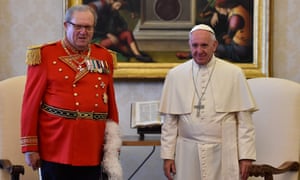
In one corner, we have Matthew Festing, a 67-year-old former
auctioneer, in his bright red, gold-tasselled suit. He represents the
old-style Catholic church, the church in which rules were made at the
top and adhered to by those at the bottom.
The church he loved, and
would love to be part of still, was the church of the 1950s, the last
hurrah of the institution that got blown away by Vatican II
and the liberalism of the 1960s.
As far as he is concerned, the
Catholic church is an unchanging institution whose members, once
married, remain married until death and who, if they want to limit their
families, must do so using only natural methods of contraception.
In the other corner we have the man who has over the last four years become the rock star of global politics: Pope Francis,
an 80-year-old Jesuit in a white cassock who has emerged from the
shadows to become one of the most authentic, respected and impressive
world leaders of our time.
“I love your pope,” said a Muslim woman I met recently, grasping my
arm to make her point. She loves him; the world loves him. It’s inside
his own church that the former Jorge Bergoglio’s deadliest enemies lurk.
They
are people such as Cardinal Raymond Leo Burke, an American
arch-conservative who has sided with Festing over the condom row, and
who has become the focal point of the hopes of those Catholics who are
deeply dismayed by what they see as the impossible liberalism of Pope Francis.
Last year, Francis issued a document called Amoris Laetitia,
which has left Burke and his ilk reeling: it seems to them to commit
the cardinal sin of leaving it open to question as to whether a divorced
and remarried Catholic can – whisper it where you will – receive
communion again.
What Francis seems to be saying in his document is: let’s get real,
folks. People get divorced and remarried all the time, Catholics
included. Not every divorced and remarried Catholic is the devil
incarnate. So, yes – he or she might very well be able to receive
communion again.
Let’s leave it up to them, shall we, after a chat with
their local priest or bishop?
To you and me, this is simply a small piece of ecclesiastical common
sense, emanating from a tiny sovereign state where not much common sense
has been forthcoming for some time. But to Burke and Festing, it’s
virtual heresy.
For them, rules are rules and they simply can’t be broken. An
incandescent Burke has tried to call Francis’s bluff by challenging him
to define exactly what he meant by his offending woolliness in Amoris
Laetitia.
So far, Francis has done the papal equivalent of sticking up two
fingers: he has ignored him, which has no doubt riled Burke even more.
Chumming up with Festing seemed like another way to get his pincers into
the pope, but he has failed again.
Francis has intervened, and Festing
has been forced to resign. The score is 2-0, in the Argentinian’s
favour.
The
Vatican is, as every Catholic watcher knows, a hotbed of flouncing
rows, scandals and prickly situations.
But what matters here – what really matters
– is that Francis has changed the Catholic church in a truly
fundamental way, and he has changed it forever.
That’s what people like
Festing and Burke realise, and that’s why they’re stopping at nothing to
challenge him. Because what Francis has done is this: he has replaced
rule-bound, traditional, unbending Catholicism with what we might call
instinctive Christianity.
Francis just isn’t that bothered by the regulations; but he is very,
very concerned with taking the path that he believes the man/God he
follows, Jesus Christ, might have taken.
Divorce, remarriage,
contraception – these aren’t the issues that keep Francis awake at
night.
Trump’s presidency, the refugee crisis and the war in Syria
probably are. That’s why the world loves him. And that’s why he’s so
dangerous to the old order of the Catholic church.
There may well be
more earthquakes to come in Italy, and not only of a geological kind.

 For the first time, Catholics have achieved employment parity with Protestants in North Ireland, the Belfast Telegraph reported.