The Church in Wales is facing mounting pressure to publish in full
two internal reports into safeguarding and governance failures at Bangor
Cathedral, after only brief summaries were released to the public.
The call for transparency follows the unexpected resignation of Most
Rev Andrew John, Archbishop of Wales, who last week stepped down from
his national role immediately and confirmed he will retire as Bishop of
Bangor by the end of August.
The published summaries describe “a culture in which sexual
boundaries seemed blurred", along with concerns about excessive alcohol
use and structural failings in leadership and safeguarding at the
cathedral, as reported by the BBC.
Labour MP Ruth Jones, who co-chairs the All Party Parliamentary Group
on Safeguarding in Faith Communities, said partial disclosure is not
enough: “We need to see what the reports actually say, not just the
summaries.”
Although there is no suggestion of personal misconduct by Most Rev
John, he issued a public apology before his resignation, saying he was
“deeply sorry” to anyone in the cathedral community who felt hurt or let
down.
The Church in Wales has defended its decision not to publish the full
documents, citing confidentiality agreements with contributors.
A spokesperson said the Church is “in dialogue with the parties
involved” and is working through an implementation group and oversight
board to address the concerns.
Plaid Cymru Senedd member Sian Gwenllian, who represents the Bangor
area, is demanding an independent, public review of the cathedral’s
recent history, saying: “We now urgently require a fully independent,
public review, not a closed-door process, to examine what went
wrong,” adding that “only with openness and an honest reckoning can
public trust be restored.”
The Church has offered to meet with Gwenllian to discuss her
concerns, but critics warn that without the full release of findings,
trust in church leadership may continue to erode.
A Worcestershire church has been given funding to replace its bellringing ropes.
The
ringing of the bells at St Mary's Church in Kempsey dates back to the
17th Century but the special ropes to help the dings dong are in need of
replacing.
Worcestershire County
Council member Martin Allen has allocated £800 from the £10,000 pot that
each councillor is allocated a year to support projects in their ward.
"I
understand that the upkeep of such a worthwhile historic part of our
history is not cheap, and I am delighted to have provided the funding to
replace the worn-out ropes," he said.
Mr Allen, Green, added: "It's important that traditions that make us what we are today continue."
Tower captain at St Mary's Church Mike Harrison said: "Anyone who is interested in learning a new skill would be warmly welcome.
"Visitors
with advanced notice can pop up the tower on Thursday evenings from
19:30 BST to watch a practice session or learn about how to join.
"We are currently fundraising for repairs and maintenance work to ensure their working operation for the next 100 years."
Church Leaders in the north have has written to the
Chief Constable of the Police Service of Northern Ireland, offering
their encouragement and support.
They have also expressed their gratitude "to the members of the PSNI
for their courage in the face of adversity’" over recent weeks.
In a letter from a group of church leaders which included, the
Catholic and Church of Ireland Archbishops of Armagh, the Moderator of
the Presbyterian Church in Ireland, and the Presidents of the Methodist
Church in Ireland, officers were praised for the protection and care
they afforded to everyone who had been ‘attacked, abused and faced
intimidation with the threat of violence.
The Church Leaders claimed that it’s everybody’s responsibility to
show love to their neighbours, to welcome the stranger, and to show
kindness and compassion to the most vulnerable in society."
The letter went on to add that ‘the last number of weeks have
seen shocking examples of violence and intimidation on the streets in
various towns across Northern Ireland as well as racially motivated
attacks initiated by individuals who decided to take the law into their
own hands.
The Church Leaders also encouraged everyone to engage positively with
PSNI, allowing its officers to do their duty and “for all to work
together in mutual respect for the safety and wellbeing of the whole
community.
A future papal visit to Ireland could include a long-awaited stop in
Northern Ireland, Archbishop Eamon Martin has said — pointing to 2032,
the 16th century of St Patrick coming to Ireland as a “really hopeful
year” to welcome Pope Leo XIV.
The Archbishop of Armagh
revealed 2032 would be the perfect time for the Pontiff to make the
journey North during his pontificate, breaking new ground where his
predecessors did not go.
While Pope John Paul II visited the Republic in 1979 and Pope Francis
came for the World Meeting of Families in 2018, neither visited
Northern Ireland — something Archbishop Martin hopes will change.
“I would be really delighted if at some point during his pontificate
Pope Leo might consider coming to the island of Ireland and particularly
to pay a visit to the North,” he said, “Given that, of course, Pope
Francis and Pope John Paul II were not able to do that for different
reasons.”
Archbishop Martin pointed to a significant milestone: “I think that
there are obvious times when that might be done, particularly given that
2032 — it might seem a long way away today, it’s seven years away but
that’s not that long in terms of planning for something like this – is
the Patrician year, where we’ll be marking the 16th centenary of the
coming of St Patrick to Ireland, it will be a big year for us and a
really hopeful year, so that is one possible opportunity to put an
invitation to Pope Leo to consider coming to Ireland and indeed coming
to the North.”
Reflecting on the last papal visit, Archbishop Martin said that “at
the time of the World Meeting of Families, it was interesting that all
of the Church leaders on the island of Ireland, all of the Christian
churches, wrote to Pope Francis at the time and said, listen, you’d be
really welcome to Northern Ireland.
“And the reason for that was we felt that a lot has been achieved in
the North in terms of the peace process and that a visit of the Pope
would be a real affirmation of peace, of reconciliation and of hope. And
for those reasons, I certainly do feel a visit of the Holy Father to
the North of Ireland, to Northern Ireland, would be a particularly
strong symbolic moment for all of us who’ve been working towards peace
and sharing and a shared island here in Ireland.”
Archbishop Martin highlighted there would be practical challenges,
saying: “A papal visit is a huge thing for any country to organise. And
of course, the World Meeting of Families which was in 2018 was something
that was of considerable expense and resources. So we have to think of
factors as to whether or not that could happen as well, will we have the
resources?”
He added: “I suppose from my own point of view, I do see this as
maybe something in the medium term rather than in the short term. I
would certainly be open to the idea of inviting Pope Leo at an
appropriate moment to consider coming to Ireland and indeed to come
North.”
Poland's Catholic news agency KAI is facing the end in its current
form.6
Journalist Marcin Przeciszewski, who has been editor-in-chief and
managing director since the agency was founded in 1993, has resigned
from both posts because the Polish bishops have decided to "effectively
liquidate the Katolicka Agencja Informacyjna (Catholic Information
Agency, KAI) despite formally retaining its name and logo".
Przeciszewski announced this on Friday in Warsaw.
The Bishops' Conference wants to incorporate KAI into its own new
"media group" and deprive it of "the possibility of independent
journalistic work", he continued. The aim of the decision already taken
by the plenary assembly in March is "not an honest portrayal of
religious and church reality in accordance with the rules of
journalistic craft", but the dissemination of "positive information"
under the control of church structures.
The press offices of the Polish
Bishops' Conference and the Archdiocese of Warsaw did not initially
respond to enquiries from the Catholic News Agency (KNA).
Warsaw's Archbishop Adrian Galbas heads the KAI Programme Council.
The 66-year-old Przeciszewski is one of the most influential Catholic
journalists in the country.
On Friday, he moderated a Polish-Ukrainian
prayer breakfast organised by KAI in the parliament building in Warsaw
with the Archbishop and Primate of Gniezno Wojciech Polak, the Grand Archbishop of Kiev Svyatoslav Shevchuk and politicians from both countries and clergy from various denominations.
Second largest religious agency in Europe
According to information from KNA, Przeciszewski officially announced
his resignation in mid-June at the most recent plenary assembly of
Polish bishops. He intends to continue in both offices until a successor
is appointed, it said. In 2018, he was awarded the papal Order of St
Gregory, the highest papal honour for lay people.
The KAI belongs to a foundation of the Bishops' Conference and has so
far operated largely autonomously. It reports regularly on
ecclesiastical and social developments at home and abroad. According to
its own information, it is the second largest religious agency in
Europe.
In Poland, it is the leading source of information on church
topics for journalists. Its customers include many church and secular
media who subscribe to it.
Przeciszewski emphasised: "As I have always tried to work for the
good of the Church - and this was the sole aim of the Catholic
Information Agency that I run - I have no choice but to step down from
my position as Chairman of the Board in view of the announced changes,
in accordance with my conscience and my professionalism as a
journalist."
According to the founder and head of KAI, the agency's previous
concept was beneficial to the Church.
The agency represents the Catholic
point of view in important public debates without involving the
authority of the Bishops' Conference.
The concept corresponds to church
models from abroad. According to Przeciszewski, Cardinals Jozef Glemp
and Franciszek Macharski, who have since passed away, were among those
involved in its creation.
According to him, the author of the
restructuring plan adopted by the bishops is the press spokesman of the
Bishops' Conference, the Jesuit Leszek Gesiak.
Is Italy's proven system of financial support for the Church
truly under threat?
On June 3, Cardinal Matteo Zuppi, President of the
Italian Bishops' Conference, criticized an amendment to Article 47 of
Law 22/85, which governs Italy's financial support for religions.
Cardinal Zuppi expressed his "disappointment at the
government's unilateral decision to alter the purposes and allocation
methods of the ‘eight per thousand’ tax revenue.
This change undermines
the original agreement between the Church and the government . .
.resulting in inequalities that harm both the Catholic Church and other
religious bodies with agreements with the state.”
The government responded that Article 47 was altered by the previous
left-wing government of Giuseppe Conte and that the recent amendment is
minor.
What exactly is the situation? To understand this "eight per
thousand" system, we must go back to 1870.
Genesis of the "Eight per Thousand"
Italy unified in 1861 following military invasions. The Papal States
resisted due to a pact between the Vatican and France. In 1870, Prussia
attacked France and forced French soldiers to return home, allowing
Italy to conquer the Papal States.
“The Pope excommunicated the King of
Italy along with any Italians who chose to run for office or participate
in elections.. . fewer than 20% of citizens took part in the voting
process.”
To resolve the situation, Mussolini offered financial compensation.
“Through the Concordat of 1929, the Vatican acknowledged Italy's
sovereignty over the former Papal States and revoked the
excommunications. Italy agreed to pay all Catholic parish priests a
monthly salary and exempted all priests from military service.”
After the fall of fascism, Italy incorporated the 1929 Concordat into
its Constitution. In 1984, the Vatican and Bettino Craxi's
socialist-led government agreed to a new concordat. The Vatican secured
the Concordat's right to remain a treaty governed by international law,
rather than Italian law.
Furthermore, Italy and the Vatican agreed to
abolish the stipend system for parish priests and replaced it with a
religious tax.
In Italy, the religious tax is not optional, unlike in Germany. The
1929 Concordat established that 0.8% of all Italian taxes is allocated
to support religion. It is not a new tax, and taxpayers cannot opt out
of it, but they can choose where their 0.8 percent will go: to the
Catholic Church, or to one of the recognized religions, or to the State
for cultural and humanitarian initiatives.
A Clause Favoring the Church
A clause allows the Church to receive an additional contribution from
the 0.8%. Each year, a significant portion of taxpayers express no
choice as to its destination. Their 0.8% is then distributed in
proportion to the preferences expressed.
Thus, in 2020, 41% of taxpayers
expressed a choice for the allocation of their 0.8%, while 59% did not.
Of those who indicated a preference, 70.4% chose the Catholic Church,
which therefore received 70.4% of the amount derived from the 0.8% of
taxes paid by 59% of Italian citizens who forgot or chose not to express
a preference. With this clause, the Church now receives more than under
the system in effect before 1984.
If the Catholic Church received 70.4% of the 0.8% of taxes from only
those who explicitly chose it, it would receive its 0.8% on 28.7% of all
taxes collected in Italy.
In contrast, under the current system, it
receives 70.4% of the 0.8% of all taxes paid in Italy.
The difference
between 28.7% and 70.4% represents several hundred million euros.
The Current Controversy
The previous Conte government allowed taxpayers who designated the
state to choose one or more of five designated areas on their tax return
to direct the 0.8% revenue. These areas cover: the fight against world
hunger, natural disaster response, refugee assistance, cultural heritage
preservation, and school infrastructure rehabilitation.
This initiative was effective: the state's percentage increased,
while that of the Church decreased. Factors contributing to the change
include the decline in the number of active Catholics and campaigns by
conservative groups calling for the withdrawal of support for the Church
in protest against its pro-immigration stance.
However, the state's percentage remains significantly lower than that
of the Church. The new government has increased the number of options
to seven, adding assistance to unaccompanied foreign minors and
extraordinary measures for the recovery from drug addiction and other
addictions, aimed at the treatment, rehabilitation, and reintegration of
people suffering from such addictions.
Catholic bishops fear that including initiatives to combat drug
addiction, which is widely supported, could increase the number of
people who would select the state, which would be detrimental to the
Church.
The government has clarified that, should this occur, the
Catholic Church currently manages a significant portion of these drug
recovery programs, which would indirectly result in it receiving
additional funds.
The controversy also stems from concern over a proposal suggesting
that religions will only receive the 0.8% of taxes from taxpayer who
would explicitly designate them. This would have disastrous consequences
for both the Catholic Church and religious minorities.
To avoid this, the Church has reminded the government that the 1984
Concordat cannot be unilaterally modified and is an international
treaty.
It is unlikely that Giorgia Meloni's government will reduce the
0.8% allocated to religions to the portion of the taxes of those who
indicate a choice only.
But the Church has already decided to warn the
state that this would violate international law.
Pope Leo XIV warned new archbishops on Sunday against following “the
same old pastoral plans without experiencing interior renewal and a
willingness to respond to new challenges.”
Speaking on
the Solemnity of Peter and Paul — saints recognized by the Catholic
Church as pillars of the faith and venerated as patrons of the city of
Rome — the pope also called for maintaining ecclesial unity while
respecting diversity.
“Our patron
saints followed different paths, had different ideas and at times
argued with one another with evangelical frankness. Yet this did not
prevent them from ... a living communion in the Spirit, a fruitful
harmony in diversity,” the pope said.
During Mass at St. Peter’s Basilica, where he bestowed the pallium on 54 new metropolitan archbishops, including eight from the U.S.,
Leo urged them to “find new paths and new approaches to preaching the
Gospel” rooted in the “problems and difficulties” arising from their
communities of faith.
“The two
apostles... inspire us by the example of their openness to change, to
new events, encounters, and concrete situations in the life of their
communities, and by their readiness to consider new approaches to
evangelization in response to the problems and difficulties raised by
our brothers and sisters in the faith.”
After the
homily, deacons descended to the tomb of the Apostle Peter, located
beneath the Altar of the Chair, to retrieve the palliums the pope had
blessed.
Avoiding routine and ritualism
In his
homily, the Pope praised the example of Sts. Peter and Paul,
highlighting their “ecclesial communion and the vitality of faith.” He
stressed the importance of learning to live communion as “unity within
diversity — so that the various gifts, united in the one confession of
faith, may advance the preaching of the Gospel.”
For Pope Leo, the path
of ecclesial communion “is awakened by the inspiration of the Spirit,
unites difference,s and builds bridges of unity thanks to the rich
variety of charisms, gifts, and ministries.”
'Turn our differences into a workshop of unity'
The pope
called for fostering “fraternity” and urged his listeners to “make an
effort, then, to turn our differences into a workshop of unity and
communion, of fraternity and reconciliation, so that everyone in the
Church, each with his or her personal history, may learn to walk side by
side.”
“The whole
Church needs fraternity, which must be present in all of our
relationships, whether between lay people and priests, priests and
bishops, bishops and the pope. Fraternity is also needed in pastoral
care, ecumenical dialogue, and the friendly relations that the Church
desires to maintain with the world,” the pope said.
He also
invited reflection on whether the journey of our faith “retains its
energy and vitality, and whether the flame of our relationship with the
Lord still burns bright.”
“If we want
to keep our identity as Christians from being reduced to a relic of the
past, as Pope Francis often reminded us, it is important to move beyond
a tired and stagnant faith. We need to ask ourselves: Who is Jesus
Christ for us today? What place does he occupy in our lives and in the
life of the Church?”
New paths and practices for the Gospel
Leo thus
encouraged a process of discernment that arises from these questions,
allowing faith and the Church “to be constantly renewed and to find new
paths and new approaches to preaching the Gospel.”
“This, together with communion, must be our greatest desire.”
At the end
of the celebration, the pontiff descended the stairs to the tomb of the
Apostle Peter and prayed for a few moments before it, accompanied by
Metropolitan Emmanuel of Chalcedon, head of the Delegation of the
Ecumenical Patriarchate.
The
Solemnity of Sts. Peter and Paul is especially important for ecumenism
because the two saints are honored by all apostolic traditions, and the
Ecumenical Patriarchate has sent a delegation to Rome for the feast
annually since the 1960s.
Return to an ancient tradition
During the
celebration, Pope Leo XIV revived the ancient tradition of personally
imposing the pallium on new metropolitan archbishops.
This
symbolic rite had been modified by Pope Francis in 2015, when he decided
to present the pallium — a white wool band resembling a stole with six
black silk crosses — to archbishops at the Vatican, while leaving it to
the nuncio in each archbishop’s country to impose the pallium in a local
ceremony.
At the
time, Pope Francis explained that this change was meant to give greater
prominence to local churches, to make the ceremony more pastoral and
participatory, and to strengthen the bond between archbishops and their
people, without weakening communion with Rome.
Calls
from the Church of Scientology for an order to ban protests outside its
British headquarters in West Sussex have been recommended for refusal.
Mid
Sussex District Council's cabinet is due to make a decision on Monday
about whether to put a Public Space Protection Order (PSPO ) in place on
Saint Hill Road and West Hoathly Road in East Grinstead.
The Church made the request
for the PSPO in July 2024, saying protests held outside its premises
caused "harassment, disturbance and alarm" to those attending the
church.
Protests were held in 2023 and
2024. Both involved ex-Scientologists and took place before the annual
International Association of Scientology event.
Alexander Barnes-Ross, a former member but now an outspoken critic of Scientology, told the Local Democracy Reporting Service the 10-month process had been "lengthy and arduous on both protesters and the local council".
He
said: "I am grateful for the careful and meticulous detail with which
they have examined over 500 pages of evidence and hours of video footage
of our protests.
"Scientology's
attempt to ban protesting through a PSPO is just another example of
their steadfast commitment to stifling free speech and using legal
threats to silence anybody who dares to speak out against them."
Scientology became a recognised religion in the UK in 2013.
The
Church also said the protests had a "detrimental effect" on the quality
of life of people living nearby and posed a risk to public safety.
A
church spokesperson said: "The purpose of our application for a PSPO is
to facilitate our members and guests being able to visit our place of
worship without them or their children being impeded, abused, shouted or
otherwise religiously discriminated against.
"The
terms of the proposed PSPO allowed for the practice of the right to
protest and suggested a location next to our Church premises but one
that didn't block the entrance.
"We will continue to seek remedies to safeguard our parishioners from hate speech and abuse."
The Bishop of Kerry has acknowledged that
more than half of all marriage ceremonies in the diocese now take place
outside of a church with couples opting instead for civil ceremonies in
hotel venues or in a registry office.
Bishop Ray Browne said there has been significant changes in how people choose to marry over the past 10 or 20 years.
“Marriage is an enormous gift: a couple
entering a life-long loving union, the birth and rearing of children,
family life, the continuity of humanity from generation to generation,
childhood, parenthood, grandparenthood and beyond,” he said.
“For most, despite all the challenges and
the major things that can go wrong, marriage is a wonderful, life-long,
fulfilling and loving union.
“Our faith is that it is not just our own
doing – it is God’s will for us too, God is ever present and ever loving
in the couple’s marriage and home,” Bishop Browne said.
He added that on their wedding day a couple
asks for and receive God’s assurance and blessing and God blesses the
journey they are setting out on.
The bishop said he humbly asks all
parishioners to be faithful to weekend Mass and he queried how healthy
numbers are joining in the celebration in each parish?
“Taking the time to join in the celebration
of the Mass is a call to look at the bigger picture, of the meaning,
motivation and purpose of all our lives as one week ends and another
begins,” he added.
He said questions for people to ask themselves include:
Are they happy with the week gone by and ready for the challenge of the week ahead?
Do they trust in the presence of God, his love and care for us all and his call to love and care for each other?
Is it important that their children grow up with a sense of Sunday as the Lord’s day and a day of rest?
Have they that sense of Sunday in their own life?
“As parish communities and as people of
faith, how can we promote both Sunday Eucharist and the Sacrament of
Marriage in all our parishes?” he asked.
The
new American pope is looking to his MAGA compatriots to shore up the
Vatican’s finances after decades of scandal and mismanagement.
The conclave that brought Pope Leo to power was overshadowed by painful divisions within the Church, a war between modernity and tradition, and bitter reflections over his predecessor’s complex legacy.
But more prosaically it was also plagued by angst over a serious fiscal
squeeze that is forcing the spiritual leader of the world’s 1.4 billion
Catholics to moonlight as a fundraiser.
Despite the Vatican’s vaults of priceless masterpieces, Leo has
ascended to the papal throne amid a steepening liquidity crisis
aggravated by a major downturn in donations from the U.S., making it
increasingly difficult for the city state to function.
Leo needs to fix it — but to do so he needs to keep traditionalist U.S. Catholics on side.
Insiders say that Leo was elected in part because as an American he
exuded an Anglo-Saxon financial seriousness. He was also seen as well
positioned to bring back donations that have dried up thanks to
persistent scandal and the hemorrhaging of support from powerful
American Catholic conservatives.
Already, the gambit seems to be working.
“Talking to some of the biggest donors in the country, they’re
absolutely thrilled,” said one conservative Catholic leader in the U.S.,
granted anonymity to speak candidly. “I don’t know that they’re already
writing their checks. I don’t see that necessarily yet. But as far as
their optimism and excitement, it’s a 10 out of 10 — absolutely.”
A boost to donations is desperately needed.
According to Reuters, the
latest internal figures show the Vatican ran a deficit of €83 million
in 2024, more than double the €38 million reported in its last-published
financial report in 2022.
The annual shortfall adds to liabilities including half-a-billion in
pension obligations to the Vatican’s superannuated beneficiaries and
past losses from the Institute for the Works of Religion (IOR), the Holy
See’s scandal-riddled investment vehicle, also known as the Vatican
Bank.
The Vatican’s income is mainly derived from property assets and
donations including from bishops and Peter’s Pence, the annual June
collection by churches for the pope’s “mission” and charitable works.
But donation revenue has fallen with increasing secularism and financial
scandals.
Donors from the U.S., the number one contributing country, were put
off by Francis’ more liberal teachings on LGBTQ+ and marriage as well as
corruption scandals including a botched investment by the Vatican’s top
financial institution in London real estate, said John Yep, president
of Catholics for Catholics, a conservative NGO.
‘Very equilibrated’
The momentum behind Leo as a bridge-builder emerged in pre-conclave
lobbying sessions, when cardinals began to envisage that Leo’s alignment
on hot-button conservative issues would help appease U.S. Catholics.
Leo went on to secure more than 100 votes in the conclave, two
well-placed insiders say, indicating that his support was broad and
included right-leaning clerics.
Pope Leo “is a very equilibrated person, and he can give something to
the right, without shifting the pontificate to the right,” one cardinal
told POLITICO.
According to the cardinal quoted above, his constituency even
included several of the die-hard Francis critics led by the
arch-traditionalist American cardinal Raymond Burke.
Burke himself
reportedly received Leo — then Cardinal Robert Prevost — in his
Vatican-owned apartment before the conclave, and spoke with him again
after, according to one person familiar with the matter.
Burke’s office
could not reached for comment.
In turn, Leo has signaled a willingness to address traditionalist
priorities, drawing particular praise for his decision to move back to
the original papal residence from his predecessor’s basic lodgings, as
well as for his penchant for singing in Latin.
This year’s conclave also happened to coincide with an annual Vatican
fundraising jamboree known as “America Week,” a week of lavish Rome
parties, that saw €1 billion committed to the Vatican should the “right
pope” be elected.
The upshot is — theoretically — more money from across the pond.
“American philanthropists want to see that so they will open up their coffers again,” said Yep.
Electing Leo “was a very smart choice because they absolutely need
the American money. The church is in a terrible position financially,”
said the Catholic leader in the U.S. quoted above. “They need the
American money. And they were able to pick an American who’s not that
American. It was kind of a perfect pick.”
Legacy of corruption
But restoring confidence will also require a credible overhaul of the
Vatican’s financial plumbing and accounting after years of scandal that
also tainted the Church’s international image.
Insiders often blame the shoddy financial situation on the Vatican
Bank’s alleged links to a sprawling money-laundering scandal in the
1970s that reportedly
involved Italian freemasonry, the mafia, the CIA, anticommunist
militias in Latin America and a Milanese banker who was found hanging
dead under London’s Blackfriars Bridge in 1982.
Creative accounting persisted over the years, and the shock
resignation of Francis’ predecessor, Benedict XVI, was partly driven by a
raft of financial scandals leaked to the Italian press. Under a
transparency drive, Francis hired former Deloitte accountant Libero
Milone to audit the Holy See’s finances.
Milone’s first task was to draw up accounting for the various
dicasteries that make up the Curia, the Vatican City government. What he
found stunned him.
“They created a proper framework to bring Vatican financial reporting
into the 21st century,” Milone told POLITICO. “But when I was brought
in to do the audit work, we were still operating in the previous
century.”
Financial accounts were written in pencil by nuns on “pieces of
paper” and stashed in drawers, Milone said. Theologians with rudimentary
financial knowledge massively underestimated the future costs of the
microstate’s pension obligations, he said.
When Milone began to notice
discrepancies in various ministerial budgets, he was accused of being a
spy. He was eventually brought in for questioning and compelled to
resign — then found that a resignation letter had already been prepared a
month prior.
Francis didn’t sit on his hands. The Vatican Bank is profitable
again, after he ended some of its shadier practices, and he also
presided over the conviction of Cardinal Giovanni Angelo Becciu, a
powerful secretary involved in a €200 million scandal involving a
botched London property investment in 2014.
As well as a hiring freeze
and salary cuts, Francis set up a new fundraising commission and
centralized the Vatican’s budgeting.
But the broader reform effort was seriously derailed by the departure
of Milone, as well as Cardinal George Pell, an Australian who had been
brought in to head a new Secretariat for the Economy but was called back
to Australia to face charges relating to the clerical abuse scandal.
Officials describe an enduring lack of transparency as well as internal
resistance to the slow-going reform efforts from entrenched interests in
the Curia, with staffers complaining about the effort to mediate
spending.
Representatives for the IOR and the Holy See’s Secretariat for
the Economy declined POLITICO’s requests for interviews.
So far, Leo has hinted that he will prioritize fundraising over
austerity, announcing a €500 bonus to curial staffers. He has also
signalled that he wants to distance the Vatican from scandals of the
past, sanctioning a new investigation into a key witness against
Cardinal Becciu’s conviction which could help overturn his conviction at
the appeal this fall.
On top of that, he will look into ways to boost
profits in the Holy See’s vast real estate portfolio, after prelates
complained about underinvestment, said the cardinal quoted above.
How all this pans out will depend on not only American largesse but
whether Leo can empower the growing caucus of Church pragmatists who
recognize that even the Holy See must occasionally lower itself to
earthly responsibilities like basic financial planning. For others, the
divine mission still trumps all — whatever the cost.
“There will always be a way to get money, just like there will always
be the poor,” said one prelate in St. Peter’s Square last month. “Right
now, my concern is lunch.”
A
bishop has claimed church leaders have been "collectively silent on
grooming gangs" in an article for The Church of England Newspaper.
Bishop of Blackburn the Right Reverend Philip North's comments followed Baroness Louise Casey's recent report, which said the ethnicity of people involved in grooming gangs had been "shied away from" by authorities.
In the article,
he described clergy's local knowledge as "legendary", adding: "There
must be hundreds of other church leaders like me who had heard rumours,
stories and concerns yet said nothing."
The BBC has asked the Church of England for a response.
Bishop
North said: "I have heard directly and on many occasions of the anxiety
of working-class families that their daughters are vulnerable to well
organised gangs.
"Why did I so readily believe the voices that claimed that calling for an inquiry was a collusion with the far right?"
In January, the prime minister accused those calling for a national inquiry of "amplifying" the far right's demands.
He has since confirmed a full national statutory inquiry into grooming gangs will be held after recommendations in the Casey report.
The review found poor data collection on perpetrators' ethnicity,
which could be "used to suit the ends of those presenting it", and
cause members of Asian, Pakistani and Muslim communities to "needlessly
suffer as those with malicious intent use this obfuscation to sow and
spread hatred".
Bishop North said the recent Casey report "causes me to ask myself a very uncomfortable question".
"Why did I not publicly support an inquiry when the issue was raised earlier in the year?"
He
said the Church was "quick to speak out on benefits and inequality, on
Israel and Gaza, on assisted dying and the care system".
"Why have we been collectively silent on grooming gangs?"
'Fear-driven silence'
Bishop
North said his own reasons were "twofold", including that he "feared
damaging" his "precious relationships with members of the south Asian
Muslim community in Lancashire, sincere friendships which really matter
to me and which are critical as we work together for social cohesion".
"Second,
the Church of England has rightly apologised for institutional racism
and is seeking to change and become a church that promotes anti-racism
at every level," he wrote.
"Raising an issue that so directly impacts one ethnic group could appear to sit ill with our commitment to racial justice."
He added he found those reasons "unconvincing" when he analysed them.
"The
cause of social cohesion is undermined by failure to name the criminal
behaviour of a tiny minority, especially when it is equally condemned by
the vast majority of Asian heritage men and women," he wrote.
He
said he was engaging in "some serious reflection about my fear-driven
silence when it comes to grooming gangs", adding: "I hope other church
leaders will do the same."
The Church itself has also faced strong criticism
of its responses when members of the clergy are accused of abuse by
survivors, with the former Archbishop of Canterbury Justin Welby resigning in 2024 after a damning report into a prolific child abuser associated with the Church.
'Gap with working class'
Bishop
North said the institution faced the problem of a "growing distance"
between a "culturally middle-class established church" and the needs of
working-class communities.
"All too
often, we are either silent or actively at odds with the issues that
most trouble working-class neighbourhoods: not just grooming gangs but
the impact of immigration on community life, benefits dependency, the
use of hotel accommodation for asylum seekers, energy costs and so on."
He added that "being attentive" to needs of working-class communities did not mean the Church had to agree with them all.
He
said the Church should be "ensuring that voices that are often silenced
are given proper attention in public dialogue", or else it would be
playing its part in "creating a political vacuum that the far right will
be all too happy to fill".
A statement from the Diocese of Leicester regarding the former employee Venessa Pinto.
We remain deeply appalled by the serious criminal behaviour that led
to Venessa Pinto’s conviction and our thoughts and prayers are with
those affected by her actions.
Ms Pinto was employed by the Diocese of Leicester as a Licensed Lay
Minister between March 2020 and November 2022.
The diocese conducted a
safer recruitment process which included a full reference from her
previous employer.
In January 2022, the diocesan safeguarding team was approached by an
individual who was concerned about alleged anonymous online harassment,
which they felt was from Ms Pinto.
The individual was supported by the diocesan safeguarding team to report this behaviour to the police.
In March 2022, a complaint was made against Ms Pinto under the
diocesan complaints procedure, which was investigated by an independent
HR expert.
Although the expert’s report, (received in May 2022) concluded that,
on the balance of probabilities, the complaint should be upheld, the
bishop did not believe there were sufficient grounds to remove Ms
Pinto’s lay ministry licence.
He did, however, (on 30 June 2022) ask Ms Pinto to withdraw from ministry concerning her behaviour.
On 25 July 2022, new evidence came to light which led the bishop to
immediately remove Ms Pinto’s licence and inform other church bodies
with which she was involved, including General Synod and the Crown
Nominations Commission.
Although Ms Pinto remained formally employed by the diocese for a
further four months, she was on leave for the duration of this period
and asked not to engage in any ministry. She was also asked to not
contact any members of the worshipping community where she had served,
at their request.
An agreement was reached to end her employment in November 2022.
Ms Pinto resigned from General Synod and the Crown Nominations Commission on 30 March 2023.
The Diocese of Leicester took the complaint about Ms Pinto seriously.
It sought legal advice and is confident that it followed HR practice
and due process in handling the complaint.
The police conducted their own investigation which uncovered
additional evidence that led to Ms Pinto being charged. She pleaded
guilty and was sentenced in May 2024
On 24 May 2024 - the day of Ms Pinto’s sentencing - the Diocese of
Leicester published a time-limited statement on its website regarding
the conviction.
Following Ms Pinto’s conviction, the bishop commissioned an
independent review into how the complaint against Ms Pinto was handled.
As part of this, the bishop met with the complainant and others
affected by these events. The bishop and diocese are committed to acting
on the recommendations made in that report.
Pastoral support and counselling were offered to those affected
throughout the process and the diocesan safeguarding team offered
support to the complainant during the investigation and court case.
It
was the summer of 2021, and Jay Hulme, a volunteer at St Nicholas
Church in Leicester, was on the door, welcoming people. That's when
Venessa walked in.
"There was
something awkward about her," he recalls. "But I assumed it was about
being in a new church with new people, and we were just coming out of
the pandemic. There was no red flag."
Venessa
Pinto, employed by the Leicester diocese of the Church of England as a
lay preacher - a non-ordained person who can lead worship - returned a
few more times to Jay's church.
A few
weeks later, they both happened to be at a midweek service in Leicester
Cathedral. When it was over, she approached him and asked to speak
privately. They stepped into the quiet of the old cathedral graveyard.
Then she asked him out.
"I
was very taken aback, because I didn't know her. And I was like, 'I'm
gay, but thank you for asking.' But she asked me if it was because she
was black."
Jay was startled by the
question. He gently reiterated that he could not go out on a date
because he was gay - and also not in the right place for a relationship.
"I left it thinking, 'That was very awkward', but I think, 'That's the end of that.'"
It wasn't.
In
fact, it was the beginning of a devastating campaign of stalking and
harassment. And when Jay complained, the highest authority in the Church
in Leicester - a top contender to be the next Archbishop of Canterbury -
said he didn't believe him.
Instead, he accused Jay of witchcraft.
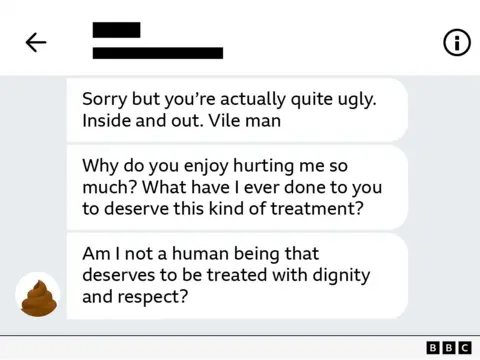
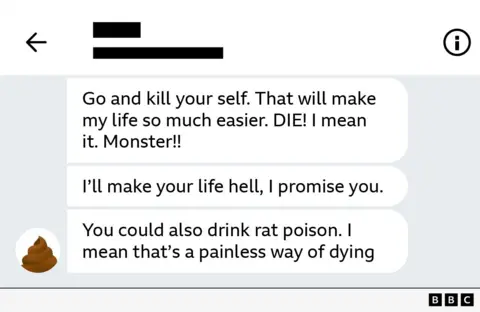
'Vile man'
That
summer, Jay Hulme, then in his mid-twenties, was at a very happy
juncture in his life. He was a poet and author, an assistant warden at
the LGBT-friendly St Nicholas Church and known on social media for his
love of church buildings and theology.
He was exploring his Christian faith and considering the possibility of training to become a priest in the coming years.
"I'm
also trans, I'd come out a number of years before, and I'd finally come
to a place of full and complete happiness with who I was. I saw my
future unfurling before me in a way that had felt impossible before," he
reminisces.
After being rejected,
Venessa, also then in her mid-twenties, sent Jay a series of "angry and
accusatory" messages, saying he was gossiping about her. Though he tried
to reassure her he wasn't, she was adamant.
To
try to resolve things, Jay agreed to a demand from her to meet. He had
been determined that the meeting happened outside in public but a heavy
rainstorm meant they ended up inside, alone together at her place of
work.
He says she yelled at him,
telling him he was a liar, a racist and an awful person - demanding an
apology over and over again without telling him what he was supposed to
have done.
Unsettled, Jay stopped
interacting with Venessa and avoided her when she continued to come to
his church. But then he started to get messages from anonymous online
accounts which could be seen by his social media followers.
Jay
quickly worked out the author was Venessa. She even sent him an email
from her personal account apologising for what she described as the
"pain" she'd caused.
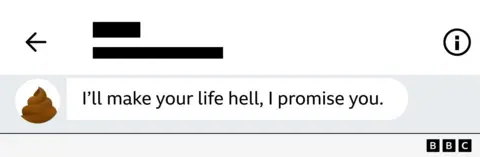
But the nastiness online escalated, with Venessa publicly making false allegations and threats.
Jay
was concerned for his safety. He reported the harassment to
Leicestershire Police. He says he didn't want Venessa prosecuted at that
point - just for the abuse to stop.
But
he heard nothing back and the abuse continued relentlessly. Each time
he blocked an account, another would spring up. Jay felt he had no way
of escaping it.
"I felt like she was
in my pocket, and in my house, and in my brain all of the time, saying
these horrendous things and I couldn't get away," he says.
Jay
needed to stay online because of his writing and speaking commitments.
But he was beginning to lose contracts. He suspects that was because of
the allegations about him online.
Finally, weeks after reporting it, the police did visit Venessa. The outcome was far from satisfactory for Jay.
"She
told the officer that it was her friends who were sending the messages,
and the officer told her to tell them to stop. I was told by the police
that I should just delete my social media," he says.
Jay says he got the impression the police did not appreciate the seriousness of the abuse because it was online.
Stalker books onto same retreat
The police visit triggered even more angry messages from Venessa.
Jay
then started assembling a powerful body of evidence, now on a mission
to prove the messages had not been sent by Venessa's friends, but by
Venessa herself.
He compiled a
detailed spreadsheet setting out the connections between the numerous
anonymous accounts which had sent abuse or posted allegations about him.
They all led back to Venessa.
Having
lost faith in the police, Jay handed all this evidence to the Church of
England, which promised to investigate his formal complaint.
While
he waited, he thought he would get some respite by going to a silent
Jesuit retreat in rural Wales. Days later, a colleague told him Venessa
had booked to go to the very same retreat.
Jay
had booked last minute and says there were not many slots left. "It's
in the middle of nowhere. As far as I'm concerned there is no way that
could have happened naturally."
Jay
left the retreat just hours before Venessa arrived. It left him
terrified, feeling the stalking had now gone beyond the confines of the
internet.
Accused of witchcraft
Finally, there was some positive news for Jay.
Back
in Leicester, the Church HR investigation concluded Venessa had been
responsible for the abuse, to Jay's huge relief. He assumed that would
be the end of it.
But almost as soon as that happened, there was an unexpected turn.
He
was called into a meeting with the Bishop of Leicester, Martyn Snow -
who's seen as a favourite to become the next Archbishop of Canterbury,
leader of the Church of England.
Jay thought Venessa was going to lose her job. But it turned out the bishop had conducted his own investigation.
"I
go in and the bishop sits down with this thick folder on his knee. And
he begins to question me about my complaint. He actually states that
'It's he said, she said'."
The bishop
said he didn't believe that Venessa had been responsible for the
harassment. And he wouldn't uphold Jay's complaint against her.
Then he made an extraordinary accusation about Jay.
"Somebody
had given a statement that I had been seen in the church, in the
darkness, with a candle – and they thought I was conducting a seance.
For clarity, I was praying with a candle in the dark, because that's a
thing that Christians do," says Jay.
It got worse.
Bishop
Snow accused him of practising witchcraft - both because of the
"seance" and the fact Jay happened to have a close friend who was a
tarot card reader.
"It felt like an
enormous gut punch. These made-up allegations were being presented to me
by a person with the power of a bishop, in a meeting which I suddenly
realised I had no control over," says Jay.
"She
[Venessa] had somehow managed to make a bishop become part of her
stalking campaign of harassment and threats, and use his power and
position, and I couldn't believe it was happening."
Jay says he was told Venessa would not lose her licence to preach, but he would be punished.
He
says Bishop Snow told him the process to begin his training for
priesthood – something he decided he wanted to pursue – would be "slowed
down".
Jay was devastated. He went home feeling trapped. And after the complaint was dismissed, more messages were posted.
"Really
horrific things, saying that I raped children, that I stole money, that
I was a racist, a bully. She created fake accounts that were me saying
really racist things and would then screenshot them and share those
things," he says.
Bishop Snow
suggested to Jay that his allegations were not in keeping with Venessa's
character. But Jay soon learned he wasn't the only person affected by
Venessa's behaviour.
Complaints 'from 30 people'
A
colleague who worked closely with Venessa, Kat Gibson, had been
complaining about her for more than a year before the campaign against
Jay began.
Kat says Venessa was
unpredictable and adversarial in the extreme. "I was just really scared
when I was around her, thinking, 'what's she going to explode at me for
this time?' with these explosive angry outbursts that I can't prevent."
She
adds that as the months went on, "around 30 people" from eight churches
approached her to informally complain about Venessa's behaviour. She
calls the issue an "open secret" but one that managers felt unable to
tackle.
In a joint statement, Kat's
manager, Lusa Nsenga Ngoy - now a bishop in London - and Leicester
Diocese said pastoral support and counselling were offered to those
affected. The Church of England says Kat's complaints were treated with
care and seriousness.
She was a lay preacher in Leicester, but Venessa soon gained increasing prominence on a national level.
In
2022, several months into her stalking campaign against Jay Hulme, she
was elected onto the Church of England's national assembly – the General
Synod.
Soon after, she was one of
just a handful of people from Synod appointed to the Crown Nominations
Commission, a panel that selects new bishops and archbishops. But all
the while, she was sending countless sinister messages to Jay.
The
online harassment from Venessa now included extreme pornographic
content posted on his social media. Then she tweeted Jay's address.
He went to the police a second time, but again felt no sense of urgency.
"There
was a period where every night, I would wake up screaming because I
dreamed that I was being murdered by Venessa. I had extra locks put on
my door," Jay says.
Apologies and conviction
Though
there appeared to be inaction, behind the scenes the Church was clearly
starting to realise it had a problem on its hands.
While
Jay had been told in summer 2022 that a Leicester Diocese investigation
found Venessa had been responsible for Jay's harassment, he was also
told that the Bishop of Leicester decided quite the opposite.
The
BBC has now learned that shortly before that, the bishop did tell
Venessa to step back from ministry because of "her behaviour", though it
is not known what this refers to.
He
also later revoked her licence to preach, after what's described as "new
evidence" coming to light. The diocese also suggested she go on leave.
But none of these things were made public and did not stop the unrelenting stalking of Jay.
All of a sudden, in late 2022, Leicester Diocese announced Venessa would be leaving.
It said she would "pursue other opportunities" and thanked her for the positive contributions she had made.
Again, this appeared to have no impact on the hate-filled barrages coming Jay's way.
"I
wrote my own will because…I felt that I'd been let down by the police,
I'd been let down by the diocese and as far as I was concerned, this
would continue until one of us died," he says.
In desperation, in December 2022 he went to the police again.
In
March 2023, 21 months after the stalking campaign against Jay began
(and eight months after the Bishop of Leicester told Jay he did not
believe him) the police finally took action against Venessa.
"I
get a phone call from Leicestershire Police [who] basically
acknowledged that they made a mess of it. And very soon Venessa was
arrested. Her devices were confiscated," says Jay.
In
a statement, Leicestershire Police acknowledged their initial response
fell short of the standards expected, adding it continued "to develop
its knowledge and training in relation to preventing and detecting
stalking offences".
By the end of
2023, Venessa had been charged. In May 2024 she pleaded guilty to
stalking, involving serious distress or harm and was given an 18-month
community order and banned from contacting Jay for a year.
After
Venessa's conviction, Jay asked for a meeting with the Bishop of
Leicester, Martyn Snow, who now apologised. "He did acknowledge in some
way his own part in it and that he should have done better, and I
agree," says Jay.
Leicester Diocese
told us it took legal advice and is confident it followed HR practice
and due process in handling Jay's complaint. But wouldn't say why it did
not sack Venessa for months after concluding she had sent the messages
to Jay.
A spokesperson for the Church
of England says they are "appalled by the serious criminal behaviour
that led to Venessa Pinto's conviction."
Venessa's
colleague Kat Gibson was recently made redundant from her post in
Leicester. She says she's much better, physically and mentally, and is
pleased to be out of Church of England employment.
'Everybody failed to protect me'
And
what of Venessa Pinto? Having carried out her community service and
abided by the restraining order, she is once again preaching – and has
also done missionary work in Brazil.
In a statement to the BBC she said one aspect of the court case in particular changed everything for her.
"Reading
[Jay's] victim impact statement brought into sharp focus the pain I
caused and strengthened my resolve to take responsibility and make
amends," Venessa says.
"I acknowledge
the seriousness of my past conduct and do not seek to diminish its
impact. I have moved forward in my life and hope those affected in
Leicester and elsewhere can find it in their hearts to allow space for
healing and growth," she says.
But
while Venessa admits to the harassment she was convicted of, she denies
some other allegations, including the frequent angry outbursts Kat and
others reported. In fact she says accusations of aggressive behaviour
were never formally raised with her in Leicester.
Venessa says she was going through a difficult period and was struggling with her mental health during her time in Leicester.
Her
targeting of Jay has left him scarred. He struggles to open his email
for fear of what he'll find and he says his finances have been destroyed
by years of sporadic work.
"I feel
that everybody failed to protect me. I almost feel like I was naive that
when the police failed to protect me, I thought the Church, which talks
about safeguarding, [would]," says Jay.
"It
fails because people are scared to do the right thing. In James, my
favourite book of the Bible, there's a bit that says that anybody who
knows the right thing and fails to do it, commits sin. And that's the
problem at the heart of this Church."
Jesuit Father David Mark Neuhaus, a German-Israeli, says Israel’s actions in Gaza count as a “genocide.”
Neuhaus is superior of the Jesuit community at the Pontifical
Biblical Institute in Jerusalem, and is a member of the Jesuit Institute
of South Africa. From 2009 to 2017, he also served as patriarchal vicar
for Hebrew-speaking Catholics in the Latin Patriarchate of Jerusalem.
The current Gaza conflict broke out on October 7, 2023, when
Hamas-led militant groups launched a surprise attack on Israel, killing
1,200 Israelis and foreign nationals, including 815 civilians, and
taking 251 people hostages.
Israel retaliated, invading Gaza on October 27, 2023, with the stated objectives of destroying Hamas and freeing the hostages.
But Israel’s response has been characterized as genocide by various
international human rights bodies, the United Nations and academics.
On December 5, 2023, Amnesty International said its research had
“found sufficient basis to conclude that Israel has committed and is
continuing to commit genocide against Palestinians in the occupied Gaza
Strip.”
“Amnesty International’s report demonstrates that Israel has carried
out acts prohibited under the Genocide Convention, with the specific
intent to destroy Palestinians in Gaza. These acts include killings,
causing serious bodily or mental harm and deliberately inflicting on
Palestinians in Gaza conditions of life calculated to bring about their
physical destruction. Month after month, Israel has treated Palestinians
in Gaza as a subhuman group unworthy of human rights and dignity,
demonstrating its intent to physically destroy them,” said Agnès
Callamard, Secretary General of Amnesty International.
On May 7, 2025, the UN Human Rights High Office of the Commissioner
issued a statement accusing Israel of “massacring the surviving
population with impunity.”
“No one is spared – not the children, persons with disabilities,
nursing mothers, journalists, health professionals, aid workers, or
hostages,” it said, but didn’t out rightly call it genocide.
Neuhaus told Crux that there was no denying the fact that Israel was carrying out genocide in Gaza.
“Unfortunately, those who commit genocides believe that the people
they are exterminating constitute an existential threat to them. That is
why they need to be removed,” he told Crux, referencing
Israel’s argument that its war is meant to root out Hamas and so remove
an existential threat to Israel’s very survival.
Neuhaus said his thoughts on Israel’s “genocidal” violence in Gaza is
also informed by his family history. Although he was born into
apartheid in South Africa, and then received his formation in the same
country, his family came from Nazi Germany, and these experiences “have
certainly profoundly influenced my awareness of what is going on in
Palestine/Israel.”
“I am indeed an Israeli and I am part of a Jewish family that escaped the horrors of Nazi Germany,” the priest told Crux.
“My family’s origins in Nazi Germany and my own birth and formation
in Apartheid South Africa have certainly profoundly influenced my
awareness of what is going on in Palestine/Israel,” he said.
Neuhaus recalled that when he arrived in Israel at the age of 15, he
“noticed similarities in the way the Israeli state established an
ethnocentric form of administration where Jews are privileged, and
Palestinians are marginalized.”
“Within the state of Israel, Palestinian citizens face endemic
discrimination. In the territories that Israel conquered in 1967, a
military occupation was put in place that made sure that Palestinians
did not enjoy even basic rights – the right to family life, the right to
property, the right to movement, the right to employment. Seeing all
this with eyes that were formed within my family which had experienced
horrific discrimination in Germany and within Apartheid South Africa, it
was easy to see the signs,” he explained.
The Jesuit priest said that the lived realities of the Palestinians
can be best explained by examining closely what has happened over the
past one hundred years, since Jews from Europe began migrating to
Palestine.
“Believing that this was their God-given homeland, they ignored the
presence of the natives of the country, the Palestinians,” he told Crux, and drew parallels with European colonization of other parts of the world.
“Most of these Jewish migrants had no intention of living with the
Palestinians and integrating into the region. Rather they sought to
replace them, removing them from their land, destroying their society
and building a Jewish society in its place,” Neuhaus explained.
He said Palestinian resistance to this plan has been brutally
crushed, and Israeli leadership in recent years has become “more radical
and thus more determined to uproot the Palestinians from their
homeland.”
The October 7, 2023 attack on Israel by Hamas therefore only served
as fodder for a long-standing plan, and Israel found a complicit partner
in the United States that offered, and has continued to offer, what
Neuhaus describes as “blanket support.”
“The consequences are a war on the Palestinians, killing men, women
and children, militants and non-militants and destroying their homes
resulting in what is now being termed genocide,” he said.
Neuhaus agrees with critics who have pointed out that Israeli Prime
Minister Benjamin Netanyahu uses war to shield his failed regime from
criticism.
“Netanyahu is a warmonger and his wars are smokescreens,” Neuhaus said.