Sunday, July 28, 2024

CWI : Operation Laonia (30)

Well now Fintan, that's another cermony done and dusted, and perhaps another feather in your mitre (or rather an extra row of tassels on the galero)...and not a bit of trouble at the ceremony yesterday.

Having plain clothes members of An Garda Síochána would see to that once they all knew (or thought they knew) who they were watching out for.

Regrettably, and not for the first time, and no doubt not the last, you were not telling the truth about people Fintan...

1. In your secret meetings with Parolin, did you tell him the truth?

2. If so Fintan, how did it feel telling the truth seeing as it is something with which you do not having a normal working relationship?

3. Did you tell him why a forged signature was on submitted paperwork to Rome?

4. Did you tell him the truth about your formal interview with An Garda Síochána a few weeks ago?

5. Did you advise him that such an interview was as part of an ongoing criminal investigation that was necessitated by your failure to carry out such an investigation?

6. Did you advise him that Cleo Yates rang a Garda Station, thereby interfering with same said ongoing criminal investigation?

7. Did you tell him that she did so whilst lying about the reason she claimed she was making such a call?

8. Did you advise him that Cleo was told by the Garda (at least twice) that she was interfering in an ongoing investigation before she was effectively warned she could be arrested for such interference?

9. Did you also tell Parolin that in fact you sought laicisation of 2 priests under false pretexts - in other words Fintan, you lied?

10. Did you tell him about your trips around the diocese - and further afar (Dublin City Marathon) - with Spandex Lady - who hangs around the front gates of Westbourne like a hooker - waiting for you to join her for a bit of jogging? Whether such jogging becomes horizontal or remains vertical - or both - is a source of scandal at the moment - and in your own warped and untruthful ways - would merit application to Rome for laicisation. Hypocrite much Fintan?

11. Did you advise him of the names of the 2 (biological) daddies in the diocese, and seek their laicisation?

12. Did you advise him of the names of priests in the diocese who are in both emotional and full on sexual relationships - and seek their laicisations?

13. Have you sought from Parolin the laicisation of the criminally convicted Jerry 'The Wanker' Carey? If not, why not?

14. The Master of Cermonies was Ger 'The Invisible Priest' Jones, and yet he has failed to carry out any First Friday visits (one now has to make an appointment by telephone to get a hold of him). He has not involved himself in his parish, visited any of the parishoners, engaged with the youth or supported efforts to seek to provide calm in a very challenging environment.

Of course, as he has put it himself, he doesn't 'do' ne'er do wells.....he will make a great bishop yet so!!

Have you recommended him for such an appointment to Parolin?

15. Now Fintan, here is the bigger question of them all - will you meet with us here in CW, and together we trawl through the evidence we have of all of what we have ever published here about you?

The only thing Fintan is this - all we ask you to do - and it is a big ask for you - is to tell the truth once and for all....and if you cannot do that, then we regrettably know that no meeting can take place.

You can bring your solicitor with you as we will have ours there as well so it will be all fair etc etc....and not just you bullying your way as heretofore.

This is your chance, and we hope you take us up on it.

_ _ _ _ _ _ _ _ _ _ _

AODHÁN DE FAOITE

Eagarthóir / Editor

Catholic leaders join French bishops in condemning Last Supper scene at Paris Olympics opening

Paris 2024 Olympics Opening Ceremony ...

Bishops and prominent prelates from around the world have joined the French Bishops’ Conference and U.S. bishops in criticizing the Paris Olympics opening ceremony held on July 26 for its depiction of the Last Supper, calling it a deeply deplorable derision of Christianity.

The controversial scene, part of the 1.5 billion euros (about $1.62 billion) spectacle to kick off the 2024 Summer Olympics in a rain-soaked French capital on Friday, featured drag queens portraying the apostles and an overweight DJ as Jesus in what appeared to be a part of a fashion show — apparently mocking Leonardo da Vinci’s famous painting.

The official Olympics Twitter account described part of the scene as depicting “the Greek God Dionysus“ making people “aware of the absurdity of violence between human beings.“

In a statement released Saturday, the French bishops expressed deep regret over “scenes of derision and mockery of Christianity, which we deeply deplore.”

“We thank the members of other religious denominations who have expressed their solidarity,” the statement on July 27 continued.

“This morning, we think of all Christians on all continents who have been hurt by the outrage and provocation of certain scenes.”

The bishops added: “We hope they understand that the Olympic celebration extends far beyond the ideological preferences of some artists.”

Archbishop Charles Scicluna of Malta said on X he had sent messages to the French Ambassador to Malta, expressing his “distress and great disappointment at the insult to us Christians during the opening ceremony of the Paris 2024 Olympics when a group of drag artists parodied the Last Supper of Jesus.”

The prelate, who also is a Vatican official, said he encouraged others to write the ambassador.

Bishop Andrew Cozzens, chair of the U.S. Bishops' Committee on Evangelization and Catechesis, issued a statement calling on Catholics to respond to the Paris incident with prayer and fasting.

Referencing the recent National Eucharistic Congress, Bishop Cozzens wrote, “Jesus experienced his Passion anew Friday night in Paris when his Last Supper was publicly defamed.“

“France and the entire world are saved by the love poured out through the Mass, which came to us through the Last Supper. Inspired by the many martyrs who shed their blood to witness to the truth of the Mass, we will not stand aside and quietly abide as the world mocks our greatest gift from the Lord Jesus,“ the bishop wrote.

“Rather, through our prayer and fasting, we will ask the Holy Spirit to strengthen us with the virtue of fortitude so that we may preach Christ—our Lord and Savior, truly present in the Eucharist—for the Glory of God and the Salvation of Souls.“

Bishop Robert Barron of Winona-Rochester called on Catholics to “make their voices heard” in response to what he termed “the gross mockery of the Last Supper.”

The Archbishop of Santiago de Chile, Archbishop Fernando Chomali, expressed disappointment with “the grotesque parody of the most sacred thing we Catholics have, the Eucharist,” ACI Prensa, CNA’s Spanish-language news partner, reported.

“The intolerance of the ‘tolerant’ has no limit. This is not the way to build a fraternal society. We witnessed nihilism at its maximum expression,” he added.

German Bishop Stefan Oster called the “queer Last Supper” scene “a low point and completely superfluous in the staging,” in a post by the German Bishops’ Conference.

Fray Nelson Medina, a well-known Colombian Dominican priest with a vast social media apostolate, stated that he “will not watch a single scene from the Olympic Games. How disgusting what they have done mocking the Lord Jesus Christ and his supreme gift of love. And they are cowards: they wouldn’t mess with Muhammad.”

Archbishop Peter Comensoli of Melbourne, Australia, commented on X: “I prefer the original.”

‘A minority of the left’

Javier Tebas Medrano, president of La Liga, Spain’s top professional football division, strongly condemned the Parisian drag queen scenes on social media. ACI Prensa reported that Medrano posted an image of the performance with the statement: “Unacceptable, disrespectful, infamous! Using the image of the Last Supper in the Paris Olympic Games is an insult to those of us who are Christians. Where is the respect for religious beliefs?”

Marion Maréchal, a French member of the European Parliament and granddaughter of the famous right-wing leader Jean Marie Le-Pen, addressed “all Christians who felt insulted by this drag queen parody of the Last Supper” on X, stating: “Know that it is not France that is speaking” in the inauguration “but a minority of the left ready for any provocation.”

French Dominican friar created the motto for the Olympic Games

olympic motto

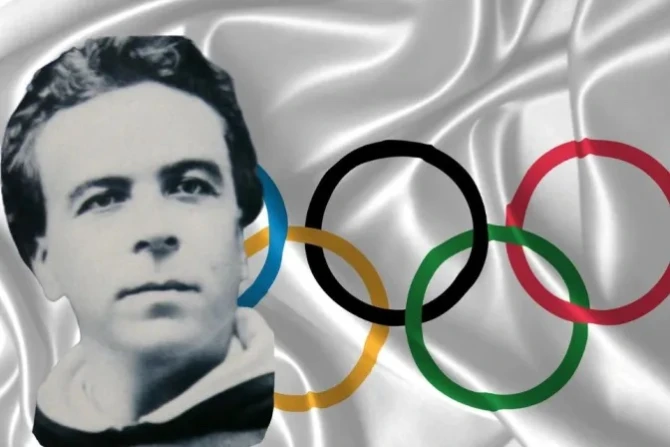
The motto of the modern Olympic Games, “Faster, Higher, Stronger,” was coined by French Dominican friar Louis Henri Didon, who became friends with the founder of the modern Olympic Games, Baron Pierre de Coubertin, five years before the 1896 Athens Games.

The motto, originally formulated in Latin as “Citius, Altius, Fortius,” was used before the modern Olympic movement at St. Albert the Great School in Paris, where the Dominican friar was the principal.

Born in 1840, Didon entered the Rondeau Minor Seminary in Grenoble, France, beginning at the age of nine, and during his youth, he stood out for his ability as an athlete. After visiting the Carthusian monastery in Grenoble, he decided to follow a religious vocation and took the habit of the Order of Preachers (Dominicans) at the age of 16. Six years later, after a period of formation in Rome, he was ordained a priest at age 22.

Military chaplain, prisoner, and refugee

Didon soon gained fame as a preacher. During the brief Franco-Prussian War, which broke out in July 1870, he was a military chaplain and for a time was held as a prisoner. When he fell ill, he ended up as a refugee in Geneva, Switzerland. From there he was sent to Marseille, where he resumed his sometimes controversial preaching activity, which led to his being sent to Corsica in 1880. 

A decade later he was appointed principal of St. Albert the Great School in Paris where he established sports as part of the school's educational program and promoted sports competition. This decision was the result of belief in the value of sports and the contact he had had with Pierre de Coubertin since 1891.

In the first race they organized, the Dominican decided to embroider on the school flag the famous motto, which would become an Olympic motto in 1894, during the first Olympic Congress held in Paris in 1894.

Two years later, Athens hosted the first Olympic Games, which have since been held every four years, interrupted only three times due to World Wars I and II (1916, 1940, and 1944) and postponed from 2020 to 2021 due to the COVID-19 pandemic.

Russian Orthodox bishop of Budapest-Hungary suspended following reports of sexual misconduct

Russian Orthodox Bishop Hilarion Alfeyev of Budapest-Hungary has been temporarily suspended following reports about an ongoing investigation of sexual misconduct with a young staff member.

According to the online news site Novaya Gazeta Europe, Georgy Suzuki, who served as the bishop’s personal assistant between Oct. 2022 and Jan. 2024, was sexually harassed on several occasions by the 58-year-old high-ranking prelate.

Alfeyev has reportedly denied all allegations made by Suzuki. 

Earlier this month, Church Times reported that 11 Russian Orthodox priests in Budapest signed a joint statement defending Alfeyev who, they believe, is innocent and a victim of a “dirty slanderous campaign.”    

Yesterday, Novaya Gazeta Europe published several photos as well as details of private messages shared between Suzuki and Alfeyev, highlighting the bishop’s sexually inappropriate behavior and materially-excessive lifestyle. Alfeyev reportedly purchased mansions in France and Hungary as well as expensive watches, and spent holidays on yachts and at expensive beach resorts.

Though Suzuki told Novaya Gazeta Europe that Alfeyev’s advances never led to sexual encounters, he said he and his family suffered coercion, blackmail, and retaliation from the bishop who, in turn, accused Suzuki of sexually inappropriate behavior.   

The Holy Synod of the Russian Orthodox Church has appointed metropolitan Bishop Nestor of Korshun and Western Europe as temporary administrator of the Budapest-Hungary diocese while investigations are underway. 

Alfeyev has subsequently been permanently dismissed as president of the Synodal Theological Commission, and as chairman of the Theological Committee. However, it is not the first time the Russian metropolitan has been removed from a prominent position in the Orthodox Church. 

In 2022, Patriarch Kirill of Moscow dismissed Alfeyev as president of the Department of External Church Relations and as a permanent member of the Holy Synod of the Russian Orthodox Church. That same year, he was also removed as metropolitan bishop of Volokolamsk and then transferred to Hungary and appointed as metropolitan bishop of Budapest. 

A 2022 article published by The Orthodox Times speculates that his dismissals two years ago were not linked to sexual misconduct but to the bishop’s “mild stance” on the conflict between Russia and Ukraine, which contrasted to that of Patriarch Kirill’s “full identification” with the Russian government’s hardline on Ukraine.     

In light of the publicity of the allegations of sexual misconduct by former church worker Suzuki, the Russian Orthodox Church has created a special committee to further investigate the case against Alfeyev. 

Scandal in the Italian Church: Bishop Accused of Covering Up Priest's Abuse

In the Italian Church, such a heavy and messy situation had never been seen before. 

A priest - Father Giuseppe Rugolo - was convicted six months ago by the Enna court for aggravated violence against a minor; at the same time, the judges - in the reasons for the sentence - raised very serious criticisms of how the bishop - Monsignor Rosario Gisana - had handled the case. 

He himself, in a wiretap, stated that he had covered it up. 

To support Gisana, even Pope Francis intervened publicly, considering him persecuted. 

The latest episode of this incredible story is Gisana's interview with the newspaper La Stampa, in which he rejects the accusations made against him by the Italian judges and contained in the reasons for Father Rugolo's conviction. 

"The facts occurred before my appointment as bishop of the diocese." 

Too bad his version was totally denied by the previous bishop. 

"If I had been aware of these facts, which for me constitute a crime, I would not have hesitated to take action." 

With this terse statement, Monsignor Michele Pennisi, emeritus bishop, cast further shadows on how the Church and the Vatican have dealt with an ugly chapter of cover-ups, silence, and transfers.

Pennisi, speaking to Ansa, seems astonished: "I have never received any report regarding Rugolo. When I was informed, as in a case in Gela, I immediately took serious measures."

PROSECUTOR'S OFFICE

In fact, it is the first time that a Prosecutor's Office strongly highlights the responsibility of a diocese in handling cases of child abuse. 

The words in the reasons for the sentence are thought-provoking: "It appears that the curia's co-responsibility exists in the person of the bishop (Gisana, editor's note), who evidently authorized Father Rugolo, as a reference figure of his association, to operate within the church, thus allowing him, with the full complacency of the diocese, to create opportunities for meetings and interactions with young adolescents (...) the investigation revealed clear and unequivocal elements supporting a knowingly culpable conduct by Bishop Gisana, which legitimizes the condemnation of the curia, in its capacity as civilly responsible, for the damages caused by the sexual abuses perpetrated by Father Rugolo."

The judicial case was handled behind closed doors in court, although several scabrous, surprising details and an unjustified underlying silence emerged in the news, to which the persistent silence of the CEI and the Vatican must be added. 

During all this time, they never took a stance, nor even hypothesized canonical sanctions either for the bishop for covering it up or for the priest, who was only convicted by the Italian court at the moment.

Monsignor Rosario Gisana, bishop of Enna, already in 2016 "and in the following years in which Father Rugolo continued to perpetrate sexual abuses against Giulio and Paolo (the names are fictitious, editor's note) was fully aware that the defendant had been reported to him for having previously engaged in similar conduct with very young boys." 

Always from the written reasons by the judges, it is added: "This circumstance was admitted by Gisana himself during his examination, as well as emerging from the testimonies of several witnesses."

Before the judges, the bishop also admitted to having spoken with Father Rugolo even before meeting the victim's parents and the victim himself. 

In a wiretapped phone call, Gisana, also in 2016, while "laughing nervously" about the events, said in Sicilian dialect that these are things that are part of the journey. 

Adding that "homosexuals love in a visceral way or hate in a visceral way and that this is a revenge of a person who was rejected." 

In another part, he repeated that he could not abandon his priest, "you have to excuse me." 

In a conversation with the defendant, whom he called "my joy," he showed awareness of what was happening: "Now the problem is not just yours, the problem is also mine because I covered up this story."

MINORS

For the judges, the bishop "clearly failed to take any serious necessary initiative to protect the minors of his community and their parents, despite having specific powers conferred within the scope of his function to protect the faithful, facilitated the predatory activity of a prelate who had already been reported. 

It would have been necessary for the religious authority leading the diocese not only to report these complaints to the religious authorities according to existing canonical procedures but even before that to prevent Rugolo from coordinating and managing numerous groups of young people in recreational activities with a religious background." 

No control was thus activated to protect the boys, and Rugolo therefore committed abuses "sexually against two young adolescents, aware that he could count on the support of the religious leaders who instead contributed to strengthening the external image of Father Rugolo as a prominent member of the local clergy." 

The judiciary's conclusion is terse: "The defendant and the curia must be sentenced to reimburse the same civil parties for the costs of constitution and defense."

A precedent in the fight against pedophilia and abuse among the clergy destined to open a new phase in Italy, in the general immobility of the Italian Church, which is not very inclined to follow the path taken by other European countries.

THE POPE

Shortly before the sentence, last December, while receiving a Sicilian religious association in the Vatican, the Pope wanted to praise the bishop of Piazza Armerina, Monsignor Gisana: "Bravo, this bishop, bravo. He has been persecuted, slandered, and he stands firm, always, just, a just man. For this reason, that day when I went to Palermo, I wanted to stop first in Piazza Armerina to greet him; he is a good bishop." 

Francis did not add anything else, but his words produced a certain echo precisely because Father Rugolo had just been sent to trial. 

According to investigations, coordinated by the Prosecutor's Office and conducted by the Caltanissetta Mobile Squad and the Gela Police Station, started in 2022, the victim had informed the bishop of the abuses suffered.

MOTU PROPRIO

A 2016 motu proprio by Pope Francis indicates that bishops who are found to be negligent should be removed from their positions. 

It is naturally up to a canonical investigation to judge their behavior. 

In practice, the provision established that, among the "serious causes" that canon law already provides for the removal from ecclesiastical office (of bishops, eparchs, or major superiors), negligence concerning cases of sexual abuse should also be included. 

The decision must always be submitted to the approval of the Pope.

Galway diocese considering issue of interment of Bishop Eamonn Casey's remains

The Galway diocese says it has begun considering the issue of the interment of the remains of disgraced Bishop Eamonn Casey in its cathedral crypt after new revelations of child abuse levelled against him.

But it said it needs time and space to consider the matter and will be making no further comment until the process is complete.

Calls mounted this week for the exhumation of the bishop’s remains, which were interred in 2017 in the crypt beneath Galway’s Cathedral of Our Lady Assumed into Heaven and St Nicholas, after an RTÉ documentary last Monday – Bishop Casey’s Buried Secrets- revealed that Catholic authorities received four separate complaints of child sexual abuse against Casey, and other ‘child safeguarding’ concerns.

It was revealed in 1992 that Casey, who was bishop of Kilmacduagh and Galway from 1976 to 1992, had defrauded the Galway diocese of £70,000 to support a son, Peter, that he had fathered with American woman, Annie Murphy, in the early 1970s.

But Casey’s niece, Patricia Donovan, told the documentary aired on RTÉ last Monday that she had been raped and sexually assaulted by Casey from when she was aged five, and that the abuse carried on for more than a decade.

She said some of the alleged assaults happened in Galway Cathedral and at the Bishop’s residence in the city.

The documentary also revealed that Casey was formally removed from public ministry in 2007 by the Vatican, following "allegations" which included Ms Donovan’s complaint of child sexual abuse.

RTÉ Radio 1's Liveline programme was flooded with callers in the days after the documentary was broadcast with many calling for Casey’s remains to be exhumed from the cathedral crypt and buried elsewhere.

One caller said: “I can’t see how I would ever stand in that building again as long as that man is buried there”, describing it now as a “temple of evil”.

In a statement on Saturday, the Galway Diocese said the interment of Bishop Casey in the cathedral crypt now requires a period of careful consideration and consultation, which has already begun.

The statement read: “Bishop Michael Duignan, in his statement last Tuesday, July 23, relating to the life and legacy of Bishop Eamonn Casey, clearly expressed his commitment to 'working with anybody affected, to help bring truth, healing and peace to such terribly painful situations’.

“In this context, the internment of the remains of Bishop Casey in the crypt beneath Galway Cathedral is a very sensitive issue that deeply affects people in different ways, and which has different facets.

“The interment of Bishop Casey in the Cathedral crypt now requires a period of careful consideration and consultation, which has already begun.

“Time and space are required to adequately and appropriately bring this undertaking to completion. 

"We will not be making any further public comment until we are in a position to provide an update.”

Garda Commissioner Drew Harris has requested the Garda National Protective Services Bureau examine the original investigation file into Bishop Casey.

Signs from Casey’s farewell mass that indicate Catholic Church believed it was burying a sinner

As President Michael D Higgins made his way up the steps of Galway Cathedral for the funeral Mass of his friend, the once-beloved Bishop Eamonn Casey, he could hardly have conceived that the deceased would stand accused of a litany of child abuse allegations.

But secretly, as the Mass got underway on March 16, 2017, there were covert signs that the Church was burying a sinner.

Indeed, in the days immediately after his death, debate raged about how to pay final respects to a man who had brought such trouble upon the Church.

Some members of the Galway Diocese knew when he was laid to rest in the crypt of Galway Cathedral that there were at least five allegations of child sexual abuse against him in every diocese in which he had served.

One member of the clergy, who described Casey as a ‘Jekyll and Hyde’ character, said allegations against him were an ‘open secret’ in the Church, including alleged consensual relations with adult women – before and after his spectacular fall from grace in 1992.

Annie Murphy exposed him, after he fathered a son, Peter, with her, forcing him to step down as Bishop of Galway and flee to Ecuador after handing his resignation to the Pope.

And by now, other women were also waiting to expose him for far greater alleged crimes when their own time came.

Monday night was Patricia Donovan’s time.

She has waited more than 50 years to tell her story and truly be heard by the public and the Church, giving her version of events for the first time on camera, in a documentary produced by RTÉ in association with The Irish Mail on Sunday.

She has claimed that she was raped and sexually abused by Casey from the age of five for more than a decade.

Now, there are calls, as well a petition, for his remains to be disinterred from the crypt and removed to a more appropriate location, in keeping with a member of the clergy removed from ministry due to credible allegations of child sexual abuse.

That is the Church’s own terminology – ‘credible’ – and clergy are only removed from ministry if it is deemed so. And yet the Church sought to bury those allegations with Casey, and persisted in trying to keep them buried years after his death.

In 2019, the Galway Diocese told the Mail on Sunday it had just one allegation on file against Bishop Casey. It had, in fact, five child sex abuse allegations on file at that time, it later admitted. 

It sought to blame a change-over with a new bishop taking up office for it not being fully across the full tranche of files on him at that time

This week, RTÉ’s Liveline programme hosted by Joe Duffy has for four days straight been fielding calls from elderly women who have since thrown their picture of Bishop Casey into the fire, as well as a woman who says a priest would not preside over a funeral Mass for her stillborn baby.

Waves of hurt have been unleashed against the Church by those who had once turned to it for solace and comfort.

By the time Casey died, the Church’s book on him had long been closed.

He had been banned from public ministry in 2007 for the last ten years of his life – a decision that was never made known to the public.

But the potential for causing even greater damage to the Church still lingered after his death and the over-riding motivation was for the institution to protect itself.

And yet the Vatican did not want any role in the funeral – nor did it send any representatives such as the Papal Nuncio – and said it left decisions to the ‘local level.’

On that day of his funeral, privately, Bishop Casey’s victims looked on with their own horror.

Outwardly, it seemed that the disgraced bishop’s ceremony was a funeral Mass in keeping with a prince of the Church.

Some 1,600 people turned up to pay their respects to the deceased, and among them were 11 bishops and 61 priests.

No cardinals or archbishops were present, and the Bishop of Limerick, Dr Brendan Leahy, who is aware of the details of three child abuse allegations filed against Bishop Casey in his diocese, said he had another prior commitment that day.

Others looked on, appalled at a different kind of hypocrisy.

‘I found that extraordinarily hypocritical. Here were his greatest critics suddenly celebrating him when he was gone,’ said Tom Kenny of Kenny’s bookshop in Galway, a friend of Bishop Casey’s.

But sources have confirmed that there was division over how best to honour Casey’s life.

How would they honour a man they knew was subject to numerous sexual allegations and quietly removed from ministry, especially when the public had not been told? How would they honour a man who fathered a child with his distant American cousin, which many parishioners had long since forgiven him for?

And how, in recognising all of this, would they merge two sets of protocols for a funeral – that of a bishop’s funeral and also one for a cleric permanently removed from ministry?

The Catholic Church sets out guidelines for the funerals of members of the clergy removed from ministry – many of which were not observed in Galway.

One of those protocols is to be mindful of the victim in every way possible.

Casey’s niece Patricia Donovan said to the more thank 490,000 viewers of the programme who watched on Monday night: ‘The week I found out that he had died, I was planning to end my life. The horror of finding out on that Saturday that he had been put into the crypt in Galway Cathedral, when they knew that I had reported him, and someone before me had reported him for abuse… And maybe, in a weird way, it saved my life, because well, I vowed at that point, I’d try and get heard.’

But there are other victims who have not been heard at all.

The National Board for Safeguarding Children within the Catholic Church in Ireland also issues protocols to dioceses regarding funerals in such circumstances.

They are asked to consider whether the location of the funeral Mass would have a negative impact on the complainants; to carefully choose the readings; to ensure that the homily does not negatively affect the complainants; and to balance the needs of the complainants with the deceased’s family members.

During the funeral Mass in 2017, Brendan Kelly, then Bishop of Galway, made repeated references to sin.

These were not lost on members of the clergy and to some faithful parishioners, but likely would have been lost on the masses.

An acknowledgment of the hurt endured by survivors of clerical sexual abuse is set out in the protocols for funerals of those removed from ministry.

‘Yes, we are all sinners, but irresponsibility, infidelity and sin are very shocking in the lives of those who preach the gospel,’ said Bishop Kelly.

‘But people had been hurt and wounded wounds that do not always heal easily or quickly. We remember these people today too.

We acknowledge their suffering. We pray for continued healing and peace for them.’

However, sources said that a number of the usual protocols for a bishop’s funeral were noticeably absent from the 2017 ceremony.

There was no pall, or religious cloth, placed over the coffin.

There was no mitre, crozier, pectoral cross or ring on Bishop Casey’s coffin.

No religious emblems of his life were brought to the altar by his family. Instead, the family crests and an emblem of Tròcaire, where he was once chairman, were brought to the altar.

His remains were not laid out on a catafalque. He did not receive an overnight vigil and guard of honour in the Cathedral.

Bishop Kelly stated to RTÉ that ‘Bishop Casey’s funeral liturgy followed the precedent set by previous such funerals for former bishops of the diocese’. This statement was made to the programme before Galway Diocese later admitted that it had more complaints on file relating to Bishop Casey than previously disclosed.

Thos responsible might have tried to square away the moral and ethical reasons for the funeral he received in their own mind, but publicly they cannot offer any justification.

One source said: ‘The funeral of Eamonn Casey was deliberately toned down. The normal thing in the Cathedral was a catafalque – that has dignity and pomp; it’s what you would lay out a king on.

‘They wanted to put a pall on the coffin, which would have given it dignity. That wasn’t done.

‘It was a simple coffin on two oak trestles.

‘His mitre wasn’t on it, his crozier wasn’t on it.

‘They would always have been at a bishop’s funeral.

‘There was no pectoral cross, no ring. None of those four symbols of his authority were present. He lay before the altar as a parishioner of the diocese.

‘If the Church said, “We’re not burying him in the cathedral because of A, B and C”, it would have raised so many questions, and the feeling was, “The man is dead, he has to be buried and we only had a matter of days”.

‘He did spend overnight [in the cathedral], but there is protocol for a bishop’s funeral of an allnight guard of honour, an all-night vigil. None of that was done. The high dignity wasn’t there. He got the honour of a sinner.

‘There was no viable Plan B. There was nothing bishop-y about his funeral, other than the people who attended. He got a sermon that would never, ever be given at a lay person’s funeral.’

Canon law expert Tom Doyle said of the protocols for a bishop’s funeral that were not followed: ‘That would probably be lost on most of the lay people.’

However, he added that ‘if you have a bishop like Casey, he is being buried in the cathedral in Galway, and you got a bunch of other bishops and priests that are present, that’s what they’re going to be looking at’.

He continued: ‘That is the statement right there, not whether they put a mitre or crozier or whatever else on the altar or next to his coffin. People aren’t aware of any of that.’

He further stated: ‘I have seen a number of times that priests who have been known as prolific sexual abusers were buried with the regular honours as a priest would get, and it causes a tremendous uproar, especially the hurt that is imposed on the victims who cannot understand why the official Church cont

Former president and canon lawyer Mary McAleese said that in her view ‘something more humble would have been called for’.

She added: ‘It is about showing a sensitivity which says, “We’re not going to give this man the full panoply that normally accompanies a bishop or a cardinal”.’

Irish Times religious affairs correspondent Patsy McGarry said: ‘It was incredible, it was like an act of reconciliation, a happy ending if you like to a turbulent life, that had brought such trouble on the Church in Ireland. A farewell in forgiveness for what had happened in the past.’

But as Monday night’s programme revealed, this was not a ‘happy ending’ in the sorry saga of a priest who was once meant to be the Church’s new great hope, who ultimately led to the crumbling of the institution’s stronghold in this country.

As one source in the Church told me: ‘Eamonn Casey’s light shined extraordinarily bright, but his dark was also extreme.

‘There is very little about Eamonn Casey that’s in the middle, that’s ordinary. With most of us there’s light and dark and they are not that far apart.’

Casey was interred, according to his own wishes and those of his family, in the bishop’s crypt in the Cathedral.

Seven years after he was laid to rest, the ghosts of Bishop Casey’s past are continuing to haunt him, the Church, his victims and the faithful.

His ‘light’ was always apparent, but his darkness will now define him.

Apache Christ icon controversy sparks debate over Indigenous Catholic faith practices

Indigenous Catholic faith ...

Anne Marie Brillante never imagined she would have to choose between being Apache and being Catholic.

To her, and many others in the Mescalero Apache tribe in New Mexico who are members of St. Joseph Apache Mission, their Indigenous culture had always been intertwined with faith. Both are sacred.

“Hearing we had to choose, that was a shock,” said a tearful Brillante, a member of the mission’s parish council.

The focus of this tense, unresolved episode is the 8-foot Apache Christ painting. For this close-knit community, it is a revered icon created by Franciscan friar Robert Lentz in 1989. It depicts Christ as a Mescalero medicine man, and has hung behind the church’s altar for 35 years under a crucifix as a reminder of the holy union of their culture and faith.

On June 26, the church’s then-priest, Peter Chudy Sixtus Simeon-Aguinam, removed the icon and a smaller painting depicting a sacred Indigenous dancer. Also taken were ceramic chalices and baskets given by the Pueblo community for use during the Eucharist.

Brillante said the priest took them away while the region was reeling from wildfires that claimed two lives and burned more than 1,000 homes.

The Diocese of Las Cruces, which oversees the mission, did not respond to several emails, phone calls and an in-person visit by The Associated Press.

Parishioners, shocked to see the blank wall behind the altar when they arrived for Catechism class, initially believed the art objects had been stolen. But Brillante was informed by a diocesan official that the icon’s removal occurred under the authority of Bishop Peter Baldacchino and in the presence of a diocesan risk manager.

The diocese has returned the icons and other objects after the community’s outrage was covered by various media outlets, and the bishop replaced Simeon-Aguinam with another priest. But Brillante and others say it’s insufficient to heal the spiritual abuse they have endured.

Brillante said their former priest opened old wounds with his recent actions, suggesting he sought to cleanse them of their “pagan” ways, and it has derailed the reconciliation process initiated by Pope Francis in 2022. That year, Francis gave a historic apology for the Catholic Church’s role in Indigenous residential schools, forcing Native people to assimilate into Christian society, destroying their cultures and separating families.

A spokesperson for the U.S. Conference of Catholic Bishops declined comment on the Mescalero case. But last month, the conference overwhelmingly approved a pastoral framework for Indigenous ministry, which pointed to a “false choice” many Indigenous Catholics are faced with — to be Indigenous or Catholic:

“We assure you, as the Catholic bishops of the United States, that you do not have to be one or the other. You are both.”

Several of the mission’s former priests understood this, but Brillante believes Simeon-Aguinam’s recent demand to make that “false choice” violated the bishops’ new guidelines.

Larry Gosselin, a Franciscan who served St. Joseph from 1984 to 1996 and again from 2001 to 2003, said he sought the approval of 15 Mescalero leaders before Lentz began the painting that took three months to complete.

“He poured all of himself into that painting,” said Gosselin, explaining that Lentz sprinkled gold dust on himself and skipped showering, using his body oils to adhere the gold to the canvas. Then he gave the painting to the humble church.

Albert Braun, the priest who helped construct the church building in the 1920s, respected Mescalero Apache traditions in his ministry and was so beloved that he is buried inside the church, near the altar.

Church elders Glenda and Larry Brusuelas said to right this wrong and to repair this damage, the bishop must issue a public apology.

“You don’t call or send a letter,” Larry Brusuelas said. “You face the people you have offended and offer some guarantee that this is not going to happen again. That’s the Apache way.”

While Bishop Baldacchino held a two-hour meeting with the parish council in Mescalero after the items were returned, Brillante said he seemed more concerned about the icon being “hastily” reinstalled rather than acknowledging the harm or offering an apology.

Still, some are hopeful. Parish council member Pamela Cordova, said she views the bishop appointing a new priest who was more familiar with the Apache community as a positive step.

“We need to give the bishop a chance to prove himself and let us know he is sincere and wants to make things right,” she said.

The concept of “inculturation,” the notion of people expressing their faith through their culture, has been encouraged by the Catholic Church since the Second Vatican Council in the early 1960s, said Chris Vecsey, professor of religion and Native American studies at Colgate University in Hamilton, New York.

“It’s rather shocking to see a priest who has been assigned a parish with Native people acting in such a disrespectful way in 2024,” he said. “But it does reflect a long history of concern that blending these symbols might weaken, threaten or pollute the purity of the faith.”

Deacon Steven Morello, the Archdiocese of Detroit’s missionary to the American Indians, said the goal of the U.S. bishops’ new framework is to correct the ills of the past. He said Indigenous spirituality and Catholic faith have much in common, such as the burning of sage in Native American ceremonies and incense in a Catholic church.

“Both are meant to cleanse the heart and mind of all distractions,” he said. “The smoke goes up to God.”

Morello said Pope Francis’ encyclical on caring for the Earth and the environment titled “Laudato Si” addresses the sacredness of all creation — a core principle Indigenous people have lived by for millennia.

“There is no conflict, only commonality, between Indigenous and Catholic spirituality,” he said.

There are over 340 Native American parishes in the United States and many use Indigenous symbols and sacred objects in church. In every corner of the Mescalero church, Apache motifs seamlessly blend in with Catholic imagery.

The Apache Christ painting hangs as the focal point of the century-old Romanesque church whose rock walls soar as high as 90 feet. Artwork of teepees adorns the lectern. A mural at the altar shows the Last Supper with Christ and his apostles depicted as Apache men. Tall crowns worn by mountain dancers known as “gahe” in Apache, hang over small paintings showing Christ’s crucifixion and resurrection.

For parishioner Sarah Kazhe, the Apache Christ painting conveys how Jesus appears to the people of Mescalero.

“Jesus meets you where you are and he appears to us in a way we understand,” she said. “Living my Apache way of life is no different than attending church. ... The mindless, thoughtless act of removing a sacred icon sent a message that we didn’t matter.”

Parishioners believe the Creator in Apache lore is the same as their Christian God. On a recent Saturday night, community members gathered to bless two girls who had come of age. Kazhe and Donalyn Torres, one of the church elders who authorized Lentz to paint the Apache Christ, sat in lawn chairs with more than 100 others, watching crown dancers bring blessings on them.

Under a half-moon, the men wore body paint and tall crowns, dancing to drumbeats and song around a large fire. The women, including the two girls donning buckskin and jewelry, formed the outer circle, moving their feet in a quick, shuffling motion.

In the morning, many from the group attended Mass at their church, the Apache Christ restored to its place of honor.

The painting shows Christ as a Mescalero holy man, standing on the sacred Sierra Blanca, greeting the sun. A sun symbol is painted on his left palm; he holds a deer hoof rattle in his right hand. The inscription at the bottom is Apache for “giver of life,” one of their names for the Creator. Greek letters in the upper corners are abbreviations for “Jesus Christ.”

Gosselin, the mission’s former priest, said he was struck by the level of detail Lentz captured in that painting, particularly the eyes — which focus on a distance just as Apache people would when talking about spirituality. He believes the painting was “divinely inspired” because the people who received it feel a holy connection.

“This has resonated in the spirit and their hearts,” he said. “Now, 35 years later, the Apache people are fighting for it.”