Sunday, June 18, 2023

Pope blesses image for prisoners in England and Wales

Pope Blesses Painting of Our Lady of Walsingham in Rome for Re-Dedication  of England in March - Catholic Bishops' Conference

Andy Keen-Downs, the chief executive of Pact, met Pope Francis in Rome last week and received his blessing for an image on behalf of prisoners in England and Wales.

Mr Keen-Downs was in Rome for a conference marking the thirtieth anniversary of the Fondazione Centesimus Annus Pro Pontifice, which promotes the study of Catholic Social Teaching.

Pope Francis spoke to delegates about the importance of community where we are “imagining and working for a future where each person can find his or her place and have room in the world”.

Mr Keen-Downs said: “When it was my turn, in terrible Italian, I asked Pope Francis to bless a beautiful silver image of Mary, Untier of Knots, on behalf of those in prison in England & Wales.

“Pope Francis, who of course washes the feet of prisoners on Maundy Thursday, smiled when he understood what I was saying and raised his hand to touch and bless the picture.

“I asked him to pray for all of us who work with people in prison too. He indicated that he would do so.”

Bishop Richard Moth of Arundel and Brighton had suggested that the image of Mary untying “knots”, a devotion which originated in seventeenth-century Germany, may be especially appropriate for those affected by the criminal justice system and for those striving to make a difference.

Bishop Moth is the prisons liaison for the bishops’ conference.

Mr Keen-Downs reflected that it was “hard to put into words what this symbolic and spiritual support from Pope Francis for Pact’s work means for me personally”.

“I still feel a little overwhelmed. His concern for people in prison is well known, and to bring back a physical symbol of that care to prisoners in England and Wales, of all faiths and none, is humbling.”

Pact’s Faith in Action team will bring the image and Pope Francis’ blessing to men and women prisons as well as to the charity’s supporters and friends.

The organisation hopes the image will enable those in the criminal justice system “to feel greater closeness to the whole Church and through the blessing of Pope Francis, to Jesus himself”.

Pact, the Prison Advice and Care Trust, is the Catholic national charity for prisoners, people with convictions, and their children and families.

Macron announces national fund for church buildings

President Macron announces national fund for church buildings | Abouna

President Emmanuel Macron announced a new fund to protect smaller churches and religious buildings around France in a speech marking the 1,000-year anniversary of the tidal-island monastery of Mont St Michel in Normandy.

The plan would be for private national subscription, similar to one of the financial schemes to fund the rebuilding Notre Dame in Paris, that would help smaller towns that cannot afford to keep up religious buildings that mostly belong to the state.

Of about 50,000 religious buildings in use in France (42,000 of them Catholic), only around 10,500 are heritage sites with access to special funds. Most depend on local mayors for public funds for any repairs.

Up to 5,000 risk closure by 2030 because of the secularisation of society, the lack of priests and tight budgets in many town halls.

Macron’s speech at Mont St Michel, a favourite setting for leaders waxing patriotic, praised the rocky site as “the symbol of the French spirit in resilience, resistance, creative and imaginative”.

After his bruising fight over pension reforms, the president can use something that appeals to France’s national pride and rich architectural heritage.

Religious leaders seemed satisfied with the announcement, while critics said it blurred the lines between Church and State in the officially secular nation.

The successful subscription for Notre Dame, for example, included a 75 per cent tax break for donors – the new fund would need something similar. 

But churches remain popular with tourists. Macron’s signature heritage projects – the reconstruction of Notre Dame and the fund announced at Mont St Michel – involve the most-visited monument in France and most-visited monument outside Paris respectively.

Macron’s scheme would involve a nation-wide inventory of religious buildings, which a French Senate report urged last year. It noted that the lack of such an inventory made it hard for Paris to identify and help crumbling rural churches in financial difficulty.

The president, baptised a Catholic as a teenager, has made support for religious heritage one of his cultural policies.

In return for more funding, local churches may have to open more for non-religious activities, such as concerts and art exhibitions.

Something similar has been launched in the Netherlands, where church closures are numerous. Maastricht city authorities will work with clerics and neighbours of about 100 houses of worship there for an overall “church vision” plan. 

“There are not many churchgoers left, so we are searchers,” said city councillor Frans Bastiaens. “Which buildings should we really keep and which ones can we say goodbye to?”

Benedict’s heirs sued in Munich abuse claim

Pope Benedict XVI 0 Euro banknote

A 38-year-old German man is suing the heirs of the late Pope Emeritus Benedict XVI and the Archdiocese of Munich and Freising for €350,000 (£299,409) in a civil court in Traunstein, Bavaria.

The plaintiff claims he was abused by Fr Peter Hullermann, a former priest of the parish of Garching an der Alz in the Archdiocese of Munich.

He wants €300,000 compensation from the archdiocese and €50,000 from Benedict’s heirs.

Joseph Ratzinger – later to become Pope Benedict XVI – was Archbishop of Munich 1977-1982.  

During his tenure, the archdiocese was asked by the Diocese of Essen in north-western Germany to allow a priest who had abused minors to receive psychiatric treatment in Munich.

Details of the Hullermann case were revealed at the beginning of January 2022 in the Munich archdiocese’s report on clerical sexual abuse. Benedict was accused of hushing up the Hullerman case.

In an 82-page initial statement on the report, Benedict denied that he had taken part in a meeting in January 1980 when he was Archbishop of Munich, at which diocesan officials discussed whether or not to allow Hullermann to receive treatment in Munich.

The Diocese of Essen had specifically informed Munich that Hullerman had abused minors. It was nevertheless decided to allow Hullermann to move to the archdiocese.

Four days after he published his statement, Benedict admitted that he had been present at the meeting and apologised for what he said was an “editing error”.

In a letter to the Munich faithful at the beginning of February 2022, Benedict apologised for all the clerical sexual abuse cases that had taken place.

“I can only express to all victims of sexual abuse my profound shame, my deep sorrow and my heartfelt request for forgiveness,” he said.

Within two months of the January 1980 meeting, and despite the Diocese of Essen’s warnings, Hullermann was again allowed to work with minors in a Munich parish.

In 1986 he was fined 4,000 Deutsch Mark and placed on probation for five years for abusing minors. But by that time Ratzinger had left Munich for Rome to become prefect for the Congregation for the Doctrine of the Faith.

In the present civil claim, filed at the Traunstein regional court, the plaintiff alleges that Ratzinger was aware of Hullermann’s abuse record and accepted the fact the he was a repeat offender.

Archbishop Georg Gänswein, the private secretary to the late Pope Emeritus, is the executor of his will. 

He has written to the five cousins who are the material heirs to ask them if they accept the inheritance. One female cousin to date has said that she wishes to forego her share.

German dioceses normally regulate compensation payments for abuse victims on their own responsibility. The sums paid are usually at most €50,000.

Bonn honours Bonny for same-sex blessings stance

The Bishop of Antwerp, Johan Bonny, popular in parts of the German Church because of the Belgian bishops’ defence of church blessings for same-sex couples, was awarded an honorary theology doctorate by the University of Bonn on 6 June.

The award came after the Flemish prelate attended the German Church’s synodal path discussions in March.

He explained how back-to-back ad limina visits to the Vatican last autumn won papal acceptance for Belgium’s blessing of same-sex couples while the German bishops could not.

Bonny, 67, has advocated such blessings as a pastoral necessity since 2015. He worked in the then Pontifical Council for Promoting Christian Unity from 1997 to 2008.

“You say out loud what many people have long hoped for and expect from the Church,” said Jochen Sautermeister, head of the theology faculty in Bonn.

“You're not afraid to confront reality and people's real lives wherever they may be.”

In one of several interviews he gave in Flemish-accented German, Bonny stressed the Belgian bishops were not defying the Vatican. But Rome should understand that local mentalities can be different.

Romans value a good impression (bella figura) more than describing reality, while Germanic peoples like the Germans and Flemish put precision first, he told Cologne’s domradio.de. 

“Being correct is more important to us than looking good,” he said.

Also, Belgium was a small country that could find a consensus among its eight bishops, while Germany was far larger and had more diversity in opinions.

When the Belgians presented their blessings policy to Pope Francis, he asked twice if they all supported it.

When they said “yes”, he said it was up to them to decide what was needed pastorally.

Bonny stressed terms like “the Vatican” or “Rome” covered a variety of opinions depending on the Catholic institutions involved.

“Rome is not just a document or a cardinal. No, Rome is also unity in diversity.”

“The papacy is not there to say ‘yes’ or ‘no’ to every question,” he added.

The Pope should create a space “where all differences can meet and live with one another”.

“We speak cum Petro et sub Petro, but not everyone in the Vatican is cum Petro et sub Petro,” the bishop said.

Bishops approve ERD review, after ‘broad consultation’ concerns

Bishops, listen to Catholic health workers, not culture warriors, on  transgender directives | National Catholic Reporter

The U.S. bishops on Friday voted to move forward with reviewing and updating their directives for Catholic health care services, after several bishops emphasized that the process should include a “broad consultation,” including the voices of the transgender community.

The proposal to review Part Three of the Ethical and Religious Directives for Catholic Health Care Services passed unanimously on a voice vote on the final day of the USCCB’s plenary assembly in Orlando.

The Ethical and Religious Directives for Catholic Health Care Services (ERDs) is a guide released by the bishops to offer ethical standards in health care, based on Catholic teaching about human dignity.

The guide is periodically updated. It is currently in its sixth edition, which was approved by the bishops five years ago.

Bishop Daniel Flores, head of the bishops’ doctrine committee, explained that part three of the document, dealing with professional-patient relationships, has not been updated since 1994. It does not include guidance on “radical modifications of the human body,” such as surgeries and hormones given for gender dysphoria, he said.

In March, the USCCB’s administrative committee authorized the publication of a doctrinal note from the conference’s doctrine committee on “moral limits to technological manipulation of the human body.”

The note said, among other things, that transgender surgeries are immoral because they “do not repair a defect in the body…these interventions are intended to transform the body so as to make it take on as much as possible the form of the opposite sex, contrary to the natural form of the body. They are attempts to alter the fundamental order and finality of the body and to replace it with something else.”

Flores introduced a proposal to incorporate the doctrinal note into the ERDs. The revision would involve the doctrine committee consulting bishops, moral theologians, doctors and other experts to create a draft that would be subject to review, discussion, and vote by the bishops.

When Flores asked if there were any questions, several bishops came forward to emphasize that they believe there should be a “broad consultation” on the issue, including the voices of people who identify as transgender.

Cardinal Robert McElroy of San Diego made a distinction between “the doctrinal tradition of the Church, particularly on male and female” and the need “to wrestle with the existential question of those who are suffering from dysphoria.”

“I think there’s a fundamental difference between a declaration on doctrine, which was issued, and the formulation of the ERDs,” he said.

He stressed that the ERDs are not just a statement of doctrine but an application of doctrine to “the existential situation of people who are suffering.”

“The ERDs are meant to be a pastoral, medical document to inform and guide the health care ministries,” he said.

“I urge therefore that the consultation be very wide and deep, within the medical communities and with people who are suffering from dysphoria also,” he said.

Cardinal Joseph Tobin emphasized the need to listen to people and to present things in a way that is understandable to people in the language of the ERDs.

“I would like to also encourage a broad consultation, including people who are from the trans community,” he said.

Bishop Shawn McKnight of Jefferson City also called for a “wide consultation, especially with the various Catholic health care systems.”

Auxiliary Bishop Robert Casey of Chicago, speaking on behalf of Cardinal Blase Cupich, who had to leave the meeting early, asked that the consultation include dioceses with a significant Catholic health care presence.

Archbishop Paul Etienne of Seattle also called for a “broader consultation,” saying that policy makers, physicians, and CEOs of health care systems should all be able to weigh in on the discussion.

Bishop Michael Olson of Fort Worth, who is a member of the doctrine committee that released the note on technological manipulation of the human body in March, emphasized that there had been extensive consultation leading up to the development of that note.

“Part of the process that we had in the doctrinal note was listening not only to members who identify themselves as part of the trans community, but those practitioners, theologians, ethicists, family members as well,” he said.

“And what became clear in this process as we compiled and formed the doctrinal note is that there is still a lack of clarity between what is authentic gender dysphoria and then also the gender ideology that in part is preying upon these people and enhancing their suffering, increasing their suffering,” he continued.

“So I’m hoping that the development and the process of the ERDs will help us to bring greater clarity between these two phenomena, of gender dysphoria and also gender ideology. So then hopefully we can write a broader pastoral document after the completion of the ERDs.”

After fielding questions and comments, the bishops held a voice vote on the proposal. The vote passed unanimously, with no abstentions or votes in opposition.

Christian Reformed synod orders church to rescind deacon in same-sex marriage

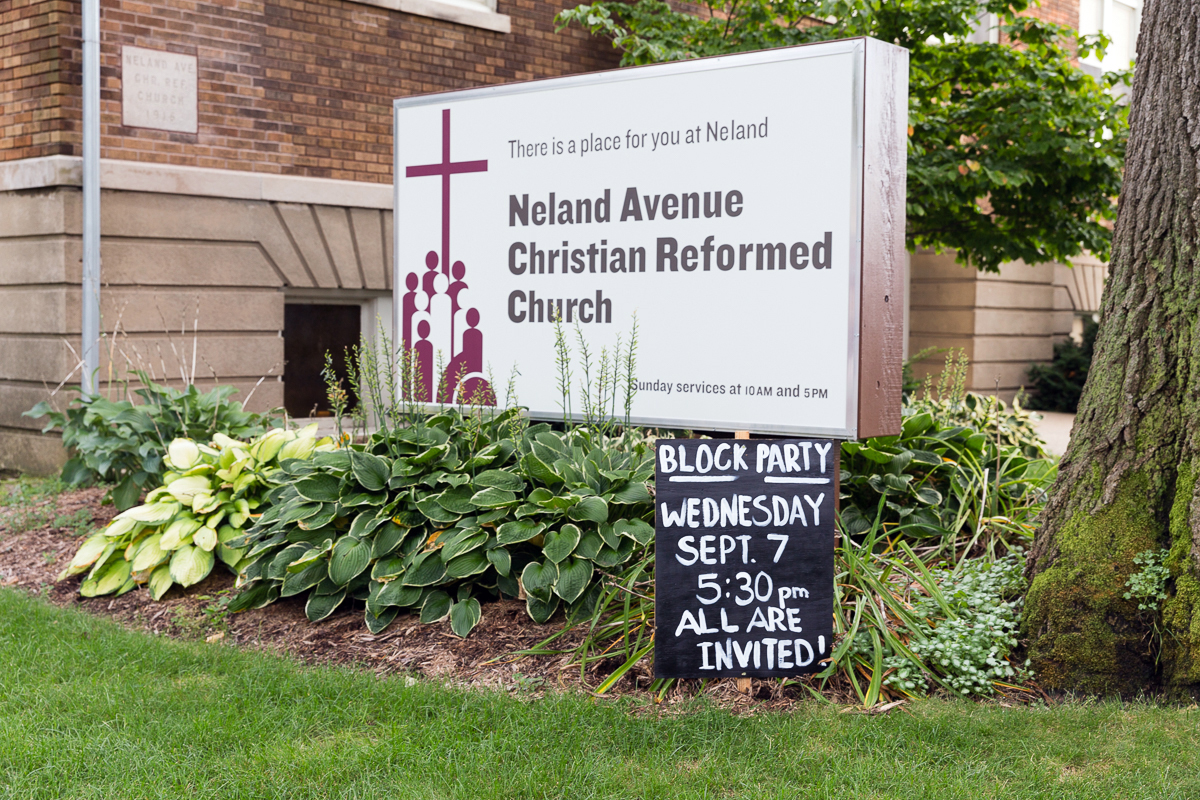
 Neland Avenue Christian Reformed Church in Grand Rapids, Michigan. Photo courtesy Otto Selles for Neland Avenue Christian Reformed Church

The governing assembly of the Christian Reformed Church of North America, meeting in Grand Rapids this week, voted not to sustain the appeal of a church that petitioned to retain a deacon who is married to a person of the same sex, against the denomination’s doctrine.

The synod ordered the Neland Ave. Christian Reformed Church, which stands a few blocks from where church leaders are meeting, to immediately rescind the appointment of “any and all” officeholders in same-sex relationships.

The synod also voted to instruct all classes, as the CRCNA’s regional jurisdictions are called, to bring pastors, elders and deacons who publicly disagree with its stance on human sexuality into compliance. 

The CRCNA, one of the oldest but smallest denominations in the Americas, with about 200,000 members across the United States and Canada, has navigated tensions over questions of sexuality since last year’s Synod 2022, when delegates voted to affirm the confessional status of its position that “homosexual sex” is sin.

Confessional status means that a position is considered part of the core beliefs of the CRCNA and that anyone holding office in the church is expected to uphold it. 

Synod 2022 also ordered Neland Avenue to rescind its 2020 appointment of a deacon in a same-sex marriage. CRCNA General Secretary Zachary King was ordered to create an in loco committee to ensure Neland complied with the order.

It remains unclear from synodical proceedings, however, how the denomination will enforce this year’s decisions. In addition, the synod’s order is largely symbolic as Neland Avenue’s deacon has completed her three-year term and is no longer in office.

This year’s synod voted against the creation of a similar committee to ensure today’s decision is upheld. During discussion prior to the vote, Paul DeVries, chair of the previous committee, said that he recommended against creating a new one and that creating another committee would result in the removal of Neland.

“The previous in loco committee failed. We were not able to do what synod asked us to do,” said DeVries. “Another in loco committee will have no better success.”

The synod also voted to defer voting until Synod 2024 on decisions regarding the denomination’s gravamen process for expressing difficulties with an aspect of the church’s confessions. 

Debates over today’s decisions reflected disagreement in the denomination over its views on homosexuality. The CRCNA has long held the position that “homosexual sex” is a sin. In 1970, synod appointed a task force to create an official church position on the topic of homosexuality in response to increasing acceptance of same-sex relations in the U.S. and Canada. 

The report, approved by Synod 1973, distinguished between same-sex attraction (which was considered “a disordered condition” but not a sin) and sex between people of the same sex (which was considered sinful). Later reports, approved in 2002 and 2013, also upheld this position.

However, not all members of the CRCNA agreed with this position. 

In 2002, First Christian Reformed of Toronto announced it would allow people in committed same-sex relationships to serve as elders and deacons, an announcement that was rescinded in 2006 under threat of disaffiliation. The church requested that synod reconsider the guidelines of the 1973 report but was denied.

In 2016, a year after the U.S. legalized same-sex marriage, Nicholas Wolterstorff, a philosopher and former professor at Reformed school Calvin University, announced his support for same-sex marriage. Classis Grand Rapids East, which houses the Neland Avenue church, also released a report in support of allowing same-sex marriage. 

The CRCNA also re-opened the question to some extent that year. Synod 2016 appointed a new study committee to create a summary of the church’s position on human sexuality. The committee was made up of 12 persons who “adhere to the CRC’s biblical view on marriage and same-sex relationships,” according to the resulting report.  

In summer 2020, Neland Ave CRC appointed a woman who is married to another woman to serve as deacon. A few months later, the CRCNA released the report of the study committee, which recommended that the synod declare that the church’s teaching barring homosexual sex “already has confessional status.”

Within a month of Synod 2022, Neland Ave CRC voted to appeal its order to remove its deacon from office.

In its report to Synod 2023, the committee recommended that synod immediately rescind “any and all” appointments of officeholders in same-sex relationships. The report also included a recommendation to admonish Classis Grand Rapids East for its failure to discipline Neland.

In the January 2023 meeting, Classis Grand Rapids East thanked the committee for its report but said it would wait to take action regarding Neland until after the church’s appeal had been processed at synod in June 2023. 

In the months leading up to Synod 2023, several classes filed overtures (as resolutions are called in the CRCNA) to discipline Neland as well as its classis, including a call to redistrict Classis Grand Rapids East over its failure to discipline Neland. There was also an overture to defund Calvin University, the denomination’s flagship university, until its faculty and staff are in compliance with the denomination’s position on homosexuality. Neither overture passed.

In the days leading up to Thursday’s decision, All One Body, a pro-LGBTQ Christian group, led demonstrations on Calvin’s campus. On Wednesday, when synod began discussions on human sexuality, there were about 40 demonstrators present. They stood outside the university library and held flags. A few demonstrators I spoke to said they themselves were members of Neland. A few others were Calvin students or alumni. 

Thursday’s decision — as well as Wednesday’s decision to uphold Synod 2022’s decision — was also contested by several of the delegates themselves.

Dave Struyk, a delegate from Classis Grand Rapids South, left prior to the Neland vote in protest of the CRCNA’s treatment of the LGBTQ community. “When we ordained this person, we believed God himself had ordained this person to holy office,” said Kathy DeMey, a delegate from Classis Grand Rapids East. DeMey is a deacon at Neland herself. 

While Classis Grand Rapids East has gathered the most attention for its reaction to Synod 2022’s decision, delegates from several other classes have also expressed disagreement with the denomination and support for Neland. 

On Wednesday, Bernard De Jonge, a delegate from classis Huron, spoke against the denomination’s affirmation of confessional status. 

“We will lose officebearers, and we will lose members if we take a hard and fast position and do not allow room for grace,” said De Jonge.

Dictatorship in Nicaragua Freezes Bank Accounts of Some Priests

Nicaragua's President Ortega calls bishops 'terrorists' | AP News

The dictatorship of President Daniel Ortega and his wife, Vice President Rosario Murillo, has ordered the bank accounts of several priests in some Nicaraguan dioceses to be frozen, according to the Nicaraguan lawyer and researcher Martha Patricia Molina.

In a statement to ACI Prensa, CNA’s Spanish-language news partner, Molina, the author of the report “Nicaragua: A Persecuted Church?”, reported that priests from dioceses such as Granada, Jinotega, León, Matagalpa, and Estelí had informed her “about their bank accounts being blocked” on June 14.

“At first, some of them thought the system was down. They then went to the branch bank and [the bank] verbally notified them, without giving them any documentation, that their accounts had been suspended,” Molina said June 15.

For Molina, “this is one more arbitrary action of the dictatorship against the Nicaraguan Catholic Church” and “it’s something that is going to be common for more priests and even laypeople.”

“Although they were not charged at the time their accounts were frozen, the priests are being investigated and possibly in the future they will be charged with the crime of money laundering, which is what the police are investigating at this time,” she said.

On May 27, the Nicaraguan National Police published a statement in which it accused the Catholic Church of various crimes, including money laundering, a charge that would have no basis, according to human rights defenders.

Molina noted that the day before that accusation, the dictatorship ordered the bank accounts of several dioceses and the Archdiocese of Managua to be frozen, as well as parochial schools, formation houses, and parishes.

In the last five years there have been at least 529 attacks by Ortega against the Church, 90 so far in 2023, according to “Nicaragua: A Persecuted Church?”

The attacks include the unjust imprisonment of Bishop Rolando Álvarez, sentenced for treason in February to 26 years and four months in prison; the expulsion of 32 nuns from the country; the confiscation of seven Church buildings; and various media being shut down.

‘I Received a Miracle,’ Says Mother of Baby Baptized by Pope Francis at Hospital in March

The family of Miguel Ángel, the baby baptized by Pope Francis at Gemelli Hospital in Rome on March 31

The story of a Peruvian immigrant family in Italy has come to light during the convalescence of Pope Francis at Gemelli Hospital in Rome, where he recovered after abdominal surgery on June 7. 

The Pope was released from the hospital on June 16.

During his stay, the Pontiff received two large cards from the family of baby Miguel Ángel, whom the Pope baptized in March at the same hospital when he was receiving treatment for a lung infection.

Marcela del Rosario Pariona Bárcena, the baby’s mother, considers the event a “double miracle” since Pope Francis became the “godfather” of her son and contributed to his healing.

According to Pariona, the whole experience is an extraordinary gift from God. On March 30, Miguel Ángel, her infant son, fell out of a baby chair and suffered a blow to the head. When Pariona saw that he was losing consciousness, she sped off in her car to take the boy to Humberto I Hospital and then on to Gemelli Hospital, all with the help of two policewomen.

“My son was admitted due to a head injury, which caused a fracture and small blood clots. For a mother, this was very scary, tremendously painful,” Pariona told ACI Prensa, CNA’s Spanish-language news partner.

On the same day of the accident, Miguel Ángel underwent a head tomography that revealed “cortical hyperdensities in the left parietal area.” This indicated that there were areas of higher density in the cerebral cortex.

In addition, a “sunken-looking discontinuity of the occipital bone on the left, indicative of fracture,” was noted. Following the findings, the little patient was transferred to the neurosurgery department to receive specialized care in the treatment of injuries in the central nervous system and brain.

At Gemelli Hospital, Pope Francis saw the baby the next day and administered the sacrament of baptism to him, sprinkling holy water while he was in the mobile cradle.

“When they sent us to the neurosurgery area, I heard the nurses say: ‘The Pope is coming to greet us,’” Pariona recounted. “I approached him and said: ‘A sinful daughter approaches you, a woman with many mistakes, a woman who asks you to intercede with God for the life of her son.’ In the images, the Pope is seen caressing his head,” she added.

“During the baptism and while the Pope poured water on the baby, my son began to cry and kick. And the Holy Father said something that at that moment I did not expect: ‘Look how the little devil kicks.’ I thought: ‘My God.’ I couldn’t believe that came from the Pope. And he said, ‘Wipe him off.’ And so I did, I wiped him off and carried him in my arms, and it felt like the whole outlook had changed. I no longer felt the weight on my back, nor the fear that I had.”

For Pariona, what happened is a miracle from God. “I felt freer, because I touched his [the Pope’s] hand and said: ‘Please help me; help me.’ And well, the next day, the doctor comes to do an exam and tells me that my son has no blood clots, that the fracture will close in six to eight weeks.”

“Today I say: ‘Yes, it’s a miracle; it’s a double miracle,’ because Pope Francis is the godfather of my son, he baptized him and helped me heal him. For me, it has been too great a gift from God,” she added.

Two and a half months later, in his room on the 10th floor of Gemelli Hospital, Pope Francis learned that Marcela, the boy’s mother, had gone on June 8 to the hospital hoping to meet him.

The young mother wanted to spend an afternoon together so that the Pope could get to know her family better, since they consider the Pope a part of their lives. That same day, Marcela received a surprise phone call from Pope Francis, who assured her that he would be delighted to see her and spend some time together.

Pariona expressed her gratitude to Francis with two large cards wishing him a quick recovery from his abdominal surgery, on which she included photos of her family with messages in her children’s handwriting and signatures. She went to the hospital several times to send greetings to the pope and even spoke with Dr. Sergio Alfieri, who operated on the pontiff.

The baby’s brothers, José Miguel, 13, and Massimo Antonio, 11, decorated a poster with drawings of hearts and photographs of their family and one of Pope Francis blessing their baby brother. On June 11, Pariona was also accompanied by the older sons’ stepfather, Edwin Alberto Bedriñana Zegarra, 32, who is Miguel Ángel’s father and works in Bologna.

Pariona describes her family as “five hearts and one beat.” Despite the trials and crises they have faced, she is grateful to have her three children and her husband.

Before giving birth to Miguel Ángel, she had three miscarriages and at one point lost her faith. However, she found comfort in her spouse. During her pregnancy, Pariona expressed her gratitude to heaven for the blessing of being a mother. She said she is grateful to feel her son’s heartbeat and all the emotions that come with it.

When she became pregnant, she recalled: “I looked up to heaven and said: ‘Thank you; I owe you one.’ That’s all I said. ‘Thank you; thank you for giving me this blessing. Thank you for feeling again these little kicks, this heart that we have within, these emotions.’”

Pariona and her family will celebrate the baptism of her other two children on June 18. In addition, she sent a message of hope: “God,” she added, “does not abandon his children and gives the most difficult trials to his strongest warriors. I bowed before God at a time when my son was with the needles [in the arm], recovering. I asked him for the life of my son, that he be well. And so, little by little, I am giving my life back to God.”

The Holy Father already has a pending appointment with his “Peruvian family” at Casa Santa Marta as soon as possible and when the doctors allow it.

Pope Francis Expresses ‘Shame and Dismay’ Over Sexual Abuse of Minors in Bolivia

Pope Francis at his general audience in St. Peter's Square on May 17.

Pope Francis has sent a letter to the president of Bolivia expressing “feelings of shame and dismay” and a firm promise to work with the government of the South American country to end clerical sexual abuse of minors.

The letter, released Friday according to The Associated Press but signed on May 31 and addressed to Bolivian President Luis Arce, is a response to another letter sent to the Pontiff on May 22 by the South American president. 

The Pope’s letter was made public on the official Twitter account of the Bolivian president.

“Dear Mr. President: I have read your letter and I thank you for the clarity and deference with which you share with me your concern, outrage, and condemnation and that of the citizens of that beloved nation, due to the deplorable events that have affected and continue to affect individuals sexually abused by members of the Church,” the Pope wrote at the beginning of his letter.

The Pontiff then expressed his sorrow: “In the face of the tangle of evil caused by those who, betraying their mission as priests, pastors, and educators — and who, as you express — committed ‘crimes that harm boys and girls for life, and that also harm the Church,’ I express my sorrow and my feelings of shame and dismay.”

In April 2023, a scandal rocked the Church in Bolivia when a report in the Spanish newspaper El País exposed the late Jesuit Alfonso Pedrajas Moreno for having sexually abused as many as 85 minors during his ministry. This revelation led to reports of more cases of abuse committed by Jesuits and other religious congregations.

At another point in the letter, the Pope revealed that he was “moved and shocked” when thinking “of the disastrous actions of those priests and also of the negligence of those who should have exercised oversight.”

The Holy Father noted that the “ministers of the Church must be ‘guardians’ and guarantors of the good and of the future of the young generations, and stand out for propagating the attitudes and sentiments that have characterized the presence of Jesus among men.”

“This problem continues to be one of the greatest challenges for the Church of our time,” the Pope noted.

Pope Francis also expressed to Arce his “firm desire to respond with the full cooperation of the Church to work alongside the government of your country.”

“I ask the Lord to help us to generously fulfill our duty to repair injustices and to always be faithful to the task of protecting those who are so dear to Jesus,” the Pontiff concluded.

For his part, Arce thanked the Pope on Twitter for his response, “in which he shares our great concern, outrage, and condemnation of the cases of pedophilia” in the country.

In addition, the head of state insists on the need to “strengthen controls to prevent foreign priests with a history of sexual crimes from entering the country.”

Same Church in Spain Where Priest Was Stabbed Has Now Been Vandalized and Robbed

The parish of  St. Josemaría in Alcorcón, Spain, was vandalized the night of June 15-16, 2023.

The same church where Father Javier Contreras was stabbed in 2020 — St. Josemaría Escrivá parish in the town of Alcorcón, Spain — was vandalized and robbed during the night of June 15–16.

In a message shared with parishioners to which ACI Prensa, CNA’s Spanish-language news partner, had access, Father Contreras said: “Tonight our parish has been partially vandalized and robbed.”

Fortunately, the priest was able to determine that the tabernacle was untouched: “Thank God, the tabernacle and the sacred vessels were unharmed, but [otherwise] there was a great deal of damage.”

Father Contreras asked for prayers for the vandals and expressed his forgiveness: “We ask you for prayers for those poor people, whom we forgive.”

The police are investigating the crime.

‘I defended myself like Bruce Lee in priest’s clothing’

Father Contreras was stabbed the morning of Sept. 24, 2020, when he was spending a few minutes in prayer before celebrating the 7:45 a.m. Mass.

The assailant was “a young kid with a psychiatric condition and who seems to have wanted one less priest,” the priest told his parishioners and the local press reported.

The parish priest received “three light stab wounds that could have been something else, especially [affecting] the sternum. I defended myself like Bruce Lee in priest’s clothing, and thanks to that the wounds weren’t greater,” Contreras said, trying to downplay the attack.

The priest, who was 73 at the time, addressed his parishioners with words of encouragement from the hospital: “There was no hatred of God [on the part of the aggressor] in all this, but an acute psychotic crisis, I hope so at least. I am at peace and eager to continue working for the Lord.”

Pilgrims Saddened by Bishop’s Traditional Latin Mass Restrictions at Walsingham Shrine

Damian Thompson on Twitter: "Henry VIII and his thugs suppressed the  traditional (pre-Trent) Latin Mass at Walsingham in the 1530s. Now Bishop  Peter Collins is reported be banning the TLM from the

Despite shrines being exempt from Pope Francis’ restrictions on the Traditional Latin Mass, England’s national shrine is effectively banning pilgrims’ ability to celebrate and attend the ancient rite both in private and in public.

Participants of two recent pilgrimages were expecting to be able to celebrate the traditional Mass at the Shrine of Our Lady of Walsingham earlier this month, but the organizers of both received notification that the local bishop would not be granting such permission in any of the churches in Walsingham.

The National Association of Catholic Families, which aims to give mutual moral, spiritual and social support in the face of today’s culture which threatens Catholic family values, has led pilgrimages to the shrine for a decade during which it has provided a Traditional Latin Mass. 

They received news in early May that for their May 27-28 pilgrimage, this was no longer to be allowed.

In an email, the acting rector of the shrine, Conventual Franciscan Father James Mary McInerney, told the organizers that Bishop Peter Collins of East Anglia had ordered that “from now on permission will not be given for the Extraordinary Form of the Mass to be offered at the Shrine, either in the Chapel of Reconciliation or in the Slipper Chapel.” 

The ruling, he added, “applies to all Masses either private or public.”

Father Patrick Pullicino, chaplain to the National Association of Catholic Families, told the Register June 16 that as they were told no traditional Masses were to be celebrated in any of the Walsingham churches, he offered the Mass “on two occasions in the marquee tent of the pilgrimage which was pitched on private land.” 

They were, however, allowed to have overnight Adoration in a church whose chaplain “facilitated this for us.”

Father Jonathan Routh of St. Thomas More Catholic Church in Bexleyheath, southeast London, also received an identical instruction from the bishop’s office, having planned a three-day pilgrimage to the shrine at the end of May during the half-term school holiday.

“Absolutely no reason was given” for the restriction, he said, adding that he therefore decided to celebrate Mass “at the scheduled time in the novus ordo, for which the shrine provided the Latin Missal.” 

He told the Register that both he and the young families who took part were saddened and disappointed by the ruling having first been told they were welcome to have the TLM celebrated at the shrine. They felt the ban on private traditional Masses seemed “totalitarian in scope” but were grateful to the shrine staff who, Father Routh said, “looked after us superbly.”

The Register asked Bishop Collins’ office on May 29 why the ban had been imposed. After several days, his secretary, Laura Hastings, responded saying that the bishop “is occupied with important matters” and directed us “for clarity” to Father McInerney, the acting rector.

Father McInerney responded June 2 by saying “the established norm of offering the extraordinary form of the Mass once a month here at the shrine is continuing as per usual, while the bishop consults Rome for clarification.” 

The Register contacted Hastings again on June 14 to see if the Vatican had shared that clarification with the bishop, but she has so far not responded. 

Shrines Exempt From Restrictions

Under Traditionis Custodes, Pope Francis’ July 2021 motu proprio that imposed sweeping restrictions on the Traditional Mass, the bishop has “exclusive competence to authorize the use of the 1962 Roman Missal [the Traditional Latin Mass] in his diocese.”

He is to “designate one or more locations where the faithful adherents of these groups” may gather for the ancient Mass, but not in “parish churches and without the erection of new personal parishes.” 

The Pope’s decree contains no prohibition of the older Mass in shrines. 

In subsequent Vatican modifications to the motu proprio — a responsa ad dubia document issued in December 2021 and a rescript published in February 2023 — such a ban or limit is also not mentioned with regards to shrines. 

The rescript clarifies that bishops must obtain authorization from the Holy See before granting use of the pre-1970 Mass but specifies this applies only in relation to parish churches. The second part of the rescript confirms that Holy See permission is also required to allow priests ordained after July 2021 to celebrate the traditional Mass. 

“If the bishop is sticking to the letter of the so-called rescript, then the cancelling of a traditional parish family Mass in the Slipper Chapel is not based on the rescript at all,” a source with knowledge of the situation told the Register on condition of anonymity. “In which case, why is he saying no to all requests for the TLM at our National Shrine?”

“It is ironic that these powers claim to be listening to the people and giving them what they want, when in fact they have robbed ‘God’s people’ of the Mass that belonged to them,” the source added. “It does not belong to a pope or a group of liberal bishops and cardinals, but to the Church.”

According to traditional Catholics who spoke with the Register, the messages coming from the bishop and rector are contradictory, and they believed the rector’s advisory that the traditional Mass was still allowed once a month was probably a means to detract from criticism. They said the restriction speaks to what they see as the continuation of "an unjust, non-inclusive and cruel” measure imposed by Rome. 

Cardinal Arthur Roche, the English prefect of the Vatican’s Dicastery for Divine Worship, has been the chief executor of Traditionis Custodes, especially measures to restrict the scope of local bishops to allow the Traditional Latin Mass to be celebrated in dioceses.