Saturday, December 31, 2022

The significant — and controversial — statements that shaped Pope Benedict XVI’s legacy

 Benedict XVI, first pope to resign in 600 years, dies at 95 - The Boston  Globe

Pope Emeritus Benedict XVI took the reins of the Catholic Church in 2005 from his much more charismatic predecessor, John Paul II. 

A German theologian, he led the church as a traditionalist.

But his papacy was buffeted by the church’s sexual abuse scandal and by existential questions about the role of the institution in the 21st century.

Ultimately, the most significant move Benedict made was to resign from the role: In 2013, citing his “advanced age,” he announced that he would step down — the first pontiff in 600 years to do so. 

The decision ushered in the era of Pope Francis, a reformer who has taken the papacy in a different direction, even as Benedict continued to live in the Vatican and occasionally opine from retirement.

He died Saturday at the age of 95.

His statements on subjects from papal celibacy and Protestantism to sexual abuse and the HIV/AIDS crisis advanced Catholic orthodoxy and a belief in the faith as a bedrock in a changing world.

Here are some of his most significant — and controversial — comments.

On reforming the church

“The impression grew steadily that nothing was now stable in the Church, that everything was open to revision”

Benedict was known for suggesting the church of the future could resemble a “mustard seed” — consisting of a smaller core of orthodox believers to serve as a Christian witness in the world, rather than an expansive body that tried to be all things to everyone. The Second Vatican Council (Vatican II), the series of meetings of Catholic leaders in the early 1960s to consider the place of the church in the modern world, ushered in major changes intended to ensure the institution’s continuing relevance, including a move away from Latin and toward local languages in the Mass and a greater effort at outreach to people of other denominations and faiths.

Benedict, who as a young priest had served as a theological adviser to Cardinal Josef Richard Frings at Vatican II, later came to believe that the changes had weakened the church.

“The impression grew steadily that nothing was now stable in the Church, that everything was open to revision,” he wrote in his 1988 memoir, “Milestones,” written while he was still Cardinal Joseph Ratzinger.

He rejected liberation theology in Latin America, and as pontiff, said Protestant communities could not properly be called churches in the Catholic sense of the word — a stance Protestant leaders said set back relations between Christian communities. Benedict also permitted Catholics to celebrate Mass with the Latin Rite that Vatican II had nixed. The decision angered Jews, since one prayer casts Jews as blind to Christian truth.

Francis, Benedict’s successor, reimposed restrictions on the Latin Mass, provoking a backlash among traditionalists.

Benedict, meanwhile, occasionally voiced opinions from retirement in an effort to sway Francis’s decision-making. 

When Francis was weighing whether to allow married men to become priests in the Amazon region, Benedict defended clerical celibacy in a book published in 2020: “The ability to renounce marriage to place oneself fully at the disposal of the Lord has become a criterion for priestly ministry.”

Francis ultimately backed away from the issue. This year, he called clerical celibacy a “gift.”

On sexual abuse

“I can only share in the dismay and the sense of betrayal that so many of you have experienced on learning of these sinful and criminal acts”

When Benedict became pope in 2005, the Catholic Church was grappling with a sex abuse scandal that had rippled across the world and shaken the faith of many adherents. 

In 2008, Benedict spent six days in the United States, where he met with victims of abuse by Catholic priests and apologized for the abuse. 

Addressing American bishops, Benedict admitted that church leaders had mishandled abuse allegations and called for spiritual renewal.

“It is your God-given responsibility as pastors to bind up the wounds caused by every breach of trust, to foster healing, to promote reconciliation and to reach out with loving concern to those so seriously wronged,” he said.

Benedict offered a similar message two years later in Ireland, after summoning Irish bishops to Rome to press them about their handling of sex abuse allegations and hold “frank and constructive” discussions about learning from past mistakes.

Benedict apologized for the abuse in a pastoral letter to the Catholics of Ireland in 2010.

“I can only share in the dismay and the sense of betrayal that so many of you have experienced on learning of these sinful and criminal acts and the way Church authorities in Ireland dealt with them,” he wrote. He directed Irish church leaders to acknowledge the abuse and work to protect minors in the future.

Benedict also drew criticism for claiming that pedophilia among priests was an outgrowth of the 1960s sexual revolution and a symptom of a breakdown of church teaching. “Why did pedophilia reach such proportions?” he asked in a 2019 letter, six years after his resignation. “Ultimately, the reason is the absence of God.”

The pope expressed “profound shame” after a German investigation accused him of “wrongdoing” in his handling of abuse cases while he headed the archdiocese of Munich between 1977 and 1982.

On HIV/AIDS

“You can’t resolve it with the distribution of condoms. On the contrary, it increases the problem.”

Benedict sparked an uproar in 2009 when he said condoms were not an effective means of fighting HIV and AIDS in Africa and instead exacerbate the epidemic. 

Speaking to journalists on his flight to Cameroon for a six-day trip, the pope said HIV/AIDS was “a tragedy that cannot be overcome by money alone, that cannot be overcome through the distribution of condoms, which even aggravates the problems.” 

Instead, he urged abstinence.

Health workers trying to fight the spread of the condition were not happy. 

An estimated 22 million people in sub-Saharan Africa were infected with HIV/AIDS at the time, according to the Guardian.

The pope had claimed on an earlier trip to Africa that condoms were among the forces threatening life on the continent.

“It is of great concern that the fabric of African life, its very source of hope and stability, is threatened by divorce, abortion, prostitution, human trafficking and a contraception mentality,” he said.

Though Francis is seen as a reformer, he has hewed to the official Vatican line prohibiting birth control. 

During his papacy, the Vatican has partnered with the United Nations to work to eliminate HIV infections among children.

Relations with Muslims and Jews

Benedict had rocky relationships, at times, with members of other faiths.

He angered Jewish leaders when he signed a decree in 2009 that allowed Pope Pius XII, who served from 1939 to 1958, to become a candidate for sainthood. Pius is accused of failing to do enough to stop the Holocaust, and rabbis called on the Vatican to refrain from beatifying him. 

Benedict also drew ire from Jewish leaders that year for lifting the excommunication of a British bishop, Richard Williamson, who denied that Nazis had killed Jews in gas chambers during the Holocaust. The pope said the Catholic Church rejected antisemitism and called on Williamson to recant his comments.

The moves drew particular scrutiny because the German-born pope had been required to enroll in the Hitler Youth, which indoctrinated young people in Nazi ideology. (He skipped the meetings.)

During a lecture at a German university in 2006, Benedict quoted a Byzantine Christian emperor who claimed that the Muslim prophet Muhammad brought “things only evil and inhuman, such as his command to spread by the sword the faith he preached.”

That quote sparked protests in Muslim countries and the killing of an Italian nun in Somalia. Benedict repeatedly voiced his regret over the speech and emphasized that he respected Islam. But he had already alienated many Muslims. John Paul II, in contrast, is remembered in Muslim communities for his commitment to interfaith dialogue.

Francis has espoused a more expansive vision than Benedict of the church’s role in the world and relations with other faiths. “We who are descended from Abraham, the father of peoples in faith, cannot be concerned merely with those who are ‘our own’ but, as we grow more and more united, we must speak to the entire human community, to all who dwell on this earth,” he told Muslim leaders gathered in Bahrain in November.

On the decision to resign

“My strengths, due to an advanced age, are no longer suited …”

Benedict shocked the church when he unexpectedly announced at a ceremony with cardinals in February 2013 that he would step down as spiritual leader of the worldwide church. 

Then 85, he said he had “repeatedly examined my conscience before God” and decided he was no longer up to the task of guiding the church in the modern world, “subject to so many rapid changes and shaken by questions of deep relevance for the life of faith.”

No pope had resigned his office since Gregory XII in 1415. Benedict’s decision is seen as having established a precedent that could make it easier for subsequent pontiffs to give up their roles.

In his final homily as pope, Benedict bemoaned the sometimes “disfigured” face of the Church. “I am thinking in particular of the sins against the unity of the church, of the divisions in the body of the church,” he said.
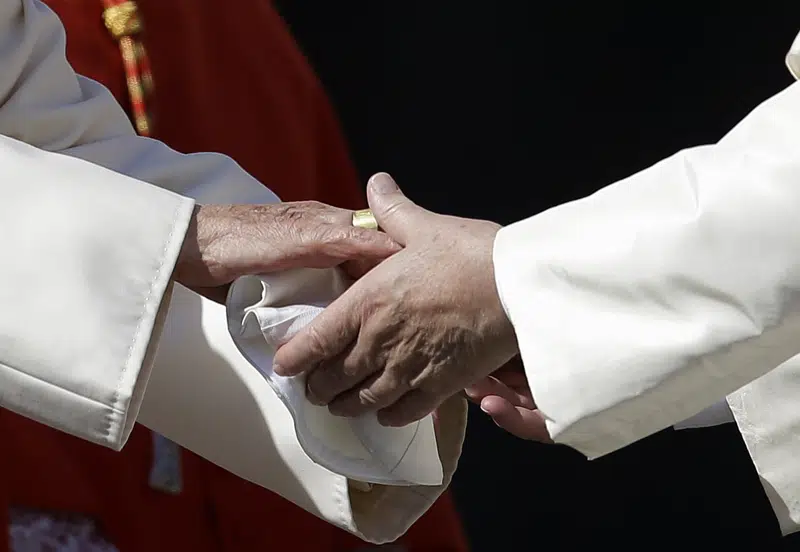
Benedict’s resignation sparked calls for retirement protocol

 FILE - Pope Francis, right, greets Pope Emeritus Benedict XVI at the end of a meeting with elderly faithful in St. Peter's Square at the Vatican, on Sept. 28, 2014. Pope Benedict XVI’s 2013 resignation sparked calls for rules and regulations for future retired popes to avoid the kind of confusion that ensued. Benedict, the German theologian who will be remembered as the first pope in 600 years to resign, has died, the Vatican announced Saturday Dec. 31, 2022. He was 95. (AP Photo/Gregorio Borgia, File)

If ever there was a moment that embodied the surreal novelty created by the first papal resignation in 600 years, it came on the morning of March 23, 2013: Newly elected Pope Francis had traveled to the papal summer retreat south of Rome and was greeted on the helipad by the previous pope, Benedict XVI, who had moved there three weeks earlier.

Two men in white — a reigning pope and a retired one — each showing the other the deference owed to a pontiff and discussing the future of the Catholic Church as it passed from one papacy to the next.

But for some, that moment on the helipad of Castel Gandolfo encapsulated everything that was wrong with Benedict’s surprise resignation and the risks it posed to the very unity of the Catholic Church and the institution of the papacy.

For these critics, Benedict’s decision to retire at age 85 rather than die on the job created the specter of two leaders of the 1.3 billion-member church, with the old pope remaining a point of reference for traditionalists who opposed the new pope and refused to recognize his legitimacy.

For a church that prides itself on unity, believes in the singular primacy of the pope and considers the pontiff the divinely inspired successor of the Apostle Peter, any confusion over who’s really in charge is not a small thing.

“Such situations could lead to a schism,” German Cardinal Walter Brandmueller warned soon after that March meeting.

Any confusion ended on Saturday, when Benedict died at his home in the Vatican Gardens at age 95. Francis will celebrate his funeral Mass on Thursday, creating a new novelty for the church: that of a reigning pope eulogizing a retired one. To underscore that this is no papal funeral, however, the Vatican invited only Italy and Germany to send official delegations, with any other leaders wanting to attend to do so “in their private capacity,” according to a diplomatic note.

From the title he chose (pope emeritus) to the cassock he wore (white) to his occasional public comments (on sex abuse and priestly celibacy), Benedict’s post-retirement decisions sparked calls for the Vatican to develop rules and regulations to guide future popes who might follow in his footsteps and quit.

Even Francis weighed in, saying a decade into Benedict’s experiment that regulations would be needed in the future. Things had worked out well enough in Benedict’s case because he was “saintly and discreet,” Francis said.

The Jesuit pope, for the record, said that if he were to retire, he would be known as the “bishop emeritus of Rome,” not “pope emeritus” and would live somewhere in Rome, not the Vatican or his native Argentina.

But Francis couldn’t craft any protocols governing a future retired pope while Benedict was still alive, creating a situation of uncertainty and unease about the status quo that particularly riled Benedict’s firmest supporters. Now that Benedict has died, the Vatican might be in a better position to draft such regulations.

“I hope we don’t have any or many retired popes, but if it was to continue, church law needs to develop a set of protocols,” said Australian Cardinal George Pell, an ardent Benedict supporter who nevertheless opposed his decision to resign.

“As it has become more and more apparent, church unity can never be taken for granted,” Pell said in a 2021 interview, noting the nostalgia among some traditionalists for Benedict’s doctrinaire papacy.

“I deeply agree with nearly everything Pope Benedict has said and written. But I don’t think it’s appropriate for retired popes to be teaching, writing or commenting. I don’t think it’s appropriate for a retired pope to wear white,” he said.

And Pell said he didn’t think a retired pope should be called “pope emeritus,” but should rather return to his birth name and take up his place as a retired member of the College of Cardinals.

And yet, it was precisely Benedict’s own longtime secretary, Archbishop Georg Gaenswein, who strongly defended the decisions by Benedict and refused to back down even after some problems became apparent.

Speaking at a 2016 book launch, Gaenswein agreed there weren’t “two popes.” 

But he said what Benedict had done by resigning was to create an “enlarged” papal ministry “with an active and a contemplative member.”

“For this reason, Benedict didn’t renounce either his name or his white cassock, and for this reason the correct way to address him is still ‘Your Holiness,’” Gaenswein said, according to an audio recording of his remarks on Vatican Radio. “In addition, he didn’t retire to an isolated monastery, but inside the Vatican as if he had just stepped aside to make room for his successor and a new chapter of the history of the papacy.”

Such a thesis has been roundly rejected, even by Benedict’s most enthusiastic champions.

And lest anyone forget, long before “The Two Popes” came out on Netflix in 2019, Dante in his “Divine Comedy” warned of threats to the church when he assailed the “cowardice” of a pope who resigned. 

Dante is believed to have been referring to Pope Celestine V, the hermit pope who quit in 1294 and was responsible for what Dante termed “the great refusal.” 

And yet it was precisely on Celestine’s tomb that Benedict prayed in 2009 in a gesture widely seen as having laid the groundwork for his own retirement.

German Cardinal Gerhard Mueller, who succeeded the former Cardinal Joseph Ratzinger as head of the Vatican’s doctrine office, said there was no legal or theological basis for a “pope emeritus” and said the title was made up and deeply problematical.

In a 2021 interview, Mueller said that applying the “emeritus” title used for retired bishops to the pope was misguided since the pope is not just any bishop or even the “first among equals,” but rather the Vicar of Christ on Earth.

“It’s only an honorary title. It doesn’t exist as an element of the divine constitution of the church,” Mueller told The Associated Press. “It is better to avoid this title.”

Many observers, including one of the Vatican’s top legal minds, the Rev. Gianfranco Ghirlanda, said a more appropriate title would have been “bishop emeritus of Rome,” to make it perfectly clear that any retired pope no longer had any claim on the papacy.

Doing so, Ghirlanda wrote in an early 2013 essay in the Jesuit journal “La Civilta Cattolica,” would follow the praxis of “every other diocesan bishop” who ceases in his functions upon his resignation.

In addition, while Benedict largely held to his promise to live “hidden to the world” in retirement, he did speak out occasionally, and those moments too became a cause for concern.

The most clamorous one came in 2020, when Benedict co-wrote a book reaffirming the “necessity” of a celibate priesthood.

There was nothing novel with his position. But the book came out at the same time that Francis was weighing whether to ordain married men in the Amazon because of a shortage of priests there.

The implications of Benedict’s intervention were grave, raising the specter of a parallel magisterium, or official church teaching, at a time when the church was already polarized between conservatives longing for Benedict’s orthodoxy and progressives cheering Francis’ merciful bent.

“It’s one thing to publish, as a private citizen, a book about Jesus as Benedict did before he resigned,” the Rev. Jean-Francois Chiron, a theologian at the University of Lyon, wrote in the French Catholic daily La Croix. “It’s another thing to take sides in important, current questions facing the universal church.”

In the end, Benedict distanced himself from the publication and asked to be removed as the co-author of the book, “From the Depths of Our Hearts.” 

But the damage was done.

Francis fired Gaenswein, Benedict’s longtime secretary, from his second job as head of the papal household.

Cardinal Robert Sarah, the lead author of the book and a critic of Francis, suffered a reputational hit for having seemingly manipulated Benedict in a way that damaged both popes.

Critics noted that retired bishops at least have official Vatican guidelines to live by and said there should be similar guidelines for future retired popes.

Those guidelines read: “The bishop emeritus will be careful not to interfere in any way, directly or indirectly, in the governance of the diocese. He will want to avoid every attitude and relationship that could even hint at some kind of parallel authority to that of the diocesan bishop, with damaging consequences for the pastoral life of and unity of the diocesan community.”

While allowing that some protocols might be developed for future popes, Benedict’s longtime spokesman said the problems that arose during his longer-than-expected retirement were few.

“From where I stand, it all went extremely well,” said the Rev. Federico Lombardi. “If you think about how many times there were some problems, or what they were, I remember three or four.”

He said it was clear that Francis and Benedict enjoyed an “excellent” relationship and that the presence of the retired pope in the Vatican Gardens “was felt as the discreet presence of someone who had loved the church a lot, and who continued to love her and pray for her.”

Lombardi noted that if some people chose to exploit Benedict for their own ideological ends, or to amplify their criticism of Francis, that was their problem.

“Even if Benedict had died, they could have said the same thing,” he said.

What will Pope Benedict’s funeral look like?

 Pin on Igreja catolica

Benedict XVI broke with tradition when he became the first pope in six centuries to abdicate. 

His death at 95, announced by the Vatican on Saturday, has raised questions about which papal funeral traditions may apply to an ex-pope.

Already, one difference emerged, in that the bells at St. Peter’s Basilica were not tolled for Benedict’s death, something that would happen only for the death of a sitting pope, a Vatican spokesman said.

Of course some other customs aren’t relevant. 

There’s no need to destroy the “ring of the fisherman” that doubles as a papal seal — his customized ring was already slashed to make it unusable when he stepped down in 2013. 

And the mourning period won’t be followed by the drama of a conclave to select his successor.

But what shape the ceremonies will take for Benedict remains unclear. 

Will he lie in state wearing red pontifical vestments? 

Will a traditional nine-day mourning period, the novemdiales, be observed after his burial? 

Will the funeral itself be an elaborate affair, with world leaders invited? 

For John Paul II, the exequial Mass lasted three hours and was at the time the largest attended funeral in history.

“Rites and ceremonies after the death of a reigning pope are clear and already well elaborated,” said Ulrich Nersinger, who studies the Vatican and has worked for the papal ceremonial office. “The big problem is: What do you do if it’s a pope emeritus who dies? That’s a new experience.”

Nersinger suggested that some direction may come from Benedict’s last will and testament, but much will also depend on the decisions of Francis.

Here’s what we know so far.

When is Pope Benedict’s funeral?

The Vatican said that his body will be placed in St. Peter’s Basilica starting Monday for a salute “from the faithful” and that the funeral Mass would take place on Thursday in St. Peter’s Square.

Who will preside over Benedict’s funeral?

Pope Francis will preside over the funeral, the Vatican said, taking on a responsibility that traditionally falls to the dean of the College of Cardinals. A sitting pope celebrating Mass for his predecessor will mark a historic moment for the church — though it was Benedict, then known as Cardinal Joseph Ratzinger, who led the funeral Mass for his predecessor, Pope John Paul II.

Where will Benedict be buried?

The Vatican said Benedict will be interred in the grottoes of St. Peter’s Basilica. Benedict biographer Peter Seewald, who interviewed him at length, has said the former pope intended to be buried there — in the tomb that contained John Paul II’s remains before he was beatified in 2011 and they were transferred upstairs to the Altar of St. Sebastian.

Sitting popes can specify their desired burial location. Some have designated important churches in Rome or their local parishes. But the majority have chosen St. Peter’s Basilica — putting them in proximity to the disciple of Jesus who would go on to lead the early Christian Church. A marble plaque on the wall indicates that 148 popes — out of 266 — have been interred there, though some of those were subsequently moved. Today, the remains of 91 popes are in the Vatican grottoes, while those who have been sainted have more prominent spots within the basilica.

The last pope to abdicate, Gregory XII, is buried in a church in central Italy. But church historians say that case didn’t offer a helpful precedent for modern times. The position of pope was more of a political office then, said Massimo Faggioli, a Villanova University professor of theology. 

And Gregory XII followed a very different path than Benedict after stepping down in 1415, amid a historic schism within the church. Whereas Benedict kept his name, continued to wear papal white and retired to a monastery within Vatican City, Gregory assumed his previous name, Angelo, and moved away from the Vatican to the town of Ancona. 

It is Benedict who will more likely set the precedent for future popes who retire.

How are popes buried? Why three coffins?

Traditionally, interment takes place four to six days after a pope’s death. The guidelines are laid out in a 400-page Vatican handbook: “Funeral Rites of the Roman Pontiff.” Three coffins are involved: an inner coffin made of cypress and bound shut with red ribbons; a slightly larger middle casket made of zinc and adorned with a cross, the pope’s name, the years of his papacy and his personal coat of arms; and an outer casket of elm or walnut, which is sealed with gold nails.

The symbolism behind the three coffins is not widely understood. Christopher Bellitto, a Kean University historian who studies the church, said via email that the tradition is “arcane.” 

Faggioli suggested the three coffins could offer heightened protection of the pope’s body — perhaps related to a time when the pope was a political figure and his remains needed to be protected from enemies.

Gabriel Radle, a professor of theology at the University of Notre Dame, said the zinc coffin confers a certain prestige while also helping to preserve the body, which would be exhumed if that pope becomes a saint. 

The wood, meanwhile, may serve as a visual connection to the common man, showing that “in their death, they are just like any other person on their way to their death,” Radle said.

Before the funeral Mass, a pope’s body is placed in the simple cypress coffin and blessed with holy water, and a white veil is placed over his face. Alongside him are coins minted in the years he was in office and a copy of a eulogy detailing his life.

The closed coffin, covered in a white pall, rests on a catafalque during the Mass, with a Book of the Gospels laid on top. Afterward, it is carried to the crypt, where the three coffins are sealed and then placed inside the sepulcher, while the small group of Vatican officials in attendance sing “Salve, Regina.”

What are the rules for a pope’s body?

Popes are not cremated. The Catholic Church has a long-standing preference for inhumation, or burying the body, going back to early Christianity. This practice was more in line with Jewish traditions of the 1st century, Radle said, noting that Jesus was buried. But more importantly, inhumation aligns with the Christian belief in resurrection, which says that Christ will return and that when he does, the souls of his followers will be reunited with their bodies. 

“The faithful rise with Christ in a corporeal sense,” Radle said. “Historically, cremation was seen as something that dishonors the Christian belief in the sanctity of the body.” It was only in 1963 that ordinary Catholics were permitted to be cremated.

While the Catholic church does encourage organ donation — both Francis and Benedict have endorsed it, the former calling it a “manifestation of generous solidarity”— the pope himself cannot donate organs. 

According to a letter written by his secretary in 2011, Benedict had an organ donation card, but it became invalid when he was elected to the papacy. There’s some concern among Vatican officials that if a pope who donated organs became a saint, the organs would become relics in another person’s body. 

“It goes back to the integrality of a person being body and soul,” Radle said. “From a Catholic moral theology perspective, I’m not sure everyone would agree with that, but I can see the logic.”

For a long time, though, hearts and intestines were removed from deceased popes as part of embalming procedures. 

The church of Saints Vincent and Anastasius at Trevi in Rome contains the embalmed hearts of 22 popes, going back to Sixtus V in 1590, preserved as relics. 

The practice was discontinued in the 20th century, though the part of John Paul II’s intestine that was removed after his assassination attempt was sent to that same church.

How Benedict’s death could reshape the Catholic Church

 Official Portrait of Pope Benedict XVI - by Igor Babailov

Pope Emeritus Benedict XVI’s death Saturday is an epochal loss for a church that was defined first by his resolute conservatism and later by his radical decision to abdicate power.

The Vatican said that Benedict died at 9:34 a.m. local time and that his body would be placed in St. Peter’s Basilica starting Jan. 2 for a salute “from the faithful.”  

Pope Francis will preside over his funeral, which will take place Thursday, the Vatican said. Afterward, Benedict’s body will be interred in the grottoes of St. Peter’s Basilica.

Benedict’s decline, after a decade of retirement, had been relatively swift. He was administered last rites on Wednesday. Francis put the Catholic world on alert, saying his predecessor was “very sick,” and asked for prayers.

“We are moved as we remember him as such a noble person, so kind, and we feel such gratitude in our hearts,” Francis said Saturday evening, in a prayer service at St. Peter’s.

The 95-year-old’s death is likely to reshape the church on several fronts, given that Benedict — who lived longer than anybody who had ever been pope — spanned so many eras, opined on so many subjects and influenced so many of the conservative faithful.

Even in retirement, he had been embraced by traditionalists as the embodiment of their ideals. His death leaves that movement — which at times is vocal and oppositional to Francis — without a figure of comparable clout. His death also, in the short-term, sets the church on a more conventional path, ending a polarizing 10-year period in which the Vatican had two figures wearing white, a pope and an ex-pope. That Francis as a sitting pope will preside over his predecessor’s funeral is another church novelty.

For all Benedict did to shape the church, though, his death does not cause the extraordinary tremors that would have resulted had he remained pontiff. In the coming days, there will be no conclave, no intrigue, no white smoke. Instead, the church will simply have the chance to reflect on an often-controversial figure who girded the institution against the forces of modernization and who presided over some of the rockiest years of the clerical abuse crisis.

It also must decide which ceremonial aspects to afford his funeral and burial, a delicate set of questions that will set precedent for handling the death of a retired pope. Already, one difference emerged, in that the bells at St. Peter were not specifically tolled for Benedict’s death, something that would only happen for the death of a siting pope, a Vatican spokesman said.

Sandwiched between two popes more skilled in outreach to non-Catholics, Benedict was seen as a bookish purist. He first gained prestige as a theologian and academic. He later wrote comprehensive volumes on Jesus. As cardinal, he served as one of John Paul II’s most trusted lieutenants. As pope, he vouched for an economic system that works for the “common good.”

“Christians will be drawing on his theological legacy for centuries,” said Michela Carrozzino, a Rome-based nun who had met Benedict in his retirement.

Tributes to Benedict quickly came pouring in, befitting a figure who was ordained in 1951, made cardinal by Paul VI in 1977 and was seen as a Vatican power broker well before becoming pope. Italian prime Minister Giorgia Meloni called him a “giant of faith and reason.” French President Emmanuel Macron said he worked “with soul and intelligence for a more fraternal world.”

But he was far from universally beloved, including in his home country of Germany, where the church in recent years — battered by scandal — had sought to modernize, reconsidering stances on homosexuality and celibacy, in an approach antithetical to Benedict’s. Wir Sind Kirche, a movement advocating for church reforms, said in a statement about Benedict’s death that he had brought the church to a “theological standstill” with a “climate of fear.”

The last time a pope died — John Paul II, in 2005 — there was a spontaneous outpouring of emotion in Rome, with Catholics flooding into St. Peter’s Square, many weeping. But in the hours after Benedict’s death, the square instead looked as it mostly does: with tourists taking selfies and waiting in lines to enter the basilica.

Across Rome on Saturday, the city prepared mostly as normal for New Year’s Eve celebrations on a day with temperatures in the mid-60s. Children shuttled on and off a holiday carousel in Piazza Navona. Couples sipped drinks. The city said that, after consulting with the Vatican, it would go ahead with an evening concert and other festivities on New Year’s Day, though in some instances there would be a minute of silence.

That difference in reaction, compared with 2005, speaks partly to the fact that Benedict had long been out of the public eye. It also speaks to the damage incurred by the Catholic Church over the past two decades as a result of the sexual abuse crisis and the Vatican’s inadequate response — an upheaval that ensnared Benedict personally.

This past year, a German investigation accused him of wrongdoing in several cases during his time leading the diocese of Munich, from 1977 until 1982. Before becoming pope, he also headed the powerful Vatican body whose purview included abuse cases.

“In our view, Pope Benedict XVI is taking decades of the church’s darkest secrets to his grave with him,” the Survivors Network of Those Abused by Priests said in a statement.

Church historians say the most significant ramification for Catholicism’s future could stem from Benedict’s decision in 2013 to abdicate power, becoming the first pontiff in 600 years to do so. Francis has several times indicated that Benedict created a precedent for future pontiffs, and he said this month that he’d already written a resignation letter — in case of dire health problems.

Francis is 86 and slowed by knee pain but keeps a busy schedule, and there is no indication he might step down soon. But Benedict’s death makes it easier for Francis to consider abdication in the future. One retired pope is less tricky than two.

Benedict’s abdication ultimately looked prescient, given the CEO-like demands of the job and Benedict’s frailty. For years, he had been moving with a walker, barely speaking above a whisper.

Still, the details of how Benedict conducted himself as a retiree proved problematic for the church. He elected not to revert to his given name, Joseph Ratzinger. He remained in the Vatican rather than returning to Germany. He continued dressing in papal white. Despite clearly asserting that Francis was the lone authority figure, he was embraced by conservatives as an alternative power, particularly as Francis sought to modernize the church.

“You can’t have a former pope walking around wearing white and then be surprised when some people say mistakenly that there are two popes,” said Christopher Bellitto, a papal historian at Kean University in New Jersey. “His [death] allows the church to have some serious conversations about how it would handle a future post-papacy. And the answer is, not this way.”

The greatest sense of mourning is likely to be felt among Catholic traditionalists, who saw Benedict as a protector of the eternal truths. He spoke about the dangers of secularism and societies that didn’t allow religious points of view. With pronouncements — and sometimes with purges of liberal theologians — he held the church line on social teachings. His appointment of conservative bishops helped push the American church toward the right. He also eased restrictions on the Latin Mass, an ancient rite adored by traditionalists — a move that was later reversed by Pope Francis.

Traditionalists sometimes have felt under siege in the Francis era. They chafe at his more ambiguous style in relation to hot-button topics, including homosexuality. Francis also has reseeded the College of Cardinals with more like-minded figures, increasing the odds — although hardly guaranteeing — that the next pope has a progressive bent. Traditionalists, in interviews, said their movement would not change substantially without Benedict, because for years he had been more of a symbol than an active participant.

“I think the traditionalists who feel isolated in the church right now should also remember that Pope Benedict stood for their unity with the whole church and not their isolation,” said Chad Pecknold, a professor of systematic theology at Catholic University in Washington. “So I think the traditionalists should not retreat into sadness at the death of Benedict.”

His nuanced, scholarly way of speaking had long fallen out of vogue with the most vocal members of the faith’s conservative wing, Vincent Miller, a professor of Catholic theology at the University of Dayton.

“He never uttered a sound bite in his life,” Miller said of Benedict. “He thought in paragraphs.”

For years, there had been intrigue about the relationship between Francis and Benedict, given their stylistic differences. Although their admirers were polarized, Francis routinely cited his predecessor and spoke warmly about him. Benedict said there was only “one pope” — Francis.

Pope Francis terms Emeritus Pope Benedict 'noble and kind' as tributes pour in globally

 Pope Francis urges prayers for 'very sick' Benedict

Pope Francis has paid tribute to his "dearest" predecessor Benedict XVI, who died earlier today at the age of 95.

"With emotion we remember a person so noble, so kind," he said at a New Year's Eve service in St Peter's Basilica, offering thanks "for all the good he has done" and underlining "his sacrifices offered for the good of the church".

"We feel in our heart such gratitude, gratitude to God for having gifted him to the church and the world," he said.