Saturday, September 29, 2012

Ohio nuns release contraception video on YouTube


A group of Roman Catholic nuns in central Ohio has produced a short anti-contraception video hoping to get it in front of Catholics in all 50 states, starting with swing states, before the presidential election.

The "You Deserve to Know the Truth: Contraception"  video, posted on YouTube by The Children of Mary order, invokes a number of statistics, studies and comments -- even lyrics to the Bloodhound Gang's “The Bad Touch." 

The video opens by saying oral contraception can make women less desirable by interfering with chemical hormones. 

It cites a study from the 1970s in which the alpha male in a tribe of monkeys became "confused" when females were injected with birth control drugs and started having sexual interactions with other males.
The video also tells viewers:
  • Possible side effects of the pill include irritability, depression, blood clots, high blood pressure and migraines.
  • The pill works by preventing fertilization. If that fails, it prevents implantation of a fertilized egg in the uterus.
  • More than half of women getting abortions say they used contraception in the month they became pregnant.
  • The overpopulation problem is a myth, and contraception puts the human race at risk of extinction.
  • Christians of all denominations condemned contraception as sinful until 1930. Martin Luther, John Calvin and Pope John Paul II all opposed the practice.
"The great harm in this birth control mentality is the consequent pollution of the heart that rejects the will of God and seeks selfish pleasure," the narrator says. "We allow our passions to take over our reason, and our actions become more like animals than humans."

The Catholic Church opposes contraception and says the purpose of sex is to unify married couples and produce children.

The video comes as the U.S. Catholic Conference of Bishops continues a religious-liberty campaign prompted by a federal health-care mandate that requires employee-provided insurance plans to pay for birth control. 

Although churches are exempt from the mandate, other religious institutions, such as hospitals and schools, are not.

"We're not stray cats that need to be neutered. We should want to procreate knowing that every new person has a unique and a mortal soul destined to live for all eternity," the video says. "Pregnancy is not a risk, it’s a privilege."

The Children of Mary, in Licking County, also offers DVDs of the video and seeks volunteers in each state to bring it to the attention of parish priests.

Bishop Felipe Estévez tells Florida’s Catholics to vote pro-life, pro-family in November

Although Catholic voters have received mixed signals this election year from some prelates, Bishop Felipe Estévez has sent a clear message to the faithful of his diocese: human life and family issues have top priority when deciding for whom to vote. 

In a letter to the Catholics of the diocese of St. Augustine, Florida, where Estévez presides, the newly-appointed bishop urges the faithful to “take your Catholic beliefs, values, and consciences into the voting booth with you.”

While refraining from specific political endorsements, Estévez notes that it is “my responsibility to remind you that, for us Catholics, some issues are simply never morally acceptable,” beginning with those that violate the right to life.

“The taking of an innocent human life, whether inside the womb or not, and up until natural death, is always and everywhere intrinsically evil,” the bishop writes. “Such issues as embryonic stem cell research and attempts at human cloning are also direct attacks against the dignity and uniqueness of human life made in the image of God.”

Moreover, Catholics have an obligation to defend the institution of marriage, the prelate observes, calling the dignity of traditional matrimony “of central importance” which “must never be undermined because marriage is a cornerstone of any stable society.”

“Any attempts to re-define marriage as something other than between a man and a woman, should be vigorously opposed by a Catholic as contrary to reason, the natural law, and the divinely revealed truths of the Bible,” writes Estévez. “Beyond these fundamental issues, and closely related to them is the issue of religious liberty – our ability as Catholics to live our lives publically according to our faith and morals at all levels of society."

Although Estévez doesn’t specify any candidates in his recommendations, he explicitly calls for a “yes” vote on two proposed state constitutional amendments, numbers 6 and 8, which would prohibit public expenditures for abortion or abortion-related services, and which would allow state funding of faith-based organizations.

Estévez, 66, was installed as Bishop of San Augustine in June of 2011 following his appointment by Pope Benedict XVI to replace retiring bishop Victor Galeone. He was born in Cuba, and fled the communist and anti-Catholic regime of Fidel Castro through Operation Peter Pan in the early 1960s.

German bishops stop weddings and funerals unless religious taxes are paid

A decree issued last week by the country's bishops cast a spotlight on the longstanding practice in Germany and a handful of other European countries in which governments tax registered believers and then hand over the money to the religious institutions. 
In Germany, the surcharge for Catholics, Protestants and Jews is up to 9pc on their income tax bills - or about €56 (£45) a month for a single person earning a pre-tax monthly salary of about €3,500, AP reported.

For religious institutions, struggling to maintain their congregations in a secular society where the Protestant Reformation began 500 years ago, the tax revenues are vital.

The Catholic Church in Germany receives about €5bn annually from the surcharge. For Protestants, the total is just above €4bn. Donations, in turn, represent a far smaller share of the churches' income than in the US.

With rising prices and economic uncertainty, however, more and more Catholics and Protestants are opting to save their money and declare to tax authorities they are no longer church members, even if they still consider themselves believers.
"I quit the church already in 2007," Manfred Gonschor, a Munich-based IT-consultant, said. "It was when I got a bonus payment and realized that I could have paid myself a nice holiday alone on the amount of church tax that I was paying on it." 

Gonschor added he was also "really fed up with the institution and its failures".

Such defections have hit the Catholic Church especially hard — it has lost about 181,000 tax-paying members in 2010 and 126,000 a year later, according to official figures. 

Protestants, who number about 24m nationwide, lost 145,000 registered members in Germany in 2010, the most recent year from which figures are available.

But the figures include some people who still want to baptize their children, take communion on major religious holidays, marry in a religious ceremony and receive Christian burials.

The group We are Church, which claims to represent tens of thousands of grassroots Catholics, said many Germans stop paying the tax because they disagree with the church's policies or simply want to save money - not because they have lost their faith.

"I haven't quit because I still think that I might want to get married in a church one day, even though I know that's absurd," said Anna Ainsley, a 31-old-year banker and a Protestant from Frankfurt. "But when I see my tax declaration, then I think every year that I should finally quit."

Those are the people who Germany's Catholic bishops had in mind when they decreed on September 20 that stopping the payment of religious taxes was "a serious lapse" and those who did so would then be excluded from a range of church activities.

"This decree makes clear that one cannot partly leave the Church," the bishops said in a statement. "It is not possible to separate the spiritual community of the Church from the institutional Church."

Wavering Catholics will now be sent letters reminding them of the consequences of avoiding the church tax, including losing access to all sacraments.

"Maybe you haven't considered the consequences of your decision and would like to reverse this step," a draft of the letter states.

Protestants have taken a less stern position, saying non-taxpayers are still welcome to attend services and take communion. 

But becoming a godparent, getting married in a church or taking a job in church-affiliated institutions such as hospitals or kindergartens are off-limits to those who stop paying their taxes.

Switzerland and Austria also tax Catholic and Protestant church members. In Denmark, the State Lutheran church collects a tax from its members. 

Members of Sweden's Lutheran Church pay around 1pc of their income, collected by the national tax authorities, just as in Finland.

In Italy, taxpayers have the choice of diverting a small part of their income taxes to religious institutions, including the Catholic Church and the country's Jewish community, but the contribution is voluntary.

So far German courts have stood by the bishops' decision. This week the country's top administrative court threw out a lawsuit against the archdiocese of Freiburg by retired theologian Hartmut Zapp, who has spent years fighting the Catholic church over the tax. 

Zapp argued that a Catholic should be free to stop paying but remain a member of the spiritual community and that his religious beliefs could not possibly be tied to a tax payment.

The archdiocese responded in a statement that "those who lack solidarity bid farewell to the community of believers".

The tax issue presents moral and ethical dilemmas to millions of German believers, even dividing couples.

Sonja Trott, a 34-year-old teacher from Munich, said she quit the Catholic Church 15 years ago because she no longer believed in its teachings.

"Now I'd like to convince my husband that he also should quit, that would save us a lot of money," she said.

But her husband Christoph, a sales executive, says he cannot imagine refusing to pay on moral grounds because it would seem like a betrayal of his faith. "I don't like paying it, but I do because I fear the step of quitting the church."

He would prefer to donate part of the money to charities "but in Germany the payment determines whether I'm allowed to consider myself a Catholic or not".

For other Germans, it's unethical to stop paying the tax but continue to use the church when it suits them.

Christine Solf, a Munich-based consultant, says she doesn't attend services regularly but appreciates the church's charitable work. For her, church membership is also a family tradition.

"I know people who quit for financial reasons but then still want their children to be baptized. That's not OK in my opinion," she said.

Burke may be the face of Catholic conservatism

When some American Catholics worry that the hierarchy is tilting toward the Republican Party, or taking the church back to the 19th century (or earlier), they often point to Cardinal Raymond Burke as Exhibit A.

That's understandable, because love him or loathe him — and few are on the fence — Burke's many pronouncements on politics and the culture wars have given both fans and critics plenty of ammunition for their respective views.

Back when he was archbishop of St. Louis in 2004, for instance, Burke touched off a fierce debate by declaring that Catholic politicians such as John Kerry who support abortion rights should be denied Communion.

Voters who supported them were in grave peril, too, he added. He later said former New York Mayor Rudy Guliani, a Republican, who was running for president and supported abortion rights, should also be denied Communion.

During Burke's stormy four-plus years in St. Louis, he also had public run-ins with singer Sheryl Crow and St. Louis University basketball coach Rick Majerus. His ongoing battle with St. Stanislaus Kostka Church and the many resulting excommunications of its board members, partially defined his tenure for St. Louisans.

Burke doubled down on his political views after Pope Benedict XVI appointed him in 2008 to head the Vatican's version of a supreme court, saying that under President Barack Obama, the Democratic Party "risks transforming itself definitively into a 'party of death.'"

In 2009, Burke fueled another controversy when he said that the late Sen. Edward Kennedy should have been denied a church funeral for his support of abortion rights and gay rights.

"They can't say anything about me that would surprise me," Burke said with a soft laugh when asked in a recent interview about the passionate reactions sparked by his public stands.

"To be honest with you, I'm the sort of person who would be very happy not to have to speak out. I'm not a person who by nature likes to do that. But I believe it's my obligation," said Burke, who is always affable and remains accessible to the media. "It's a responsibility that's been given to me. I try to do it, though certainly not perfectly."

The 63-year-old prelate — in his workaday attire of black cassock with red piping and a scarlet sash with matching skullcap — was speaking in his gilded offices on the upper floors of the 16th century Palazzo della Cancelleria, one of the most famous Renaissance palaces in Rome that now houses the Catholic Church's highest court.

The Apostolic Signatura handles canon law cases from around the world, from marriage annulments to parish closings; since 2008 Burke has effectively served as the chief justice of the church's supreme court. It's a platform that he has used to great effect — and to the consternation of his critics.

Indeed, when Burke was called to Rome after just four tumultuous years in St. Louis, many suggested that he was getting "kicked upstairs" in order to get him out of the U.S. spotlight. 

A case of "promuovere per rimuovere," as the Italians say — to remove through promotion.

But if that was the plan, it hasn't worked out so well.

In his four years in Rome, Burke has continued to speak his mind — he is a favorite on the conservative Catholic speaking circuit in the United States — while also becoming a player in Vatican politics in ways that extend his influence well beyond the occasional rhetorical broadside.

Benedict elevated Burke to cardinal in 2010, giving him a vote in a conclave that would elect the pontiff's successor, and put him on the Congregation for Bishops, the Vatican body that vets candidates for bishops in the U.S. and around the world. 

That gives Burke a key role in shaping the hierarchy for years to come.

Vatican observers saw Burke's hand in the 2011 promotion of Archbishop Charles Chaput, whose conservatism closely tracks Burke's, from Denver to Philadelphia. 

And they say Burke was key in Oakland Bishop Salvatore Cordileone's recent move to San Francisco.

Blogger Rocco Palmo dubbed Cordileone's promotion the "Bombshell by the Bay" — Cordileone is an outspoken conservative and leading supporter of California's Prop 8 banning gay marriage, and will now be archbishop of the nation's gay mecca. He's also a longtime friend of Burke's.

Burke also was believed to be one of the instigators of the controversial Vatican crackdown on a major group of American nuns, the Leadership Conference of Women Religious, whom Rome viewed as straying too far from orthodoxy and spending too much time on social justice issues.

In the interview, the cardinal acknowledged that he was consulted about the LCWR takeover, but he argued that it was "logical" to seek his input given his long experience in the U.S. church. 

He also reiterated his view that the Vatican had every right to undertake the investigation, even as he stressed that he was not involved in carrying out the actual overhaul.

Burke said his opinion "is certainly heard" on a range of matters at the highest level of the Vatican, even if his views are not always followed. "I don't have any pretenses about being some powerful figure, no," he added. "But it is heard, and respectfully."

Yet whatever his success since coming to Rome, Burke's rise hasn't been without its stumbles.

Another of his U.S. protégés, Bishop Robert Finn of Missouri, was found guilty in September of covering up for a priest suspected of child abuse — the first bishop ever convicted in the long history of the clergy abuse scandal. When asked to comment about Finn at a September meeting with journalists, Burke demurred. "It wouldn't be proper," he said.

Burke is also a leading advocate of a restoration of the church's older rites and traditions, like the Latin Mass, which he argues were heedlessly cast aside in the liberal "euphoria" after the reforms of the Second Vatican Council in the 1960s. 

But Burke has been celebrating so many old-style liturgies and donning the most ornate regalia — long trains of watered silk, velvet gloves and elaborate brocades — that several Vatican officials said he had been asked to "tone it down a bit." 

Whether he will is another matter.

"The vestments, everything, are part of a tradition," Burke says in his defense. "We need to understand that and not just discard it and say, well, it was all just an ugly accretion."

For Burke, the risks are too high to remain on the sidelines. 

Obama's presidency and the advancement of issues like gay marriage and abortion rights have made it imperative for Catholic bishops to speak up, he says, though he realizes that the president is ahead in the polls and could well win. 

"I don't know what would happen if that would be the case," he said, shaking his head.

But he said he has been encouraged that a growing number of bishops appear to be joining the campaign for religious freedom that has targeted White House policies on contraception coverage.

"These are definitive moments, and the stakes are as high as you can get," Burke says. "That really pleases me, that more bishops are speaking out on their own."

Church set for Calungsod's canonization

The Catholic Bishops Conference of the Philippines (CBCP) is exerting more effort to make Filipinos better acquainted with the life and sacrifice of Blessed Pedro Calungsod, ahead of his canonization at the Vatican City in Rome on October 21.
 
The CPCP Episcopal Commission on Social Communications and Mass Media on Saturday briefed the media on Calungsod's life, his mission, martyrdom and his miracle.

It also spoke on the role of media in spreading the good news on the canonization of the second Filipino saint after Saint Lorenzo Ruiz.

“This is a very visible manifestation of his recognition, of the need to have a young person proclaimed as having lived a virtuous life especially since Pope Benedict is worried that in 3 or 4 years, 3/4ths of the world will no longer know who Christ is. This is like validating or affirming our role as Christians in the world,” said Amb. Henrietta de Villa.

“Every Filipino should be grateful to God because we have another model,” said Fr. Marvin Mejia, CBCP assistant secretary general.


Pope Benedict XVI beatified Calungsod on February 18.

Philippine representatives say Calungsod's canonization will be preceded by a week-long celebration in Rome.

Calungsod's image will then be brought to Manila on October 25 for visits to various dioceses across the country.
 
A national thanksgiving is scheduled in Cebu at the end of November.

Pope says gay people are not fully developed humans

Pope Benedict XVI has said gay people are not fully developed humans because they do not adhere to Catholic law.Pope Benedict XVI has said gay people are not fully developed humans as they do not obey Catholic law.

The head of the Catholic Church made these claims while speaking to bishops about the French President Francois Hollande’s plans to legalize marriage equality.
 
During his speech at Castel Gandolfo, he reportedly said: ‘The family is threatened in many places by a defection of human nature.’

The German religious leader added: ‘Marriage and the family are institutions that must be promoted and defended from every possible misrepresentation of their true nature, since whatever is injurious to them is injurious to society itself.’

The Pope says the Catholic values of marriage and the family must be obeyed, because they ‘permit the full development of the human person’.

In France, Catholics have ramped up their campaign against marriage equality including reviving a centuries-old ‘Prayer For France’ day to specifically attack government plans.
Christian pop star Lady Gaga said gay people should not pay attention to what the Pope thinks of gay people.

She said: ‘What the Pope thinks of being gay does not matter. It doesn’t matter to the world. It matters to the people who like the Pope and follow the Pope. It’s not a reflection of all Christians. It is not a reflection of all religious people. It’s a point of view of one person.’

‘And to all the gay people here,’ she added. ‘May you live and love each other until the end of time. I hope you will have the human right to breed as an entirely equal, valuable and special member of society.’

In January, the Pope received criticism for saying gay marriages ‘threaten human dignity and the future of humanity itself.’

Vatican court adjourns trial of ex-butler

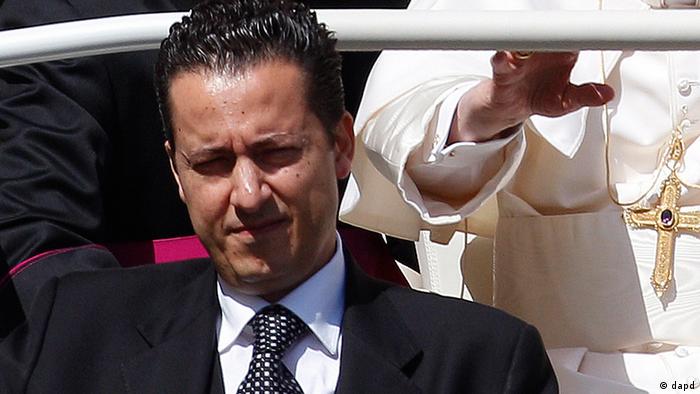
Gabriele in St. Peter's square on May 2, 2012. Behind him are the gowns of Pope Benedict XVI. Photo:Alessandra Tarantino, File/AP/dapd)A Vatican court trying the pope's ex-butler for allegedly stealing confidential papers has adjourned its proceedings until next Tuesday. 

The former aide could face four years in an Italian jail.

The trial of Pope Benedict XVI's former aide, Paolo Gabriele, opened on Saturday in a 19th century courtroom behind the apse of St Peter's basilica which is normally off-limits to the public within the small Vatican city-state.

Gabriele did not speak at the trial opening, but is expected to testify next Tuesday. 

Television cameras were largely excluded from the courtroom and only eight journalists were allowed to observe proceedings throughout. They later briefed other journalists.


What secrets will the Gabriele trial in this courtroom reveal?

The court comprising three Italian law professors ruled that only evidence provided by a Vatican prosecutor and Vatican police would be admissible. The court declared that the results of a separate probe carried out by cardinals was not admissible.

Presiding judge Giuseppe Dalla Torre, said the trial might be wrapped up in four court hearing days. Attendees in the public gallery included Vatican spokesman Federico Lombardi.

Separate trial for another accused

The court also accepted a request for the trial of Claudio Sciarpelletti -- a Vatican computer technician who is accused of abetting Gabriele's crime -- to be conducted separately. No date for that hearing was set.


Gabriele, a once loyal papal assistant, had been quoted by prosecutors - when arrested last August - as describing himself as a whistle-blower, who was trying to expose alleged graft at the headquarters of the Roman Catholic Church.

Gabriele faces a charge of aggravated theft, and, if convicted by the panel, the 46-year-old could face a prison sentence of up to four years.

Prosecutors had alleged that Gabriele met with investigative reporter Gianluigi Nuzzi earlier this year and gave him copies of the documents which were then widely published across international media outlets.

Power struggle exposed

The allegedly leaked documents pointed to a power struggle at the highest level of the church and offer an insight into the workings of the Holy See.

A spokesperson for the Vatican said the 85-year-old pontiff was hurt by the betrayal of confidence by someone he "knew, loved and respected."

The papal state has no prison system, meaning if convicted, Gabriele would serve time in an Italian jail, however, it is expected the pope will pardon him.

Paolo Gabriele trial: Pope butler evidence thrown out

President of the tribunal Giuseppe Dalla Torre (front R) is seen at the start of the trial of Pope Benedict's former butler Paolo Gabriele (3rd L, in grey), accused of stealing and leaking the pontiff's personal papers, at the Vatican September 29, 2012. REUTERS-Osservatore RomanoVatican judges have refused to admit key evidence in the trial of the Pope's former butler, charged with stealing sensitive documents.

Paolo Gabriele's lawyers had asked to include evidence gathered by cardinals who carried out an inquiry into the "Vatileaks" scandal for Pope Benedict.

But judges at the high-profile trial said they would rely only on evidence from the Vatican police and prosecutor.

They adjourned the case until Tuesday, when Mr Gabriele will be questioned.

The 46-year-old admitted to investigators that he had leaked confidential documents to expose "evil and corruption".

Trusted servant

The first session of the Pope's butler's trial, held under heavy security inside Vatican City's only courtroom, confirmed the intention of the Vatican authorities to try to limit the fallout from the worst security breach to occur in living memory.

Secret evidence collected earlier in the year by three senior Cardinals appointed by Pope Benedict to look into the theft of papers from his own desk, theoretically one of the most secure places in the entire city state, has been disallowed by the panel of three judges.

The Vatican makes a clear-cut distinction between ecclesiastical matters dealt with by the Holy See, defined as the international headquarters of the Roman Catholic Church, and the ordinary administration of the tiny city state, the world's smallest sovereign state. 

The butler's case is being dealt with under Vatican City's criminal code, which closely follows Italian judicial procedure. 

If convicted, Paolo Gabriele could serve up to four years in an Italian jail under the terms of a treaty the Vatican signed with Italy during fascist times.

In other words, the Vatican is in serious damage control mode, anxious to avoid the prying eyes of world media into the rarefied world of decision makers within the Holy See.

He was identified as the source of leaked documents that were published in a book by an Italian journalist in May.

The documents included private correspondence between senior Vatican figures, and appeared to reveal bitter power struggles and corruption.

The Pope ordered cardinals to carry out an inquiry separate to the probe by Vatican police after the scandal broke.

The results of their investigation have not been made public.

Mr Gabriele faces up to four years in prison if convicted of aggravated theft, but he could be pardoned by the Pope.

The court decided that his fellow defendant, Vatican computer technician Claudio Sciarpelletti, will be tried separately for aiding and abetting a crime. He had exerted his right to stay away from the hearing.

Mr Gabriele was the Pope's trusted servant for years and held the keys to the papal apartments.

The BBC's David Willey in Rome says it has been one of the most difficult crises of Pope Benedict's seven-year papacy.
 
'Sadness to my heart'

No TV cameras or recorders are being allowed inside the courtroom for the most high-profile case to be held in the Vatican since it was established as a sovereign state in 1929.

Mr Gabriele, dressed in a pale grey suit, showed little reaction as judges rejected almost all of his lawyers' requests.

He will be interrogated in court by the president of the Vatican City tribunal on Tuesday.

The chief judge said the court hoped to reach a verdict by the end of next week.

Among witnesses due to give evidence next week is Pope Benedict's private secretary, Georg Gaenswein, and one of the six German and Italian nuns who work in the pope's private household.

The Vatican butler was arrested in May, accused of passing papal correspondence to journalist Gianluigi Nuzzi, whose book His Holiness: The secret papers of Pope Benedict XVI was published that month.

Correspondents say the revelations seem aimed primarily at discrediting the Vatican's powerful Secretary of State, Cardinal Tarcisio Bertone, who has been in his post since 2006.

Prosecutors quoted Mr Gabriele as saying during his interrogation that he knew taking the documents was wrong but he felt the Holy Spirit was inspiring him to shed light on the problems he saw around him.

He said he felt the Pope was being kept in the dark or misinformed by his collaborators.

Pope Benedict said after his former butler's arrest that the news had "brought sadness in my heart".

Corruption whistleblower on trial instead of Vatican officials

http://s1.reutersmedia.net/resources/r/?m=02&d=20120929&t=2&i=658108882&w=&fh=&fw=&ll=700&pl=300&r=CBRE88S0VOQ00
Instead of trying high-ranking officials of the Catholic Church for financial and moral corruption, a Vatican court has put the Pope’s former butler on trial for disclosing information on corruption.

Pope Benedict XVI's former butler Paolo Gabriele went on trial on Saturday in the Vatican for exposing financial and moral corruption within top brass of the Vatican.


The trial reportedly began at a 19th-c
entury courtroom in a corner of the city state where only eight reporters were allowed inside the courtroom and TV cameras were also banned. If found guilty, he risks up to four years in prison.

The 46-year-old, who was arrested in May on suspicion of stealing secret documents from the pope's office, has confessed to taking confidential documents and memos and leaking them to Italian press. The ex-butler has however entered a non-guilty plea.


Gabriele says he acted alone, but many believe he worked as part of a wider group of disgruntled Vatican employees.

Many of the letters and other confidential documents that he allegedly took from the pontiff's desk were published in a book by an Italian journalist in May, which prove that the highest levels of Vatican officials are deeply involved in financial corruption and infighting over the power.

Judges order separate trials for papal butler, computer expert

http://s1.reutersmedia.net/resources/r/?m=02&d=20120929&t=2&i=658105800&w=&fh=&fw=&ll=700&pl=300&r=CBRE88S0UR700A Vatican tribunal determined the two suspects indicted for their parts in the VatiLeaks' scandal should be tried separately.

During the opening session of the trial Sept. 29, the judges said the trial against Paolo Gabriele, the papal assistant charged with aggravated theft, would continue Oct. 2. 

A separate trial for Claudio Sciarpelletti on charges of aiding and abetting Gabriele will be scheduled at a later date, they said.

Giuseppe Dalla Torre, the presiding judge, said four more sessions "next week should be sufficient" for completing Gabriele's trial.

Gabriele, a 46-year-old married father of three, will be the first person to be questioned Oct. 2. No members of Gabriele's family were present for the trial's opening.

Although under Vatican law a defendant is not obliged to appear in person, Gabriele -- dressed in a light gray suit and tie -- was present in the courtroom Sept. 29.

Sciarpelletti, a computer technician in the Vatican Secretariat of State, was represented by his lawyer, who said his client fell ill unexpectedly because he felt too nervous.

The trial's first session, in a small Vatican courtroom just to the southwest of the apse of St. Peter's Basilica, lasted two and a half hours, which included an 80-minute break during which the judges went behind closed doors to consider the motions and objections made by the defense lawyers as the trial opened. They decided:

* The court would exclude evidence from two interviews Domenico Giani, head of the Vatican police force, conducted with Gabriele while in custody because they were done without the presence of his lawyers.

* The court would exclude information gathered during a conversation between Giani and Msgr. Georg Ganswein, the pope's secretary, concerning how Gabriele allegedly obtained a check for 100,000 euro (almost $123,000) and a nugget of what's presumed to be gold, which were reportedly found in Gabriele's possession.

Meanwhile, the judges rejected other motions entered by the defense, including:

* A request for a ruling that a security camera installed on the landing outside Gabriele's Vatican apartment lacked the proper authorization from Vatican judges.

* A request to enter into evidence transcripts of interviews conducted by a papally appointed commission of cardinals to investigate how information is handled and released by various Vatican offices. The judges determined the cardinal's work was a matter concerning the Catholic Church and not Vatican City State.

* An argument that the judges were not competent to hear a case which could involve matters falling under the so-called "pontifical secret" because, the judges said, the contents of the stolen documents were not the object of the investigation.
* A motion to overturn the indictment on the basis that it was too "generic."

* A request for the floor plan of Msgr. Ganswein's office. The judges cited security concerns in denying the request.

The judges also said they would rule on other motions at a later date, including:

* Whether to accept evidence gathered from the apartment Gabriele used when he was with the pope at Castel Gandolfo. The defense said the material was gathered without informing the defendant or his lawyers.

* Whether or not to test the presumed gold nugget for fingerprints.

At the beginning of the trial -- which opened with the ringing of a small bell and the announcement, "The trial is open" -- the presiding judge called the names of the 13 people asked to testify either by the court or by the defense teams.

Eight witnesses will be called to testify in Gabriele's trial and five are set to be called for Sciarpelletti's case.

The Gabriele witness list includes six Vatican police officers, as well as Msgr. Ganswein and Cristina Cernetti, one of the consecrated laywomen who work in the papal household. Neither of them was present in the courtroom.

The Sciarpelletti witness list includes: Gabriele; Giani; Maj. William Kloter, vice commander of the Swiss Guard; and Msgr. Carlo Maria Polvani, head of the information and communications section of the Vatican Secretariat of State.

With about 30 people -- including the judges and lawyers -- present, the small Vatican courtroom was full. There was no jury because a Vatican trial is decided by a three-judge panel.

The Vatican television center and Vatican newspaper photographer provided media with images from the opening minutes of the trial, which was not broadcast.

Although Vatican trials do not begin with defendants entering a plea of "guilty" or "not guilty," before the judges ruled to separate the two trials Sciarpelletti's defense lawyer said his client has declared himself innocent. The lawyer, Gianluca Benedetti, pointed out that, in fact, Sciarpelletti told investigators the envelope found in his desk came from Gabriele, which pointed the investigation in that direction. In addition, he said, the information in the envelope was not confidential and had already been made public.

In the indictment, Vatican investigators said Sciarpelletti changed his story during interrogation, claiming at one point that a monsignor gave him the envelope to give to Gabriele. Sciarpelletti, 48, faces a maximum of one year in prison.

When Benedetti told the court his client and Gabriele weren't close friends, but just acquaintances, Gabriele nodded his head.

Gabriele was arrested in May after Vatican police found papal correspondence and other items in his Vatican apartment; he faces up to four years in prison. Most of the documents dealt with allegations of corruption, abuse of power and a lack of financial transparency at the Vatican.

Giani told the court the papers collected from Giani's apartment filled 82 boxes. Jesuit Father Federico Lombardi, Vatican spokesman, told reporters the boxes were different sizes and that most of the material in them was not pertinent to the case.

Gabriele, who did not make any declaration regarding his guilt or innocence during the opening session, had admitted to Vatican investigators that he took the material and leaked it to a journalist; he claimed he did so for the good of the church and of the pope. His previous lawyer told reporters he had sent a personal letter to Pope Benedict in July, seeking forgiveness.

Under Vatican City law, a confession is not absolute proof of guilty. The trial is designed to verify the information gathered during the investigation, including the interrogation of Gabriele.

Trial of pope's butler starts with setback for defense


http://s1.reutersmedia.net/resources/r/?m=02&d=20120929&t=2&i=658108881&w=&fh=&fw=&ll=700&pl=300&r=CBRE88S0VOP00Pope Benedict's butler, accused of using his access to the pope to steal papers that he thought would expose Vatican corruption, suffered a blow on Saturday's first day of his trial when judges refused to admit evidence from the Church's own investigation.

Gabriele's arrest in May, after police found confidential documents in his apartment inside the Vatican, not only threw a spotlight on allegations of malpractice but also pointed to a power struggle at the highest levels of the Church.

The 46-year-old Paolo Gabriele, an unassuming man who served the pope his meals and helped him dress, looked pale at his first public appearance since May. He smiled as he chatted with his lawyer but often staring into space during a hearing that lasted just under two and a half hours.

His lawyer, Cristiana Arru, had asked the court to allow as evidence the results of an inquiry by a commission of three cardinals who questioned Vatican employees, including prelates, about the leaks of the documents to Italian media.

But chief judge Giuseppe Dalla Torre, sitting before a crucifix and with a large, framed picture of Benedict looking down from the wall, said the commission answered only to the pope and had "no relevance" to the Vatican City's penal code.

According to an indictment issued in August, Gabriele told investigators he had acted because he saw "evil and corruption everywhere in the Church" and wanted to help root it out "because the pope was not sufficiently informed".

Domenico Giani, head of the Vatican police force, told the court that 82 boxes of evidence had been seized in Gabriele's apartments in the Vatican and in the papal summer residence.

Arru had wanted to see the commission's transcripts in the hope that they could help to explain her client's motives.

19TH CENTURY CODE

Instead, trial evidence will be based solely on the results of the investigation by a Vatican prosecutor and Vatican police.

The trial is being held under a 19th-century criminal code, so Gabriele did not enter a plea and did not speak. He is expected to testify when the trial resumes on Tuesday.

In a mostly procedural session, the court split off the case of Claudio Sciarpelletti, a Vatican computer expert charged with helping Gabriele who was not present in court.

The session was attended by eight police witnesses. The other four witnesses, including the pope's private secretary, Monsignor Georg Ganswein, were not present but are expected to give evidence next week. Gabriele's family also did not attend

Dalla Torre, wearing a black robe with gold epaulettes and a white, ruffled cravat, said he hoped to wind up the proceedings next week. It was not clear when the verdict would come.

The self-styled whistle-blower, who wore a smart light grey suit and light grey tie, could be jailed for four years.

Gabriele, who has said he saw himself as an "agent of the Holy Spirit", is widely expected to be found guilty because he has confessed.

"He has done harm by leaking this information because there will always be somebody who will take advantage of these things to denigrate the Church," said Rome resident Sergio Caldari in Saint Peter's Square.

Another local onlooker, Giovanni Maisto, said he was hopeful that the trial could mark "a new dimension of openness and transparency" in the Church's affairs.

Gabriele, a father of three who lived a simple but comfortable life in the city-state, told investigators after his arrest that he believed a shock "could be a healthy thing to bring the Church back on the right track".

MONTHS OF INTRIGUE

His capture capped nearly five months of intrigue and suspense after a string of documents and private letters found their way into the Italian media.

It was the latest embarrassment for a Church still reeling from the scandal of worldwide sexual abuse by members of its clergy.

The most notorious of the letters were written to the pope by Archbishop Carlo Maria Vigano, currently Vatican's ambassador to Washington, who was deputy governor of the Vatican City at the time.

In one, Vigano complains that when he took office in 2009, he discovered corruption, nepotism and cronyism linked to the awarding of contracts to outside companies at inflated prices.

Vigano later wrote to the pope about a smear campaign against him by other Vatican officials who were upset that he had taken drastic steps to clean up the purchasing procedures.

Despite begging not to be moved, Vigano was later transferred to Washington by Secretary of State Cardinal Tarcisio Bertone, effectively the Vatican's prime minister.

Since the papal state has no prison, Gabriele would serve time in an Italian jail, though the pope is widely expected to pardon him.

Television cameras, tape recorders and computers were not allowed into the court, a small, wood-paneled room with an ornate papal emblem on its ceiling.

The eight journalists allowed to cover the hearing were even blocked from bringing their own pens inside for fear that they could contain hidden recorders or cameras.

Paolo Gabriele, the papal butler who fell from grace

File photo of Pope's butler, Paolo Gabriele with Pope Benedict XVI at St. Peter's Square in VaticanBy day, Paolo Gabriele was a member of the Vatican's innermost circle, the "papal family", possessing a key held by fewer than 10 people to an elevator leading from a small Vatican courtyard directly into Pope Benedict's apartments.

By night, he was a different man, obsessed with helping root out what he saw as corruption in the Roman Catholic Church.

The pious butler who helped Pope Benedict dress and served him his meals now finds himself on trial for aggravated theft, accused of stealing documents in what could prove to be the most sensational Vatican trial in decades.

Gabriele, 46, a reserved family man and devout Catholic, told investigators he acted for the good of the Church.

While tending to the man Catholics believe is Christ's vicar on earth, the clean-cut, black-haired butler said he saw "evil and corruption everywhere in the Church", and began leaking the papers that would cause one of the biggest crisis of Pope Benedict's papacy.

The documents, which Gabriele admits he photocopied and passed to an Italian journalist, contained allegations of corruption in the Vatican's business dealings.

His trial, which could bring a sentence of up to four years in jail, starts in the Vatican's small tribunal on Saturday.

Gabriele told a pre-trial inquiry that he never received payment for the papers, which included personal letters to the pope, but felt he was acting for the good of the Church and as an "agent" of the Holy Spirit.

"I was sure that a shock, perhaps by using the media, could be a healthy thing to bring the Church back on the right track," he said in pre-trial testimony, explaining how he felt the pope was not sufficiently informed of problems the letters outlined.

The butler, who told investigators he was in a state of confusion and disorder in the months leading to his arrest, seems to have been thrown into a crisis of conscience by insights into the inner workings of the Vatican that he encountered.

Acquaintances interviewed by investigators described a devout Catholic and a good father who lived in a comfortable apartment in the Vatican with his wife and three children.

To fathom the apparent gulf between Gabriele's acts and his appearance as a reserved and obedient servant of the pope, the Vatican summoned psychologists to determine if he could be held responsible for his actions.

The results were conflicting. One report cited in the indictment concluded that Gabriele showed no signs of major psychological disorder or of being dangerous.

But another concluded the opposite: that while he could be held accountable for his actions, he was socially dangerous, easily influenced and could "commit acts that could endanger himself or others".

The latter described Gabriele as subject to ideas of "grandiosity", as attention-seeking, and as a simple man with a "fragile personality with paranoid tendencies covering profound personal insecurity".

He turned to more than one person to share his anguish. He confided in a man he called his "Spiritual Father", referred to only as "B" in the indictment, and passed copies of incriminating papers to him as well as to the journalist.

"B" told investigators he destroyed the documents because he knew they had been obtained illegally.

The trial may shed more light on the strange case of Paolo Gabriele, the man who started out as a humble cleaner in the Vatican, slowly rose to become an aide to one of the most revered spiritual leaders, and then quickly fell from grace.

Spanish bishop tells parents to not hinder son's vocations

Bishop Demetrio Fernandez of Cordoba, Spain called on parents to support their sons who feel they have a vocation to the priesthood and to consider it a gift from God for their families and the Church.

“Mothers and fathers, if your son says he wants to go to the seminary, don’t hinder him in any way.  Don’t be responsible for hindering something from God,” the bishop said in his weekly pastoral letter.


“Don't hold him back, for whatever excuse. If that vocational seed dries up, whose fault will it be?”


Referring to the ordination of two new priests on Sept. 29 in his diocese, Bishop Fernandez said the event will be “an occasion to thank God for these gifts, as well continue to pray that he send laborers, because the harvest is plenty and the laborers are few.”  


This year, he noted, 25 new candidates have entered the Seminary of Cordoba – nine in the major seminary and 16 in the minor.


During his remarks, Bishop Fernandez also called on priests, catechists and teachers to talk to children and young people about a call to the priesthood with love and encourage them to be open to a vocation.


“When a child or young man is excited about his future, point out to them examples of a life of priestly service, like those of so many holy priests such as St. John of Avila or the Cure of Ars,” he added.


In his letter, Bishop Fernandez touched on the new school year that has begun, the Year of Faith and the proclamation of St. John of Avila as Doctor of the Church, the 50th anniversary of the beginning of the Second Vatican Council, the 20th anniversary of the Catechism of the Catholic Church and the upcoming Synod of Bishops on the new evangelization.


“These are not separate issues, but rather they all flow towards the same objective: to know and deepen in the love of God manifested in Christ and to make others participants in the full communion of the Church, under the guidance of the Magisterium and with the testimony of the saints, so that everyone might enjoy divine life on earth and for all of eternity,” he said.

Pakistan: could disabled girl's case change Blasphemy Law?

http://www.indcatholicnews.com/files/image/article/full_21139.jpegThere are signs that Pakistan’s draconian blasphemy law could be relaxed, according to the Lahore-based president of the Catholic Church’s National Commission of Justice and Peace.

Speaking during a visit to Aid to the Church in Need, Fr Emmanuel Yousaf said that while there was no prospect of the law being abolished, there was increasing discussion in the media about the need to modify it – even by Islamic clerics.

Fr Yousaf, whose Commission for Justice and Peace supports those accused of blasphemy and their families, said: “They would never agree to a complete annulment of the law, but they say that something must be done about its abuses. For many years we have been talking about how the law is being abused.”

Those found guilty under the country’s blasphemy law can face life imprisonment for defacing the Qur’an or death if found guilty of insulting the Islamic Prophet Mohammed.

But since 2001 at least 50 Christians have been killed by mobs following accusations of blasphemy, before their cases reached court.

The priest described the recent case of Rimsha Masih as a “precedent”.

The 14-year-old girl, who is reported to have Down’s Syndrome, was arrested on Thursday 16 August after an angry mob gathered outside her family’s home inIslamabad.
 

She was accused of burning pages containing verses from the Qur’an.

Police have now arrested Muslim cleric Khalid Jadoon who is suspected of having planted the singed pages incorporating text from the Muslim holy book.

Fr Yousaf said: “I met Rimsha’s parents and I visited the place where the events occurred. 500 Christian families live in the girl’s neighbourhood. The false accusations of blasphemy are intended to drive them out of there.”

According to the president ofPakistan’s National Commission of Justice and Peace, Imam Jadoon had previously stated that he wanted to “get rid of these people”.

Fr Yousaf added that many of those accused of blasphemy were murdered by enraged mobs.

He said: “Religious minorities are totally vulnerable and unable to defend themselves. Many of the accused who belong to religious minorities have already been killed without the chance of a court hearing.”

Fr Yousaf was one of about 100 experts meeting at the World Council of Churches in Geneva (17-19 Sept), who said the legal processes in cases such as Rimsha Masih’s should be reviewed.

The World Council of Churches criticised the abuse of the law and called on the Pakistani Government to review its legal proceedings.

Asiya Nasir, a Christian member of Pakistan’s National Assembly who spoke at the meeting, said: “In the parliament we have been voicing [the] concerns of the Christians and other religious minorities in Pakistan. We must go back to the vision of our founder Mohammed Ali Jinnah, who stressed… the rights of all people, regardless of their religion”.

The Feast of Sts. Michael, Gabriel and Raphael: Archangels and Powerful Spiritual Allies Sent by Love and for Love

The whole of salvation history is the story of God reaching out to his people but for one purpose: the reception of divine love. As we read in the Rite of Baptism of Children, "The God of power and Father of our Lord Jesus Christ has freed you from sin and brought you to new life through water and the Holy Spirit" (62). That new, everlasting life is life in Christ, the light of men (Jn 1:4), who came to give life in abundance (Jn 10:10).

God the Father has given us his Son on the cross as the supreme example of sacrificial love; he has gathered us together as his holy people into the Church, the city of truth; and he has poured out his Spirit upon as as the first fruits of glory. That should be enough. Yet it is not enough for God.

"He has given his angels charge over you to guard you in all your ways" (Ps 91:11).

Today we celebrate the Feast of Sts. Michael, Gabriel and Raphael: Archangels. Sent from the hands of God, these powerful messengers bring promises of love and of hope. When the angel Gabriel appeared to the Virgin Mary, she was "greatly troubled" by his greeting. The angel Gabriel said, "Do not be afraid, Mary, for you have found favor with God" (Lk 1:30).

Gabriel's words are for each and every one of us; they should resonate in the depths of our hearts: "Do not be afraid!" For God has gone to every end in order to communicate his life to us, draw us to himself, protect and nourish us into spiritual maturity, that we may live forever in the embrace of his superabundant, burning love as members of the divine family.

Given the numerous present dangers, the division and strife, the blatant perpetration of intrinsic moral evils which surround us, and the decline of American culture, we can be tempted to fall into despair. Yet there is no need to fear! Now is a time for that boldness, courage and hope that springs forth from God's fiery love. Let us remember: we are not alone. In order to guide and protect us on our often perilous journey, God has given each of us a guardian angel, a spiritual being whose power of intellect and will far exceeds that of any man, for the sake of seeing us to our predestined end of perfect happiness.

The Catechism explains: "From infancy to death human life is surrounded by [the guardian angels'] watchful care and intercession. Beside each believer stands an angel as protector and shepherd leading him to life. Already here on earth the Christian life shares by faith in the blessed company of angels and men united in God" (336).

"These words should fill you with respect, inspire devotion and instill confidence;" wrote St. Bernard, "respect for the presence of angels, devotion because of their loving service, and confidence because of their protection. And so the angels are here; they are at your side, they are with you, present on your behalf. They are here to protect you and to serve you. But even if it is God who has given them this charge, we must nonetheless be grateful to them for the great love with which they obey and come to help us in our great need."

Who Are The Archangels?

St. Augustine wrote: "'Angel' is the name of their office, not of their nature. If you seek the name of their nature, it is 'spirit'; if you seek the name of their office, it is 'angel': from what they are, 'spirit,' from what they do, 'angel.'"

The name Michael means "Who is like God." The Archangel Michael's will is focused, immovable, and entirely driven toward accomplishing goodness; he is the protector of souls, and wields his powerful sword of truth and love against the poisonous and vindictive aspirations of the Father of Lies.

Blessed John Paul II said during a visit to the Sanctuary of Saint Michael the Archangel, "The battle against the devil . . . is the principal task of Saint Michael the archangel."

Scripture affirms the same: "Then war broke out in heaven; Michael and his angels battled against the dragon. Although the dragon and his angels fought back, they were overpowered and lost their place in heaven. The huge dragon, the ancient serpent known as the devil or Satan, the seducer of the whole world, was driven out; he was hurled down to earth and his minions with him" (Rev 12:7-9).

Gabriel means "God is my strength." He was sent from God to Nazareth, "to a virgin betrothed to a man named Joseph, . . . and the virgin's name was Mary. And coming to her, he said, 'Hail, favored one! The Lord is with you'" (Lk 1:27-28). Pope St. Gregory the Great wrote: "[Gabriel] came to announce the One who appeared as a humble man to quell the cosmic powers. Thus God's strength announced the coming of the Lord of the heavenly powers, mighty in battle" (excerpt from Hom. 34, 8-9).

Raphael means "God is my health."


He is one of seven angels "who enter and serve before the Glory of the Lord" (Tob 12:15). The meaning of Raphael's name reflects the fact that he touched Tobit's eyes and brought sight from blindness.

More On The Angels


"As purely spiritual creatures angels have intelligence and will: they are personal and immortal creatures, surpassing in perfection all visible creatures, as the splendor of their glory bears witness" (CCC, 330; Dan 10:9-12).

God created the angels, like man, with an intellect and will, yet these shared attributes cannot be exactly compared, for they differ greatly in strength and power. For instance, we might draw a comparison of the intellect and will of a child with those of an adult: the former is not nearly as strong as the latter. So it is with man and the angels.

The angels' intellect, one of vast and far-reaching intelligence, is far superior to man's. Unlike man, whose intellect is but dim and fragmented in comparison, the angels have no need to labor for years on end, plowing through dozens or hundreds of books in order to gain merely a partial understanding of a handful of soon-forgotten subjects. They do not struggle over a lifetime, gathering and storing perceptions and insights into meaningful wholes which we call knowledge. On the contrary, God infused the angels' intellect, one of exacting precision and penetrating vision, with angelic knowledge at the very moment of their creation. Consequently, the angels have no need to engage in a process of learning, but rather they simply know. They know about humanity, science, music, culture and the arts; they know about not only the world but the farthest reaches of the universe as well.

As for their will, the good angels do not struggle with doubt, fickleness, and the tendency to fall into sin. They are not weakly moved one moment to accomplish a task which is easily abandoned the next. On the contrary, an angel's will is an unwavering and immovable force, unceasingly directed toward the Ultimate Good, powerfully focused upon the divine Other who is Life Itself: God. For that reason, it is of great advantage to implore our guardian angels' aid through intercessory prayer. If we ask our angel to pray for our entrance into everlasting life, he will not cease doing so; he will not give up on us; he will not one day ambivalently wonder if we are worth the effort.

Cultivate a Relationship of Love With Your Guardian Angel

The angels belong to Christ, they are his, created through him and for him, who "belong to him still more because he has made them messengers of his saving plan: 'Are they not all ministering spirits sent forth to serve, for the sake of those who are to obtain salvation?'" (CCC 331).

"Angels have been present since creation and throughout the history of salvation, announcing this salvation from afar or near and serving the accomplishment of the divine plan: they closed the earthly paradise; protected Lot; saved Hagar and her child; stayed Abraham's hand; communicated the law by their ministry; led the People of God; announced births and callings; and assisted the prophets, just to cite a few examples. Finally, the angel Gabriel announced the birth of the Precursor and that of Jesus himself" (CCC 332).

"In the meantime, the whole life of the Church benefits from the mysterious and powerful help of angels" (CCC 334).

In the present, due to our darkened intellect and limited vision, we cannot entirely understand nor see the full extent of our angel guardians' help. However, we can be sure their expert, dedicated assistance has been given on numerous occasions. How often have they intervened, saving us from injury or death? How often do they come to our aid in time of terrifying peril and desperate need?

What we do know by the light of faith, is that these glorious, powerful and unfailingly trustworthy spiritual friends of ours, united as we are in Christ, share a profoundly intimate bond of love with us -- one which cannot be broken, since we this moment share in God's own supernatural life. They as spirit; we as body and spirit. Yet we both nevertheless stand as brethren, sustained in the love of God, living in and through and with Christ, whose common purpose is but one: to love and serve God. In our case, we often find this most honorable and fulfilling calling, one which is defined by and founded on true love and freedom, difficult as we struggle along as pilgrims who have not yet reached our final end. Our guardian angels, however, have attained the goal of the Beatific Vision and see God face-to-face. Consequently, they are not plagued by weakness, fear, uncertainty and temptation, but rather are overflowing with the strength of God's glory.

Charged by God to supply our aid, the guardian angels are eager to help us as our spiritual allies in the earthly battle. They do not begrudgingly engage in this effort, merely as half-hearted servants, but rather pour themselves into it with the full force of their angelic intellect and will, directing their formidable powers toward our success in attaining the everlasting life of heaven. This precious aid is as close and available as our relationship with our guardian angels -- all we need do is ask for it. This moment they say to us: "Do not be afraid!" Let us love our angels, for they most certainly love us.

Philippine ivory probe team blocked from church

https://encrypted-tbn3.gstatic.com/images?q=tbn:ANd9GcS0XG-M7RqVWnLgzHoxgNqUiv2BDlS9DAkdrXqLFCzCkkq-PUEcjAPhilippine authorities looking for religious statues made from "blood" ivory were prevented from entering a church where the banned items were allegedly kept, a government investigator said on Saturday.

A joint team from the Justice Department's investigation bureau and the Environment Department were denied entry to the Shrine of the Black Nazarene in the central island of Cebu when they visited on Friday, a member said.

Security guards at the shrine, set up by a priest allegedly linked to the illegal smuggling of ivory, told investigators they would have to speak to the priest's lawyers first, said Eddie Llamedo, an Environment Department spokesman.

He conceded the team did not have a search warrant at the time an d would have to obtain the proper legal papers, possibly giving suspects time to conceal any ivory items.

Asked about the incident, Cebu archdiocese spokesman Monsignor Achilles Dakay said "the lawyers are taking care of that. We will be cooperating (with authorities) but we have church lawyers".

The shrine is maintained by Monsignor Cristobal Garcia, a priest named in a National Geographic article as giving advice on how to smuggle ivory and naming carvers who would turn it into statues.

The article has touched off a nationwide investigation into the smuggling of ivory, and particularly its use in making religious statues in this largely Roman Catholic country.

Philippine authorities on Friday said they had launched a nationwide investigation into Catholic devotees collecting religious figures made of ivory smuggled from Africa.

The probe, initially focused primarily on Garcia, has become an investigation into other owners of ivory figures, amid concerns the trade is extensive, said National Bureau of Investigation's environment division Sixto Comia.

After the National Geographic article was published, the Catholic Church revealed he had been suspended in June after the Vatican began an investigation into allegations he sexually abused children three decades ago.

Garcia, who himself is known to have a large collection of ivory statues, has been sick and confined to a hospital, keeping him out of the public eye.

Catholic statues have for centuries been made with ivory, but the church now officially condemns the practice in a bid to prevent the slaughter of elephants for their tusks.

Importing ivory has been banned in the Philippines since 1981. 

The maximum penalty for possessing illegal ivory is four years in jail.

Covenant parade opens peacefully

People protest as Orange Order bands pass St Patrick's Catholic Church while taking part in the Covenant Centenary Parade in Belfast today. Photograph: Eric Luke/The Irish TimesThe most contentious element of the massive Ulster Covenant centenary parade passed off peacefully in city centre Belfast today.

As some 30,000 marchers make their way from Belfast City Hall to Stormont, there was relief that the feeder parade past St Patrick's Catholic Church was trouble-free this morning.

The six-mile parade marking the signing of the anti-Irish Home Rule Ulster Covenant 100 years ago is one of the biggest witnessed in Northern Ireland in recent generations.

Over 200 bands are leading some 20,000 Orange Order members and members of other loyal institutions such as the Apprentice Boys and the Royal black Institution in the parade. 

A number of participants in the parades are wearing period costume.

Sectarian actions by loyalist bands members during the summer outside St Patrick's Church on Donegall Street raised concerns about this morning's parade by the church. The parade however featuring 2,000 Orangemen and other loyal order members and about a dozen loyalist bands was free of violence.

In accordance with a Parades Commission ruling about 150 local nationalists protested peacefully outside the church as the parade went by. The bands also observed the ruling that only sacred music be played past the church.

There were complaints by local nationalists that while the letter of the ruling in relation to music may have been observed the spirit of the determination was not - that some of the bands acted "provocatively".

Some of the bands drummed very loudly while one drummer in particular assertively pranced about while playing at the church.

Frank Dempsey, chairman of the local nationalist Carrick Hill Concerned Residents group accused at least one of the bands of breaching the commission ruling by playing The Sash shortly after passing the church.

He also said the "dancing drummer" showed disrespect while some of the drumming was "provocative". Referring to concerns about the return parade past the church this evening he said, "Overall this morning was peaceful but we wait now with baited breath for when they come back."

Mr Dempsey said the Orange Order should talk to the residents' group. "We are confident that this problem can be resolved through dialogue," he said.

St Patrick's administrator the Rev Michael Sheehan said, "I am glad it went off peacefully. 
The residents acted very well; the Orangemen marched with dignity down the road." 

He said some of the bands seemed "quite exuberant" which some local people found insulting. "There were some hymns that I never heard played with such drums accompaniment."

The way to resolve differences was through dialogue between the loyal orders and the residents group, he added.