Monday, February 28, 2011

EU expresses ‘profound concern’ over violence towards Christians

EU foreign ministers have issued a statement condemning violence against Christians and calling upon states to protect freedom of worship.

The statement was issued after the Foreign Affairs Council Meeting in Brussels last Tuesday.

The foreign ministers said: “The Council expresses its profound concern about the increasing number of acts of religious intolerance and discrimination, as epitomised by recent violence and acts of terrorism, in various countries, against Christians and their places of worship, Muslim pilgrims and other religious communities, which it firmly condemns.

“Regrettably, no part of the world is exempt from the scourge of religious tolerance.”

The ministers expressed their condolences and “solidarity” with the countries where religious violence was being experienced, as well as the victims.

They went on to affirm the EU’s “strong commitment” to the promotion and protection of religious freedom and called upon states to protect citizens, including members of religious minorities.

“All persons belonging to religious communities and minorities should be able to practice their religion and worship freely, individually or in community with others, without fear of intolerance and attacks,” the statement continued.

“The international community needs to consolidate its collective response to those who want to use religion as an instrument of division, fuelling extremism and violence.

“The EU will continue to engage with partner countries and offer its cooperation to promote religious tolerance and to protect human rights.”

The reference to Christians was included despite the previous reluctance of some foreign ministers to single Christians out for special mention.

According to European Dignity Watch, five foreign ministers and EU High Representative Catherine Ashton had refused to make any mention of Christians in a statement on religious violence at the last Council meeting in January, despite the wave of attacks on Christians in the Middle East in recent months.

Christians across the Middle East have experienced an intensification of persecution in recent months. 

In Iraq, dozens were killed when gunmen opened fire inside the Our Lady of Salvation church in Baghdad last October, while in Egypt more than 20 Christians were killed in a bomb attack on a church in Alexandria on New Year’s Day. 

Both attacks were followed by random deadly attacks on Christians.

European Dignity Watch welcomed the statement but criticised the foreign ministers for making only a single reference to Christianity.

The advocacy group said the Council had produced a “carefully worded” and “politically correct” statement.

“A more courageous message on the part of the European Union would have unequivocally condemned the atrocities committed exclusively against Christians,” it said.

However, the group added that the statement would be welcomed by victimised Christian minorities in the Middle East “who need the ongoing support and solidarity of the EU”.

Live Action president responds to controversy over group's tactics

Lila Rose, president of the pro-life activist group Live Action, has issued a new statement responding to ethical concerns from several top theologians and philosophers about her group's work.

Live Action's Catholic critics overwhelmingly agree with the group's goal of exposing and de-funding Planned Parenthood. What troubles them is the use of “sting” tactics, which employ false identities and statements – such as claiming to be a pimp or prostitute – in an attempt to show Planned Parenthood's willingness to cover up crimes. 

Since Feb. 1, the group has been releasing a series of videos in which Live Action's actors claim to manage a ring of underage prostitutes. Planned Parenthood employees are shown agreeing to help them confidentially acquire abortions and other services. 

On Feb. 18, Live Action President Lila Rose provided CNA with a statement responding to her critics, reproduced here in its entirety. 

"Live Action is a small, pro-life grassroots organization, and one of our primary goals is to unmask the lies of the abortion industry and lobby,” she wrote. “We are not about deception; we are about the truth.”

“Some Catholic intellectuals,” she acknowledged, “have a problem with Live Action's practicing of established methods of investigative work.”

“We in no way mean to dismiss their opinions, but we are in profound disagreement with them.”

“At this time,” Rose concluded, “our team's energies and attentions must be focused on advancing the opportunities our investigative research has provided the Pro-Life movement. We invite you to join us 100 percent to work together with all our hearts to defend the lives of the millions at stake.”

Among the Catholic intellectuals who agree with Live Action's intentions, but not their tactics, is Professor Robert George of Princeton. 

George, one of the drafters of the strongly pro-life Manhattan Declaration, called attention to the apparent conflict between Live Action's investigative practices, and the authoritative teaching of the Catholic Church, in a Feb. 15 essay entitled “Life and Truth” on the Mirror of Justice blog.

Professor George acknowledged that the first edition of the Catechism of the Catholic Church appeared to justify lying to someone who did not have “the right to know the truth.” 

However, the passage in question was substantially revised under the direction of Cardinal Joseph Ratzinger, now Pope Benedict XVI, in his preparation of the authoritative second edition. 

“The firm teaching of the magisterium, reconfirmed in the Catechism,” Professor George recalled, “is that lying is intrinsically immoral, and is therefore impermissible even as a means of preventing grave injustices and other evils.”

Among the Catechism passages in question are paragraphs 2483 and 2485. The first teaches that “to lie is to speak or act against the truth in order to lead someone into error,” while the second upholds the judgment that “by its very nature, lying is to be condemned.”

“I don't see how it is possible to avoid the conclusion that this teaching requires of Catholics the submission of intellect and will that is known as 'religious assent',” George stated. 

“Catholics certainly, but non-Catholic pro-lifers, too, should reject lying even in the greatest of good causes,” he concluded. “We must not forfeit our standing in the debate as the tellers of truth.”

George's remarks agreed with the position of Professors Germain Grisez and William May, two U.S. moral theologians who helped Pope Benedict XVI revise the Catechism into its authoritative form prior to his election to the papacy. 

Both professors unequivocally told CNA on Feb. 11 that Live Action's undercover actors could not present overt falsehood as truth for the sake of a good end.

However, other highly regarded Catholic thinkers have expressed disagreement with this position.

Professor Janet Smith, who teaches moral theology at Sacred Heart Major Seminary in Michigan, thinks that the question may not be as settled as Grisez and May believe.

“I think if tomorrow, the Vatican announced that it wanted theologians to debate thoroughly the question of the morality of telling falsehoods to evil doers who threatened the lives of the innocent, a large number of theologians who are now silent on the point would defend the practice,” she wrote in response to questions from CNA.  

“Right now,” Smith explained, “those who wish to defend the practice hesitate to do so, because they fear appearing to question or reject Church teaching, and fear producing an atmosphere that leads to questioning or rejecting Church teaching.”

There may well be room, she indicated, for interpreting the condemnation of lying in a different manner than Grisez, May, and George.

“The formulation of the first edition (of the Catechism),” she pointed out, “has not been officially repudiated, and I believe it is not necessarily incompatible with the formulation of the second.”

She indicated that the question needed to be discussed more openly. “In my discussion with theologians who practice religious assent to Church teaching,” she recalled, “I have found many – even high Churchmen – who believe it moral to tell falsehoods in some situations. They are not, however, willing to write or speak publicly on the matter.”

Dr. Christopher Kaczor, a Professor of Philosophy at Loyola Marymount University, is a notable scholar of the works of St. Thomas Aquinas – who held, along with St. Augustine, that “every lie is a sin.” 

But Professor Kaczor, who has defended Live Action in the current controversy, pointed out that a lie was not necessarily easy to define.

“Although there are some Church Fathers who hold otherwise, I do believe it is wrong – intrinsically evil – to lie,” Professor Kaczor explained in response to questions. “But precisely what is being debated is, what constitutes a lie?” 

He referred to Bl. John Henry Newman, who considered the question in his essay “Lying and Equivocation.”

The piece pertains, in Kazcor's words, to the question of “how one is to understand what formally – not merely materially – constitutes lying.” 

In the essay, Newman noted there were “different schools of opinion” in the history of the Church regarding “this difficult doctrine,” as to which intentional falsehoods constituted lies in the full sense. 

“A given individual,” Cardinal Newman wrote, “cannot agree with all, and has a full right to follow which he will.” 

According to Kaczor, Newman also held that “what the Catechism of the Council of Trent says about lying” – that Christians should “suffer any inconvenience, rather than utter a falsehood” – was “meant for general instruction of the faithful, and is not an authoritative adjudication among rival theological schools.” 

Pertinently, the question answered in that catechism also had to do with the personal consequences of one's own truth-telling, rather than the more complex case in which others would be made to suffer. 

Like Professor Smith, Kaczor suggested that falsehoods in that instance might not formally constitute lies. 

“About this matter, as far as I am aware, there is no authoritative Catholic teaching, but rather more or less probable points of view,” Kaczor said. 

Probability, in this sense, refers not to the statistical likelihood of an outcome, but – in the traditional language of moral theology – to the possibility of following different permitted opinions in regard to a disputed question. 

Kaczor maintained that he follows Newman's analysis in considering the question of lying to be a disputed one in some cases. He also indicated that the Catechism itself, even in its second edition, was not meant to resolve this difficult question with perfect clarity. 

“I believe that the Catechism's recent revision reflects a desire on the part of the revisers to have a more probable definition of lying expressed for general catechetical instruction, rather than a less probable definition,” he stated, referring to the degrees of certainty associated with varying opinions in moral theology. 

Kaczor did, however, grant that there may be a more serious problem with telling the particular kind of falsehood that Live Action's actors told – namely, the kind that could involve pretending to be a willing participant in gravely immoral actions. 

Although Live Action's purpose is to expose immorality, their actors directly presented themselves, if only strategically and temporarily, as committed pimps and sex traffickers. 

“In normal circumstances,” Kaczor noted, “pretending that you believe something is right, which actually is wrong, may be morally impermissible.”

Catholics defend Cathedral of Lima against gay provocation with prayer

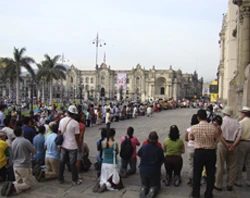
On Saturday, Feb. 19, hundreds of Peruvian Catholics gathered at the entrance to the Cathedral of Lima to pray a Rosary for Peace in response to a “Kiss-in Against Homophobia” organized by a small group of homosexuals and lesbians just a few yards away from the church.

This was the second time gay activists staged a “kiss-in,” after their first protest ended with police forcibly removing them from the steps of the cathedral on Feb. 12.

This time they came with the explicit blessing of Lima’s mayor, Susana Villaran, who has voiced her support for homosexual unions on numerous occasions.

Despite a heavy media campaign to promote the Feb. 19 “kiss-in,” only eight people showed up in Lima’s central square. 

In response to the planned protest, some 200 Catholics showed up at 3:30 p.m. outside the cathedral and formed a human barrier for more than three hours. The group spent the time peacefully praying the Rosary and singing hymns.

Not surprisingly, a large contingent of reporters and cameramen showed up to cover the protest by  three gay couples and a pair of lesbians.

Daniel Torres Cox, who came to pray the rosary, told ACI Prensa, “We are really here to protect our faith in some way.”  

He called the homosexual protest “an attack on what we believe in, and that’s why we are here, to simply protect that.”

Nancy Freundt of the Center for the Promotion of Natural Family Planning said that in Peru homosexuals are not persecuted, “but they do provoke and challenge us because they want to do away with every moral principle, and for them the Catholic Church represents everything they want to tear down.

“The Catholic Church isn’t a pile of bricks. The Church is all of us Catholics who live and profess our faith,” Freundt said.

The Catholics gathered outside the cathedral ended their prayers around 6:45 p.m., after successfully preventing the homosexual couples from approaching the cathedral. 

The group of Catholics promised they would gather again if the gay activists staged another protest.

The “Kiss-in Against Homophobia” was organized by gay activists to protest the widespread rejection of homosexual unions in Peru. 

A measure that would have allowed such unions was shelved by the Peruvian Congress on Feb.8 as unconstitutional.  

The country’s Constitution establishes that marriage is a union between one man and one woman. 

Recent polls show that 75 percent of Peruvians oppose homosexual “marriage.”

Sunday, February 27, 2011

February - Purification of the Blessed Virgin Mary


Almighty and beneficent God! who didst impose upon our mother Eve, in punishment for her sin, that she should give birth to her children in pain:

I offer to Thee all the pains which I have thus suffered in atonement for my sins, and thank Thee, that I have safely brought a child into the world, whom I now offer to Thee, according to the example of the Mother of Thine only-begotten Son, for Thy holy service, whom I shall zealously endeavor to educate for Thy honor.


Give me but this grace through the intercession and merits of this most blessed Mother.


Bless me and my child, and grant, that we may here live in accordance with Thy divine will, and receive eternal salvation.


Through Christ, our Lord.


Amen.

Prayer To Saint Matthew

 
O Glorious Saint Matthew, in your Gospel you portray Jesus as the longed-for Messiah who fulfilled the Prophets of the Old Covenant and as the new Lawgiver who founded a Church of the New Covenant. 
Obtain for us the grace to see Jesus living in his Church and to follow his teachings in our lives on earth so that we may live forever with him in heaven.
Amen.

Spanish Anglicans, Catholics Reach Accord on Baptism

Anglicans and Catholics in Spain have made official a mutual recognition of the validity of baptism in both confessions.

Bishop Adolfo González Montes of Almeria, president of the Spanish Episcopal Conference's ecumenical relations department, and Episcopal Bishop Carlos López Lozano signed Tuesday a joint declaration on baptism.

The declaration follows the guidelines of Anglican-Catholic theological dialogue and recognizes "with gratitude our common faith in God our Father, in our Lord Jesus Christ and in the Holy Spirit, and our common baptism in the one Church of God." The declaration is valid only in Spain.

The bishops noted how ecumenical dialogue has strengthened conviction about the importance of baptism in building the Church. 

The joint declaration expresses the desire that this conviction "enjoy an authoritative expression."

The declaration does not address differences in belief regarding the sacramental nature of confirmation.

"This difference does not affect the recognition of the sacramentalism of baptism and its valid administration," the document states.

The signing took place at the headquarters of the Spanish Episcopal Conference in the presence of the Catholic bishop of Vic, Román Casanova Casanova, and a representative of the archbishop of Canterbury. 

A thanksgiving ceremony with a solemn "Te Deum" followed in the Anglican Cathedral of the Savior in Madrid.

This declaration, similar to those signed already by numerous episcopal conferences worldwide, concludes in Spain a long process of dialogue that began in the 80s.
 

Renewed faith needed for sustainable future - priest

A Co. Wexford based priest is to hold a series of talks and films arguing that it will take more than economics and politics to build a sustainable future for Ireland.

Fr Paddy Banville, curate in New Ross, will host the events in St Leonard's Church running weekly up to the end of March.

''Could anyone really believe that the Church, the economy, all the different strata of human life are running parallel, never meeting?

''The current financial crisis is at root both spiritual and moral,'' Fr Banville said.

Fr Banville says we need to realise ''we're pulling the carpet from under our feet'' so we can inject a renewed sense of urgency to the Catholic Church.

''The Church needs to fight big time and get our voice heard. We have a choice - are we going to choose lightness or darkness because politicians are only a reflection of the culture we have all developed. We need to look in the mirror or we'll make the same mistakes over and over.''

For more information contact 087-9967610.

UC Davis withdraws religious discrimination description after Christian group protests

After protests from a student group, the University of California at Davis has withdrawn a school policy that implied Christians were the only perpetrators of “religious discrimination” in the U.S. 

The university's Office of Campus Relations issued a “Principles of Community Glossary” that defined “religious/spiritual discrimination” as “(t)he loss of power and privilege to those who do not practice the dominant culture’s religion. In the United States, this is institutionalized oppressions toward those who are not Christian.”

The Alliance Defense Fund – a Christian legal alliance – reported that affiliated attorney Timothy J. Swickard wrote the university on Feb. 16 on behalf of 25 students who found policy offensive. UC Davis responded the same day, stating that the student's concerns were noted and that the language was removed until further consideration.

In his letter to the school, Swickard argued that it was “patently clear” that UC Davis’s definition of religious discrimination was “blatantly unconstitutional” under both the Federal and California State Constitutions.

“The policy singles out certain faiths for official school protection from discrimination while denying the same protection to others solely on the basis of their particular religious views,” he wrote. 

Citing research, Swickard called the policy “simply nonsensical” given the environment “on most University campuses where Christian students, if anything, are among the most likely to be subjected to discrimination because of their faith.”

CU Davis’ Associate Executive Vice-Chancellor Rahim Reed said that the webpage containing the glossary “has been taken down to permit further review of the terms used there and their continuing utility.” 

Reed also said that because the religious discrimination definition “is not in keeping with the aspirations of the campus community or our Principles of Community,” if the glossary returns, “this definition will be appropriately revised.”

The associate vice-chancellor went on to say that the “Principles of Community are not University policy” but “an aspiration to each member of our campus to strive to build a true community of spirit and purpose based upon mutual respect and caring.”

Swickard released a statement on Feb. 17, praising the university’s “prompt and forthright response.”

“We greatly look forward to UC Davis’s newly stated community aspiration to protect all students – including Christian students – from unlawful discrimination on campus,” he said.

Vatican charity offical says new challenges call for new leadership at Caritas

The Vatican believes that its top aid agency, Caritas Internationalis, needs new leadership to build a stronger Catholic identity within the organization, said Cardinal Robert Sarah, who oversees the agency’s work as president as president of the Pontifical Council Cor Unum.

The Rome-based Caritas recently announced that the Vatican would not permit its current secretary general, Lesley-Anne Knight, to run for re-election to the position this May. 

Cardinal Sarah explained the Vatican’s reasons during the course of a Feb. 22 press conference to release the Pope's annual Lenten message.

Cardinal Sarah told journalists, "we must recognize the work accomplished by Mrs. Knight, but for today's new challenges we need someone else." 

He added that it is "normal that for new challenges other people are chosen that the confederation presents."

Caritas officials issued a statement Feb. 18 expressing satisfaction with Knight’s performance and dismay at the Vatican’s decision. 

Cardinal Sarah said, however: "I think that each of us has limits. We can be competent in organizing but lack some qualities for coordinating work or for reinforcing the Catholic identity," Cardinal Sarah said concerning  Knight’s qualifications.

The British Catholic weekly, reported Feb. 18 there had been communications miscues between then-president of "Cor Unum," German Cardinal Paul Josef Cordes, and Caritas when organizing a response to the earthquake in Haiti in 2010.

An unnamed official from one of the 165 Caritas locations worldwide told the British Catholic weekly, The Tablet that Knight ruffled feathers as she has been “critical of the Vatican machine, has made no secret of it and has failed to be discreet.”

Asia Bibi from prison: God will hear my prayers

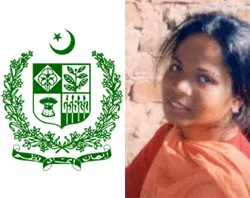
Speaking from the Sheikhupura Prison near Lahore, Pakistan, Asia Bibi, the first Christian woman condemned to death under the country’s Blasphemy Law, is reiterating her innocence and says she trusts “God will hear my prayers and will help me get out of here and get back home to my family.”

In an interview published Feb. 20 by the Spanish daily, El Pais, Bibi recalls the beginning of her calvary and maintains that she is innocent of charges of committing blasphemy.

“One day I complained to a tax collector because he was allowing his animals to run free and they were damaging my house. He insulted me, and from then on he began a campaign against me,” Asia says. 

A few days later, during her job as a farm worker, she offered a drink of water to her co-workers. 

“They told me they could not drink from the same jug as a Christian, and we began to argue, but I never blasphemed,” she insists, noting that five days later she was accused of blasphemy and taken to prison.

She is currently the only prisoner condemned to death among the 2,400 prisoners in the country.  

Ninety-five percent of those in prison are men.

Asia will mark two years in prison this coming June. 

She occupies a nine square-foot cell and spends her days reading the Bible. 

She cooks her own food out of fear she could be poisoned by Muslim radicals.

She agrees with her lawyers that the legal process is affected by pressure from Islamic fundamentalists.

“I did not commit blasphemy,” she says. “I would never speak against the Prophet. And I believe that God sees all and in the end things will be made right.” 

She thinks her case may be related to some of the difficulties experienced with other people in her town who discriminated against her family because they are Christians.

Asia says she suffers greatly because of the rumors of death threats against her family and that she terribly misses her twelve year-old daughter Isham. 

“She is my joy, she is a very good girl with a bright smile. It hurts me so bad not to see her grow up.”

Muslim extremists have offered more than $5,000 in reward money to anyone who assassinates Asia.  Her husband is unable to work and her children cannot attend school, as radical Muslims have declared them to be targets.

“I have to confront this trial with patience and courage,” she tells El Pais.

Pakistan’s Blasphemy Law groups together a number of norms based on Sharia Law to punish any statement or action considered offensive to Allah, Muhammad or the Quran. Anyone can file an accusation of blasphemy without the need of witnesses or evidence. 

The accused are subject to immediate trial and, if found guilty, are sentenced to life in prison or death. 

The law is often used to persecute the Christian minority, which is subjected to exploitation and discrimination in schools and in running for positions of public service.

Billboard in Manhattan describes abortion as ‘number one killer’ of blacks

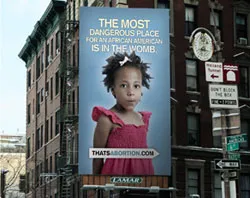
A new billboard campaign has responded to the high abortion rate among black women in New York City by declaring “the most dangerous place for an African American is in the womb.”
 
The billboard, which depicts a young black girl, is located in the Manhattan neighborhood of SoHo about half a mile from a Planned Parenthood abortion facility. 

The three Planned Parenthood abortion clinics in New York City altogether reported nearly 17,000 abortions in 2010.

The pro-life group Life Always is sponsoring the billboard, its first in the state of New York, as part of a new national campaign which charges that Planned Parenthood targets minority neighborhoods.

“During Black History Month, we celebrate our history, but our future is in jeopardy as a genocidal plot is carried out through abortion,” commented Life Always board member Pastor Stephen Broden. 

“We have seen the heartbreaking effects of opportunists who happen to be black abortionists perpetrating this atrocity; it’s not just babies who are in danger, it’s also their mothers, and our society at large.”

A New York City health department report released in January revealed a 41 percent abortion rate in the city, twice the national average.

The abortion rate among black women was higher than average.

“This campaign highlights the tragedy that abortion is the number one killer since 1973 in the black community and the truth that we must confront in a city with a near 60 percent abortion rate for black women,” explained Rev. Derek McCoy, another Life Always board member.
 
The billboard advertises the web site www.thatsabortion.com, which offers pregnancy help information and facts about the effects of abortion on the black community.

Papal Visit gave a boost to Humanism (Contribution)

Last month two groups of people met in a church in central London to discuss gay adoption, abortion and religious schools. 

On one side were representatives of Catholic Voices, on the other a group from the Central London Humanist Group.

The point, says Paul Sims of New Humanist magazine, was “to experiment with the idea of Humanists and Catholics sitting down and engaging with each other on contentious issues in a cordial manner”.

It was the second such event. 

The first took place in October, at the instigation of the Humanists, following a blog post by Sims in which he expressed concerns about the tone of the discussion during the Pope’s visit to Britain. That tone was evident during a pre-visit debate in Conway Hall, where “Catholic speakers were frequently drowned out by rowdy heckling”.

Alan Palmer, chairman of the Central London Humanist Group, then invited Sims and 23 others to a smaller debate. Catholics were represented by Austen Ivereigh, Jack Valero and Fr Christopher Jamison. 

Sims was happy with the courteous nature of the meeting. As he wrote at the time: “Given the way Catholics and Humanists were portrayed in some of the press coverage of the Pope’s visit, that’s something you might have thought as likely as West Ham and Millwall fans enjoying a pre-match pint together on derby day.”

But not all atheists were happy. Terry Sanderson, president of the National Secular Society, criticised Sims for speaking to a group he holds in contempt. 

Sanderson said Sims was “obviously of the opinion that something can be achieved by debating and negotiating with Catholic Voices”, which was “an activity surely worthy of King Canute”. Is Sanderson right? Is there any point in talking to the other side?

I met Sims last week near the Gower Street home of the magazine, which was established in 1885 (three years before The Catholic Herald). It was originally known as Watt’s Literary Guide, and its founder was Charles Watts, founder of the National Secular Society.

I asked Sims what the meeting with Catholics was like.

“It was very interesting to meet the people and get to know some people you wouldn’t meet at Humanist events,” he replied. The gathering was cordial, although “it got most heated over abortion”.

Humanists don’t have to be in favour of abortion, he said, but “in gay rights and gay adoption Humanists are generally pro. I don’t think there’s an anti-gay rights branch of Humanism.”

The Catholics and Humanists found little common ground, but Sims said the tone of the debate was refreshing, especially in contrast to that during the papal visit.

“People get carried away with themselves on all sides,” he said. “In some of the newspaper columns the oppositional language being used at times didn’t reflect the reality. On the Friday when the Pope was in town I went to the pub with a few friends and they didn’t even realise the Pope was around. The idea that the country was divided into two camps was not true. As is often the case with anything to do with religion now, most people fall in the middle.”

The Church was very happy with the papal visit.

Not only did most people warm to the Holy Father but his opponents often seemed shrill and intolerant. 

Church attendance jumped and The Catholic Herald’s website got record traffic. 

But perhaps it’s easier, in the echo chamber of likeminded company, to overstate the popularity of one’s own views; talking to Sims I realised that the other side saw it the same way.

“Both sides claimed they had a PR victory and isn’t that always the case?” Sims asked. “The Catholic Church was in the public eye for four days and there was lots of positive PR, but the Protest the Pope side were on the news, and Humanism and secularism was in the public eye as well. We had lots of new subscriptions and record web traffic during September, and the British Humanist Association had a nice spike in membership. It pushed people into camps. Who won the PR battle? It was a draw. It had benefits for both sides.”

So what about the argument, put forward by journalist Brendan O’Neill, that the anti-papal protests were a perversion of John Stuart Mill’s Humanism? 

Sims said he disagreed.

“There was the odd sign that said: ‘F— the Pope’. But as a rule it was mostly jolly and tongue in cheek. Brendan said the march was about closing down discussion but they weren’t calling for the Pope to be kicked out of the country. They just said they didn’t agree with a state visit and they were going to voice their opposition. But I don’t think if you say the Pope is ‘an enemy of the state’ or ‘an enemy of humanity’ there’s anything to be gained by saying that. It’s just going to annoy Catholics who look up to the Pope.”

New Atheism arose in a fury following the publication of Richard Dawkins’s The God Delusion. But its real spark was 9/11 and I’ve often thought it was a displaced fear of Islam. Sims didn’t agree with me. He said it had more to do with gay rights.

“Humanism has not used religion as a proxy for Islam. A lot of the opposition to the Catholic Church was specifically over Vatican-related things. I wouldn’t say Protest the Pope was using the Vatican to protest Islam.”

I asked him if he thought Dawkins was sometimes a liability to his cause.

“No,” he said. “He’s done more than anyone. Atheism has become a thing widely debated.”

The last thing I wanted Sims to tell me was, why are New Atheists so angry?

“Obviously I can only speculate,” he said. “But I think part of it is it’s an area driven by polemical books, by people like Christopher Hitchens. You feed that into the internet, which is quite aggressive. But it’s also that Richard Dawkins played a really important role in allowing people in the southern states who have been allowed to come out as atheists. They are people who feel they can’t say things within their real-life community so they go on the internet at two in the morning.”

Sims is anything but angry and I agree that the argument needs to be toned down.
 
“One of the comments during the papal visit was by a Labour Catholic who used the phrase ‘secular jihadists’,” he said.

“That to me is just an utterly ridiculous phrase. I don’t think voicing an opinion strongly is a dangerous thing.”

Blair’s priest parties with transvestite 'nuns' (Contribution)


He is the best-known Catholic priest in ­Britain after Cardinal Cormac Murphy-O’Connor, the former Archbishop of Westminster.

So it was only fitting that Father Michael Seed, 53 — the man who helped convert former Prime ­Minister Tony Blair to Catholicism — should mark 25 years in the priesthood with a mass at the Church Of The Immaculate Conception in Mayfair earlier this month.

So far, so acceptable.

I can reveal, however, that Seed also had a second, rather less devout celebration — a ­champagne-fuelled party with entertainment provided by ­transvestites dressed as nuns.

A close friend of Father Seed’s arranged the bash at the Pigalle Club — housed in a pink basement in London’s Piccadilly and known for racy floor shows — to mark the anniversary of the well-connected priest’s ordination into the Franciscan Friars Of The Atonement.

The 200 guests, many of them ­fellow clergymen, were startled to be greeted at the door by four burly transvestites, who took their coats.
  
Party-goers — who ranged from clerics from the Diocese of ­Westminster to millionaire benefactors who had flown in for the ­celebrations by private jet — were again taken aback when the ­transvestites appeared on stage later wearing nuns’ habits.

The 6ft ‘nuns’ proceeded to give what can only be described as a rather unsuitable cabaret act. 

‘A female singer came on first. She sang rather good, classic jazz songs, which was fine,’ says one wide-eyed reveller.

‘But then these transvestites came on stage. Mouths dropped. Quite a few people scuttled off to the bar in embarrassment. Lots of champagne had flowed and I can’t recall the songs that the nuns sang. Needless to say, they weren’t singing vespers!’

Father Seed — who also converted politician-turned-dance queen Ann Widdecombe and the late MP Alan Clark — is used to causing a stir.

His 2009 autobiography revealed he had met the Queen, how ­Miss Widdecombe organised an ­exorcism of the Home Office to rid the place of the evil aura left behind by Michael Howard, and how he often gets mistaken for a strippagram vicar.

Despite all this, Father Seed — who once acted as unofficial ­chaperone to Blair’s daughter, Kathryn — is currently setting up the ­Catholic Church’s committee on human dignity.

Twin Cities archdiocese critical of lay preaching at Bloomington church

At a recent Sunday Mass at St. Edward Catholic church in Bloomington, a woman stepped up to the podium on the altar -- and started to preach.

For at least one parishioner, the act of a female lay person (albeit with a master’s degree in theology from St. Paul seminary) addressing the congregation during the homily portion of the worship service was too out of bounds.

So the parishioner contacted the Archdiocese of St. Paul and Minneapolis after the Jan. 23 service. 

And not long after, the Rev. Peter Laird, the archdiocese vicar general, spoke to St. Edward’s pastor, the Rev. Mike Tegeder, about the situation.

According to Tegeder, Laird said it was not appropriate for a lay person to preach during the homily, the part of the Mass when priests or deacons usually reflect on the Gospel and scripture. 

Tegeder said Laird indicated it was only OK for lay people to preach or make comments after Holy Communion, near the end of Mass.

Tegeder, however, stands by his move to allow the woman to address the congregation about the issue of adult faith formation at St. Edward, an area she’s in charge of leading at the church -- one of the largest in the Twin Cities with nearly 6,400 members.

Tegeder maintains lay parishioners have many skills and gifts to offer churches and their talents should not be wasted.
 
“She probably is more competent than most priests when it comes to putting together a good message,” said Tegeder, a frequent critic of Twin Cities Archbishop John Nienstedt.
“She has basically the same training as a priest.”

As many parishes across the country (including those in the Twin Cities) struggle with a growing shortage of priests, lay participation in church ministry (or lack thereof) can have very real impact on a church’s existence, proponents of lay preachers say. 

Also, they maintain that lay preachers allow for a diversity of voices and views to be heard within the church.

For decades, the Catholic Church did allow for lay followers to preach during Mass -- a practice approved of in the 1960s at the Vatican II council. 

The idea behind lay preaching was to encourage greater participation by non-clergy members in the Mass and other church activities.

In 2004, however, the Vatican amended the practice to say lay people could only preach or make comments following Holy Communion, near the end of Mass.

Twin Cities archdiocese spokesman Dennis McGrath said the archdiocese is following the policies of the Vatican.

“The purpose of the homily at the Mass is to interpret the Gospel,” McGrath said. “Normally a priest is far more qualified to deliver that message. Also there’s an opportunity there for wrong teaching or misinterpretation (with lay preachers).”

Tegeder said the woman parishioner is scheduled to preach at an April 11 Lenten penance service at St. Edward’s, which is not a Mass. 

He’d also like her to preach at a Mass celebrating Mother’s Day in May. 

He said he’s not sure yet if he’ll ask her to preach during the homily or after communion.

Pastors take different approaches when parishioners skip Communion

Father Adam Forno occasionally notices parishioners skipping the Eucharist at St. John the Evangelist and St. Joseph parish in Rensselaer, where he is pastor.

Sometimes, a Massgoer doesn't receive Communion because he or she has remarried without having a first marriage annulled. Other times, it is because of personal shame.

"We've got some people who just feel they're not worthy," Father Forno explained. "People have a strong sense of not being in right relationship with God, and so they honor that by not going to Communion as they were taught. But my sense is that you need Communion more than ever then."

A man in one of Father Forno's former parishes attended daily Mass, but he never received Communion. Father Forno approached him and said: "You come to supper with the Lord, but you don't eat." The priest asked if the man needed to reconcile anything with God and offered to help.

Several pastors throughout the Albany Diocese said they have spotted handfuls of Catholics at their parishes abstaining from the Eucharist, occasionally or habitually. They noted that many parishioners falsely believe being divorced or forgetting to pray are reasons to abstain.

Massgoers who stay seated during Communion present pastors and parish leaders with complex tasks of spiritual guidance. Whenever possible, parish leaders are advised to teach about church rules but help people differentiate between mortal and venial sin.

"It calls for such pastoral nuancing," Father Forno said. "It's not black and white."

According to the Catechism of the Catholic Church, parishioners who are "aware of having committed a mortal sin must not receive holy Communion, even if (they experience) deep contrition, without having first received sacramental absolution, unless (they have) a grave reason for receiving Communion and there is no possibility of going to confession."

For a sin to be considered mortal, its object must be grave matter and it must be committed with full knowledge and deliberate consent, according to the catechism.

Often, people falsely believe they are in a state of mortal sin because their actions contradict church teaching, said Father Peter Sullivan, assistant judicial vicar to Albany Bishop Howard J. Hubbard.

Father Sullivan said pastors and spiritual directors should counsel people based on their individual situations. He offered the example of 19th-century Eskimos leaving their elders to die on the ice to prevent them from experiencing long, excruciating deaths without the aid of morphine: Today, this might be considered murder; back then, it was mercy.

Culture, Father Sullivan said, "programs you -- and sometimes programs you poorly. You just absorb it. You don't even know how you absorb it."

In turn, culture can affect a Catholic's feelings of worthiness before the Eucharist.

"I tell people Communion is not a reward for having been good, but the spiritual food necessary to continue the journey," Father Sullivan said, recalling the Gospel story of the vine and the branches: "(Jesus is) saying, 'If you do not receive my body and blood, you do not have my life in you.'

"You need to go to Communion, and you can do so very humbly. You're not doing this with pride; you're doing this out of a need and out of a command."

Father Forno recalled the prayer recited immediately before receiving Communion: "Lord, I am not worthy to receive you, but only say the word and I shall be healed."

"If we say those words and believe it," he said, "then the Lord should be able to heal (us)."

Further, Father Sullivan said, no one should discourage others from receiving; conscience decisions are private.

Father Anthony Barratt, pastor of Annunciation Parish in Ilion and Our Lady Queen of Apostles Parish in Frankfort, also notices abstainers every now and then. In his experience, they are usually Catholics who feel they are overdue for confession.

"I'm always amazed at people's love for the Eucharist, their reverence for it," he told The Evangelist, Albany diocesan newspaper.

Marianne Lee, a parish eucharistic minister, agrees that few "sit out" Communion, but older Catholics might be influenced by the culture of their youth, when people went to confession more frequently.

"There are still some people who feel they need to have the sacrament of reconciliation before they receive," Lee said.

Father Paul Catena, pastor at Sacred Heart Parish in Margaretville, said he often faces the task of making people aware of outstanding sins. But approaching them about the need for confession before receiving Communion is no easy task.

"It's hard to go up to somebody and say they shouldn't," Father Catena said. "I think every priest struggles with, 'What do I say? When do I say it?' The best I can do is try to teach over time."

Christianity, he said, is about continual conversion; followers should always learn and grow in faith.

Church teachings can also confuse Catholics. "They're not easy to understand," Father Catena said. "It takes time and effort to understand the teachings, and it takes a certain openness."

Along the way, Father Sullivan said, the Eucharist is there to help: "It is the nourishment that is demanded by the Lord in order to walk the way."

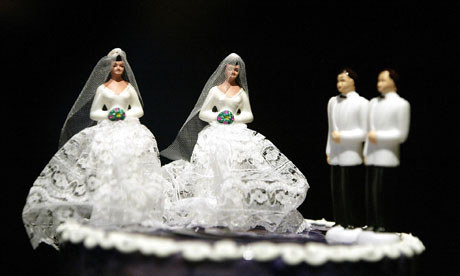
Catholic archbishop accuses coalition over gay marriage in church move

The Catholic church is on a collision course with the government after declaring it will oppose in the "strongest terms" changes to the Equality Act that will allow gay couples to register civil partnerships in places of worship.

A statement from the archbishop of Southwark, the Most Rev Peter Smith, said it was neither "necessary nor desirable" to allow gays and lesbians to have civil partnership ceremonies in religious premises and accused the government of "considering a fundamental change to the status of marriage".

Churches and Christian groups have criticised the Home Office decision, announced last week, to lift the bar on civil partnership ceremonies being held in places of worship. 

The equalities minister, Lynne Featherstone, has come under fire for disclosing the government's intention to consult over how marriage laws in England and Wales can be reformed further.

The home secretary, Theresa May, said the rule changes would not be mandatory: "No religious group will be forced to host a civil partnership registration, but for those who wish to do so this is an important step forward."

But Smith said the change was something "never envisaged by the Equality Act or any other legislation passed by parliament".

The archbishop added: "Marriage does not belong to the state any more than it belongs to the church. It is a fundamental human institution rooted in human nature itself. It is a lifelong commitment of a man and a woman to each other, publicly entered into, for their mutual wellbeing and for the procreation and upbringing of children."

There was also implicit criticism of those religions and movements supporting the change – Quakers, Unitarians and Liberal Jews have welcomed the government's modernising agenda.

Smith said: "No authority – civil or religious – has the power to modify the fundamental nature of marriage.

"The Equality Act was amended to permit civil partnerships on religious premises, which unhelpfully blurs the distinction previously upheld by parliament and the courts between marriage and civil partnerships.

"A consenting minister is perfectly free to hold a religious ceremony either before or after a civil partnership. That is a matter of religious freedom, but it requires no legislation by the state. We do not believe it is either necessary or desirable to allow the registration of civil partnerships on religious premises. These will not take place in Catholic churches."

The Catholic bishops of England and Wales have had mixed success when they have lobbied government in the past.

In 2006 they succeeded in persuading the then education secretary, Alan Johnson, to scrap plans for quotas in faith schools, but failed to persuade the Labour government in 2007 that Catholic adoption agencies should be exempt from sexual orientation regulations, which would have led them to consider gay couples as prospective parents.

The Lesbian and Gay Christian Movement, a UK-based international and non-denominational charity campaigning for an inclusive church, welcomed Featherstone's announcement.

Its chief executive, the Rev Sharon Ferguson, said: "We are of course delighted by this development which has been a long time coming. We reject concerns by some that this is an infringement upon religious liberty. No religious group, Christian or otherwise, will be forced to conduct civil partnerships. But the current situation is an infringement upon the religious liberty of those faith groups who are happy and indeed keen to conduct such civil partnership ceremonies."