Sunday, October 30, 2011

Church Investors Linked to Birthday Party Scandal

A German dance troupe is under fire for their performace at a party for Chechen strongman Ramzan Kadyrov, who has been accused of human rights abuses. 

Now the controversy has unexpectedly spread to the Catholic Church. 

SPIEGEL reports the 'television ballet' also receives funding from a firm partly owned by nine dioceses.

Chechen President Ramzan Kadyrov's 35th birthday party in Grozny was a lavish affair. 

Held on Oct. 5, it featured performances by international artists, including a company of dancers partly owned by the German state television channel MDR.

The decision by the Deutsches Fernsehballet, or "German Television Ballet," to perform for a man accused of human rights abuses sparked a barrage of criticism. 

Green party parliamentarian Volker Beck demanded to know why "a state-funded ballet group" should "perform for someone with blood on their hands."

A number of Kadyrov's opponents and critics have been murdered over the last several years, though he denies all allegations of his involvement.

Last week even MDR, the home channel and largest shareholder of the dance troupe, criticised the dance troop's participation in Kadyrov's birthday celebrations.

The broadcaster owns 40 percent of the company.

Another 30 percent of the Berlin-based dance troupe's shares belong to Munich TV production firm Tellux, the shareholders of which include nine Catholic dioceses in Germany, according to SPIEGEL information.

Among these are the archdioceses of Munich-Freising and Cologne.

'Deep Regret'

The fact that Tellux, whose website points out the group's "specifically Christian approach," was involved in that kind of show business, reportedly came as a surprise to its Catholic investors.

But the Grozny performance is particularly uncomfortable for the bishops.

The Rottenburg-Stuttgart diocese's press office told SPIEGEL that as a shareholder it was not "informed about daily business in advance," but added that it "deeply regretted this affair."

The diocese wished to distance itself "in every way" from leaders accused of human rights abuses, the press office said.

The circumstances of the television ballet troupe's performance in Grozny are still under investigation, but they weren't the only performers to be criticized for taking part.

After the event Human Rights Watch said that guests including Belgian actor Jean Claude Van Damme, British violinist Vanessa Mae and Oscar-winning US actor Hillary Swank had trivialized "the suffering of countless victims of human rights abuses" through their presence.

Swank later told AP that she "deeply regretted" attending the party, saying she had not had a "full understanding" of the event.

Lefebvrians against Assisi

“May the Lord remove the veil that is covering the hearts of Churchmen, and make them recognise that only one Peace is possible between men: that of Christ in the Kingdom of Christ…”

This was the statement made by the Italian headquarters of the Society of Saint Pius X, three days ahead of the Pope and other religious leaders’ pilgrimage to Assisi, on 27 October. 

The pilgrimage celebrated the 25th anniversary of the first interreligious meeting of its kind, instigated by John Paul II.

Even though Benedict XVI is not quoted, the reference to the veil being removed from the heart is aimed at him. 

Benedict XVI welcomed this new meeting in Assisi, although the schedule and structure of the event are different with respect to the one which took place in 1986, placing emphasis on the common pilgrimage in the city of Poverello rather than on prayer.
 
The Lefebvrian communiqué comes very close to the deadline established by the Holy See for the Society of Saint Pius X to send a response. 

Last 14 September, the Society received the text of a doctrinal preamble from the Pontifical Commission Ecclesia Dei, which they had to accept and sign, in view of the re-establishment of a full communion with the Catholic Church and the canonical settlement proposed by the Holy See.
 
“In compensation for the celebration of the 25th anniversary of the interreligious meeting in Assisi in 1986, the communiqué read, the Society of Saint Pius X is calling for this 27 October to be a day of prayer and penitence. The Brotherhood’s convents will dedicate the day to the adoration of the Holy Sacrament, the recital of the Holy Rosary and members of the Brotherhood will fast.”
 
The Italian Headquarters of the Society of Saint Pius X went on to say: “We invite all faithful and friends to join together in prayer and in this day of fasting, for the following three reasons: 1) To compensate for the celebration of a historic event which more that any other, has humiliated Mary Magdalene, putting her on the same level as false religions; 2) In order for Christ our Lord to remove the veil that is covering the hearts of Churchmen, making them recognise that only one Peace is possible between men: that of Christ in the Kingdom of Christ. Pax Christi in Regno Christi; 3) So that our Lord may eliminate the growing breeding grounds for war across the world, which seem to be His answer to the “peace” meeting in Assisi.”
 
The communiqué was signed by the Superior of the Society’s Italian headquarters, Fr. Davide Pagliarani. 

The third point stands out in particular, as it seems to portray the growing number of wars in the world, as divine will’s response to the meeting in Assisi.

A little secret revealed

Religious and secular media were quick in reporting on the surprise visit Benedict XVI and his brother, msgr Georg Ratzinger, made in early August to a tiny church that is a real art jewel etched in the mountains of the Marsica district in Abruzzo.

But these media failed to pose a question, probably because they did not have the answer: how did the Pope come to the decision to select such unique place in a region known as a treasure chest of hundreds if not thousand ancient churches, convent and monasteries, many of which of invaluable religious and artistic value, scattered all over its impervious and picturesque territory?

The church in question, until then also virtually unknown, is Santa Maria in the Porclaneta Valley (more commonly referred to as church of Santa Maria in Valle or Santa Maria in Porclaneta) , close to the village of  Rosciolo, which is part of the municipality of Magliano dei Marsi, in the province of L'Aquila. Santa Maria in Porclaneta dates as far back as early medieval times and is nested in a grandiose and breath-taking mountain setting, at the foot of Mount Velino, that with its over 2 500 meters is the third highest peaks in Abruzzo after Gran Sasso and Maiella.

But thanks to an exclusive interview with the local persons involved in the visit on the spot, we are in a position to provide the above answer. 
 
This little secret was revealed by Costanza Di Cristofaro, the octuagenarian custodian of Santa Maria in Porclaneta, who has been volunteering on this job for 62 years now. The key person, she said, was the Pontiff’s brother, Msgr. Georg, who had visited the church the year before. 

“I gave him a copy of the book on the history of the church, asking him to make sure for it to be also passed on to his brother, Pope Benedict”, she went on, hardly disguising a well deserved sense of satisfaction for having somehow contributed to stir the interest of the Pope and thus prompt his decision to come to Rosciolo to visit a jewel he had never seen before.   

“You see, I did pass the book on to my brother”, Msgr. George was said to have quipped upon seeing again Costanza, since he was also accompanying the Pope during his visit there. 

The administrator priest attached to the local parish church, don Vincenzo Angeloni, was the person responsible to oversee the welcome arrangements for the Pope and his delegation. “The idea of a visit was probably suggested by his brother”, he said, thus confirming Costanza’s recount, “who had already come here the year before and was struck by this temple set here, amidst these mountains”. 

Few days prior to the Pope’s arrival, he went on, a monsignor from the curia came to see and tell him the Pope would be coming on Thursday, August 11th, for a visit, an event that obviously was to be kept as an absolute secret, “and naturally I did so”, don Vincenzo remarked.
 
“We prepared the church”, he goes on saying, “and very punctually at 5 pm the Pope arrived here, we first prayed that day’s Vespers of St Clare and then he stayed on for a while visiting the church guided by an art history expert who was part of the Papal retinue”. 

However, the more one gets to know don Vincenzo, an almost 90 years old priest ordained in 1941, the more one realises how fitting is the English word “understatement” to describe him: in other words, with all due respect, the impression is that there could not have been a better guide than don Vincenzo himself, as slowly but surely emerged during the meeting with the author of this article. 

Not only did he author the above book (whose 8000 copies, due to the “Benedict effect” went totally sold out after his visit), but he also authored another book on the likewise ancient parish church in Rosciolo itself, Santa Maria delle Grazie. 

Moreover, he said he was delighted to have found out that he had a passion in common with Msgr. Georg Ratzinger: music. In fact, don Vincenzo is also a music expert and composer, and he gladly donated us a copy of his latest music production.

After the guided tour inside the Chuch, don Vincenzo recounts, there was a somewhat familiar conversation between him and the Pope, mainly focused on past and recent local historical events and Church developments, including the ancient history of the noble household of “conti dei Marsi” (the earls of Marsi, the local population), that even gave two saints to the Church: the Patron saint of Sicily, Santa Rosalia, and bishop Berardus.

The earls of Marsica were a powerful family originated by a noble Frank, Berardus, claiming to be of Carolingian stock (directly descending from Charlemagne) who settled in Abruzzo in late IX - early X centuries replacing the local defeated Longobards’ rule, and under whose aegis, protection and jurisdiction the crucial and documented early stages of our little church came to unfold in the XI century. 

The first written reference to the church of Santa Maria in Porclaneta dates as far back as the XI century, when Berardus V, earl of Marsica, in 1048 donates the castle of Rosciolo with all its possessions to the Benedictine Monastery of Santa Maria in Porclaneta.

Berardus was also instrumental in the subsequent donation of the whole complex to the Benedictine Abbey of Montecassino in 1084, before being replaced by the Benedictine Abbey of Farfa two centuries later until 1836, when with a bull Pope Gregory XVI finally decreed for Santa Maria in Porclaneta and its properties to be incorporated into the local diocese and therefore under the jurisdiction of the Marsica bishop (or “Vescovo dei Marsi”).

But what about the rest of the complex, since the document spoke of a monastery and not just a small church, which is what has been left today? However incredible it may be, the rest of the complex disappeared in the wake of an event which was at the heart of Italian and European medieval history: the crucial battle of Tagliacozzo that took place on August 23rd, 1268, in the nearby Piani Palentini between Conradin of Swabia, the last descendant of the Holy Roman German emperors of the Hohenstaufen line, and the French king Charles I of Anjou.

A battle which was also immortalized by Dante Alighieri in his masterpiece “The Divine Comedy”. However, don Vincenzo pointed out, it’s not clear whether the destruction of the monastery annexed to the church was carried out by the soldiers of Conradine, who notoriously was the standard bearer of the faction opposing the Pope, or by the forces of the Anjou who, in their hot pursuit of the routed enemy soldiers up the hills from where they had descended, set alight the whole area, including the monastery. 

Interestingly, the prestige of the earls of Marsica reached its apogee after they supported Pope Boniface VIII in the historical vicissitudes known as the “outrage of Anagni” by the King of France Philip IV “the Fair” in 1303. The pope could ultimately save himself also thanks to the support of the earls of Marsica.

Therefore, as explained by don Vincenzo, no surprise if the Benedectine, in order to please such valuable and powerful allies, did not spare efforts to restructure and embellish the complex of the church of Santa Maria in Porclaneta by resorting to the most capable and famous artists of the time.

Albeit virtually unknown to today’s public, these artists worked in a church which could not have been more secluded and far away, albeit nested in such a gorgeous setting, leaving us such immortal art treasures in terms of architectural design, sculptures, frescoes and most of all one of the rarest and finest, even unique according to some scholars, examples of iconostasis, which here takes the shape of a sort of elevated wooden trabeation  with inlaid ornamental symbols supported by two little columns, in turn premised on a small wall with stone plates similar to a bas-relief with etched icons depicting episodes of sacred history.

Don Vincenzo is convinced that such feature, the fact that “Porclaneta” is considered a word of Greek origin meaning “rock mantled” and the presence of so many decoration elements of Byzanthine style, have prompted scholars to opine that a community of oriental monks fleeing the iconoclast war raging in the Byzanthine empire under Leo Isauricus in VII-VIII centuries settled in the area, thus starting the building of the church where they reproduced the features of their religious life.

Vatican official defends Occupy Wall Street

HOLY SEE RESPONSE: A SENIOR Vatican official said the Occupy Wall Street protests were justified as the Holy See called for global financial rules to be overhauled and an international market regulator to be established.

“Do people at a certain time have a right to say: ‘Do business differently, look at the way you are doing business because this is not leading to our welfare, to our good’?” Cardinal Peter Kodwo Appiah Turkson told reporters at the Vatican Monday.

“Can people demand this of the people of Wall Street? I think people can and should be able to.”

The comments came as the Vatican office he heads, the pontifical council for justice and peace, called for changes in the way financial markets are run and regulated.

Publishing a document entitled Towards Reforming the International Financial and Monetary Systems in the Context of Global Public Authority , the Vatican points out that, between 1900 and 2000, the world population increased almost fourfold but “the distribution of wealth did not become fairer but in many cases worsened”.

The document argues that Bretton Woods institutions of the early 1970s are no longer effective.

“In particular, the International Monetary Fund has lost an essential element for stabilising world finance, that of regulating the overall money supply and vigilance over the amount of credit risk taken on by the system.”

It argues that the international monetary system must be reformed. The international community must commit to “some form of global monetary management”, in other words, a new central world bank.
 

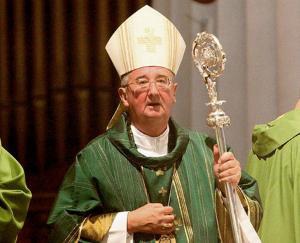
MISSION SUNDAY 2011 - Homily Notes of Most Rev. Diarmuid Martin

Homily Notes of
Most Rev. Diarmuid Martin 

Archbishop of Dublin and Primate of Ireland
----------
Saint Francis Xavier Church, Gardiner Street, 23rd October 2011

I am very pleased to be able to celebrate Mission Sunday here in this Church dedicated to Saint Francis Xavier, Patron of the Missions, a Church which is both a Jesuit Church and a Parish Church here in the centre of a changing Dublin.

I am pleased that there are here with us some returned missionaries:  men and women who have dedicated much of their lives to missionary work.  They carried out their mission in different times, when luxury was a word that was never in their dictionary.  Theirs was hard dedicated work; going on the missions in those days meant effectively never knowing if you would ever return home again.   We thank God for that witness of dedication.

I have to note that in a recent publication of the Irish Missionary Union there was analysis of the current membership of missionary congregations by age-groups.  On the one hand you cannot but be worried at the drop in numbers of young members of the missionary congregations and of the high average age of their members.  But what struck me was the very high numbers who have lived to 85 and over.  The hardship of missionary life may not have been such a bad thing after all! 

We celebrate Mission Sunday in a parish Church.  Mission at home and mission in other parts of the world are not two separate realities.  The mission of the Church is one.  Today, Ireland is in many ways a mission country.  People have received the message of Jesus and have received the sacraments of initiation but the message and its significance have weakened and at times have become eclipsed.  All of us need to find ways in which we can permit the message of Jesus to reach into the lives of those around us.  We have to develop ourselves a deep relationship with Jesus Christ and witness through our lives to just what that relationship means.  That is a missionary task to which all Christians are called.

Many of our catechetical programmes of the past have been over cerebral; they have taught about Jesus but they have not introduced people into the importance of a real encounter with Jesus Christ.  Jesus is not an idea or an ideology.  Jesus is a person who comes out to meet us and to be with us in our lives “even to the ends of the earth”, as our Gospel reading said.  That means that Jesus reaches out not just geographically but to the people and to the cultures of any period in the history of the earth and of humankind.

Mission at home and mission aboard are not separate realities.  Those missionaries who are with us today will obviously be full of memories of those places where they lived out their lives as missionaries.  Many – indeed most of them – would probably have wished to spend their last days in those places which had become their home.  But it is also true that their missionary sprit was born and was nurtured in the faith community to which they belonged here in Ireland.  They developed a faith which was borderless – they learned that as children of God we are all brothers and sisters; they learned that knowing Jesus was something important in their own lives but also something powerful which can change lives and can change societies and cultures for the good.  Without the faith communities which nourished them and then supported them, their missionary activity would not have been the same.

We thank God today for those families which over the years encouraged missionary vocations and who supported them and indeed were proud of their sons and daughters as they saw them achieve things that they could not have imagined.  As our readings stress, it is the Spirit who drives missionary activity and gives us the strength to witness to Jesus Christ way beyond geographical borders and human limitations. The spirit frees us to witness to Jesus Christ whom we present then not as an imposition but as true freedom: the way and life and truth

Mission at home and mission abroad are not two separate realities.  There are many here in this Church today who have never been abroad on mission and never will, yet they carry the missionary intention in their hearts and very often support missionary activity very generously.  The great Irish missionary tradition was the fruit not just of great missionaries, but of humble men and women here at home who gave generously to support the missions.

Some of you will know that the only writing that we have from Matt Talbot - who prayed perhaps daily in this Church - was not a refection on spirituality but two short lines with which he sent a contribution to Dalgan Park.  It reads simply: “two pounds from a poor man Matthew Talbot”.

Mission at home and mission abroad are not two separate realities. Mission is part of the very nature of the Church.  The dynamic of missionary activity abroad will inevitably be linked to the life of the Church at home.  Only a mission-focussed Church will foster missionary vocations.  It might be useful on this Mission Sunday for all of us to reflect on the fact that many religious congregations founded in Ireland and which are today experiencing difficulties here at home, are in fact thriving in other places.   Does that not make us ask what has happened to the Church in Ireland and has it lost something of its missionary zeal?   We need to understand what new-evangelization means here at home.  Renewal in the Church will not be the fruit of endless and inward-focussed consultation processes but by a renewal in our ability “to go out” and make disciples.   An inward-looking, almost narcissistic Church will never be missionary.

Mission in Ireland today is a difficult task   Many find that the tried and tested ways and structures of passing on the faith are no longer the rights ones, but find also that attempts to change that situation have not brought the results they hoped for.  We have always to remember that while it the duty of the Church to proclaim the Gospel of Jesus Christ everywhere, it is Jesus himself who is the primary evangelizer.   When we think we can go it alone, we will always get it wrong.

It is consoling to me to note that even at the very last moment of the presence of Jesus with his disciples – as we see in our second reading - they had failed to understand what their mission was to be.  As Jesus prepared to commission them to preach the good news, they came up with precisely the wrong question: “Is it now you will restore the kingdom of Israel”.   We too make mistakes and get it wrong.  But Jesus remains with us; he always remains faithful.

In these years we have witnessed enormous social and scientific change, which has brought much benefit to humankind.  But there is also another side to the story of what we call progress.   Our Western societies are marked by a loss of the sense of God and of the sacred.  At times this loss of the sacred encroaches also into the life of the Church and of our faith.  Some of the very foundations of our faith are challenged: the existence of a God who cares for us; the realization that Jesus Christ is the one Saviour; a common understanding of what is to be a human person and of the fundamental common ethical principles which should guide our coexistence.

Societies like our own where faith and the Christian life once flourished and faith communities were strong are now undergoing a far-reaching transformation.  We experience the effects of indifference to religion, of secularism and atheism.

Our presence in society will change.  Society needs the message of Jesus. But if we are to attempt to bring about a renewed active presence of the Christian message within the fabric of society, then we must first of all renew the Christian fabric of the Church community itself. 
Mission at home and mission abroad are not two separate realities.  Irish missionaries are still active and effective in so many parts of the world.  They owe much to their roots, but their missionary zeal should also and can also be a means to renew the Church in Ireland.  The experience, for example, of young volunteers who spend time with missionaries abroad enriches their faith when they return.  The Church in Ireland needs to be nourished by the faith and commitment of our missionaries.  Let us remember them and their work – very often today in isolation – in our prayers and in our generosity. 

 The root of all evangelization however, is not to be found in any human plan or strategy of ours.  Mission is about wishing to share the extraordinary gift of faith that God has wished to give us, when he made us sharers in his own life.  We must share that gift with others, here at home or in any other part of the world.

Has Irish Church lost its missionary zeal Archbishop asks

Many religious congregations, which were founded in Ireland and are currently experiencing vocations difficulties at home, are thriving in other places Archbishop Diarmuid Martin noted on Mission Sunday, and he suggested that this fact should prompt the Irish Church to ask itself “has the Church in Ireland lost something of its missionary zeal?”

In his homily at St Francis Xavier Church on Gardiner Street in Dublin, which is dedicated to the Jesuit Saint who is Patron of the Missions, the Archbishop of Dublin told the returned missionaries present that Ireland today is, “in many ways, a mission country.”

Of their dedicated missionary service overseas, Dr Martin thanked God for their, “witness of dedication.”

The great Irish missionary tradition was the fruit not just of great missionaries, but of humble men and women here at home who gave generously to support the missions, he told the congregation in Gardiner Street.

Underlining that mission is part of the very nature of the Church, he said in his homily that the “dynamic of missionary activity abroad will inevitably be linked to the life of the Church at home. Only a mission-focused Church will foster missionary vocations."  

He underlined that “Mission at home and mission in other parts of the world are not two separate realities” and added, that the “mission of the Church is one.”

Recognising that many catechetical programmes in the past had been overly cerebral, the Primate of Ireland said they had taught about Jesus but they have not introduced people to the importance of a real encounter with Jesus Christ. 

“Jesus is not an idea or an ideology.  Jesus is a person who comes out to meet us and to be 
with us in our lives ‘even to the ends of the earth’,” Archbishop Martin said.  

“We need to understand what new-evangelisation means here at home,” he commented, and added that renewal in the Church “will not be the fruit of endless and inward-focused consultation processes but by a renewal in our ability to go out and make disciples.”

“An inward-looking, almost narcissistic Church will never be missionary,” the Archbishop warned.

Recognising that Irish missionaries are still active and effective in so many parts of the world, Archbishop Martin said their missionary zeal should also and can also be a means to renew the Church in Ireland. 

“The experience of young volunteers who spend time with missionaries abroad enriches their faith when they return.  The Church in Ireland needs to be nourished by the faith and commitment of our missionaries,” he suggested.

He concluded, “Mission is about wishing to share the extraordinary gift of faith that God has wished to give us, when he made us sharers in his own life.  We must share that gift with others, here at home or in any other part of the world.”
 

Malta grants its first divorce

The Maltese courts granted their first divorce judgement last Friday to a couple who had been living apart for 21 years from the day of their legal separation.

Malta voted in a referendum to legalise divorce in May.  

The referendum was passed by a narrow margin of 52 pc to 48 per cent.  

It was the last country in Europe, apart from the Vatican, to do so.  

Outside Europe, the only other country that does not permit divorce is the Philippines.

The couple in question had filed a joint application for divorce on October 11, just after the law came into force on October 1. 

Madame Justice Abigail Lofaro said the requisites for divorce were satisfied and the couple had no intention of reconciling.

She noted that the couple's children were now adults so there was no need for maintenance to be paid. 

Madame Justice Lofaro ordered the court registrar to advise the director of the public registry about the divorce within a month for it be registered.  

She also upheld the woman's request to revert to her maiden surname.

The divorce measure, passed in the referendum, allows people to divorce after living apart for four years and as long as provision was made for spouses and dependents.  

Pro-divorce campaigners said that there were already plenty of separations in Malta, and that these people should be allowed to marry again.

However the No campaign argued that the institution of marriage is strong in Malta precisely because couples do not have the option of a fallback position.  

The Catholic bishops of Malta had urged the overwhelmingly Catholic population of the small island to reject the proposal.  

Ninety five per cent of Maltese voters belong to the Catholic Church.

In a pastoral letter on the eve of the vote, they said that marriage and the family “form the natural core which is essential for a person to live and grow within an atmosphere of genuine love, as well as for the building of a strong society.”

“For this reason, Jesus Christ teaches us that marriage, which goes hand in hand with the dignity of mankind, should, by its very nature, be a permanent bond.”

The bishops acknowledged the pain of those whose marriages had broken down, but said that legalising divorce would not solve the problem.  Instead, “as a gesture of love towards those who are suffering, and towards future generations, we must together try and improve the conditions of marriage and the family.”

“By his vote, the citizen will either build or destroy,” they said, posing the question of divorce as a fork in the road for Malta's future.

“A choice in favour of permanent marriage is an act of faith in the family, built upon a bond of love which cannot be severed,” they wrote. 

“Whereas a choice in favour of divorce leads to the further destruction of marriage and the family and, as a consequence, the destruction of values and the quality of life.”
 

Changes in the West

Bishop Patrick Rooke described some of the changes in the west of Ireland since his childhood in his sermon at last Sunday’s service of enthronement in St Patrick’s Cathedral, Killala.

Bishop Rooke said: Much of my knowledge of the West of Ireland comes from childhood holidays spent here over the month of August each year until I was 10 or 11.  I remember the long long journey from Dublin with nine of us –yes, nine of us, without a seat belt in sight, crammed into a Morris Minor. 

I can still picture my late father bent double in a quiet corner somewhere with his radio held to his ear as he desperately tried to decipher the commentary of the latest cricket test match. 

On my Uncle’s farm where we stayed, I recall the arrival of the first hay bailer and the excitement that it would bring to an end the laborious task of building haycocks with hay forks. Yes, I really am that old!

How things have changed.


Now we have motorways traversing the country. Cars are nothing like what they were then. 

Thanks to satellites, placed thousands of miles up in the sky, we now have little or no difficulty with radio signals, let alone television, mobile phone and internet connection.  

Life on the farm has changed beyond recognition with massive multi–purpose farm machinery available to ensure maximum speed at the lowest possible cost in terms of manual labour.

And it isn’t just that we can do things we couldn’t have dreamt of doing then, but also that they, in turn, have changed bigger things about society and the way we live. 

For instance, now that we can be in touch pretty much with anywhere in the world and at anytime;  so our rules of courtesy and privacy are challenged as never before.
So too how we find and keep friends, contacts and do business are very different.

Even 10 years ago we could hardly have predicted how our lives today would be altered so dramatically by email and the web. So also employment patterns and opportunities have changed – not always for the better!  

And who knows what changes are ahead and how in another 10 or 20 years life will have moved on.  Each great invention will involve some kind of shift, the benefits and costs of which will, no doubt, be great;  so that of one thing we can be sure, life will never be the same again.

‘Life will never be the same again’ – familiar words we have all said ourselves at some time or other. Words that the Pharisees and Sadducees too must have uttered in response to our Lord’s command – “Love your neighbour as yourself. He was introducing something very new to them – something that was no less of a shift in the existing world order, which is why it caused so much conflict.  ‘Love the Lord you God with all your heart and with all your soul and with all your mind’ – they could cope with that.  But ‘Love your neighbour as yourself,’ that was quite a different matter!

It is hardly radical stuff to our way of thinking, but what Jesus was proposing was a whole new way of life for them. He was challenging moral and hierarchical standards – No longer were the rich, as a matter of rite, assured a place in the kingdom of heaven, while those at the bottom of the social pile were to be placed on an equal footing with the ‘respectable and religious’. 

The familiar was being turned upside down….and they didn’t like it!

Gay groups get 10 times more cash from Scots Govt

Homosexual groups in Scotland have received nearly ten times as much Government funding as church groups over the past decade.

New figures reveal that since 2001-2, three homosexual lobby groups have received a total of £5.9m.

However over the same period only £600,000 has gone to church groups.

Christian groups Solas and CARE for Scotland as well as a national newspaper criticised the news.

Campaign

Critics also highlighted recent official statistics which found only 1.5 per cent of Britons say they are homosexual or bisexual. Almost 70 per cent of Britons identify themselves as Christian.

Director of Solas David Robertson said the lopsided nature of the funding was “more than a little disproportionate”.

He continued: “The trouble is that the various LGBT groups are funded by the Government – they then use a considerable proportion of that money to run campaigns which then compel politicians to keep giving them money to show that they are not homophobic.”


Agenda

Gordon Macdonald, of Christian Action Research and Education (CARE) for Scotland, said: “I think these figures show there is a clear agenda being pursued by the equalities unit of the Scottish Government which favours the LGBT groups.”

Mr Macdonald also said, “my view is that we need to examine the very close relationship enjoyed by these groups with the people running the Government’s equalities unit”.

The Scottish Daily Mail drew attention to the revelations in an editorial under the headline: “Discrimination – in the name of ‘equality’”.

Fear

The newspaper said: “Ironically, the Holyrood department disbursing this cash is the Scottish Government’s ‘equalities unit’. Is this not a classic example of inequality?

“The decision undoubtedly stems from a neurotic fear on the part of the Government of being seen to be homophobic.

“This fear has stampeded politicians into giving militant homosexual organisations privileged status and huge amounts of taxpayers’ money.”


Marriage

The Scottish Government pointed out that it provides funding for faith schools and had backed celebrations for the 450th anniversary of the Reformation.

“Funding for equality work is allocated on a needs basis”, it added.

Scotland is currently consulting on the highly contentious issue of whether to redefine marriage so that homosexual couples can wed.
 

Church helping Scotland's poorest communities thrive

The Church of Scotland has launched a radical new regeneration programme to boost some of the poorest parts of the country.

The Chance to Thrive project will work with eight communities on development initiatives over the next five years.

The Church says the onus of the project will be on the hopes of the people, rather than buildings.

It wants to support local people in bringing about long-term change through their own ideas rather than "having ideas imposed from outside".

Communities will be supported by a panel of volunteers with relevant experience as entrepreneurs, community workers, business planners, artists and architects.

It is hoped that the projects will lead to the development of major new and sustainable church-based community facilities.

The Rt Rev David Arnott, Moderator of the Church of Scotland’s General Assembly, said: “Despite the massive public investment of recent years, many of our poorest communities a generation ago tragically remain our poorest communities today. Particularly in the current economic climate a different approach is needed.

“Over the last decade the Church of Scotland has doubled its commitment to Scotland’s poorest neighbourhoods.

“Through Chance to Thrive we are well placed to play our part in the transformation of a number of these areas. We are committed to doing that with others, particularly with local people.”

The Rev Dr Martin Johnstone, who coordinates the Kirk’s work in areas of deprivation, said: “In many of the post war housing schemes, churches provided the first community facilities, helping to create and support the community, and the churches are committed to remaining there even when others walk away.

“Over the last 10 years we have learnt some critical lessons including the importance of starting small and focusing on the local. We also know that real change comes about when people who live in local communities are really listened to and supported to become the architects of change.

“This is not primarily about buildings – it is about people and their aspirations for the places where they live. It is about a model of regeneration which recognises the importance of inter-dependence, that in order to build places where we all want to live everyone needs to be involved.”

Participating churches are based in Glasgow, Larkhall, Stirling and Dundee. They include Drumchapel St Mark's, which hosts a boxing club on its premises.

A boxing ring was set up in the church hall to support Argo Boxing Club after it was left homeless when Glasgow City Council demolished the Argo Centre. 

The church is looking to expand its support to the community amid public sector cutbacks.

St Mark’s minister Rev Audrey Jamieson said the church had been preparing to demolish the church hall when the boxing club offered to work with them in renovating the building.

She explains how the partnership was mutually beneficial.

"I can see that the trainers teach the young boys, and a few girls, fitness and focus and give them role models, as well as giving them a positive outlook and aspirations for the future," she said.

“The boxing club has totally transformed our church hall, and sorted out the plumbing, electrics as well as giving it a lick of paint.

“This demonstrates to us the talents and possibilities in Drumchapel when we all come together to meet the needs of our community, and we hope the Chance to Thrive project will help us take a huge step forward with this.”
 
Chance to Thrive will be launched at the Scottish Parliament on Tuesday with a celebration hosted by Alex Neil MSP, Cabinet Secretary for Infrastructure and Capital Investment.

If the five-year pilot is successful, the Church plans to roll the model out across other parts of Scotland.
 

Problems continue for St Paul’s as protesters stay put

St Paul’s Cathedral is considering taking out an injunction to remove hundreds of anti-capitalist protesters occupying the churchyard.

The cathedral has been in talks about legal action with the City of London Corporation.

Around 300 protesters have gathered outside the cathedral in the last 10 days since the Occupy Wall Street demonstration went global.

They continue to defy requests by St Paul’s to leave voluntarily, despite their presence forcing the cathedral to close its doors to the public for the first time since World War II.

The cathedral, situated in London's financial district, is estimated to be losing around £16,000 every day in lost tourism income – revenue that is vital to the upkeep of the building.

The cathedral reportedly turned away worshippers from services on Sunday.

A spokesman for the cathedral told the BBC: “A lot of independent traders are being affected and that whole part of London is not easily accessible.

“This is no longer just about St Paul’s and it is not something we can deal with on our own.”

Some protesters have reportedly vowed to remain camped outside the cathedral until after Christmas.

In a statement, Cathedral Dean the Rt Rev Graham Knowles said: “I am asking the protestors to recognise the huge issues facing us at this time and asking them to leave the vicinity of the building so that the Cathedral can re-open as soon as possible. Some will rightly say that the Church should be alongside those seeking equality and financial probity. We are. The debate about a more just society is at the heart of much of our work at St Paul’s. But today is about our ability, practically, to carry on our mission with free and open access to this public space and treasured place and I hope that the protestors will understand the issues we are facing, recognise that their voice has been legitimately heard, and withdraw peacefully.”
 
Hymns Ancient and Modern had been due to hold a service at St Paul’s in celebration of its 150th anniversary but has been forced to move the service to Southwark Cathedral.

Christian employee’s pay slashed over Facebook comments

A Christian employee at a housing association in Manchester has had his pay cut by 40 per cent over comments he made about homosexual civil partnerships on Facebook.

Adrian Smith shared a link on his Facebook page to a news headline about gay church marriages being given the go ahead, to which he added the comment: “an equality too far.”

The comment was read by two colleagues, one of whom asked him to explain what he meant. 

Mr Smith replied that he could not understand why people of no faith would want to marry in a church and that the state “should not impose its rules on places of faith and conscience”.

The colleagues complained to their employers at Trafford Housing Trust about the comments. 

An investigation and disciplinary proceedings were launched against Mr Smith, before they took the decision to demote him from his managerial post and cut his salary by 40 per cent.

Although the comments were made on Mr Smith’s personal page and outside of work hours, the trust said the remarks had damaged their reputation and amounted to gross misconduct.

Mr Smith was told he had only been spared dismissal because of his loyal service over the last 18 years.

Although Mr Smith appealed the decision, it was upheld by senior managers. He is now taking the trust to court, claiming unlawful interference with his rights to free speech and religious liberty.

He is being supported in his legal challenge by the Christian Institute and solicitor Tom Ellis, of the Manchester-based law firm Aughton Ainsworth.

Mr Ellis said his client had been left no other choice but to seek justice through the court after the trust refused to respond to a letter they sent requesting that Mr Smith be given his job back.

“As a Christian, Adrian believes in the values of fairness, courtesy and respect for the opinions of others," said Mr Ellis.

"These are the values of a mature and healthy society. Surely that leaves room for colleagues to discuss and even disagree about the topics of the day. Conversations like that happen in offices and factories up and down the country every day.

“Nothing he said was offensive or abusive. His comments were calm, measured and reasonable. Adrian has been treated disproportionately and even those who disagree with his opinions will surely agree that he has been treated unfairly.”

Mike Judge, of The Christian Institute, said the comments made by Mr Smith on civil partnerships were “tame and inoffensive” and that he had been the victim of a “witch hunt”.

“The comments certainly don’t amount to gross misconduct, which is usually reserved for things like theft or fraud,” he said.

“His bosses should get some sense of perspective.

“Employers have a responsibility to protect the rights of their staff – and that includes their Christian staff.
 
“One set of rights should not trump another. It looks to me like there has been some sort of witch hunt against Mr Smith because of his Christian views.”

Spanish bishop hopeful separatist group will abandon violence

Bishop Juan Ignacio Munilla of San Sebastian, Spain recently reacted to a Basque separatist group's announcement that it would abandon violence. 

The bishop said he was hopeful the group would adhere to its promise.

Europa Press reported that in an interview with Punto Radio, Bishop Munilla discussed the announcement by ETA. 

He noted that on Oct. 23 he sent a letter to all parishes in the dioceses to encourage Catholics, “because our people have suffered and continue to suffer from the scourge of terrorism and every scourge that comes with it.”

ETA is a terrorist organization that has used violence in support of an independent Basque region in Spain and southern France.

The bishop also urged parishioners to pray that ETA would keep its word and that a positive conclusion to the four-decades-long conflict would be achieved.

The people are aware, he continued, that “even with the total disbanding of ETA, which we hope will happen, not everything will be over.”  

“We must then work to heal the very deep wounds and I believe here the Church has much to offer,” the bishop said. 

The Church “has to achieve the difficult balance of not getting involved in politics because obviously that is not our mission, but living together in society does have moral dimensions which are clear.”

“If the Church were to say nothing where hatred, confrontation and cruelty exist in society, she would not be preaching the gospel,” Bishop Munilla stated.

Vatican council proposes a global financial authority

The Pontifical Council for Justice and Peace is calling for the creation of a new global authority which it hopes can make economic decisions based of the international common good rather than individual national interest.

The document on the economy, which was unveiled Oct. 24 at a Vatican press conference, was drafted with an eye to contributing to the upcoming G-20 summit, which will focus on the international monetary system and strengthening financial regulations. 

It aims to “propose a reflection on possible ways forward--in line with the most recent social Magesterium--that are effective and representative at a global level, and which seek the authentic human development of all individuals and peoples,” said Bishop Mario Toso S.D.B., Secretary of the Justice and Peace council, in comments to the media.

The 20-page document is entitled “Towards reforming the international financial and monetary systems in the context of a global public authority.”

The document notes how economic globalization has meant that “between 1900 and 2000 the world population increased almost fourfold and the wealth produced worldwide grew much more rapidly,” while at the same time “the distribution of wealth did not become fairer but in many cases worsened.”

It adds that “today the modern means of communication make these great economic, social and cultural inequalities obvious to everyone, rich and poor alike,” giving rise to international tension and mass migration.

The document then reflects upon the roots of the present global economic crisis, and sets ethical parameters for a sustainable recovery, before concluding with some practical policy considerations.

Historically, it blames three strains of thought for the current crisis: economic liberalism, utilitarianism and technocracy.

The council writes that economic liberalism “spurns rules and controls” being placed on the free market but runs into trouble when such doctrinaire “laws of capitalistic development” do not reflect or explain economic realities. Such a system “runs the risk of becoming an instrument subordinated to the interests of the countries that effectively enjoy a position of economic and financial advantage,” it says.

Utilitarian thinking believes that “what is useful for the individual leads to the good of the community.” However, the document observes that sometimes “individual utility–even where it is legitimate –does not always favor the common good.”

In a technocracy all the problems that need tackling are seen as “exclusively of a technical nature,” which leads to those issues escaping “the needed discernment and ethical evaluation.”

But global markets require global ethics if they are to function properly, the council emphasized.

The document suggests that the present crisis has uncovered “behaviors like selfishness, collective greed and the hoarding of goods on a great scale.” Such a spectacle should motivate people to action as “no one can be content with seeing man live like ‘a wolf to his fellow man,’ according to the concept expounded by Hobbes,” it says.

Cardinal Peter Turkson, President of the Council for Justice and Peace, reflected on the current global situation in the preface of the publication. “The economic and financial crisis which the world is going through calls everyone, individuals and peoples, to examine in depth the principles and the cultural and moral values at the basis of social coexistence,” he said.

The document recalls how Pope John XXIII hoped in his 1963 encyclical “Pacem in Terris” (Peace on Earth) that one day “a true world political authority” would be created.

“A supranational Authority of this kind should have a realistic structure and be set up gradually,” it says.

However, the encyclical also cautions that “an Authority with a global reach that cannot be imposed by force, coercion or violence,” but only through “free and shared agreement” on the needs of “the world common good.”

And, the pontifical council said, in keeping with the principle of subsidiarity, which advocates always dealing with problems at the lowest or more local level of authority possible, the authority should intervene in global matters only when “individual, social or financial actors are intrinsically deficient in capacity, or cannot manage by themselves to do what is required of them.”

The suggestions issued today by Justice and Peace recognize that “a long road still needs to be traveled before arriving at the creation of a public Authority with universal jurisdiction,” and proposes that the reform or enhancing of present institutions such as the United Nations, International Monetary Fund or European Central Bank could be a starting point.

In terms of policy priorities it suggests that the global authority should prioritize “those regarding global social justice,” including crafting “financial and monetary policies that will not damage the weakest countries; and policies aimed at achieving free and stable markets and a fair distribution of world wealth.”

The document then gives three practical ideas for consideration: a financial transaction tax, making state backing of banks conditional on “virtuous” behavior, and a greater separation between retail and investment banking.

It also calls for moral training for those working in financial industries because “the gap between ethical training and technical preparation needs to be filled.”

It concludes by saying that the “time has come to conceive of institutions with universal competence, now that vital goods shared by the entire human family are at stake, goods which the individual States cannot promote and protect by themselves.”

Prayer During Recession


In this time of recession,
we remember all those who have financial problems
and are finding life difficult.

We hold before You, O Lord,
all those who are fearful for their jobs,
all those who are desperately looking for work
and all those who have become depressed and have given up looking.

May Your Holy Spirit
come among us to heal the tensions of this time
and calm the many fears.

And with Christ by our side,
make us aware of each other's troubles
so that we may
reach out our hands with His friendship
and give unstintingly of His love.

AMEN

Rosary Prayer For October

This short invocation to Mary, the Queen of the Most Holy Rosary, is an appropriate prayer for the Month of the Holy Rosary, as well as for reciting at the end of the rosary.

To Our Lady of the Rosary

In this prayer to Our Lady of the Rosary, we ask the Virgin Mary to help us to cultivate a habit of interior prayer through the daily recitation of the rosary. 

This is the object of all of our prayers: to arrive at the point where we can "pray without ceasing," as Saint Paul tells us to do.

To the Queen of the Most Holy Rosary

This theologically rich prayer to Mary, the Queen of the Most Holy Rosary, calls to mind our Blessed Mother's protection of the Church - as, for example, at the Battle of Lepanto (October 7, 1571), when the Christian fleet defeated the Ottoman Muslims through the intercession of the Queen of the Most Holy Rosary.

For the Crusade of the Family Rosary

This prayer for the Crusade of the Family Rosary was written by Francis Cardinal Spellman, the cardinal archbishop of the archdiocese of New York in the mid-20th century. 

The Family Rosary Crusade was originally an organization, founded by Fr. Patrick Peyton, dedicated to convincing families to recite the rosary together daily.

Today, we can pray this prayer to spread the practice of the daily recitation of the rosary.

In that vein, it is especially appropriate to add this prayer to our daily prayers for the Month of the Holy Rosary.